
- Release Year: 2009
- Platforms: Windows
- Publisher: 1C Company, 1C Publishing EU s.r.o., Battlefront.com, Inc., Excalibur Publishing Limited
- Developer: 1C Company
- Genre: Simulation, Strategy, Tactics
- Perspective: Diagonal-down
- Game Mode: LAN, Online PVP, Single-player
- Gameplay: Air support, Artillery fire, Impact vectors, Mission generator, Real-time tactics, Reinforcements, Victory points
- Setting: Europe, Historical events, World War II
- Average Score: 70/100
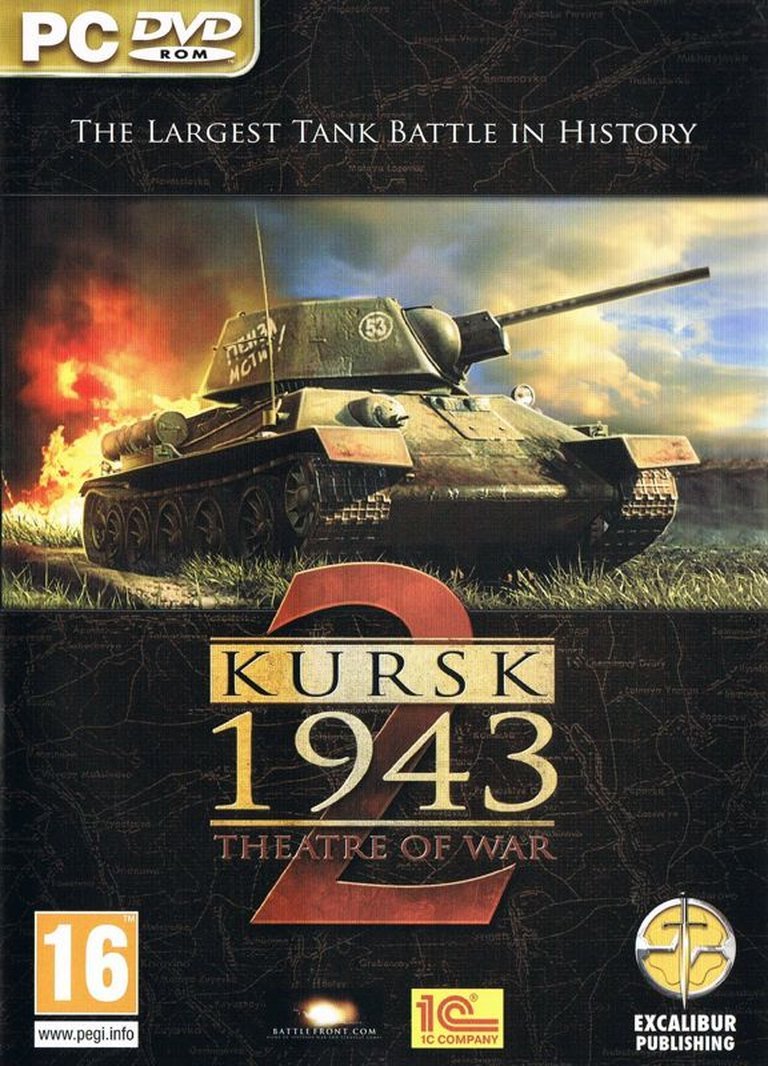
Description
Theatre of War 2: Kursk 1943 is a standalone expansion set during the historic Battle of Kursk in World War II, offering two campaigns—one as the German Grossdeutschland Kampfgruppe and another as the Soviet 67th Guards Rifle Division and 3rd Mechanized Corps—across nine major battles each. The game emphasizes realistic real-time tactics with features like impact vectors for unit damage and a victory points system that allows players to earn reinforcements while affecting their military skill rating.
Gameplay Videos
Where to Buy Theatre of War 2: Kursk 1943
PC
Theatre of War 2: Kursk 1943 Patches & Updates
Theatre of War 2: Kursk 1943 Guides & Walkthroughs
Theatre of War 2: Kursk 1943 Reviews & Reception
metacritic.com (70/100): I gave this game a generous score of 7 for its historical accuracy and pleasing graphics, as well as accessibility for newcomers.
Theatre of War 2: Kursk 1943: A Granular Crucible of Eastern Front Realism
Introduction: The Arithmetic of Attrition
In the vast and often romanticized landscape of World War II video games, few titles commit to the brutal, unvarnished mathematics of combat with the single-minded intensity of Theatre of War 2: Kursk 1943. Released in 2009 by the Russian studio 1C Company (operating through its Battlefront.com label), this game is not about heroic sprints across beaches or cinematic explosions set to a soaring score. It is, instead, a painstakingly detailed, squad-and-vehicle-level real-time tactics (RTT) simulator that places the player in the command chair of a Kampfgruppe or Guards Rifle Division during the largest tank battle in history. This review will argue that Kursk 1943 is a title of profound contradiction: a simultaneously brilliant and deeply frustrating experience. It achieves a legendary status among a small, devout cadre of wargamers for its unparalleled commitment to historical and mechanical authenticity, yet its notorious technical instability, obtuse interface, and punishing difficulty create a formidable barrier that prevented it from achieving broader acclaim. It stands as a peak of the “Men of War” spiritual lineage—a game that values systemic truth over accessibility, and in doing so, offers a uniquely sobering and educational tableau of the Eastern Front in 1943.
Development History & Context: The “Battlefront” Ethos
Theatre of War 2: Kursk 1943 was developed by 1C Company, a prolific Russian publisher and developer with a deep catalog of military simulations, under the stewardship of its dedicated western-facing subsidiary Battlefront.com. The project was led by Oleg Bazarnov (Project Lead), Alexander Chistyakov (Lead Designer), and Gennady Roginsky (Lead Artist), among a team of 48 developers. This team was intimately familiar with its subject matter, having previously released Theatre of War 2: Africa 1943 earlier the same year and laying the groundwork with the original Theatre of War (2007).
The studio’s vision was rooted in a specific, highly informed design philosophy: the belief that tactical authenticity—the “feel” of a battle—is derived not from abstracted stats or rapid-fire gameplay, but from the meticulous simulation of individual components. This meant modeling every vital vehicle system and crew member individually, implementing a fully simulated visibility system (where Line of Sight is obstructed by terrain, smoke, and foliage in a granular way), and calculating ballistics and armor penetration with projectile vectors that can be visually toggled. The goal was to replicate the chaos, uncertainty, and lethality of a WWII engagement, where a single well-placed shot from a hidden anti-tank gun could alter a battle’s outcome.
Technologically, the game was built on a proprietary engine that prioritized simulation depth over graphical polish. Released in October 2009 for Windows, it competed in a crowded RTS/RTT space dominated by more accessible titles like Company of Heroes (2006) and the also-niche Men of War (2009). Its contemporaries were pushing cinematic presentation and streamlined resource management. Kursk 1943 took a diametrically opposed path, doubling down on the cumbersome, “old-school” interface and systems that defined the genre’s earlier, more obsessive entries. This was a game for historians and grognards, not for the mainstream RTS audience, a fact immediately apparent in its demanding system requirements for the time (a Core 2 Duo and 2GB RAM minimum) and its infamous instability. Reviews from sources like Absolute Games (AG.ru) bluntly stated that despite two post-release patches, the game suffered from “awful technical condition” and “critical errors,” a sentiment echoed by a significant portion of the Steam user base, who still discuss workarounds for crashes on modern Windows 11 systems via compatibility modes and tool like DXVK.
Narrative & Thematic Deep Dive: Command Under the Salient
The game’s narrative is not a sweeping, scripted war epic but a series of historical combat vignettes tied directly to operational realities. The player does not control a charismatic protagonist but assumes the role of a battle group commander answering to historical superiors: Lieutenant General Ivan Chistyakov for the Soviets and Major General Walter Hoerlein for the Germans. This framing is crucial; it subordinates individual heroism to the grinding, impersonal machinery of war. The theme is one of operational attrition and constrained agency.
The two campaigns, “Fiery Salient” (Soviet) and “Operation Citadel” (German), each contain up to nine major engagements covering the initial defensive phase of the Battle of Kursk from July 5-10, 1943. The Soviet campaign tasks the player with commanding elements of the 67th Guards Rifle Division and the 3rd Mechanized Corps, holding the southern face of the Kursk salient against the German onslaught. The German campaign puts the player in charge of the elite Grossdeutschland Kampfgruppe, spearheading the southern pincer of Operation Citadel. This symmetrical focus on specific, historically engaged units is a strength, providing immediate context and a clear “order of battle” feel.
There is no conventional plot with dialogue trees or character arcs. The “story” is told through mission briefings, which outline the historical objective (e.g., “Secure Village X,” “Hold the railway line”), and through the consequences of victory points. These points, earned by destroying enemy forces and completing High Command orders, directly feed into the campaign’s meta-game: spending them on reinforcements, artillery barrages, and air support for subsequent battles. More significantly, the points left unspent at a mission’s end determine your “military skill level,” which in turn affects the strength and equipment of your starting forces in the next engagement. This creates a powerful thematic and mechanical loop: careful conservation of resources and preservation of your veteran units for the strategic good is rewarded, while reckless spending leads to a weaker force later. It embodies the Soviet strategy of defense-in-depth and the German need for rapid, decisive breakthroughs. The narrative, therefore, is the player’s own evolving campaign—a story of attrition, logistics, and the cold calculus of command.
Gameplay Mechanics & Systems: The Granular Grind
Theatre of War 2: Kursk 1943 operates on a real-time tactics (RTT) foundation, distinct from traditional RTS. There is no base building, resource harvesting, or tech tree progression in the moment-to-moment gameplay. You begin each mission with a pre-defined, historically-based force and your only “production” is the strategic deployment of victory point-purchased reinforcements at designated zones.
The core gameplay loop is therefore a cycle of Reconnaissance -> Planning -> Execution -> Assessment.
1. Reconnaissance & Planning: The free camera allows for a classic “God view” or a close, dramatic perspective. The simulated visibility system is paramount. Woods, hull-down positions, and buildings conceal units. Infantry in a building are invisible until they fire or you physically move a unit into line of sight. This makes scouting with light units (motorcycles, scout cars) absolutely mandatory. Failure to do so results in your armor blundering into ambushes.
2. Execution: Control is via point-and-select for individual units or small groups. The interface is famously dense and archaic by modern standards. Right-clicking issues a move/attack order; holding the right button and dragging creates a formation line or arc, a critical command for deploying infantry and anti-tank guns effectively. The “Assault” and “Retreat” commands are vital, directing units to move more aggressively with better target prioritization or to fall back cohesively.
3. The “Pause-on-Damage” System: A highly divisive feature, also noted by Steam users, is the default automatic pause and camera jump when any of your units takes damage. This is designed to ensure you witness pivotal moments, but many find it jarring and disruptive to tactical flow. It can be disabled, but its presence speaks to the game’s “simulation first” ethos: every hit matters and demands your attention.
Innovative/Flawed Systems:
* Victory Points as a Strategic Resource: This is the game’s most brilliant and innovative mechanic. It ties tactical success directly to strategic longevity. Sacrificing a unit to destroy an enemy tank might be a net loss if those points were needed for critical infantry reinforcements later.
* Unit Persistence and Personnel Management: Soldiers and tank crews have individual names, skills, and experience levels that persist through a campaign. An experienced gunner on an anti-tank rifle will perform better. You can even rename units for easier management. This fosters a powerful emotional connection to your platoons, making their loss genuinely costly.
* Detailed Damage Model: Tanks are not “hit point pools.” A round can hit a specific component: the gun mantlet, the track, the engine deck, the crew compartment. Crew members can be killed or wounded individually, affecting reload speeds or driving accuracy. The option to display impact vectors and projectile info when zoomed in on a damaged unit is a unique educational tool.
* “The Flaw”: For all its depth, the game is plagued by pathfinding issues, unreliable unit AI (infantry sometimes refuse to take cover or use weapons properly), and a steep, undocumented learning curve. As a Gamers Daily News review noted, it “has a lot to offer but prevents you from readily accessing it.” The manual is essential but often insufficient. The game does not hold your hand; it expects you to have already read a treatise on WWII small-unit tactics.
World-Building, Art & Sound: Functional Authenticity Over Spectacle
The visual presentation of Kursk 1943 is a study in functional authenticity rather than graphical grandeur. The 2009-era 3D engine creates vast, rolling steppe landscapes dotted with the distinctive clusters of pine forests (“isbashas”), muddy ravines, and the rubble of Belgorod and Kursk region villages. The terrain is not just backdrop; it is the primary tactical element. The models for the over 60 controllable units—from the German Panzer IV and Tiger I to the Soviet T-34/76 and KV-1, and lend-lease M4 Shermans and Churchill tanks—are accurate and detailed. You can see the wire mesh screens on German tanks, the different road wheel configurations, and the distinct silhouettes of Soviet vehicles.
The art direction aims for a muted, realistic palette: khaki, olive drab, forest green, and the ubiquitous ochre of the Central Russian earth. Explosions and fire effects are serviceable but not spectacular. The UI is information-dense and utilitarian, with numerous panels for unit lists, reinforcement menus, and the victory point counter. It feels like a command post screen, not a game overlay.
The sound design is, ironically, one of the game’s most immersive strengths. The cacophony of battle is relentless: the crack of high-velocity anti-tank guns, the deep booms of tank cannons, the staccato rattle of machine guns, the whine of incoming artillery, and the screams of stricken crews. The engine notes for each tank are distinct. The ambient sounds of wind, distant firing, and radio chatter (in Russian or German) create a palpable atmosphere of being in a warzone. There is no dynamic musical score; the soundscape is purely diegetic, which reinforces the grim realism.
Reception & Legacy: A Cult Classic Forged in Frustration
Theatre of War 2: Kursk 1943 received a mixed-to-positive critical reception, averaging 73% from the few critics who reviewed it at the time. Calm Down Tom praised it as a complete package for “WW2 oriented strategy” fans, highlighting its features and environments. Absolute Games was more cautious, acknowledging its fidelity to the series’ ideals but criticizing its unstable technical state. Review Graveyard and Gamers Daily News both scored it 7/10, with the latter summing up the divide: it’s a must-have for “serious WWII history and RTS buffs” but a frustrating experience for others due to its inherent complexity and technical flaws. The Dutch review from Gameplay (Benelux) was scathing, calling it “not even finished” and “barely playable.”
Its commercial and community legacy is defined by this niche appeal. On Steam, it holds a “Mixed” rating (65% positive from 184 reviews) as of 2025, with the positive reviews lauding its historical accuracy, deep tactics, and satisfying granularity. The negative reviews consistently cite crashes (especially on newer Windows versions), a terrible UI, brutal AI pathfinding, and an impenetrable learning curve. The fact that Steam community guides from 2025 are still detailing how to get the game to run stably on Windows 11 is a damning testament to its long-term technical neglect.
Its influence is indirect but significant. It represents a branch of the WWII RTT genre that prioritized simulation depth over spectacle, a philosophy continued by its sequel, Theatre of War 3: Korea (2010), and by the deeper, more polished but similarly demanding Men of War series (from which this game borrows its DNA). It is a direct predecessor to the ultra-niche but critically adored “Command: Modern Operations” and “ArmA” mods that focus on hyper-realism. It did not redefine the mainstream RTS, but it served as a gold standard for tactical authenticity for a small, dedicated community that values a historically accurate ballistic calculation over a streamlined build order.
Conclusion: A Flawed Masterpiece of the Grind
Theatre of War 2: Kursk 1943 is not a game for the faint of heart or the impatient. It is a simulation first and a game second, a meticulous digital diorama of the Eastern Front where every shell, every infantry squad, and every meter of ground is accounted for. Its genius lies in the victory point system and the persistent, personal nature of its units, which together create a profound sense of operational consequence. Its fatal flaw is an execution so riddled with technical problems and an interface so dated and cryptic that it actively works against the very experience it wants to provide.
To play Kursk 1943 is to engage in a form of digital historiography. You are not playing to win a quick, satisfying match; you are grappling with the same problems of reconnaissance, combined-arms coordination, and logistical scarcity that faced commanders at Prokhorovka and Oboyan in July 1943. When it works—when your carefully laid ambush finally lures a German panzer column into a crossfire from concealed T-34s and anti-tank guns, when you hold a key village by the skin of your teeth with battered, renamed Guards units—the feeling of tactical triumph is unmatched in its specificity and weight.
Its place in video game history is secure as a pinnacle of the hardcore tactical wargame, a cult classic that represents the absolute limit of what the RTT genre could be in terms of historical detail before accessibility became a paramount concern. It is a game that demands everything from the player—patience, research, tolerance for failure—and in return, offers a sober, unflinching, and unparalleled window into the grinding, terrifying reality of mid-20th century mechanized warfare. For those willing to suffer its bugs and its brutal learning curve, it remains an unforgettable, if deeply flawed, monument to the battlefield of Kursk.