
- Release Year: 2000
- Platforms: Linux, Windows
- Publisher: Microforum International, Ubi Soft Entertainment Software
- Developer: Philos Laboratories
- Genre: Strategy, Tactics
- Perspective: Diagonal-down
- Game Mode: LAN, Online PVP, Single-player
- Gameplay: Building construction, Combat, Heroes, Human Sacrifice, Magic, Mana System, Province management, Real-time strategy, Resource gathering, Spell casting, Trade
- Setting: Aztec, Fantasy, Pre-Columbian Americas
Description
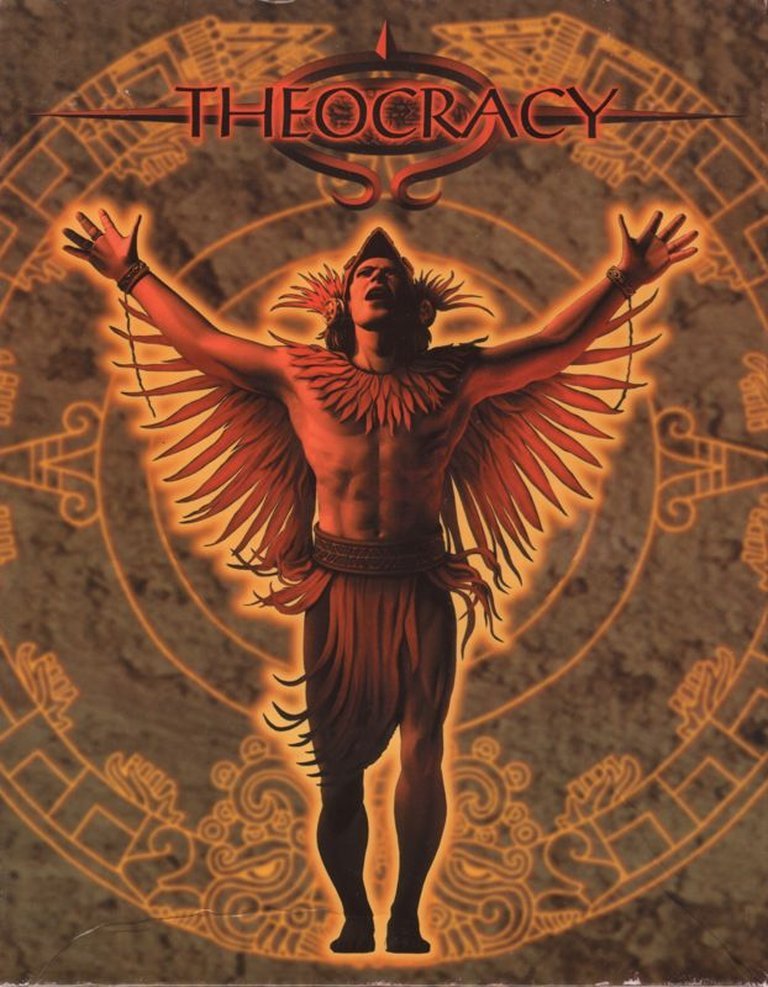
Theocracy is a real-time strategy game set in a fantastical version of Pre-Columbian Americas during the Aztec Empire era. Players strive to unite the warring civilizations of central Mexico before the Spanish conquistadors invade, managing resources through slave labor and harnessing mana from human sacrifices to fuel priestly spells and gain an edge in conquest.
Gameplay Videos
Where to Buy Theocracy
PC
Theocracy Guides & Walkthroughs
Theocracy Reviews & Reception
myabandonware.com : Theocracy is not a bad game, but it’s also not a great one.
Theocracy: A Sovereign Ambition, a Flawed Empire
In the crowded pantheon of real-time strategy (RTS) games from the turn of the millennium, few titles cast a longer or more peculiar shadow than Theocracy. Developed by the Hungarian studio Philos Laboratories and published by Ubisoft in 2000, it arrived with a proposition both alluring and audacious: to merge the grand, epoch-spanning sweep of Sid Meier’s Civilization with the frantic, unit-hossing tactical combat of Westwood’s Command & Conquer, all while draped in the rarely-explored, spiritually charged vestments of the pre-Columbian Aztec empire. Its core paradox—a game about uniting warring tribes through conquest, diplomacy, and the systematic sacrifice of slaves to fuel magical warfare—promised a strategy experience unlike any other. However, as this deep historical and mechanical analysis will demonstrate, Theocracy is a classic case of a game whose bold, innovative architecture is fundamentally undermined by a shaky, often frustrating, foundation. It stands not as a classic, but as a profoundly fascinating and deeply flawed artifact of its era—a “what if” scenario crystallized in code.
Development History & Context: From I-Magic’s Ashes to Ubisoft’s Embrace
The story of Theocracy is intrinsically linked to the turbulent publisher landscape of the late 1990s. It began at Philos Laboratories, a studio already acquainted with ambitious strategy design through 1996’s Perihelion: The Prophecy. Following that project, several key hires with experience on Perihelion formed the core team for a new project with an explicit design goal: synthesizing the best elements of Command & Conquer and Civilization. The setting, according to multiple development interviews cited in Wikipedia and Everything Explained, was a creative decision from the game’s graphic artists, who championed an Aztec theme—a choice that would become the game’s most distinguishing and controversial feature.
Development proceeded for approximately two years with a target release of spring 1999 under the banner of Interactive Magic (I-Magic), a publisher known for quirky, innovative titles like Seven Kingdoms. However, in a pivotal March 1999 decision, I-Magic announced a strategic pivot away from physical boxed releases toward an online-only model. Theocracy, then reportedly feature-complete, was suddenly without a home. Philos Laboratories managed to buy back the publishing rights, a financially strenuous move that forced a significant re-tooling. This “update” phase, as documented in its Wikipedia entry, involved redrawing most of the game’s graphics, switching the resolution to 800×600—a then-modern standard—and the addition of the “Chronicles,” a set of tutorial missions framed as heroic Aztec legends.
The French giant Ubisoft, expanding its PC strategy portfolio, acquired the publishing rights. This second wind, however, came at a cost: the game’s release was pushed back to March 24, 2000, for both Windows and, notably, Linux—a significant move that would earn it a cherished, if technically troubled, place in the Linux gaming community. The protracted development, marked by publisher instability and a mid-stream overhaul, left its fingerprints all over the final product: a game of immense scope and clever ideas, yet one that perpetually feels like it needed another six months of polish, particularly in user interface and combat AI. The consideration of a sequel, mentioned in post-release interviews, speaks to the team’s belief in the core concept, a belief not fully shared by the market.
Narrative & Thematic Deep Dive: Blood, Gods, and the Twilight of a World
Narratively, Theocracy presents a fascinating alternate history. The player assumes the role of the leader of the fictional Atlan tribe, escaped from the oppression of the Axocopans. The overarching objective is clear and dire: within 100 in-game years, you must unite the fractious city-states of Central Mexico (roughly 50 provinces) to present a consolidated front against the imminent, apocalyptic arrival of the Spanish conquistadors.
This framing is delivered with minimal traditional storytelling. There are no elaborated cutscenes (the intro is described by critics as “pale” and unskippable), and the plot is advanced almost entirely through the game’s mechanics and the “Chronicles” missions. These Chronicles, as noted in the Wikipedia and Everything Explained sources, are objective-based scenarios based on legendary Aztec heroes. They primarily serve as an extended tutorial—a rather sobering one, as they often involve tasks like “Conquer X Province” or “Sacrifice Y Slaves,” acclimating the player to the game’s morally and mechanically complex core.
The true narrative is systemic and emergent, emerging from the player’s actions within its stringent rules. Thematically, the game is a direct, unflinching engagement with the historical and mythological realities of the Aztec world. The central mechanic—human sacrifice to generate Mana—is not a peripheral “dark” option but the primary fuel for the game’s magical system. Priests channel power from five spheres (Sun, Moon, Star, Nature, Soul), but that power is replenished by the literal sacrifice of your slave population in temple ceremonies. This is not presented as a villainous act but as a necessary, state-sanctioned religious ritual, a grim reflection of the flor and fauna of Aztec cosmology where death feeds life.
This creates a profound and uneasy thematic core. Every expansion, every military victory, every spell cast is potentially predicated on a dwindling population of worker units. The game forces the player to reconcile economic growth (which requires more slaves to work) with military and magical power (which requires sacrificing those very slaves). It’s a brilliant, brutal simulation of a society operating on a logic utterly alien to modern players, where “progress” and “piety” are inextricably linked to ritualized violence. Diplomacy with other tribes—ranging from the “aggressive and warlike” Izhuacans (red) to the peaceful Huaputecs (green)—further explores this world of shifting alliances and inevitable conflict, mirroring the pre-colonial political landscape. The final, inevitable clash with the historical Spanish forces (represented as a grey, faceless invasion) frames the entire campaign as a desperate, possibly futile, rearguard action against an unstoppable tide of technology and disease—a historical tragedy played out through the lens of strategy gameplay.
Gameplay Mechanics & Systems: The Dual-Temporal Engine
Theocracy’s most defining and divisive mechanical innovation is its dual-view system, creating a unique, albeit awkward, temporal flow.
-
Realm View (Strategic): This is the default, real-time “god view.” A hand-drawn map of Central America displays all provinces, colored by faction control (blue for player, red/yellow/green/purple/cobalt for others, paper for neutrals, grey for Spanish). All time progression occurs here. Players can adjust the time scale from a glacial pace (one year per ~10 minutes) to hyper-accelerated (one year per ~20 seconds), or pause entirely. It is from this view that you issue high-level orders: moving armies (which travel as dots on the map), establishing caravans to transport resources between provinces, and initiating diplomacy. This layer provides the “Civilization”-esque grand strategic sweep.
-
Province View (Tactical): Zooming into any owned or contested province pauses the game’s clock completely. Here, the isometric view reveals a detailed, animated Aztec settlement. This is where all micromanagement happens: assigning the ubiquitous slave population to specific jobs (farming corn, ranching meat, mining stone/gold/jade, chopping wood), constructing buildings from a categorized list (Production, Training, Storage), and training specialized workers and warriors from slave recruits at Schools and Barracks. The visual representation is lively—slaves carry goods, priests dance during sacrifices—but as multiple reviews (MobyGames, GamesDomain) cruelly note, these animations are purely cosmetic. Time is frozen; the workers are not actually producing resources. The resources tick up annually based on the number of assigned slaves and building levels.
This separation is the game’s central, flawed genius. It cleanly divides grand strategy from base management, but creates a massive cognitive and mechanical disconnect. You cannot watch your economy grow while time moves; you must constantly zoom in to build and assign, then zoom out to let time pass and see the results. There is no seamless integration. This leads to the profound interface failings repeatedly cited by critics. There is no province overview screen to see a summary of resources, buildings, or populations across all your territories. Managing a large empire means manually clicking through dozens of province views, a “painfully intricate” chore (GamesDomain). The absence of a “next province” button or a functional minimap in the province view (Jeuxvideo.com, Power Play) makes navigation a disorienting chore. The auto-governor option, meant to alleviate micromanagement, is gated behind the scarce resource Jewels (crafted from Gold and Jade), making it a late-game luxury rather than a quality-of-life tool.
The Economy & Sacrifice Loop: The resource web is complex but logical. Food (Corn from farms, Meat from ranches/fishing huts) is paramount, as it feeds the population and, for Meat, tamed jaguars. Materials (Wood, Stone) are for construction. Precious Metals (Gold, Jade) are mined and combined in Workshops to create Jewels, the currency for advanced buildings, decorations, and governors. Mana is the wild card, divided into five spheres. It is generated trickly by temples but can be mass-generated by sacrificing slaves. This creates the central, morally harrowing tension: sacrifice your economic base (slaves) for immediate military/magical power.
Military & Magic: Military production follows a tiered system. Small/Medium Barracks produce one warrior type (melee infantry, spearmen, or archers); the Large Barracks can produce any type but only one at a time, faster. There are no cavalry, a historical choice that limits tactical diversity. Formations can be pre-set (line, wedge, etc.) and leaders promoted from veteran units, but as PC Action and GamesDomain lament, formations disintegrate on contact. The pathfinding is notoriously poor, with units getting stuck or taking long detours, ruining any semblance of tactical control.
The five-sphere magic system is a highlight in theory. Sun Priests wield fire attacks, Moon Priests defensive wards, Nature Priests heal, Star Priests debuff/distract, and Soul Priests are generalists. Spells are potent but their use is hampered by the chaotic, real-time combat with no pause or speed control (Jeuxvideo.com, GamesDomain). Priest units are fragile and expensive to train, making their loss in the chaotic “massed brawls” of battle particularly frustrating. The inclusion of tamed jaguars as allies adds a unique, if “gimmicky,” flavor (GamesDomain).
The 100-Year Doomsday Clock: The ultimate goal is to survive the Spanish invasion. This fixed timer, on a fixed, non-random map (PC Player), severely limits replayability. As PC Player notes, “your opening moves will always probably be the same.” The game’s depth is funneled into optimizing one specific scenario, rather than the endless procedural replay of a Civilization or Age of Empires.
World-Building, Art & Sound: Evocative, Yet Disconnected
The artistic and auditory presentation of Theocracy is a study in evocative atmosphere undermined by technical execution and, ultimately, irrelevance to the core gameplay loop.
Visuals & Setting: The game fully embraces its isometric, Aztec-inspired fantasy setting. The hand-drawn realm map is colorful and clear, effectively communicating territorial control. The province view, where the game spends its “active” time, is where the art team shines. Buildings are detailed and authentically Mesoamerican in style (pyramids, temples, thatched huts). Animations for slaves working, priests performing sacrifices (the “dancing priest” is a noted, morbidly charming detail), and units moving are surprisingly fluid and characterful for the era. The color palette is earthy and warm, capturing the Central American landscape.
However, this beauty is functionally inert. As GamesDomain’s dissection is devastatingly accurate: “the graphics only play a large role in the game while in the tactical view but the game doesn’t progress while in that view. The game only advances while in the strategic view at which point the graphics don’t play a role at all.” The detailed province view is a static diorama; the strategic overview reduces all units to colored pixels. This schism between the game’s two primary views means the impressive art is seen only during the paused, management phase, while the active, real-time phase occurs over an abstract, low-detail map. Furthermore, the landscapes are often described as “monotonous” (Jeuxvideo.com, PC Joker) and units as “detailarm” (Power Unlimited), lacking the personality of Age of Empires II’s distinct civilizations.
Sound & Music: The audio design is widely regarded as average to poor. Effects are described as “muffled,” “basic,” and “uninspiring” (GameOver). The music is barely mentioned in critical reviews, implying it was forgettable ambient fare. The most notable sound is the click of interface buttons, praised in the Linux review as “satisfying,” a small bright spot in an otherwise aurally barren experience. The lack of a compelling soundtrack or impactful, immersive soundscape fails to elevate the dramatic themes of sacrifice and conquest.
The world feels thematically resonant but mechanically disembodied. The Aztec setting is more than a skin; it informs the mechanics of sacrifice, the magic spheres, and the unit types (no cavalry, jaguar warriors). Yet, the disconnect between the beautiful, static province view and the abstract, chaotic realm view, combined with a muted soundscape, prevents the player from ever feeling truly immersed in this lost world. The atmosphere is suggested, not sustained.
Reception & Legacy: A Curate’s Egg of a Cult Classic
Theocracy’s critical reception was, and remains, profoundly mixed, mirroring its design schisms. On MobyGames, it holds a 72% average from 17 critics, ranking it #5,076 on Windows—a solid middle-of-the-road score indicative of a game with clear merits and equally clear flaws.
The Praise: The most effusive reviews celebrated its ambition and originality. Eurogamer (90%) was its chief champion, arguing that the “mix of real time and turn based strategy means that Theocracy takes place on a far larger canvas than a purely real time game ever could.” They valued the “sheer scale” and “wealth of options,” forgiving “minor niggles” in combat and trade. PC Zone called it “as refreshing as a pint of lager after a chicken vindaloo.” These reviewers saw a game that successfully blended empire management with RTS in a way few had attempted, with a setting that felt genuinely fresh.
The Criticism: The majority of the press was far less convinced. The most common criticisms became its defining reputational traits:
1. Cumbersome Interface & Micromanagement: The lack of overview screens, the province-by-province sprawl, and the clumsy navigation were almost universally panned (Jeuxvideo.com’s 60%, RealGamer’s 55%, PC Player’s 69%).
2. Flawed Combat: The breakdown of formations, poor pathfinding, lack of unit variety (no cavalry), and inability to control the chaotic pace were fatal flaws for an RTS. As PC Action stated, the battles are “anspruchsvoll” (demanding) but the economic management is overly “zeitaufwendig” (time-consuming). The absence of a combat pause or speed control was a recurring sore point.
3. Archaic & Simple: Some, like Absolute Games (65%), found the core gameplay “strange” and “poorly executed,” despite clever ideas. Fragland.net bluntly stated it couldn’t beat Civilization.
4. Technical Issues: The Linux port, while praised for its “solid” feel by some, was plagued by installation problems, 16-bit color limitations, and no proper full-screen mode (LinuxGames, LinuxUser).
Commercial Performance & Cult Status: Despite the mixed reviews, the game reportedly “sold well enough, especially on Linux where it became a best-seller” (Wikipedia). This points to a niche but devoted audience. Its legacy is not one of mainstream influence but of a curated cult classic. It is cited as a precursor or parallel to other “hybrid” strategy titles like Kohan: Immortal Sovereigns and Majesty: The Fantasy Kingdom Sim, which also explored filtering classic RTS through a more managerial, indirect control lens. Its most enduring contribution is its brave, unflinching integration of a historically sensitive and morally complex setting into the core strategic loop. The sacrifice mechanic remains a daring, rarely-emulated design choice that forces players to engage with the game’s world on its own terms.
However, its technical and interface failings ensured it would not spawn imitators. The fixed map, the dual-view disconnect, and the problematic combat created too many barriers. It is remembered today more in retro gaming circles and on abandonware sites (where it holds a 4.31/5 from 39 votes on MyAbandonware) as a fascinating “what if”—a game that reached for a novel fusion of genres and history but was ultimately held back by the very systems it designed.
Conclusion: The Unfulfilled Prophecy
Theocracy is a game of magnificent, unfulfilled prophecy. Its thesis—that the Aztec experience could be translated into a deep, hybrid strategy game about empire, piety, and sacrifice—is brilliant and largely successful in its conceptual purity. The five-sphere magic system, the brutal economics of slave sacrifice, and the fixed-timer defense against history’s most famous invaders create a strategic problem space unlike any other. It is a game that thinks differently.
Yet, its execution is riddled with the classic signs of a troubled development and design overreach. The dual-view system, while conceptually interesting, creates a jarring, unintuitive loop that buries the player in micromanagement. The interface is a relic of an earlier, less user-centric design philosophy, lacking the quality-of-life features that would make its depth accessible. The combat is not merely simple but actively broken in its lack of control and pathfinding, undermining the investment required to build armies and priests.
In the hierarchy of RTS history, Theocracy does not stand with the titans like StarCraft, Age of Empires II, or Warcraft III. Its influence is negligible, its sales outside its niche modest. But its place is secure as a cult artifact and a cautionary tale. It demonstrates that ambitious theme and innovative mechanics are not enough; they must be woven into a coherent, accessible, and technically sound whole. For the historian, it is an invaluable case study in the perils of merging complex temporal systems and morally charged themes within the tight constraints of the RTS genre circa 2000. For the curious player, it remains a challenging, often frustrating, but ultimately unique journey into a mind-space few games dare to tread. It is not a forgotten masterpiece, but a flawed sovereign—a realm of intriguing laws and customs, perpetually hampered by a clumsy, inefficient bureaucracy. You play it not for the slick satisfaction of a Blizzard classic, but for the uneasy, thought-provoking collision of your own strategic instincts with a world where the altar and the economy are one and the same.