
- Release Year: 2004
- Platforms: Windows, Xbox
- Publisher: ak tronic Software & Services GmbH, Eidos Interactive Corporation, Eidos Interactive Limited, Mastertronic Games Ltd., Noviy Disk, Square Enix, Inc.
- Developer: Ion Storm Austin
- Genre: Action
- Perspective: 1st-person
- Game Mode: Single-player
- Gameplay: Body dragging, Lock picking, Pickpocketing, Stealth
- Setting: Asylum, Church, Fantasy, Mental facility, Monastery, Steampunk
- Average Score: 81/100
Description
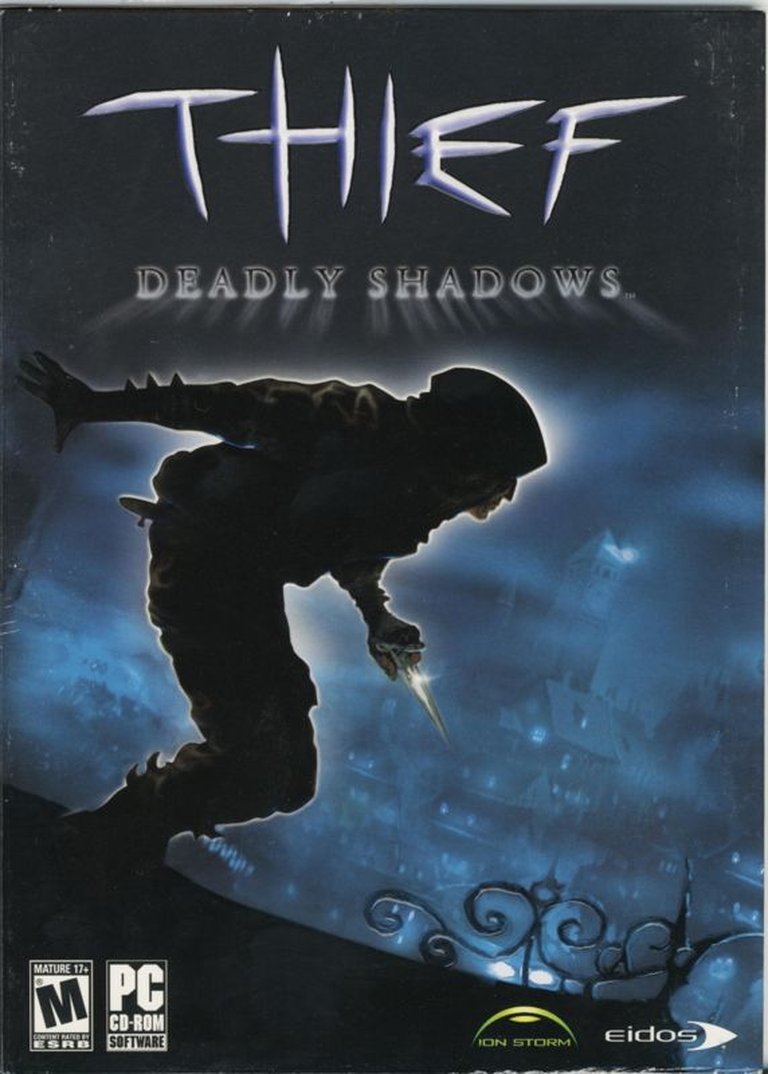
Thief: Deadly Shadows is the third installment in the Thief series, following master thief Garrett as he navigates a dark, steampunk-inspired city to uncover a prophecy foretelling a coming Dark Age. Tasked by the Keeper Artemus to steal two valuable artifacts, Garrett must explore a non-linear open world, avoiding guards, solving mysteries, and completing missions while contending with a traitor within the Keepers. The game emphasizes stealth, shadow manipulation, and environmental awareness, with new mechanics like wall-climbing and third-person perspective, blending linear missions with an immersive, reactive city hub.
Gameplay Videos
Where to Buy Thief: Deadly Shadows
Thief: Deadly Shadows Free Download
Thief: Deadly Shadows Cracks & Fixes
Thief: Deadly Shadows Patches & Updates
Thief: Deadly Shadows Mods
Thief: Deadly Shadows Guides & Walkthroughs
Thief: Deadly Shadows Reviews & Reception
metacritic.com (82/100): A triumphant return to form for the series.
ign.com : The goodness creeps up on you. It takes a while for Deadly Shadows to get going, but once it does, it will grip you.
imdb.com (80/100): Excellent graphics and sound but sadly limited compared to Thief 1 and 2.
gamespot.com : Like its predecessors, Thief: Deadly Shadows features a memorable protagonist, a great setting, and some very interesting missions.
Thief: Deadly Shadows: A Masterclass in Stealth and Atmosphere
Introduction
Thief: Deadly Shadows (2004) stands as a pivotal entry in the Thief series, a franchise that not only defined the stealth genre but also elevated it to an art form. Developed by Ion Storm Austin—a studio that absorbed key talent from the defunct Looking Glass Studios—Deadly Shadows is a game of contradictions: it is both a faithful continuation of its predecessors and a bold evolution, a critical darling and a commercial underperformer, a technical marvel and a flawed experiment. This review will dissect Thief: Deadly Shadows in exhaustive detail, exploring its development history, narrative depth, gameplay mechanics, world-building, and lasting legacy. Through this analysis, we will argue that Deadly Shadows is a masterful, if imperfect, swan song for a studio and a genre-defining series, one that remains unmatched in its atmospheric tension and immersive simulation design.
Development History & Context
The Fall of Looking Glass and the Rise of Ion Storm
The Thief series began with Thief: The Dark Project (1998), a revolutionary title developed by Looking Glass Studios, the same team behind System Shock and Ultima Underworld. These games pioneered the “immersive sim” genre, emphasizing player agency, emergent gameplay, and environmental storytelling. Thief II: The Metal Age (2000) refined this formula, but financial troubles led to Looking Glass’s closure in May 2000, leaving Thief III in developmental limbo.
Eidos Interactive, the publisher of the Thief series, acquired the rights to the franchise and handed development to Ion Storm Austin, a studio led by Warren Spector, a former Looking Glass employee and the creative force behind Deus Ex (2000). Spector’s team included several Looking Glass alumni, such as Randy Smith (project director) and Terri Brosius (writer), ensuring continuity in vision. However, the transition was not seamless. The original Thief III had been in “advanced stages” of development at Looking Glass, with a focus on an open-ended city and a deeper exploration of the Keepers’ lore. Ion Storm inherited these concepts but faced the challenge of adapting them to a new engine and a dual-platform release (PC and Xbox).
Technological Constraints and Innovations
Ion Storm opted to use a heavily modified version of the Unreal Engine 2, the same engine that powered Deus Ex: Invisible War (2003). This decision was pragmatic—Unreal Engine 2 offered advanced lighting and physics capabilities—but it also introduced limitations. The Dark Engine, used in the first two Thief games, was optimized for stealth mechanics, particularly dynamic shadows and sound propagation. Unreal Engine 2, while visually impressive, required significant tweaking to replicate these features.
Key innovations in Deadly Shadows included:
– Dynamic Lighting and Shadows: For the first time in the series, shadows were rendered in real-time, allowing players to hide in the shifting darkness cast by torches, doors, or even their own movements. This was a monumental leap from the pre-baked shadows of the Dark Engine.
– Havok Physics: The integration of the Havok physics engine enabled more realistic interactions, such as ragdoll deaths for enemies and environmental objects that could be manipulated (e.g., stacking crates to climb or extinguishing torches with water arrows).
– Body Awareness: The game introduced a first-person perspective where players could see Garrett’s limbs and torso, enhancing immersion. This feature, while divisive, was a precursor to modern first-person games like Half-Life: Alyx.
– Third-Person View: A optional third-person camera was added, primarily to accommodate console players but also to aid in navigation and combat.
The Gaming Landscape in 2004
Deadly Shadows released into a gaming ecosystem that was rapidly evolving. The stealth genre, which Thief had helped pioneer, was now dominated by titles like Splinter Cell (2002) and Metal Gear Solid 3: Snake Eater (2004). These games emphasized linear, action-oriented stealth, often with a focus on combat and gadgets. Deadly Shadows, by contrast, remained committed to the “pure” stealth philosophy of its predecessors: avoidance over confrontation, patience over reflexes, and environmental interaction over scripted set pieces.
The Xbox, released in 2001, was still finding its footing as a platform for complex, narrative-driven games. Deadly Shadows was one of the few immersive sims to attempt a console release, a decision that influenced some of its design choices (e.g., the third-person view, simplified controls). However, the PC version remained the definitive experience, showcasing the game’s technical prowess and depth.
Narrative & Thematic Deep Dive
Plot Summary
Thief: Deadly Shadows follows Garrett, the sarcastic and cynical master thief, as he becomes entangled in a conspiracy involving the Keepers, a secretive order of scholars who guard ancient prophecies. The game begins with Garrett stealing a rare opal, only to be contacted by Keeper Artemus, who tasks him with retrieving two artifacts: the Builder’s Chalice (held by the Hammerites) and the Jacknall’s Paw (held by the Pagans). These artifacts are tied to a prophecy foretelling the “Dark Age,” a cataclysmic event that could destroy the City.
As Garrett delves deeper, he uncovers a traitor within the Keepers and a sinister plot involving Glyph magic, a form of sorcery tied to the prophecies. The primary antagonist is revealed to be Gamall, a young Keeper apprentice who is secretly the Hag, an ancient and monstrous entity. Gamall seeks to harness the power of the Glyphs to destroy the Keepers and plunge the City into chaos. The climax involves Garrett sabotaging the city’s clock tower, which collapses and points toward the Keeper Compound, symbolizing the order’s complicity in its own downfall.
Themes
-
The Illusion of Control and the Weight of Prophecy
The Keepers, despite their vast knowledge of the future, are paralyzed by their own dogma. They believe their role is to observe, not intervene, even when prophecies directly implicate them. This fatalism is embodied in their motto: “We watch. We wait. We act.” The game subverts this philosophy by demonstrating that inaction is itself a form of action—one that enables evil to flourish. Garrett, by contrast, is a pragmatist who rejects destiny, yet he is repeatedly drawn into the Keepers’ conflicts, suggesting that free will and fate are not mutually exclusive but intertwined. -
The Corruption of Institutions
Deadly Shadows critiques institutional power, particularly the Keepers, who have grown complacent and secretive. The Hammerites and Pagans, while antagonistic toward Garrett, are portrayed as flawed but understandable factions. The Keepers, however, are revealed to be the true villains of their own story—their secrecy and inaction make them complicit in the rise of the Hag. This theme is underscored by the game’s ending, where the Keepers’ prophecies are erased, symbolizing the collapse of their authority. -
The Duality of Garrett
Garrett is a morally ambiguous protagonist. He is a thief, a cynic, and a loner, yet he repeatedly risks his life to save the City. His missing eye, which occasionally “speaks” to him, serves as a metaphor for his fractured identity. The eye represents his past as a Keeper, a part of himself he has suppressed but cannot fully escape. His journey in Deadly Shadows is one of reluctant heroism, as he grapples with his role in a world that seems determined to drag him into its conflicts. -
The Horror of the Past
The game’s most haunting level, Shalebridge Cradle, embodies this theme. The Cradle is a former orphanage and asylum, a place of unimaginable suffering where the boundaries between past and present blur. Garrett’s exploration of the Cradle is not just a physical journey but a psychological one, as he confronts the ghosts of the institution’s victims. The level’s design—dark, labyrinthine, and filled with eerie sounds—creates an atmosphere of dread that rivals the best horror games.
Characters and Voice Acting
- Garrett (voiced by Stephen Russell): Russell’s performance is a masterclass in dry wit and world-weariness. Garrett’s sarcastic narration and offhand remarks provide much of the game’s humor, but Russell also conveys the character’s vulnerability, particularly in moments of introspection.
- Keeper Artemus (voiced by Terri Brosius): Artemus serves as Garrett’s primary contact within the Keepers. His voice is calm and measured, reflecting the Keepers’ stoicism, but there is an undercurrent of urgency as the plot unfolds.
- Gamall / The Hag (voiced by Lani Minella): Gamall’s voice is deceptively sweet, masking her true nature as the Hag. When her true form is revealed, her voice becomes a guttural, monstrous growl, emphasizing her inhumanity.
- Inspector Drept (voiced by John Cygan): Drept is a Hammerite investigator who aids Garrett in uncovering the truth about the Hag. His voice is gruff and authoritative, befitting a hardened detective.
Dialogue and Environmental Storytelling
Deadly Shadows excels in environmental storytelling. The City is alive with NPCs who engage in dynamic conversations, providing clues, side quests, and world-building details. Eavesdropping is not just a gameplay mechanic but a narrative tool, allowing players to piece together the game’s lore organically.
The game’s written materials—books, notes, and prophecies—are equally rich. The Keeper prophecies, in particular, are deliberately vague, requiring players to interpret their meanings. This ambiguity reinforces the game’s themes of fate and free will, as players must decide how to act on incomplete information.
Gameplay Mechanics & Systems
Core Gameplay Loop
At its heart, Thief: Deadly Shadows is a stealth game where the player must navigate environments undetected, avoiding or incapacitating enemies to achieve objectives. The core gameplay loop involves:
1. Planning: Studying guard patrol routes, identifying loot locations, and determining the best path through a level.
2. Execution: Moving silently, using shadows to remain hidden, and employing tools (e.g., water arrows to extinguish torches, moss arrows to muffle footsteps).
3. Adaptation: Reacting to unexpected events, such as guards discovering a knocked-out comrade or a change in lighting conditions.
Stealth Mechanics
- Light and Shadow: The game’s most innovative mechanic is its dynamic lighting system. Shadows are not just visual effects but gameplay elements. Players must constantly monitor their visibility, using the “light gem” (a UI indicator) to gauge how exposed they are. Extinguishing light sources is crucial, but it also alerts guards, creating a risk-reward dynamic.
- Sound: Sound propagation is meticulously modeled. Footsteps on different surfaces (e.g., carpet vs. stone) produce varying noise levels. Guards react to suspicious sounds, investigating their source. Players can use this to their advantage, luring guards away with noise arrows or thrown objects.
- AI Behavior: The AI in Deadly Shadows is sophisticated but not infallible. Guards have patrol routes, memory (they remember where they last saw the player), and varying levels of alertness. However, the AI is not without flaws—guards can be overly sensitive to minor noises while ignoring more obvious threats (e.g., a knocked-out comrade).
Combat and Non-Lethal Options
Garrett is not a combatant. While he can use a dagger or blackjack, direct confrontation is discouraged. The game provides several non-lethal tools:
– Blackjack: A blunt weapon that knocks out enemies temporarily.
– Water Arrows: Extinguish torches and fires, creating shadows.
– Moss Arrows: Create soft patches on hard surfaces, muffling footsteps.
– Flash Bombs: Temporarily blind enemies.
– Gas Arrows: Put enemies to sleep.
Lethal options exist (e.g., broadhead arrows, swords) but are rarely necessary. The game rewards stealth and creativity, punishing brute-force approaches with overwhelming enemy numbers and alert states.
Mission Structure and Open-Ended Design
Deadly Shadows introduces a semi-open world: the City. Between missions, players can explore the City, stealing from civilians, completing side quests, and purchasing equipment. This was a significant departure from the linear mission structure of the first two games, offering a sense of freedom and immersion.
However, the City is divided into loading zones, which can disrupt the flow of exploration. Additionally, the City resets after each mission, meaning that stolen items and knocked-out guards reappear, breaking immersion.
The main missions are diverse, ranging from heists in mansions to infiltrations of haunted asylums. Each mission has multiple approaches, encouraging replayability. For example, the mission Robbing the Cradle (Shalebridge Cradle) can be completed through stealth, combat, or a combination of both, though the latter is ill-advised given the level’s horror elements.
Progression and Economy
- Loot and Economy: Loot is a central mechanic. Players must steal valuables to fund their operations, purchasing tools and equipment from fences (black market dealers). Special loot items, tied to mission objectives, cannot be sold but are essential for progression.
- Reputation System: The game features a faction system, where players can ally with the Hammerites or Pagans by completing side quests. These alliances unlock unique dialogue and mission variations, adding replay value.
User Interface and Controls
The UI in Deadly Shadows is functional but dated. The inventory system is clunky, requiring players to scroll through items, and the mission briefings use overly large text, a concession to console players. The first-person controls are precise but can feel sluggish, particularly when turning or leaning.
The optional third-person view is a mixed blessing. While it aids in navigation and combat, it breaks immersion and is less effective for stealth. The first-person perspective remains the superior choice for most players.
World-Building, Art & Sound
The City: A Living, Breathing World
The City is the game’s most ambitious achievement. A sprawling, Gothic-metropolitan environment, it is divided into distinct districts (e.g., Old Quarter, Docks, South Quarter), each with its own architecture, NPCs, and atmosphere. The City is not just a hub but a character in its own right, filled with secrets, side quests, and dynamic events.
- Architecture and Aesthetics: The City blends Gothic, Victorian, and steampunk elements. Stone towers loom over narrow alleys, gas lamps flicker in the fog, and the ever-present sound of distant church bells reinforces the game’s oppressive atmosphere. The art direction is consistent with the series’ dark fantasy tone, though the Unreal Engine 2’s limitations occasionally result in repetitive textures and stiff animations.
- NPCs and Ambience: The City is populated by civilians, guards, and faction members who engage in scripted and dynamic interactions. Eavesdropping on conversations reveals gossip, rumors, and mission clues. The ambient sound design—distant shouts, clanging metal, creaking wood—creates a sense of a living world.
Level Design: From Mansions to Nightmares
The mission levels in Deadly Shadows are meticulously crafted, each with a distinct identity:
– Rutherford Castle: A classic heist level, featuring opulent halls, hidden passages, and patrolling guards.
– Shalebridge Cradle: The game’s masterpiece, a haunted asylum where the environment itself seems alive. The level’s design is labyrinthine, with shifting shadows, ghostly apparitions, and a pervasive sense of dread.
– The Abysmal Gale: A ghost ship infested with undead pirates, requiring players to navigate tight corridors and use holy water arrows to survive.
– The Keeper Compound: A climactic infiltration mission, where players must avoid Keeper Enforcers and uncover the truth about the Hag.
Sound Design: The Unsung Hero
Sound is arguably the most critical element of Thief: Deadly Shadows. The game’s audio design is a masterclass in immersion:
– Ambient Sounds: The creaking of wood, the distant howl of wind, the drip of water—these sounds create an atmosphere of tension and isolation.
– Voice Acting: As discussed earlier, the voice work is superb, with Stephen Russell’s Garrett standing out as one of gaming’s most iconic performances.
– Music: The score, composed by Eric Brosius, is sparse but effective. It avoids overpowering the game’s natural soundscape, instead using subtle cues to heighten tension (e.g., a low, droning note during stealth sequences).
Reception & Legacy
Critical Reception
Thief: Deadly Shadows received generally positive reviews, with critics praising its atmosphere, sound design, and stealth mechanics. However, it was not without its detractors. Common criticisms included:
– Technical Issues: The game suffered from long load times, particularly on the Xbox, and occasional bugs (e.g., AI pathfinding issues, collision detection problems).
– Console Compromises: The third-person view and simplified UI were seen as concessions to console players, diluting the PC experience.
– Repetitive Gameplay: Some critics felt that the stealth mechanics, while refined, had not evolved significantly from the first two games.
Despite these flaws, Deadly Shadows was recognized for its achievements:
– GameSpy’s “Best Sound of the Year” (2004): The game’s audio design was universally acclaimed.
– Metacritic Scores: 85/100 (PC) and 82/100 (Xbox), indicating strong critical approval.
Commercial Performance and Cancellation of Thief 4
Deadly Shadows underperformed commercially, failing to meet Eidos’s sales expectations. This, combined with Ion Storm’s closure in 2005, led to the cancellation of Thief 4: Dagger of Ways, a planned sequel that would have continued Garrett’s story. The franchise lay dormant until 2014, when Eidos Montréal released a reboot simply titled Thief. This reboot was poorly received, lacking the depth and atmosphere of the original trilogy.
Influence and Legacy
Thief: Deadly Shadows’s influence can be seen in numerous modern games:
– Immersive Sims: Titles like Dishonored (2012) and Prey (2017) owe a debt to Thief’s emphasis on player agency and environmental interaction.
– Stealth Games: The Hitman series and Deus Ex games have adopted Thief’s non-linear approach to stealth.
– Horror Games: Shalebridge Cradle’s atmospheric horror has inspired levels in games like Amnesia: The Dark Descent (2010) and Outlast (2013).
The game’s modding community has also kept it alive. Tools released by Ion Storm allowed players to create custom missions, extending the game’s lifespan. Mods like The Sneaky Upgrade have addressed many of the game’s technical issues, improving textures, AI, and controls.
Conclusion: A Flawed Masterpiece
Thief: Deadly Shadows is a game of remarkable ambition and execution, marred only by the constraints of its time and the challenges of its development. It is a testament to the power of immersive simulation, a genre that prioritizes player freedom, environmental storytelling, and emergent gameplay over scripted set pieces and linear narratives.
While it may not surpass Thief II: The Metal Age in the hearts of some fans, Deadly Shadows stands as a worthy conclusion to Garrett’s trilogy. Its strengths—dynamic lighting, sound design, open-ended mission structure, and the haunting beauty of Shalebridge Cradle—far outweigh its weaknesses. It is a game that rewards patience, creativity, and attention to detail, offering an experience that few modern titles can match.
In the pantheon of stealth games, Thief: Deadly Shadows is a masterpiece, flawed but unforgettable. It is a game that does not just challenge the player’s skills but their imagination, inviting them to become not just a thief, but a master of shadows.
Final Verdict: 9/10 – A triumph of atmosphere and stealth, and a fitting swan song for a legendary series.