
- Release Year: 1986
- Platforms: Intellivision, Windows, Xbox 360
- Publisher: INTV Corp., Microsoft Corporation
- Developer: Mattel Electronics
- Genre: Action
- Perspective: Top-down
- Game Mode: Single-player
- Gameplay: Arcade
- Setting: Arctic, North Pole
- Average Score: 88/100
Description
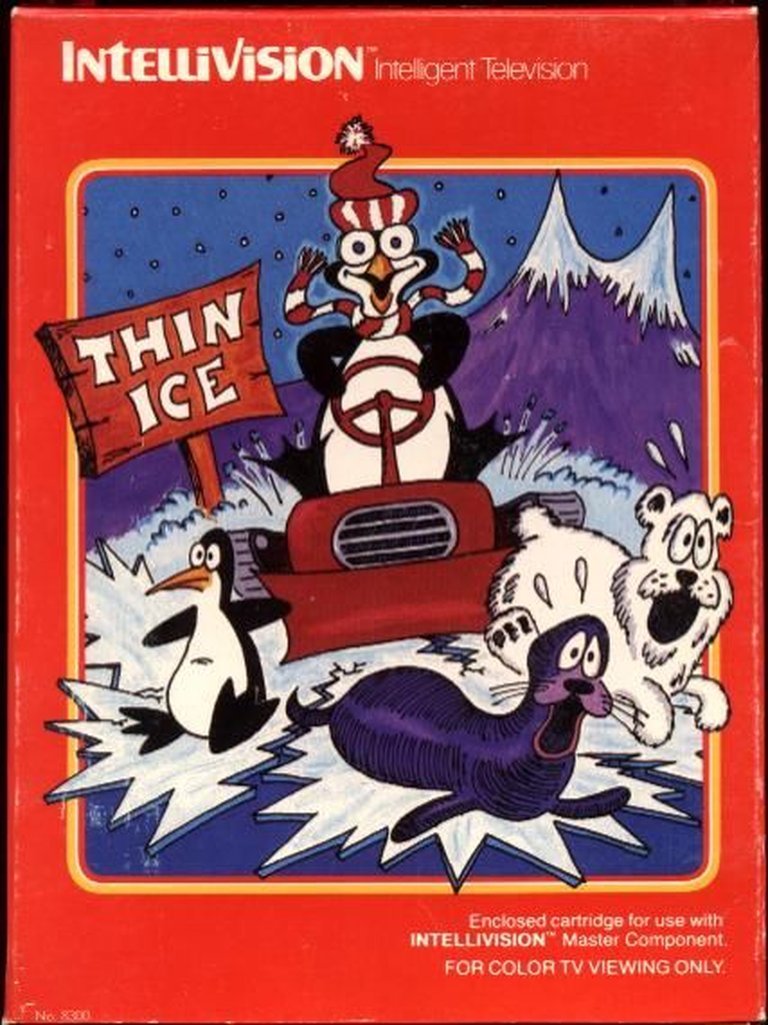
In ‘Thin Ice’, players take on the role of Duncan the penguin, who skates on thin ice in a quirky arcade game set in the Arctic. The goal is to outmaneuver other penguins, dunking them into the frigid water while collecting shrimp cocktails to boost speed. Duncan must also avoid the evil seal and polar bear, who pose threats by batting him around. Successfully sinking all penguins advances the player to the next level, where more penguins await. The game features a top-down perspective, vibrant graphics, and a soundtrack by composer George Alistair Sanger, making it a charming and challenging experience.
Gameplay Videos
Where to Buy Thin Ice
PC
Thin Ice Mods
Thin Ice Guides & Walkthroughs
Thin Ice Reviews & Reception
jayisgames.com (88/100): Thin Ice is an enjoyable concept executed in classic Nitrome fashion, but it fails to provide an experience without a few minor kinks.
Thin Ice Cheats & Codes
Intellivision
Press ENTER on the left hand controller, CLEAR on the right one, and press RESET.
| Code | Effect |
|---|---|
| ENTER (left controller), CLEAR (right controller), RESET | Switch between Duncan’s Thin Ice and Voochko On Ice |
Thin Ice: A Frozen Gem of the Intellivision Era
Introduction
In the annals of video game history, few titles capture the whimsy and charm of the early 1980s quite like Thin Ice. Released in 1986 for the Intellivision, this arcade-style game is a delightful blend of strategy, action, and humor, set against the backdrop of a frozen Arctic wonderland. At its core, Thin Ice is a game about Duncan, a mischievous penguin who skates around a frozen pond, trapping other penguins in squares of thin ice and sending them plunging into the frigid waters below. But beneath its simple premise lies a rich tapestry of development drama, innovative gameplay mechanics, and a legacy that has endured for nearly four decades.
Thin Ice is more than just a game; it is a snapshot of an era when video games were transitioning from mere novelties to a legitimate form of entertainment. It reflects the creative spirit of its developers, the technological constraints of its time, and the marketing whims of a company struggling to find its footing in a rapidly evolving industry. This review will delve deep into the game’s development history, narrative and thematic elements, gameplay mechanics, artistic and auditory design, critical reception, and lasting legacy. By the end, we will understand why Thin Ice remains a beloved classic among retro gaming enthusiasts and a fascinating case study in game design and corporate maneuvering.
Development History & Context
The Birth of an Idea
Thin Ice began its life not as a penguin-themed skating game, but as an adaptation of Disco No. 1, a 1982 arcade game by Data East. In Disco No. 1, players controlled a roller-skating “Disco Boy” who trapped “Disco Girls” by skating squares around them on a dance floor. While the game was fun and original, its theme was seen as dated and sexist by the standards of the early 1980s. Mattel Electronics, which had a first-look deal with Data East for their arcade games, recognized the potential in the gameplay mechanics but felt the disco theme was not a good fit for their Intellivision console.
Enter Keith Robinson, a programmer and designer at Mattel Electronics known for his work on TRON Solar Sailer. Robinson was a fan of Disco No. 1 and saw an opportunity to retheme the game in a way that would appeal to a broader audience. On May 28, 1982, he wrote a proposal for Thin Ice, a game in which a mischievous penguin would skate around other penguins on a frozen lake, trapping them in squares of ice that would collapse and send them into the water. The proposal also included a charming detail: between levels, a Zamboni ice-resurfacing machine would drive out to repair the ice, adding a touch of authenticity and whimsy to the game.
Robinson’s proposal was met with enthusiasm, and Thin Ice was given the green light. To prove the game’s feasibility, Robinson programmed a demo that limited the skating penguin’s movements to the borders of the screen’s background cards, demonstrating that the core mechanics could work within the Intellivision’s technical limitations.
The Development Team
The development of Thin Ice was a collaborative effort involving some of the most talented individuals at Mattel Electronics. The programming was handled by Julie Hoshizaki, who had recently completed work on the revised version of Lock ‘n’ Chase. Hoshizaki was a skilled programmer who understood the Intellivision’s hardware intimately, and her expertise was crucial in bringing Robinson’s vision to life.
The game’s graphics were designed by Monique Lujan-Bakerink, whose artistic sensibilities helped create the charming and colorful visuals that would become a hallmark of Thin Ice. Lujan-Bakerink’s work on the game’s title screens and character designs added a layer of personality and charm that set Thin Ice apart from other games of the era.
The game’s sound design was a collaborative effort between David Warhol and George Alistair Sanger, the latter of whom would go on to become one of the most prolific and influential composers in the video game industry. Sanger, who was just starting his career at the time, composed the game’s iconic theme, “Carnival of the Penguins,” which would become one of his earliest and most memorable works. Warhol, who was already an established figure at Mattel Electronics, handled the sound effects and additional music, ensuring that the game’s audio was as polished and engaging as its visuals.
Corporate Turmoil and Creative Resilience
The development of Thin Ice was not without its challenges, many of which stemmed from the corporate turmoil at Mattel Electronics. As the game neared completion in mid-May 1983, the marketing department at Mattel began to push for a new direction in the company’s game development strategy. Instead of licensing established characters from cartoons and movies, they wanted to create original characters that could be spun off into other products. The penguin from Thin Ice was seen as a prime candidate for this new approach.
A penguin-naming contest was held from June 17 to June 30, 1983, with the winning name, “Duncan,” submitted by David Warhohl, a programmer at Mattel Electronics. The game was officially renamed Duncan’s Thin Ice, and the cartridge size was increased from 8K to 12K to accommodate new animated title screens introducing Duncan and his penguin pals: Bobo, P.J., Minky, and Norman.
However, the creative process was soon disrupted by a major upheaval in Mattel Electronics’ management structure. President Josh Denham was replaced by Mack Morris, who had no prior experience in the video game industry. Morris brought in Jeff Rochlis, a former Mattel executive, as a consultant to evaluate the company’s game development efforts. Rochlis’s review of Thin Ice was mixed: while he liked the game, he felt that the penguin was too cute and ordered that it be replaced with a fisherman named “Fishin’ Sam” who would chop at the ice with an ax. He also recommended changing the game’s name to Iceman.
The developers, Julie Hoshizaki and Monique Lujan-Bakerink, were less than thrilled with these changes and reluctantly began modifying the game’s animations to accommodate Rochlis’s vision. However, Rochlis’s heavy-handed approach to management soon led to his downfall. Gabriel Baum, the VP of Application Software, banned Rochlis from having any further direct contact with the programmers, and Rochlis was eventually let go.
With Rochlis out of the picture, Fishin’ Sam was scrapped, and the developers returned to completing Duncan’s Thin Ice. But the marketing department had one more twist in store. Mattel Electronics had spent millions of dollars to secure the rights to the 1984 Winter Olympics license, but due to poor communication, no original game had been developed to capitalize on this opportunity. In a last-minute decision, the marketing team ordered that Duncan be replaced with Voochko the Wolf, the mascot for the Winter Olympics, and that the game be rebranded as Voochko on Ice.
The developers were disappointed by this decision, as they had grown attached to Duncan and his penguin pals. However, they complied with the order, replacing the penguins with Cossack dancers named Ivan, Oskar, Misha, and Bobo. In an unprecedented move, Gabriel Baum gave permission for Duncan’s Thin Ice to be hidden within the Voochko on Ice cartridge as an Easter egg, despite the fact that Easter eggs were officially forbidden at Mattel Electronics. This required increasing the cartridge size from 12K to 16K, but Baum justified the decision by claiming that the size increase was necessary due to the last-minute nature of the changes.
Two versions of the game were created: Voodun, in which Duncan was hidden within Voochko, and Dunvoo, in which Voochko was hidden within Duncan. Voodun was the version intended for production, while Dunvoo was the version the developers took home for themselves. To switch between Duncan and Voochko in either version, players could press the ENTER button on the left-hand controller, the CLEAR button on the right-hand controller, and then the RESET button.
The Collapse of Mattel Electronics and the Rise of INTV Corporation
Just as Voochko on Ice was about to go into production in January 1984, Mattel Electronics was shut down, leaving the game’s future in limbo. It wasn’t until 1986 that Thin Ice was finally released, this time by INTV Corporation, a company formed by former Mattel Electronics employees to continue supporting the Intellivision console. INTV Corporation opted to release the original 8K version of the game, which lacked the introduction screens and hidden Voochko Easter egg, in order to save on production costs. The title screen still bore the “Mattel Electronics presents…” logo, a remnant of the game’s tumultuous development history.
Fun Facts and Trivia
The development of Thin Ice is filled with fascinating anecdotes and trivia that add to the game’s charm and legacy. One of the most notable is the story of how George Alistair Sanger, then a relatively unknown composer, came to write the game’s iconic theme. David Warhol, who was roommates with Sanger’s brother, approached Keith Robinson with the idea of having Sanger compose a theme for Thin Ice for free. Despite Mattel’s policy against using freelancers, Warhol had Sanger write the music anyway, and the theme, “Carnival of the Penguins,” was so well-received that it was included in the game. Sanger was eventually paid $1,200 for the 15-second theme, marking the beginning of his illustrious career in video game music.
Another interesting tidbit is the involvement of Richard Zamboni, president of Frank J. Zamboni & Co., who gave permission for the Zamboni trademark to be used in the game’s instruction book. Zamboni even provided photos of the ice-resurfacing machines invented by his father to ensure that the depiction in the game was accurate.
The names of the penguins in Duncan’s Thin Ice also have a humorous backstory. Norman and Minky were named after Keith Robinson (whose rarely-used first name is Norman) and his boss, Mike Minkoff, the creator of Snafu.
Finally, the game’s packaging and instructions were designed by Keith Robinson himself, who had started his own graphic design business, Strand Cruisers, by the time INTV Corporation was ready to release Thin Ice. Robinson’s involvement in the game’s packaging and marketing materials led to him designing the packaging and writing the copy for many of INTV Corporation’s subsequent releases.
Narrative & Thematic Deep Dive
The Story of Duncan the Penguin
At its core, Thin Ice is a simple game with a straightforward premise: players control Duncan, a mischievous penguin who enjoys skating on thin ice and trapping other penguins in squares of ice that collapse and send them plunging into the frigid waters below. The game’s narrative is minimal, with no cutscenes or dialogue to speak of. Instead, the story is conveyed through the game’s visuals, sound design, and the player’s interactions with the game world.
Duncan’s motivations are simple: he wants to skate around the pond, trap other penguins, and avoid the seal and polar bear who are out to get him. The game’s levels are structured as a series of increasingly challenging ponds, each filled with more penguins to trap and more obstacles to navigate. As players progress through the levels, they are treated to charming animations, such as Duncan riding a sled between levels and a Zamboni resurfacing the ice.
Themes of Mischief and Survival
While Thin Ice may not have a deep or complex narrative, it does explore a few key themes that resonate with players. The most prominent of these is the theme of mischief. Duncan is not a hero or a villain; he is a mischievous trickster who takes pleasure in causing chaos and mayhem. His actions are not malicious, but they are certainly not benevolent either. He is a character who exists in a moral gray area, and players are encouraged to embrace this ambiguity as they guide him through the game’s levels.
Another key theme in Thin Ice is survival. Duncan is not just skating for fun; he is also trying to avoid the seal and polar bear, who are constantly trying to knock him off his feet. The game’s mechanics reinforce this theme, as players must constantly be on the lookout for these predators and take evasive action to avoid being caught. The shrimp cocktails that Duncan can consume to gain extra speed also play into this theme, as they represent a source of sustenance that helps him survive in the harsh Arctic environment.
The Arctic Setting and Its Influence on Gameplay
The Arctic setting of Thin Ice is more than just a backdrop; it is an integral part of the game’s design and mechanics. The frozen pond, the thin ice, and the frigid waters below all play a crucial role in shaping the player’s experience. The game’s mechanics are built around the idea of skating on thin ice, with players needing to carefully navigate the pond to avoid falling in themselves while trapping other penguins in squares of ice.
The Arctic setting also influences the game’s visual and auditory design. The game’s graphics are filled with snowy landscapes, icy ponds, and charming animations that evoke the beauty and danger of the Arctic. The sound design, with its cheerful theme music and playful sound effects, further reinforces the game’s whimsical and lighthearted tone.
The Role of the Seal and Polar Bear
The seal and polar bear in Thin Ice serve as the game’s primary antagonists, adding a layer of challenge and tension to the gameplay. The seal, who loves to bounce Duncan on her nose, and the polar bear, who likes to bat him around, are constant threats that players must avoid or outmaneuver. Their presence adds a sense of urgency to the game, as players must constantly be on the lookout for these predators while trying to trap the other penguins.
The seal and polar bear also serve as a reminder of the harsh realities of life in the Arctic. While Duncan may be a mischievous trickster, he is also a small and vulnerable creature in a world filled with larger and more powerful predators. The game’s mechanics reinforce this dynamic, as players must use their wits and agility to avoid being caught by these predators.
The Zamboni and the Resurfacing of the Ice
One of the most charming and memorable aspects of Thin Ice is the appearance of the Zamboni ice-resurfacing machine between levels. The Zamboni serves as a playful nod to the real-world process of maintaining ice rinks, adding a touch of authenticity and whimsy to the game. The animation of the Zamboni driving out to resurface the ice is a delightful detail that enhances the game’s overall charm and appeal.
The Zamboni also serves a practical purpose in the game’s design. By resurfacing the ice between levels, it ensures that each level starts with a clean slate, allowing players to focus on the new challenges and obstacles that await them. The Zamboni’s appearance also provides a brief moment of respite between levels, giving players a chance to catch their breath and prepare for the next round of skating and trapping.
Gameplay Mechanics & Systems
Core Gameplay Loop
At its heart, Thin Ice is a game about strategy, timing, and precision. The core gameplay loop revolves around skating around the pond, trapping other penguins in squares of ice, and avoiding the seal and polar bear. Players control Duncan using the Intellivision’s disc controller, which allows for smooth and responsive movement in all directions.
The game’s mechanics are simple but deceptively deep. To trap a penguin, players must skate around it in a square, causing the ice to weaken and collapse. The timing and precision required to execute these traps add a layer of challenge and skill to the gameplay. Players must also be mindful of their own position on the ice, as skating too close to the edge or into a square that is about to collapse can result in Duncan falling into the water.
Character Progression and Power-Ups
While Thin Ice does not feature a traditional character progression system, it does include a few power-ups that can help players gain an edge. The most notable of these is the shrimp cocktail, which Duncan can consume to gain extra speed. This power-up is crucial for navigating the pond quickly and avoiding the seal and polar bear.
The game’s levels are structured as a series of increasingly challenging ponds, each filled with more penguins to trap and more obstacles to navigate. As players progress through the levels, they are treated to charming animations and new challenges that keep the gameplay fresh and engaging.
Combat and Enemy AI
The combat in Thin Ice is minimal but effective. The primary threats to Duncan are the seal and polar bear, who are constantly trying to knock him off his feet. Players must use their wits and agility to avoid these predators, either by skating out of their way or by trapping them in squares of ice.
The enemy AI in Thin Ice is simple but effective. The seal and polar bear follow predictable patterns, allowing players to anticipate their movements and plan their strategies accordingly. The other penguins, while not directly hostile, can also pose a challenge, as they move around the pond and can interfere with the player’s attempts to trap them.
User Interface and Controls
The user interface in Thin Ice is minimal and intuitive, with a focus on the gameplay itself. The game’s controls are responsive and easy to learn, with the Intellivision’s disc controller providing smooth and precise movement in all directions.
The game’s visual design is clean and uncluttered, with a focus on the action taking place on the pond. The score and other relevant information are displayed at the top of the screen, ensuring that players can keep track of their progress without being distracted from the gameplay.
Innovative and Flawed Systems
One of the most innovative aspects of Thin Ice is its use of the Zamboni ice-resurfacing machine between levels. This charming detail adds a touch of authenticity and whimsy to the game, while also serving a practical purpose in resetting the ice for the next level.
However, the game is not without its flaws. The most notable of these is the lack of a save or continue feature, which can make the game frustrating for players who are unable to complete it in a single sitting. Additionally, the game’s difficulty curve can be steep, with later levels requiring a high degree of precision and timing to complete.
World-Building, Art & Sound
The Arctic Wonderland
The world of Thin Ice is a charming and whimsical Arctic wonderland, filled with snowy landscapes, icy ponds, and playful animations. The game’s visual design is colorful and vibrant, with a focus on creating a sense of fun and excitement. The Arctic setting is brought to life through the game’s graphics, which feature detailed and expressive character designs, as well as a variety of environmental elements that add depth and texture to the game world.
Visual Direction and Artistic Style
The artistic style of Thin Ice is a blend of simplicity and charm, with a focus on creating a visually appealing and engaging experience. The game’s graphics are colorful and vibrant, with a strong emphasis on clarity and readability. The character designs are expressive and playful, with Duncan and the other penguins featuring exaggerated and cartoonish proportions that add to the game’s whimsical tone.
The game’s visual design is also notable for its use of animation. The animations in Thin Ice are smooth and fluid, with a strong emphasis on creating a sense of movement and dynamism. The Zamboni animation, in particular, is a standout feature, adding a touch of authenticity and charm to the game.
Sound Design and Music
The sound design in Thin Ice is playful and engaging, with a strong emphasis on creating a sense of fun and excitement. The game’s sound effects are simple but effective, with a variety of playful and whimsical sounds that add to the game’s overall charm.
The music in Thin Ice is one of the game’s most memorable features. The game’s iconic theme, “Carnival of the Penguins,” was composed by George Alistair Sanger, who would go on to become one of the most prolific and influential composers in the video game industry. The theme is cheerful and upbeat, with a strong emphasis on creating a sense of fun and excitement. The music is perfectly suited to the game’s whimsical tone, and it has become one of the most beloved and recognizable themes in retro gaming.
Atmosphere and Immersion
The atmosphere in Thin Ice is one of fun and excitement, with a strong emphasis on creating a sense of immersion and engagement. The game’s visual and auditory design work together to create a cohesive and engaging experience, with a focus on creating a sense of fun and excitement.
The game’s Arctic setting is brought to life through the game’s graphics and sound design, with a strong emphasis on creating a sense of immersion and engagement. The game’s visual design is colorful and vibrant, with a focus on creating a sense of fun and excitement. The sound design is playful and engaging, with a strong emphasis on creating a sense of fun and excitement.
Reception & Legacy
Critical Reception
Upon its release in 1986, Thin Ice received generally positive reviews from critics. The game was praised for its charming visuals, playful sound design, and innovative gameplay mechanics. Critics also noted the game’s whimsical tone and engaging gameplay, which set it apart from other games of the era.
One of the most notable reviews came from TeleMatch, which gave the game a perfect score of 100%. The review praised the game’s graphics, sound effects, and animation, calling it “almost grand” in its execution. The Video Game Critic also gave the game a positive review, noting its personality and amusing details, as well as its impressive title screen and pleasant harmonized soundtrack.
However, not all reviews were universally positive. All Game Guide gave the game a score of 70%, noting that while it was fun to play, it lacked a clear goal beyond achieving a high score. Tilt gave the game a score of 67%, calling it “very seductive for all” but noting that it was primarily aimed at children.
Commercial Reception
The commercial reception of Thin Ice is less well-documented, but it is clear that the game found an audience among Intellivision owners. The game’s charming visuals, playful sound design, and innovative gameplay mechanics helped it stand out in a crowded market, and it remains a beloved classic among retro gaming enthusiasts.
Evolution of Reputation
Over the years, Thin Ice has evolved from a simple arcade-style game to a beloved classic with a dedicated fanbase. The game’s charming visuals, playful sound design, and innovative gameplay mechanics have helped it endure for nearly four decades, and it remains a favorite among retro gaming enthusiasts.
The game’s reputation has also been enhanced by its fascinating development history, which is filled with corporate drama, creative resilience, and a touch of whimsy. The story of how Thin Ice evolved from a disco-themed arcade game to a penguin-themed skating game, and how it survived the collapse of Mattel Electronics to be released by INTV Corporation, is a testament to the creativity and determination of its developers.
Influence on Subsequent Games
While Thin Ice may not have directly influenced many subsequent games, its innovative gameplay mechanics and charming visual design have left a lasting impact on the video game industry. The game’s use of the Zamboni ice-resurfacing machine between levels, for example, is a playful and authentic detail that has been emulated in other games.
The game’s legacy is also evident in the careers of its developers. George Alistair Sanger, who composed the game’s iconic theme, went on to become one of the most prolific and influential composers in the video game industry, working on games such as Loom, Wing Commander, and The 7th Guest. Julie Hoshizaki and Monique Lujan-Bakerink, who handled the game’s programming and graphics, respectively, also went on to have successful careers in the video game industry.
Conclusion
Thin Ice is a frozen gem of the Intellivision era, a game that captures the whimsy and charm of the early 1980s in a way that few other titles can match. Its simple but deceptively deep gameplay mechanics, charming visual design, and playful sound design make it a standout title in the Intellivision’s library. The game’s fascinating development history, filled with corporate drama, creative resilience, and a touch of whimsy, adds to its appeal and ensures that it remains a beloved classic among retro gaming enthusiasts.
While Thin Ice may not have the same level of recognition as some of the other classics of the era, it is a game that deserves to be remembered and celebrated. Its innovative gameplay mechanics, charming visual design, and playful sound design have left a lasting impact on the video game industry, and its legacy continues to endure nearly four decades after its release.
In the end, Thin Ice is more than just a game; it is a testament to the creativity and determination of its developers, a snapshot of an era when video games were transitioning from mere novelties to a legitimate form of entertainment, and a reminder of the simple joy of skating on thin ice.