
- Release Year: 2006
- Platforms: Windows
- Publisher: Focus Multimedia Ltd.
- Genre: Compilation
- Game Mode: Single-player
- Average Score: 86/100
Description
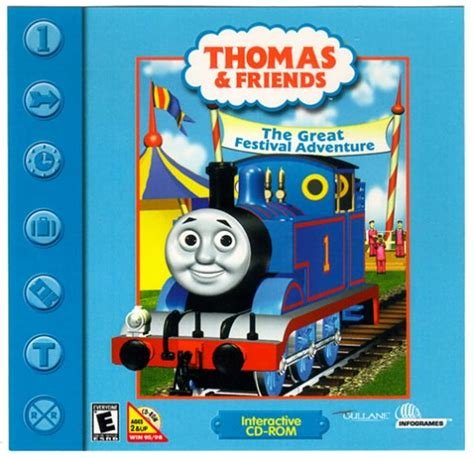
Thomas & Friends: The Great Festival Adventure – Double Pack is a 2006 Windows compilation bundling two educational games from the beloved Thomas the Tank Engine series: The Great Festival Adventure (1999) and Trouble on the Tracks. Set on the Island of Sodor, players assist Thomas, Percy, Gordon, and other engines with festival preparations through interactive activities like cleaning and repairing engines, clearing rockfalls with Harold, loading cargo at Brendam Docks, picking up specific passengers, herding escaped cows with Terence, building rides, and making music at the bandstand, all narrated by Michael Angelis (UK) or Robin Smith (US).
Thomas & Friends: The Great Festival Adventure – Double Pack Reviews & Reception
myabandonware.com (86.4/100): a really nice educational game
Thomas & Friends: The Great Festival Adventure – Double Pack: Review
Introduction
Imagine a bustling day on the Island of Sodor, where the chug of steam engines mingles with the anticipation of a grand festival—rides spinning, music playing, and passengers eager for fun. This is the whimsical world captured in Thomas & Friends: The Great Festival Adventure – Double Pack, a 2006 Windows compilation that bundles the 1999 edutainment classic Thomas & Friends: The Great Festival Adventure with the lesser-documented Thomas & Friends: Trouble on the Tracks. Rooted in Rev. W. Awdry’s beloved Railway Series and the hit TV show Thomas the Tank Engine & Friends, this double pack arrives like a shiny coal truck in an era dominated by high-octane blockbusters, offering simple, heartfelt minigame joy for preschoolers and nostalgic parents. As a game historian, I argue that while technically creaky by modern standards, this pack endures as a pure distillation of early licensed children’s software—charming, educational, and evocatively faithful to the Thomas mythos, cementing its place as an overlooked gem in edutainment history.
Development History & Context
Developed originally by UK studio Minds Eye Productions and published by Hasbro Interactive in 1999, The Great Festival Adventure emerged during the golden age of CD-ROM edutainment, when publishers like Hasbro flooded the market with licensed titles targeting young children on Windows 95/98 PCs. Minds Eye, known for kid-friendly 3D adventures, crafted a vision centered on interactive storytelling drawn directly from the TV series’ model-era aesthetics—think wooden trains rendered in rudimentary polygons. The game’s narrative and activities were designed to teach motor skills, pattern recognition, and sequencing through Thomas’s daily chores, aligning with Hasbro’s strategy of blending play with subtle pedagogy amid competitors like Blue’s Clues: Blue’s Birthday Adventure (1998) and LEGO Island (1997).
Technological constraints were pronounced: Built for DirectX and early 3D acceleration, it relied on DirectDraw, leading to modern compatibility woes like crashes, pink screens on Alt+Tab, and choppy framerates—issues fixable today with wrappers like DDrawCompat or dgVoodoo2, as noted in abandonware communities. The 2006 Double Pack, republished by Focus Multimedia Ltd. under licenses from HIT Entertainment and The Britt Allcroft Company, repackaged it with Trouble on the Tracks (a puzzle-focused Thomas title with sparse documentation) for the UK market on July 28, 2006. This re-release reflected the post-Hasbro era of Thomas media, as HIT shifted toward digital preservation amid declining physical edutainment sales. In a landscape shifting from CD-ROMs to online Flash games and early mobiles (e.g., later Thomas apps like Go Go Thomas! in 2014), the pack served as a budget-friendly nostalgia bundle, capturing the tail end of an industry enamored with point-and-click preschool software before the iPad revolution.
Narrative & Thematic Deep Dive
The Double Pack‘s centerpiece, The Great Festival Adventure, unfolds a linear yet replayable tale of industriousness on Sodor, narrated with series authenticity—Michael Angelis for the UK (with German support) and Robin Smith for the US, marking Smith’s debut in Thomas media. Sir Topham Hatt (the Fat Controller) rallies his engines for “The Great Festival,” assigning tasks amid cheeky banter: Thomas teases Gordon after a wind spins him on the turntable (echoing the Tenders and Turntables episode), evoking themes of humility and teamwork. The plot progresses episodically: Thomas aids James at a quarry rockfall (Harold clears debris), loads trucks at Brendam Docks with Percy and Cranky, fills with water (abandoning a race with Henry), picks up festival-goers with Annie and Clarabel, herds cows with Terence, races Harold, builds rides, witnesses Edward’s truck-induced tumble down Gordon’s Hill, and ends with festival music and restful praise.
Characters shine through canon fidelity: Core steam team (Thomas, Edward, Henry, Gordon, James, Percy, Toby) embody personalities—Thomas’s cheeky grinning face (an unused 3D second-series design), Gordon’s grumpiness, Percy’s helpfulness—while non-speakers like Bertie, Bulstrode, and Troublesome Trucks add mischief. Sir Topham Hatt guides via on-screen pop-ups, praising efficiency with a jolly “Santa Claus laugh” in the US version. Themes delve deeper than whimsy: Responsibility (engines’ jobs), cooperation (Harold/Terence assists), consequences (Edward’s grumbling backfires), and community joy culminate in earned rest, subtly instilling railway work ethic for tots. Trouble on the Tracks reportedly extends this with track-laying puzzles (inferred from title and series), but lacking detailed plots, it serves as thematic extension—troublesome rail fixes reinforcing problem-solving. Dialogue is sparse but quotable, like UK guard trivia (corrected to “stationmaster” in US), blending education with lore immersion.
Gameplay Mechanics & Systems
At its core, this is a minigame anthology—no combat, progression, or RPG elements, but a forgiving loop of activity selection via a Sodor map, unlocked sequentially with certificates and postcards (printable rewards viewable in Hatt’s office). Each of the seven activities in The Great Festival Adventure features three auto-advancing levels, emphasizing click-based skills:
- Engine Sheds: Pick tools (sponge, wrench, oilcan, coal bucket) to clean/repair Thomas, Percy, and Gordon—sequencing bolts, oiling rods, loading coal.
- Rockfall: Load quarry rocks into James’s trucks using Harold’s helicopter sling—pattern matching and timing.
- Loading at the Docks: Sort packages from Cranky/Bulstrode into correct trucks—color/shape categorization.
- Passenger Pickup: Select groups for Annie/Clarabel (e.g., Level 1: 1-5 passengers; Level 2: “children/men/boys”; Level 3: specifics like “lady in green and her two girls, except yellow-dress girl”)—counting, exclusion, description.
- Cows Escape: Guide Terence to herd cows—pathfinding/mouse control.
- Building the Rides: Shadow-matching pieces for Harold to assemble festival stalls/rides—spatial puzzles.
- Making Music: Free-play bandstand with piano, guitar, xylophone, drums, maracas; randomized engine cameos (Thomas/Edward/etc.) on replays.
UI is toddler-proof: Hatt’s corner avatar offers hints, logbook tracks progress (buggy truck audio can crash), no fail states—pure positive reinforcement. Trouble on the Tracks likely mirrors this with rail puzzles (unconfirmed), but flaws abound: Repetitive loops, imprecise controls, auto-levels limit agency. Innovative for 1999: Replay variety, printable outputs. Flawed: No save beyond autos, compatibility crashes.
World-Building, Art & Sound
Sodor pulses with lived-in charm across 13 locations (Tidmouth Sheds, Brendam Docks, Ffarquhar Quarry, Gordon’s Hill, etc.), traversed in linking cutscenes—viaducts, tunnels, fields evoking TV episodes. 3D art mimics models: Blocky engines, vibrant greens, festival vibrancy build festive atmosphere, but goofs undermine polish—static wheels/rods, missing eyebrows/backheads, scaled Cranky, blue Edward tires, narrow tracks. Atmosphere thrives on progression: From grimy sheds to twinkling stalls.
Sound design elevates: O’Donnell/Campbell/Fielding’s original score remixes series themes (Thomas/Edward/Percy first-series motifs, Gordon remake). Whistles (Edward borrows Gordon’s), chugs, and narration immerse; music minigame lets kids conduct, fostering creativity. Narration’s warmth—Angelis’s gravelly tales, Smith’s debut pep—ties visuals to lore, creating cozy, railway-nostalgic immersion despite technical jank.
Reception & Legacy
Launch reception is ghostly: No MobyScore, Metacritic, or critic reviews; MobyGames notes zero player/critic input. Commercial obscurity followed—Hasbro’s 1999 release vanished amid edutainment saturation, the 2006 pack a UK budget repack without fanfare. Modern legacy blooms on abandonware (MyAbandonware 4.32/5 from 50 votes; Archive.org downloads), with users praising nostalgia but griping framerates/UK crashes. No direct influence, but it pioneered Thomas PC games (pre-Thomas Saves the Day 2003), feeding mobile era (Adventures!, Minis). Preservation via demos (2001 Best of Thomas DVD) ensures history; as first Smith-narrated media, it’s a milestone. In industry terms, it exemplifies licensed edutainment’s peak—simple, safe, now emulated in apps—whispering “preserved obscurity” in gaming’s margins.
Conclusion
Thomas & Friends: The Great Festival Adventure – Double Pack distills Sodor’s magic into clickable chores, blending heartfelt narrative, skill-building minigames, and series fidelity into a time capsule of 1990s kid-PC joy. Flawed by era tech (goofs, DirectDraw quirks) and sparsity on Trouble on the Tracks, it triumphs in evoking teamwork and wonder for its audience. In video game history, it claims a niche as essential Thomas artifact—chug-worthy for retro parents, a reminder of edutainment’s innocent ambitions. Verdict: 8/10—A festive relic deserving emulation and emulation fixes; really useful software.