
- Release Year: 2010
- Platforms: Windows
- Publisher: THQ Inc.
- Genre: Compilation
Description
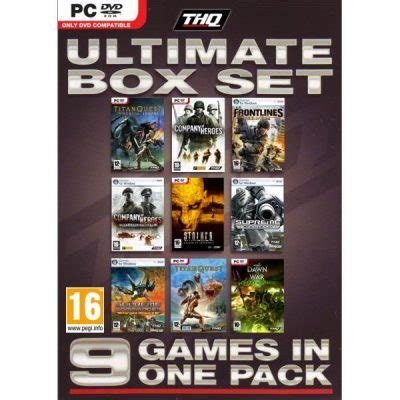
THQ Ultimate Box Set: 9 Games in 1 Pack is a compilation released in 2010 for Windows, bundling nine critically acclaimed titles across various genres. The collection includes real-time strategy games like Company of Heroes and its expansion Opposing Fronts, the sci-fi RTS Warhammer 40,000: Dawn of War – Dark Crusade, and the large-scale warfare of Supreme Commander and its Forged Alliance expansion. It also features the post-apocalyptic shooter Frontlines: Fuel of War, the survival horror FPS S.T.A.L.K.E.R.: Shadow of Chernobyl, and the action RPG Titan Quest with its Immortal Throne expansion. This diverse set offers a mix of intense strategy, immersive storytelling, and action-packed gameplay, catering to fans of military, fantasy, and sci-fi settings.
THQ Ultimate Box Set: 9 Games in 1 Pack Reviews & Reception
firstgames.co.nz : Get ready to battle your way through nine challenging games that will have you on the edge of your seat.
THQ Ultimate Box Set: 9 Games in 1 Pack: A Monumental Compilation of Gaming Excellence
Introduction
In the annals of video game history, few compilations have offered the sheer breadth and depth of THQ Ultimate Box Set: 9 Games in 1 Pack. Released in 2010, this collection is a testament to THQ’s golden era, bundling nine critically acclaimed titles across multiple genres into a single, value-packed offering. For gamers, this box set is not just a purchase—it’s an investment in a diverse library of experiences, from the tactical depths of real-time strategy to the adrenaline-fueled chaos of first-person shooters and the mythic grandeur of action RPGs. This review will dissect the compilation’s legacy, its individual components, and its enduring impact on the gaming landscape.
Development History & Context
THQ, founded in 1989, was a powerhouse publisher that carved its niche by acquiring and nurturing talented development studios. By the mid-2000s, THQ had established itself as a dominant force in the industry, thanks to franchises like Company of Heroes, Warhammer 40,000: Dawn of War, and Saints Row. The Ultimate Box Set was released during a transitional period for the company, as it sought to capitalize on its back catalog while navigating the shifting sands of the gaming market.
The compilation was a strategic move, designed to appeal to both hardcore gamers and budget-conscious consumers. It arrived at a time when digital distribution was on the rise, yet physical box sets still held significant allure. The inclusion of games spanning 2006 to 2008 showcased THQ’s ability to curate a collection that highlighted its strongest titles, ensuring that each game in the set had already proven its worth in the court of public opinion.
Technologically, the games in the set were products of their time, leveraging the power of mid-to-late 2000s hardware. Titles like Supreme Commander and Company of Heroes pushed the boundaries of real-time strategy with their massive unit counts and dynamic battlefields, while S.T.A.L.K.E.R.: Shadow of Chernobyl and Frontlines: Fuel of War delivered immersive, atmospheric experiences that tested the limits of contemporary PCs.
Narrative & Thematic Deep Dive
While the THQ Ultimate Box Set is a compilation rather than a single narrative-driven experience, the individual games within it weave rich tapestries of storytelling and thematic depth.
-
Warhammer 40,000: Dawn of War – Dark Crusade: This expansion to the Dawn of War series plunges players into the grim darkness of the 41st millennium, where war is eternal and humanity’s survival hangs by a thread. The narrative revolves around the Necron threat awakening on the planet Kronus, forcing multiple factions into a brutal conflict. The game’s themes of desperation, fanaticism, and the cyclical nature of war are quintessential to the Warhammer 40K universe.
-
Company of Heroes and Opposing Fronts: These titles offer a grounded, human-scale perspective on World War II, focusing on the bravery and sacrifice of soldiers. The narratives are episodic, following the journey of Able Company through key battles like D-Day and the Battle of the Bulge. The themes of camaraderie, heroism, and the cost of war are palpable, reinforced by the game’s cinematic presentation and dynamic combat.
-
Titan Quest and Immortal Throne: Set in a mythological world where gods and monsters clash, these games draw heavily from Greek and Egyptian lore. The player assumes the role of a hero tasked with stopping the Titans from overthrowing the Olympian gods. Themes of destiny, heroism, and the struggle between order and chaos permeate the experience, with a narrative that feels epic in scope yet personal in execution.
-
S.T.A.L.K.E.R.: Shadow of Chernobyl: This game is a masterclass in atmospheric storytelling, blending survival horror with first-person shooting. The narrative is open-ended, with the player navigating the eerie, radiation-scarred Zone around Chernobyl. Themes of isolation, survival, and the unknown are central, as players uncover the mysteries of the Zone while battling both human and supernatural threats.
-
Supreme Commander and Forged Alliance: These real-time strategy games eschew traditional storytelling in favor of a grand, operatic conflict between three factions vying for galactic supremacy. The narrative is secondary to the gameplay, but the overarching theme of total war and the struggle for dominance is ever-present, reinforced by the game’s massive scale and strategic depth.
-
Frontlines: Fuel of War: Set in a near-future dystopia ravaged by energy wars, this first-person shooter explores themes of resource scarcity, geopolitical conflict, and the dehumanizing effects of war. The narrative is delivered through cinematic missions, with the player taking on the role of an elite soldier fighting for control of the world’s last remaining fuel reserves.
Gameplay Mechanics & Systems
The THQ Ultimate Box Set is a masterclass in gameplay diversity, offering something for nearly every type of gamer. Below is a breakdown of the core mechanics and systems that define each title:
Real-Time Strategy (RTS)
-
Company of Heroes and Opposing Fronts:
- Core Loop: Build and manage resources, construct bases, and command units in real-time battles.
- Combat: Emphasizes tactical positioning, cover mechanics, and combined arms warfare. Units can take cover behind obstacles, and suppression fire plays a critical role.
- Progression: The single-player campaign is linear, with missions unlocking as the player progresses. Multiplayer offers persistent progression through ranked matches.
- Innovations: The dynamic battlefield system, where terrain can be destroyed or used for cover, was groundbreaking. The game also introduced a unique resource system where players capture strategic points rather than harvesting resources.
- Flaws: The AI can be inconsistent, and pathfinding issues occasionally mar the experience.
-
Warhammer 40,000: Dawn of War – Dark Crusade:
- Core Loop: Similar to Company of Heroes, but with a stronger emphasis on faction asymmetry. Each race (Space Marines, Orks, Eldar, etc.) has unique units and playstyles.
- Combat: Fast-paced and brutal, with a focus on melee combat and special abilities. The game introduces a morale system where units can break and flee if overwhelmed.
- Progression: Features a non-linear campaign where players conquer territories on a strategic map. Multiplayer includes a persistent ladder system.
- Innovations: The strategic meta-campaign was a standout feature, allowing players to choose their path to victory. The game also introduced heroic units with powerful abilities.
- Flaws: Balancing issues between factions can make some matchups feel unfair.
-
Supreme Commander and Forged Alliance:
- Core Loop: Focuses on large-scale warfare with hundreds of units on screen simultaneously. The game introduces a strategic zoom feature, allowing players to switch between a bird’s-eye view and a ground-level perspective.
- Combat: Emphasizes macro-management and strategic decision-making. The game’s unit cap is virtually non-existent, allowing for massive armies.
- Progression: The single-player campaign is mission-based, with a focus on large-scale battles. Multiplayer includes a persistent ranking system.
- Innovations: The strategic zoom and the sheer scale of battles were revolutionary. The game also introduced a unique economy system based on mass and energy.
- Flaws: The learning curve is steep, and the game can be overwhelming for newcomers. Performance issues can arise with large battles.
Action RPG
- Titan Quest and Immortal Throne:
- Core Loop: Hack-and-slash combat with deep character customization. Players choose from multiple classes and skill trees, allowing for a wide variety of builds.
- Combat: Fast-paced and fluid, with a focus on loot collection and character progression. The game features a dynamic difficulty system that scales with the player’s level.
- Progression: The single-player campaign is linear, with a strong emphasis on exploration and side quests. The expansion, Immortal Throne, adds a new act and additional endgame content.
- Innovations: The flexible class system, which allows players to combine two masteries (e.g., Warrior and Rogue), was a standout feature. The game also introduced a dynamic world with day/night cycles and weather effects.
- Flaws: The game can feel repetitive, and the lack of multiplayer in the base game was a missed opportunity.
First-Person Shooter (FPS)
-
Frontlines: Fuel of War:
- Core Loop: Combines traditional FPS gameplay with open-world elements. Players can choose from multiple classes, each with unique abilities and weapons.
- Combat: Emphasizes tactical gameplay, with a focus on squad-based mechanics and objective-driven missions. The game features a dynamic frontline system, where the battlefield shifts based on player actions.
- Progression: The single-player campaign is mission-based, with a strong narrative focus. Multiplayer includes a persistent ranking system and unlockable content.
- Innovations: The open-world design and dynamic frontline system were innovative for the time. The game also introduced a unique cover system and destructible environments.
- Flaws: The AI can be inconsistent, and the game’s performance can suffer in large battles.
-
S.T.A.L.K.E.R.: Shadow of Chernobyl:
- Core Loop: Blends FPS gameplay with survival horror and RPG elements. Players must manage resources, navigate hazardous environments, and battle both human and supernatural enemies.
- Combat: Emphasizes realism, with a focus on weapon degradation, limited ammunition, and environmental hazards. The game features a dynamic AI system where enemies react intelligently to the player’s actions.
- Progression: The single-player campaign is open-ended, with multiple paths to victory. The game also includes a multiplayer mode with cooperative and competitive modes.
- Innovations: The game’s atmospheric design and dynamic AI were groundbreaking. The survival mechanics, such as radiation and hunger, added depth to the experience.
- Flaws: The game is notoriously buggy, and the lack of polish can detract from the experience.
World-Building, Art & Sound
The THQ Ultimate Box Set is a showcase of the artistic and technical achievements of its era. Each game in the collection features distinct visual and auditory identities that contribute to its immersive qualities.
Visual Design
- Company of Heroes and Opposing Fronts: The games feature a realistic, gritty art style that captures the brutality of World War II. The environments are highly detailed, with dynamic lighting and weather effects that enhance the immersion. The character models are well-animated, and the attention to detail in the weaponry and vehicles is impressive.
- Warhammer 40,000: Dawn of War – Dark Crusade: The game’s visual design is heavily influenced by the Warhammer 40K universe, with a dark, gothic aesthetic. The unit models are highly detailed, and the environments are richly textured, with a strong emphasis on atmospheric lighting.
- Supreme Commander and Forged Alliance: The games feature a futuristic, high-tech art style, with sleek unit designs and vibrant color palettes. The strategic zoom feature allows players to appreciate the sheer scale of the battles, with thousands of units rendered simultaneously.
- Titan Quest and Immortal Throne: The games feature a lush, mythological art style, with detailed character models and environments inspired by Greek and Egyptian mythology. The game’s use of lighting and particle effects creates a sense of grandeur and epic scale.
- Frontlines: Fuel of War: The game’s visual design is grounded in realism, with a focus on detailed environments and realistic weapon models. The dynamic frontline system is visually impressive, with the battlefield shifting in real-time.
- S.T.A.L.K.E.R.: Shadow of Chernobyl: The game’s visual design is atmospheric and eerie, with a strong emphasis on environmental storytelling. The Chernobyl setting is rendered with a high level of detail, and the game’s use of lighting and fog effects creates a sense of dread and isolation.
Sound Design
- Company of Heroes and Opposing Fronts: The games feature a dynamic soundtrack that adapts to the player’s actions, with intense orchestral scores during battles and somber melodies during quieter moments. The sound effects are highly detailed, with realistic weapon sounds and environmental audio.
- Warhammer 40,000: Dawn of War – Dark Crusade: The game’s soundtrack is epic and operatic, with a strong emphasis on choral and orchestral elements. The sound effects are highly detailed, with each faction featuring unique audio cues.
- Supreme Commander and Forged Alliance: The games feature a futuristic, electronic soundtrack that complements the high-tech setting. The sound effects are highly detailed, with realistic weapon sounds and environmental audio.
- Titan Quest and Immortal Throne: The games feature a mythological, orchestral soundtrack that enhances the epic scale of the narrative. The sound effects are highly detailed, with realistic weapon sounds and environmental audio.
- Frontlines: Fuel of War: The game’s soundtrack is intense and cinematic, with a strong emphasis on orchestral and electronic elements. The sound effects are highly detailed, with realistic weapon sounds and environmental audio.
- S.T.A.L.K.E.R.: Shadow of Chernobyl: The game’s soundtrack is atmospheric and eerie, with a strong emphasis on ambient and electronic elements. The sound effects are highly detailed, with realistic weapon sounds and environmental audio.
Reception & Legacy
The THQ Ultimate Box Set was released to critical acclaim, with reviewers praising the value and diversity of the included titles. The compilation was seen as a testament to THQ’s ability to curate a collection of high-quality games that appealed to a wide range of gamers.
- Critical Reception: The individual games in the set had already received positive reviews upon their original releases, and the compilation was no exception. Critics highlighted the sheer volume of content and the variety of genres as major selling points. The inclusion of expansions like Opposing Fronts and Immortal Throne was particularly praised, as it added significant value to the package.
- Commercial Success: The Ultimate Box Set was a commercial success, appealing to both hardcore gamers looking to expand their libraries and budget-conscious consumers seeking a cost-effective way to experience multiple high-quality titles. The compilation’s release during the holiday season further boosted its sales.
- Legacy: The THQ Ultimate Box Set is remembered as one of the best value compilations of its era. It showcased THQ’s strength as a publisher and its ability to deliver diverse, high-quality experiences. The games included in the set have stood the test of time, with many still considered classics in their respective genres. The compilation also served as a swan song of sorts for THQ, as the company would face financial difficulties in the years following its release, ultimately leading to its bankruptcy in 2012.
Conclusion
The THQ Ultimate Box Set: 9 Games in 1 Pack is a monumental achievement in gaming compilations. It offers an unparalleled variety of experiences, from the tactical depth of Company of Heroes to the mythic grandeur of Titan Quest and the atmospheric horror of S.T.A.L.K.E.R.. Each game in the set is a standout title in its own right, and together they form a collection that is greater than the sum of its parts.
For gamers, this box set is more than just a purchase—it’s an investment in a diverse library of experiences that have stood the test of time. Whether you’re a fan of real-time strategy, action RPGs, or first-person shooters, there’s something in this compilation for you. The THQ Ultimate Box Set is a testament to the golden era of THQ and a reminder of the publisher’s ability to deliver high-quality, innovative games.
Final Verdict: A must-own compilation for any serious gamer, the THQ Ultimate Box Set: 9 Games in 1 Pack is a masterclass in value and diversity. It earns its place in video game history as one of the most comprehensive and well-curated collections of its era. 9.5/10