
- Release Year: 2001
- Platforms: Windows
- Publisher: 1C-SoftClub, Activision Publishing, Inc., Sierra On-Line, Inc.
- Developer: CLICK Entertainment
- Genre: Role-playing (RPG)
- Perspective: Diagonal-down
- Game Mode: LAN, Online Co-op, Single-player
- Gameplay: Action RPG, Crafting, Formation control, Party-based, Real-time combat
- Setting: Classical, Fantasy, Japan (Ancient, Medieval)
- Average Score: 85/100
Description
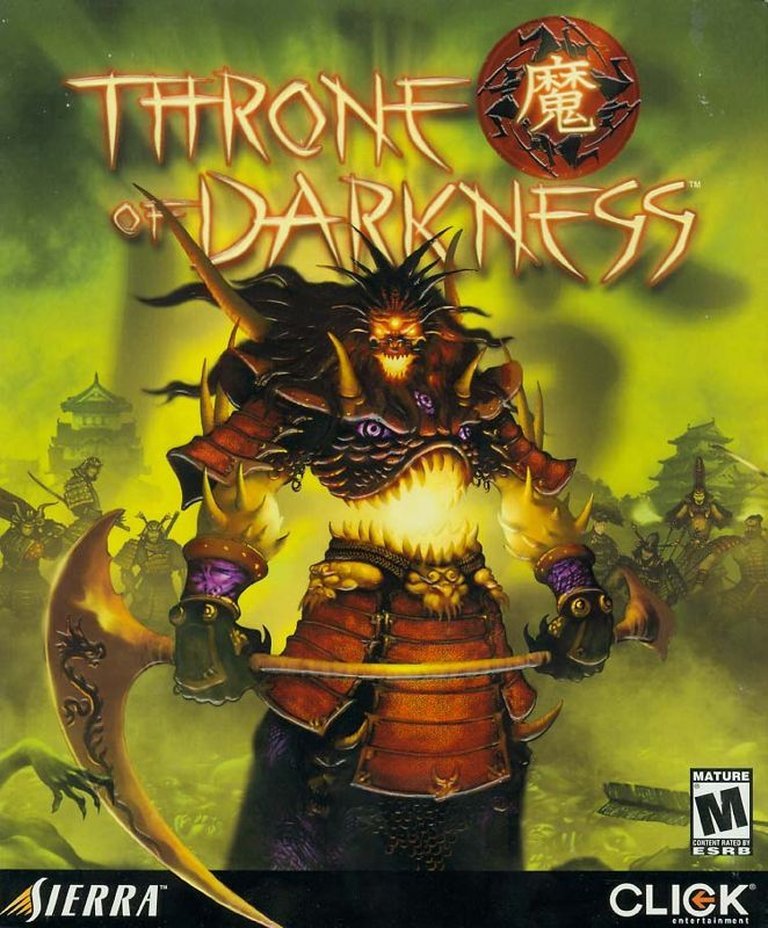
Set in medieval Japan’s land of Yamato, Throne of Darkness tasks players with commanding seven samurai warriors to stop the demon Zanshin and his undead horde from destroying the realm. This action-RPG features real-time combat, party-based gameplay, and a Japanese-inspired fantasy setting, drawing comparisons to Diablo in its mechanics.
Gameplay Videos
Where to Buy Throne of Darkness
Throne of Darkness Free Download
Throne of Darkness Patches & Updates
Throne of Darkness Guides & Walkthroughs
Throne of Darkness Reviews & Reception
metacritic.com (95/100): A terrific title; it is entertainment-rich, and one of those games that makes a mockery of time because it will fly when you play.
ign.com (75/100): This Japanese-themed action-RPG adds a few new features and a few new headaches to the Diablo model.
Throne of Darkness Cheats & Codes
PC
| Code | Effect |
|---|---|
| Press [Alt] | See all items |
| Press [Shift] + 6, then Press [Shift] + 5 | Restore health and Ki |
Throne of Darkness: Review
Introduction
In the shadow of Blizzard’s Diablo II, which had redefined the action RPG genre in 2000, Throne of Darkness emerged as a bold, if imperfect, contender. Developed by Click Entertainment—a studio founded by ex-Blizzard veterans including Ben Haas and Doron Gartner, who had worked on the original Diablo—this 2001 release promised a fresh twist on the hack-and-slash formula. Set in the mythologized, war-torn land of feudal Japan, Throne of Darkness sought to differentiate itself with party-based tactical combat, deep customization, and an evocative East Asian aesthetic. Yet, despite its ambitious vision, the game became a cautionary tale of ambition outpacing execution. This review deconstructs Throne of Darkness not merely as a Diablo clone, but as a fascinating artifact of early 2000s game design—a flawed, atmospheric, and ultimately underrated gem that deserves reappraisal.
Development History & Context
Click Entertainment’s pedigree was both a blessing and a curse. Founded by key figures behind Diablo, including lead designer Doron Gartner and artist Ben Haas, the studio leveraged its Blizzard connections to craft a game that felt like a spiritual successor. Sierra On-Line, the publisher, marketed Throne of Darkness aggressively as a “Japanese-themed Diablo killer,” capitalizing on the genre’s explosive post-Diablo II popularity. However, development was fraught with challenges. The team, comprising 289 credited individuals (including names like Steven Jay Blum and Ken Eaton), struggled to balance innovation with accessibility. The game’s complex party-control system and crafting mechanics, while novel, were hampered by the technological constraints of 2001. Isometric 2D graphics with limited 3D elements, coupled with CD-ROM distribution, resulted in visuals that couldn’t compete with Diablo II’s artistry. Released on September 25, 2001, Throne of Darkness arrived amid a saturated market, overshadowed by titans like Diablo II and Arcanum: Of Steamworks & Magick Obscura. Its legacy as a “what if” experiment in action RPG innovation was cemented before launch.
Narrative & Thematic Deep Dive
Throne of Darkness’s narrative is a classic samurai tragedy wrapped in dark fantasy. Set in the war-ravaged realm of Yamato, the story begins with the shogun Tsunayoshi’s pact with a corrupt priest, transforming him into the demonic warlord Zanshin. Zanshin’s undead hordes decimate the four ruling clans—Mori, Oda, Tokugawa, and Toyotomi—each led by historical daimyō (e.g., Tokugawa Ieyasu, Oda Nobunaga). As the sole survivors of their clan, the player commands seven samurai (archetypes like the Swordsman, Berserker, Ninja, and Wizard) on a quest to avenge their fallen daimyō and thwart Zanshin.
The plot unfolds linearly across a ring of territories, but its true strength lies in its thematic depth. The game explores the cyclical nature of corruption: the daimyō, revealed as the true villain in a gut-punch twist ending, sacrifices his samurai to become the new Zanshin, erasing their memories and turning them into undead minions. This bleak subversion of heroism—echoing Akira Kurosawa’s Throne of Blood, to which the game pays homage—ties into themes of loyalty, betrayal, and futility. Dialogue is sparse and often stilted, with Gratuitous Japanese (e.g., item names like Iaito or Chiljido) adding atmosphere but little narrative depth. Characters remain functional rather than compelling, serving as vessels for combat and progression. Yet the tragic ending, where the player’s samurai become unwitting pawns in a demonic rebirth, elevates the story beyond its clichéd foundation.
Gameplay Mechanics & Systems
At its core, Throne of Darkness is a Diablo-inspired action RPG with two revolutionary additions: party-based combat and deep item crafting. The player controls up to four samurai from a pool of seven, swapping them in and out via a central shrine. Combat is real-time and visceral—left-click to attack, right-click to cast spells—but the standout feature is the “formation” system. Players assign tactical presets (e.g., “archer support” or “berserker charge”) to coordinate party members, adding a layer of strategy absent in Diablo.
However, the execution is inconsistent. Formations feel clumsy without a pause function, and AI pathfinding often breaks, rendering tactical play a frustrating chore. Character progression emphasizes loot over story, with gear driving stats. Crafting, though ambitious, is resource-intensive: components (claws, teeth, gemstones) dropped by enemies can be fused with weapons via the blacksmith to add elemental resistances or damage boosts. Yet the system’s complexity is undermined by a punishing economy: players cannot sell items, only trade them to vendors for gold or spell points, forcing meticulous inventory management. The UI exacerbates issues; a single save slot and cluttered 2D interface turn looting into a chore. Despite these flaws, the combat remains satisfying, with 80+ spells and diverse weapons (polearms, katanas, throwing blades) creating visceral feedback.
World-Building, Art & Sound
Throne of Darkness’ greatest triumph is its atmosphere. Yamato is a meticulously realized fusion of history and myth, drawing from Japanese folklore without veering into caricature. Environments range from blood-soaked castles to eerie forests teeming with yōkai—onig, kappa, and jorogumo—each rendered with gothic flair. The art direction leans into darkness: decapitated corpses, millstones grinding villagers, and hazy fog create a sense of oppressive dread. While technically primitive by 2001 standards (2D isometrics with occasional 3D effects), the art’s commitment to authenticity—from samurai armor to shrine architecture—earns praise.
Sound design elevates the experience. Traditional taiko drums and shamisen melodies underscore battles, while spell effects (thunder cracks, fire roars) provide tactile feedback. Voice acting is minimal but effective, with character grunts and demonic roars enhancing immersion. Yet technical limitations mar the presentation; low-resolution textures and poor gamma control make environments murky, and cluttered layouts obscure interactive objects. Despite these issues, the game’s commitment to its East Asian aesthetic—furthered by TV Tropes’ observation of its “gratuitous Japanese” and historical in-jokes (e.g., the Tokugawa/Mōri clan rivalry based on real battles)—creates a world that feels lived-in and unique.
Reception & Legacy
At launch, Throne of Darkness received a mixed reception. Critics lauded its setting and ambition but lamented its execution. Game Revolution awarded it 91%, calling it a “must-have” for genre fans, while GameSpot gave it 7.1/10, praising combat but criticizing “underdeveloped features.” Metacritic’s 68 aggregate score reflected this divide, with European outlets like PC Zone Benelux (88%) and IGN (75%) hailing its atmosphere, while American publications like Game Informer (40%) dismissed it as a “poor Diablo clone.” Player reviews were equally polarized: some celebrated its crafting and tactical depth, while others, as noted on MobyGames, called it “a dreadfully lame attempt at a ‘Diablo-killer’” marred by “boring gameplay.”
Over time, Throne of Darkness has cultivated a cult following. Its legacy lies in its bold experimentation: the party-control system, though flawed, prefigured later tactical RPGs, while its crafting system influenced action RPGs like Titan Quest. The game’s downer ending and mythological themes resonate in modern titles (Nioh, Ghost of Tsushima). Yet it remains a footnote in the genre’s history, remembered more for its ambition than its impact. As Metacritic user reviews attest, some players still praise it as “one of the finest equipment customization systems ever created,” while others lament its “tiresome pryljakten” (pry hunting).
Conclusion
Throne of Darkness is a game of fascinating contradictions. It succeeds in delivering a rich, atmospheric world rooted in Japanese folklore and offers innovative mechanics like tactical formations and deep crafting. Yet its execution—clunky UI, poor AI, and a punishing economy—prevents it from reaching the heights of its inspiration. As a product of post-Diablo ambition, it stands as a testament to the risks of innovation: a flawed diamond that, for all its shortcomings, remains a compelling artifact of early 2000s game design.
Verdict: Throne of Darkness is not a Diablo killer, but it is a flawed, atmospheric, and underrated gem. Its place in gaming history is secure as a bold, if imperfect, experiment—a reminder that ambition, when married to a unique vision, can transcend even its own limitations. For players willing to overlook its archaic flaws, it offers a dark, samurai-laden journey unlike any other.