
- Release Year: 1999
- Platforms: Windows
- Publisher: GT Interactive Software Corp.
- Developer: Devil’s Thumb Entertainment
- Genre: Strategy, Tactics
- Perspective: 3rd-person (Other)
- Game Mode: Single-player
- Gameplay: Exploration, Naval combat, Open World, Real-time, Resource Management, Ship Customization
- Setting: 18th century, Historical
- Average Score: 70/100
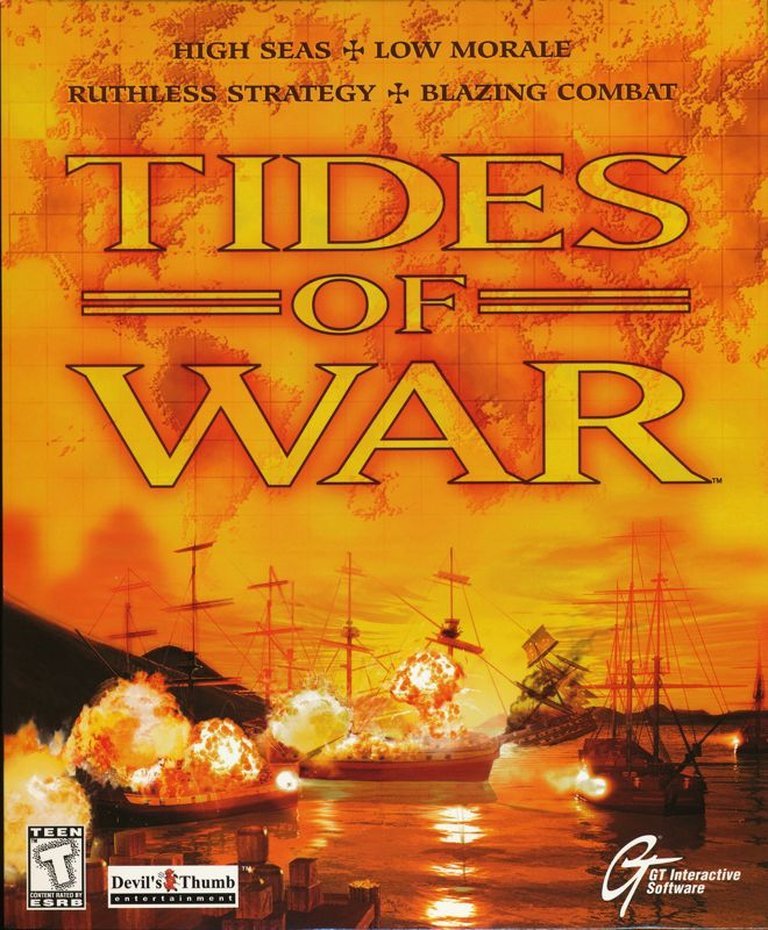
Description
Set in the 18th century, Tides of War places players in command of a naval vessel, tasked with sailing the open seas, completing missions involving combat, delivery, and exploration, while managing crew morale, discipline, and ship upgrades. Players earn money to purchase better cannons and vessels, engage in real-time battles leveraging wind direction, and gradually progress from modest beginnings to commanding larger fleets in this strategy-focused maritime adventure.
Gameplay Videos
Where to Buy Tides of War
PC
Tides of War Free Download
Tides of War Cracks & Fixes
Tides of War Guides & Walkthroughs
Tides of War: Review
Introduction
In the turbulent sea of late-1990s real-time strategy (RTS) games, Tides of War emerges as a bold, if flawed, vessel from developer Devil’s Thumb Entertainment. Released in 1998 by GT Interactive, this ambitious naval combat title promised a “Sid Meier’s Pirates!”-like experience fused with strategic depth. Set during the 18th century, it cast players as ship commandants navigating vast oceans, engaging in tactical battles, and pursuing wealth through combat and trade. Yet despite its intriguing premise, Tides of War ultimately capsized under the weight of executional flaws, leaving it as a curio of gaming history rather than a celebrated classic. This review deconstructs its design legacy, mechanics, and reception to chart its place in the annals of naval gaming.
Development History & Context
Devil’s Thumb Entertainment, founded in Boulder, Colorado in November 1996, was a fledgling studio with a singular vision: to craft an open-world naval strategy game that merged exploration with real-time combat. Brainchild of director Brian Ullrich and executive producer Tony Harman, the project faced significant technological constraints. Released in September 1998 for Windows, Tides of War operated on 32-bit architecture, requiring a Pentium 120 MHz processor with 16MB RAM—modest specs for an era increasingly defined by graphically intensive titles like StarCraft and Age of Empires II.
The late ’90s gaming landscape was dominated by medieval/fantasy RTS titles, with naval warfare being a niche subgenre. While Age of Sail (1996) had established a tactical naval combat template, Tides of War sought differentiation through its non-linear “sandbox” approach, allowing players to freely explore 60,000 screens of ocean—a staggering scale for the time. However, the team’s limited resources and experience (many staff members, including lead programmer Timothy Weisser, were new to the industry) resulted in compromises. The engine struggled with performance, and art director David Osborne’s team could not deliver the visual fidelity promised in pre-release previews. Ultimately, GT Interactive’s marketing positioned the game as a competitor to Pirates!, but its RTS-leaning mechanics failed to resonate with fans of either genre.
Narrative & Thematic Deep Dive
Tides of War eschews a traditional narrative in favor of emergent storytelling, framing the player as a rising naval officer in a lawless 18th-century world. The narrative unfolds through mission chains—combat, delivery, exploration, or escort tasks—each offering incremental rewards. Players align with factions like England, Spain, or pirates, enabling roleplay as privateers, traders, or buccaneers. However, the plot remains skeletal, with no overarching story or character development beyond the player’s avatar. Dialogue is sparse, limited to mission briefings and generic NPC interactions, failing to capture the swashbuckling spirit of its inspiration.
Thematically, the game explores freedom and consequence within a simulated ecosystem. Managing crew morale, rations, and discipline adds a layer of survivalism, where neglect can lead to mutiny or reduced combat efficacy. Yet these systems feel superficial, with no meaningful narrative weight. The pirate faction, for instance, lacks the charismatic outlaws of Pirates!, reducing them to reskinned enemies. The world’s political tensions (e.g., colonial rivalries) are hinted at but never explored, leaving the narrative adrift in a sea of missed potential.
Gameplay Mechanics & Systems
Core Loop & Progression:
The game revolves around a cycle of sailing, mission completion, and ship upgrades. Players start with modest vessels, earning gold to purchase better ships, cannons, and equipment. This progression mirrors Pirates! but with a strategic focus: larger ships boast superior firepower but maneuver poorly, creating tactical trade-offs.
Combat Mechanics:
Battles unfold in real-time via a top-down isometric view, emphasizing positioning and wind direction—critical for maneuvering and firing broadsides. Players can deploy specialized ammunition:
– Chain Shot: Damages sails and rigging to immobilize foes.
– Hot Shot: Ignites fires that can destroy enemy magazines.
– Canister Shot: (Announced but not implemented) Intended for crew suppression.
However, the system is rudimentary. Ship controls are indirect (click-to-move), leading to frustrating unresponsiveness. Boarding—a core mechanic—is a simplistic afterthought, lacking the depth of hand-to-hand combat.
Crew & Resource Management:
Players set discipline levels, rations, and food types, affecting crew morale and combat stats. High morale boosts accuracy; low morale increases desertion risk. Yet these systems feel like a spreadsheet overlay, with little visual feedback or dynamic consequence.
Innovations vs. Flaws:
The non-linear world and dynamic weather (storms, fog) were ahead of their time, but AI is its Achilles’ heel. Enemies exhibit predictable behaviors, often sailing in circles when disabled. Mission variety is another casualty: escort tasks devolve into tedious waiting, while combat missions lack escalation. The absence of a save system exacerbates tedium, forcing players to replay lengthy sessions after failures.
World-Building, Art & Sound
Setting & Atmosphere:
The 18th-century Caribbean serves as the primary canvas, with islands, ports, and open seas forming a cohesive, if repetitive, world. The scale is impressive—60,000 screens encouraged exploration—but the world feels sterile. Ports lack unique identities, and towns are mere backdrops for trade, not hubs of interaction.
Visual Direction:
Artistically, Tides of War is a product of its era. Rendered cut-scenes (painted by Jeff Litchford and Shawn Spradling) add cinematic flair, but in-game graphics are rudimentary. Low-poly ships and simplistic terrain evoke “shareware-level” visuals, as one critic noted. The isometric perspective offers clear tactical views but fails to convey the grandeur of naval warfare. Water effects are static, and ships lack detail, making battles feel mechanical rather than epic.
Sound Design:
Composer Michael Smith’s soundtrack blends maritime themes with orchestral cues, effectively setting a somber tone. Sound effects—cannon fire, wind, waves—are functional but unremarkable. Voice acting is absent, leaving dialogue to text-based logs, which further distances players from the world.
Reception & Legacy
Launch Reception:
Critics were divided but largely underwhelmed. MobyGames aggregates a 54% average score based on three reviews:
– Hacker (Croatia): 80%, praising its “vast world” and tactical depth.
– PC Joker (Germany): 58%, noting the “60,000 screens” but criticizing “shareware graphics.”
– GameStar (Germany): 23%, calling visuals “pre-flood” and gameplay “shallow.”
Players rated it 2.2/5, with no written reviews. Games Domain summed up the consensus: “An excellent game toppled by flawed design implementation.”
Commercial Performance:
Sales figures are unrecorded, but the game’s obscurity suggests it was a commercial flop. Its niche genre and technical issues limited its reach.
Legacy:
Tides of War has no direct descendants, but its ambition influenced later naval games like Age of Sail II (2001). Its greatest legacy, however, is cautionary. It highlights the perils of overreaching with limited resources—a lesson echoed in modern indie projects. A spiritual successor, Tides of War: Letters of Marque, was announced in 2015 by Salty Sea Dogs but remains unreleased, underscoring the genre’s niche appeal.
Conclusion
Tides of War is a time capsule of late-’90s ambition undone by execution. Its open-world vision, dynamic combat, and resource systems were prescient, yet marred by AI incompetence, dated visuals, and shallow mechanics. For naval history enthusiasts, it offers a glimpse into an era of experimental game design, but for modern players, it remains a frustrating relic. As a historical artifact, it is fascinating; as a game, it is unfulfilling. In the pantheon of RTS titles, Tides of War is not a classic but a cautionary tale—a vessel that never quite reached its destination.
Final Verdict: A flawed but ambitious naval experiment that merits historical appreciation over gameplay recommendation.