
- Release Year: 1997
- Platforms: Antstream, PlayStation, Windows
- Publisher: GameBank Corp., GT Interactive Software Corp., Piko Interactive LLC
- Developer: n-Space, Inc.
- Genre: Action
- Perspective: Behind view
- Game Mode: Single-player
- Gameplay: Arcade, Shooter
- Setting: Aquatic, Futuristic, Sci-fi, Underwater
- Average Score: 63/100
Description
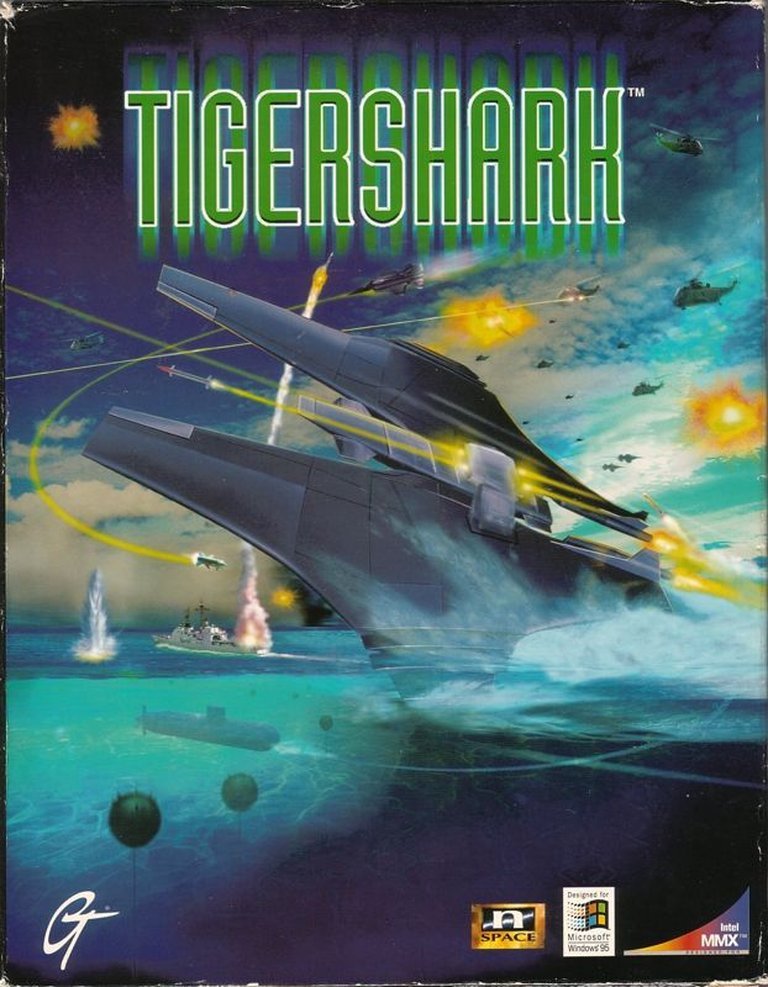
Set in the year 2060, ‘Tigershark’ is a sci-fi action shooter where players command a prototype attack subfoil (submarine-hydrofoil) to thwart a Russian commander’s plot to destabilize and sink the Pacific tectonic plate using geothermal taps. Battling enemy submarines, aircraft, and battle cruisers across dynamic underwater and aerial environments, the game combines arcade-style combat with mission-based objectives, such as escorting allied submarines to safety.
Gameplay Videos
Where to Buy Tigershark
Tigershark Free Download
Tigershark Patches & Updates
Tigershark Mods
Tigershark Guides & Walkthroughs
Tigershark Reviews & Reception
ign.com (65/100): Non-stop underwater dogfighting ensues, and you must utilize all your piloting and shooting skills in order to beat them.
wikiwand.com : being able to quickly submerge and surface is enjoyable as the action dynamically changes depending on your depth.
Tigershark Cheats & Codes
PC
Press the button you have designated as ‘Pause’ to bring up the game menu. After that, press N+Space Bar to access the cheat mode. You may then enter the following codes exactly as typed for the corresponding effects.
| Code | Effect |
|---|---|
| BOX | Box Mode |
| EMPTY | Enemies Don’t Have Ammo |
| HAPPY | Invincibility |
| FREE | No Collisions |
| AMMO | Super Weapons |
| BLAST | Unlimited Ammo |
| MOVIE | View FMV Sequences |
PlayStation
Enter the following code at the Password screen:
| Code | Effect |
|---|---|
| BUGGY | Bug Riders Preview |
| RUSSI | Clean Pause Screen |
| DNEPR | Collision Boxes |
| MINSK | Disable Cheats |
| LENIN | Easy Mode |
| VOSTA | Final Level Password |
| KIROV | Infinite Ammo |
| KURSK | Invincibility |
| AKULA | Level 2 |
| PASHA | Level 3 |
| MIRAS | Level 4 |
| NAKAT | Level 5 |
| REZKY | Level 6 |
| TUCHA | Level 7 |
| ZARYA | Level 8 |
| SOYUZ | Low Gravity |
| BURAN | No Collisions |
| VOLGA | Random-Colored Terrain Polygons |
| KAMOV | Sound Test |
| RUBLE | Stronger Weapons |
| SNEEG | Unlock Sea Hunter Mini-Game |
| KIEV | View FMV Sequences |
| D00A58EC | Joker Command |
| 800BFF4A 000A | Infinite SM25’s |
| 800BFF4C 000A | Infinite SR70’s |
| 800BFF5C 1515 | Max Prod |
| 800BFF5E 1515 | Max Sens |
| 800BFF60 1515 | Max Weap |
| 800BFF50 0013 | Infinite ECM-9000’s |
| 800BFF44 0013 | Infinite EMP Torpedoes |
| 800BFF38 01FF | Infinite Gatling Ammo |
| 80084798 0003 | Infinite Lives |
| 800BFF3E 0013 | Infinite MK-65’s |
| 800BFF42 0013 | Infinite MK-77’s |
| 800BFF48 0013 | Infinite SM-19’s |
| 800BFF52 0013 | Infinite ECM Torpedoes |
| 800BFF3C 0013 | Infinite MK-60’s |
| 800BFF46 0013 | Infinite MK-90’s |
| 800BFEF4 00F0 | Infinite Armor |
| 800BFEF6 00F0 | Infinite Armor |
| 800BFF3A 07D0 | Laser Never Overheats |
Tigershark: A Submerged Relic of Ambitious Design and Technical Limitations
Introduction
Beneath the churn of 1997’s gaming landscape—a year defined by Final Fantasy VII, GoldenEye 007, and Star Fox 64—Tigershark surfaced as an audacious experiment in hybrid combat. Developed by n-Space, a fledgling studio later known for Call of Duty: Modern Warfare Remastered, this submarine-hydrofoil shooter promised a revolutionary fusion of aerial and subaquatic warfare. Yet, despite its ambitious premise, Tigershark sank into obscurity, remembered not as a cult classic but as a cautionary tale of unrealized potential. This review argues that while Tigershark pioneered innovative mechanics and atmospheric depth, its crippling technical constraints, repetitive design, and harsh difficulty curve left it stranded in the abyss of mid-tier ’90s shooters.
Development History & Context
A Studio’s Baptism by Fire
n-Space, founded in 1994 by Erick S. Dyke, faced immense pressure with Tigershark as its debut title. The late ’90s were a battleground for 3D acceleration, with studios racing to exploit MMX processors and the nascent 3Dfx Voodoo cards. The team, including lead programmer Sean Waldron and designer Mike Wikan, envisioned a “Descent under waves”: a fast-paced, six-degrees-of-freedom shooter leveraging the unique properties of underwater traversal.
Technological Ambitions vs. Reality
The PlayStation’s limited RAM (2MB) and the PC’s fragmented hardware ecosystem forced brutal compromises. Tigershark’s dual-environment rendering—surface skirmishes against aircraft and submerged submarine combat—strained systems. On PC, MMX optimization was notoriously half-baked, causing severe slowdowns during explosions. Critics like Computer Games Strategy Plus noted that without a 3Dfx card, “the game plays like DOOM II on a 386” (1997). The PlayStation version fared worse, plagued by fog-drenched draw distances and polygon pop-in, described by MAN!AC as “square, murky, and technically sloppy.”
A Crowded Market
GT Interactive’s marketing framed Tigershark as a competitor to Soviet Strike and Warhawk, but it lacked their polish. Released weeks before Gran Turismo and Castlevania: Symphony of the Night, Tigershark drowned in a wave of genre-defining titles, its identity lost in the shuffle.
Narrative & Thematic Deep Dive
Cold War Redux in 2060
Tigershark’s plot is quintessential ’90s schlock: In 2060, a rogue Russian commander destabilizes the Pacific tectonic plate using geothermal taps, flooding Japan and threatening global annihilation. The player pilots the “Tigershark,” a prototype subfoil, to dismantle the villain’s network of underwater bases and warships.
Characters and Dialogue: Functional but Forgettable
Narrative exists solely to contextualize destruction. Brief FMV cutscenes (rendered in Smacker Video) feature flat, B-movie dialogue like “The feeding frenzy is about to begin!”—a line repeated ad nauseam in promotional material. Characters are archetypes: the stoic American hero, the mustache-twirling Russian antagonist, and a roster of allies reduced to escort mission fodder.
Themes: Environmental Anxiety and Technological Hubris
Beneath the jingoism lies a kernel of ecological commentary. The villain’s geothermal taps weaponize Earth’s natural forces, echoing contemporary fears of climate catastrophe and nuclear hubris. Yet these themes are underexplored, overshadowed by relentless combat.
Gameplay Mechanics & Systems
Core Loop: Depth as a Double-Edged Sword
Tigershark’s defining mechanic is fluidly transitioning between surface and underwater combat. On the surface, the subfoil handles like a nimble aircraft, dodging enemy fighters and bombarding battleships. Submerged, it transforms into a sluggish submarine, weaving through trenches and torpedoing foes. The dynamic reshapes strategy: Surface combat favors speed and evasion, while underwater play demands cautious maneuvering.
Combat and Progression: Repetition and Rage
Weapons include homing torpedoes, flak cannons, and a “hyper pulse” main gun, but balancing issues sap their impact. The lock-on system falters at close range, and enemies—swarms of drones, cruisers, and turrets—spawn relentlessly. Electronic Gaming Monthly (1997) criticized the “unfair” difficulty: “You’re bombarded from 20 directions before mastering controls.” Mission design exacerbates this: Escort missions punish players for ally AI incompetence, while volcanic escape sequences demand pixel-perfect precision.
Technical Quirks and UI
Save systems are archaic—progress is only retained after mission completions—a design choice Gamezilla derided as “sadistic” (2000). The UI, though functional, obscures critical data: Damage indicators are minimalist, and radar ranges are unreliable. Control customization is robust, supporting joysticks and rudders, but default mappings feel unintuitive on PlayStation’s D-pad.
World-Building, Art & Sound
Visuals: Beauty in the Blur
Tigershark’s art direction oscillates between inspired and indifferent. Environmental artists Bradley Weckman and Christopher Stone crafted haunting underwater vistas: sunken cities draped in coral, volcanic vents spewing magma, and Soviet bases glowing with eerie bioluminescence. Surface battles, however, suffer from homogeneity—endless blue horizons and blocky ship models—while draw distances on PlayStation evoke “swimming through pea soup” (IGN, 1997).
Sound Design: Marshes and Marching Bands
Composer Russell Lieblich’s score blends martial brass with synth-driven tension, amplifying the militaristic tone. Sound effects shine: Torpedoes hiss through water, depth charges explode with bowel-shaking bass, and enemy sonar pings create palpable dread. Yet voice acting is laughably wooden, with lines like “Enemy destroyed!” looping into madness.
Atmosphere: Isolation Meets Carnage
The game’s strongest achievement is its claustrophobic immersion. Submerged sections mute ambient noise, amplifying the creak of metal and the distant thrum of engines. Surfacing unleashes cacophonous skies alive with gunfire and radio chatter—a jarring, effective contrast.
Reception & Legacy
Launch: A Lukewarm Tide
Critics averaged 58% (MobyGames), praising ambition but slamming execution. PC Multimedia & Entertainment (1997) lauded its “excellent control scheme” and 3Dfx-enhanced visuals, while GameSpot (1997) bemoaned “murky graphics” and “frustrating missions.” PlayStation reviews were harsher; Fun Generation (1997) dismissed it as “a game nobody needed.” Commercially, it underperformed, lost in GT Interactive’s portfolio between Duke Nukem 3D and Unreal.
Enduring Influence: Ripples, Not Waves
Tigershark’s legacy is negligible but instructive. Its dual-environment combat foreshadowed Depth Hunter (2013) and Subnautica’s vehicle dynamics, while its unforgiving difficulty presaged the “hardcore shooter” revival of the 2010s. For n-Space, it was a baptismal lesson—they later refined their tech in Duke Nukem: Time to Kill and Call of Duty projects.
Conclusion
Tigershark is a relic of its era: a game straining against the confines of its hardware and design naïveté. Its bold fusion of aerial and submarine combat remains conceptually thrilling, and its atmospheric sound design still captivates. Yet, plagued by repetitive missions, brutal difficulty, and technical unevenness, it never ascends beyond a historical curiosity. For game historians, it offers a snapshot of 1997’s experimental fervor; for players, it’s best remembered as a proof-of-concept drowned by its own ambition. In the pantheon of ’90s shooters, Tigershark is neither predator nor prey—it’s driftwood, carried by currents it couldn’t control.
Final Verdict: A fascinating, flawed artifact—worth studying, but not revisiting.