
- Release Year: 1996
- Platforms: Windows
- Developer: Jeremy Dickson
- Genre: Puzzle
- Perspective: Fixed / flip-screen
- Game Mode: Single-player
- Gameplay: Board game
Description
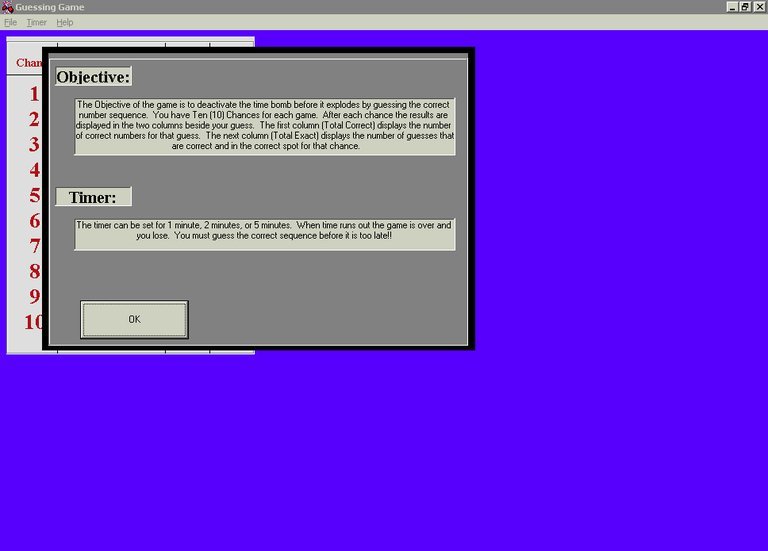
Time Bomb is a single-player puzzle game released in 1996 for Windows, where the player must deduce a four-digit sequence (using numbers 1-10) within ten guesses. The game is timed, offering three difficulty settings (one, two, or five minutes), and is entirely mouse-controlled. It is a freeware variant of the classic Mastermind game, challenging players to crack the code before time runs out.
Time Bomb Reviews & Reception
en.wikipedia.org : CRASH magazine’s review described Timebomb as fun, noting the skill required in using the tile scrolling feature in order to reach the bomb within the time limit.
Time Bomb: A Mastermind Variant Lost to Time
Introduction: The Forgotten Puzzle of 1996
In the vast, ever-expanding universe of video games, some titles fade into obscurity not because they were flawed, but because they were overshadowed by the relentless march of progress. Time Bomb (1996), a freeware Mastermind variant developed by Jeremy Dickson, is one such game—a modest yet intriguing puzzle experience that deserves rediscovery. At first glance, it appears simple: a digital adaptation of the classic code-breaking board game, where players must deduce a four-digit sequence within ten attempts. Yet, beneath its unassuming surface lies a fascinating snapshot of mid-90s puzzle design, a testament to the era’s experimental spirit, and a curious footnote in the history of digital board games.
This review aims to dissect Time Bomb in exhaustive detail, exploring its development context, gameplay mechanics, and the subtle ways it distinguishes itself from its analog predecessor. We’ll examine its place in the broader landscape of puzzle games, its reception (or lack thereof), and why it remains a compelling artifact for game historians and puzzle enthusiasts alike. By the end, you’ll understand why Time Bomb is more than just a digital curiosity—it’s a time capsule of an era when games were often made out of passion rather than profit.
Development History & Context: The Birth of a Digital Mastermind
The Studio and the Creator
Time Bomb was developed by Jeremy Dickson, a lone creator whose work on the game reflects the indie spirit of the mid-90s. Unlike the corporate-backed titles of the era, Time Bomb was a freeware project, distributed digitally and free of charge. This was a time when the internet was still in its infancy, and shareware/freeware games thrived as a means of creative expression and community engagement. Dickson’s decision to release Time Bomb as freeware aligns with the ethos of the era, where developers often created games as labors of love rather than commercial ventures.
Little is known about Dickson’s broader career or other projects, making Time Bomb a rare glimpse into the work of an obscure but talented developer. The game’s simplicity suggests it may have been a passion project or a technical exercise, but its polished execution indicates a clear understanding of puzzle design.
Technological Constraints and Design Choices
Released in 1996 for Windows, Time Bomb was constrained by the technological limitations of its time. The game is entirely mouse-controlled, a design choice that reflects the growing dominance of the mouse as the primary input device for PC games in the mid-90s. The shift from keyboard-only controls to mouse-driven interfaces was still relatively new, and Time Bomb embraces this change wholeheartedly, offering an intuitive point-and-click experience.
The game’s visual presentation is fixed/flip-screen, a common approach for puzzle games of the era. Unlike modern games with dynamic cameras or scrolling views, Time Bomb presents its challenge in a static, board-like interface, reinforcing its roots in traditional tabletop games. The real-time pacing adds a layer of tension, as players must deduce the correct sequence before the timer runs out.
One of the most notable design choices is the unconventional number range. While traditional Mastermind uses digits 0-9, Time Bomb expands this to 1-10, adding an extra layer of complexity. This subtle tweak forces players to adjust their strategies, making the game feel fresh even to those familiar with the original.
The Gaming Landscape of 1996
The mid-90s were a golden age for puzzle games, with titles like Tetris, Lemmings, and Myst dominating the genre. However, digital adaptations of classic board games were still relatively niche. Time Bomb entered this landscape as a Mastermind variant, a subgenre that included other digital adaptations like Mastermind (1980) and T.N.T. Bomb Bomb (1984). Unlike these earlier titles, Time Bomb was designed specifically for the Windows platform, leveraging the mouse-driven interfaces that were becoming standard.
The rise of freeware and shareware games in the 90s also played a crucial role in Time Bomb’s existence. Developers like Dickson could distribute their games freely, reaching audiences without the need for physical media or publisher backing. This democratization of game development allowed for experimentation, and Time Bomb is a prime example of how a simple idea could be refined into a polished, if overlooked, experience.
Narrative & Thematic Deep Dive: The Art of Deduction
The Premise: A Race Against Time
Time Bomb strips away any narrative frills, presenting players with a pure, unadulterated puzzle challenge. The premise is straightforward: defuse a virtual time bomb by guessing a four-digit sequence within ten attempts. The game’s title and theme evoke a sense of urgency, reinforced by the timer mechanic, which can be set to one, two, or five minutes. This time pressure transforms what could have been a leisurely logic puzzle into a tense, high-stakes challenge.
The absence of a traditional narrative or characters is not a flaw but a deliberate choice. Time Bomb is not about storytelling; it’s about pure gameplay mechanics and mental agility. The “time bomb” framing serves as a metaphor for the player’s own cognitive race against the clock, turning each guess into a life-or-death decision.
Themes: Logic, Pressure, and the Illusion of Consequence
While Time Bomb lacks overt storytelling, it subtly explores themes of pressure, deduction, and consequence. The ticking clock is more than just a gameplay mechanic—it’s a psychological tool that heightens the stakes. Every incorrect guess feels like a step closer to failure, and the limited number of attempts forces players to think critically about each move.
The game also plays with the illusion of consequence. Unlike narrative-driven games where failure might result in a character’s death or a story branch, Time Bomb’s “failure” is abstract. There’s no explosion, no game over screen with dramatic music—just a simple message indicating that the bomb has detonated. Yet, the tension remains palpable because the player’s own investment in solving the puzzle creates the stakes.
In this way, Time Bomb is a study in minimalist game design. It proves that a game doesn’t need elaborate storytelling or cutscenes to be engaging—just a well-crafted core mechanic and a sense of urgency.
Gameplay Mechanics & Systems: The Anatomy of a Puzzle
Core Gameplay Loop: The Mastermind Formula
At its heart, Time Bomb is a digital adaptation of Mastermind, the classic code-breaking board game. The objective is simple: guess a four-digit sequence within ten attempts. After each guess, the game provides feedback in the form of correct digits in the correct position (black pegs) and correct digits in the wrong position (white pegs). Using this feedback, players must deduce the correct sequence before running out of guesses or time.
The game’s real-time timer adds a layer of complexity not present in traditional Mastermind. Players must balance speed and accuracy, as hesitation can lead to a loss even if the solution is within reach. This mechanic transforms Time Bomb from a purely logical exercise into a test of mental agility under pressure.
Innovations and Flaws: The 1-10 Twist
One of Time Bomb’s most interesting deviations from traditional Mastermind is its number range. While most versions of Mastermind use digits 0-9, Time Bomb expands this to 1-10. This seemingly minor change has significant implications:
- Increased Complexity: With ten possible digits (1-10) instead of nine (0-9), the number of possible combinations rises, making the puzzle slightly more challenging.
- Psychological Impact: The inclusion of “10” as a digit forces players to think differently. In traditional Mastermind, players might subconsciously avoid “0” as a leading digit, but Time Bomb’s 1-10 range eliminates this bias, requiring a more systematic approach.
However, this innovation is not without its flaws. The lack of a “0” digit means that players cannot use traditional Mastermind strategies that rely on eliminating “0” as a possibility. This can be disorienting for veterans of the board game, though it also makes Time Bomb feel distinct.
UI and Controls: Mouse-Driven Simplicity
Time Bomb’s interface is minimalist and functional, reflecting its roots as a freeware puzzle game. The entire experience is controlled via mouse input, with players clicking to input their guesses and submit them. The feedback system is clear, with black and white pegs indicating correct and misplaced digits, respectively.
The game’s timer display is prominently featured, ensuring that players are always aware of the ticking clock. The attempt counter is equally visible, reinforcing the limited number of guesses. While the UI lacks the polish of modern games, it is effective and uncluttered, ensuring that the focus remains on the puzzle itself.
Difficulty and Replayability
Time Bomb offers three difficulty settings based on the timer:
– 1 Minute: A high-pressure challenge for experienced players.
– 2 Minutes: A balanced experience for most players.
– 5 Minutes: A more relaxed pace for beginners.
The game’s replayability is inherently limited by its nature as a puzzle. Once a player understands the logic behind Mastermind, the challenge diminishes. However, the randomized sequences and time pressure ensure that each playthrough feels distinct. The lack of additional game modes or variations means that Time Bomb is best enjoyed in short bursts rather than extended sessions.
World-Building, Art & Sound: The Aesthetics of Urgency
Visual Design: A Digital Board Game
Time Bomb’s visual presentation is functional rather than flashy. The game adopts a fixed/flip-screen perspective, presenting the puzzle as a static board. The digits and pegs are rendered in a clean, no-frills style, reminiscent of early Windows applications. There are no animations or elaborate graphics—just a straightforward representation of the Mastermind board.
This minimalist approach is not a limitation but a design philosophy. By stripping away unnecessary visuals, Time Bomb ensures that the player’s attention remains solely on the puzzle. The color-coded feedback system (black and white pegs) is intuitive, making it easy to track progress without distraction.
Sound Design: The Silence of Tension
Time Bomb’s sound design is equally minimalist. The game features no background music, relying instead on the ambient tension of the ticking timer. The absence of sound effects or musical cues is a deliberate choice, reinforcing the game’s focus on mental concentration.
The silence is, in itself, a form of sound design. It creates an atmosphere of isolated focus, where the only sounds are the player’s own thoughts and the occasional click of the mouse. This approach is reminiscent of early puzzle games like Minesweeper, where the lack of audio forces the player to engage deeply with the mechanics.
Atmosphere: The Illusion of Stakes
Despite its simple presentation, Time Bomb excels in creating an atmosphere of urgency. The timer, the limited attempts, and the abstract “bomb” premise combine to create a sense of high stakes, even though there are no real consequences for failure. This is a testament to the power of game design psychology—the game doesn’t need explosions or dramatic cutscenes to make the player feel invested.
The digital board game aesthetic also contributes to this atmosphere. By presenting the puzzle in a clean, clinical interface, Time Bomb evokes the feeling of a high-tech defusal scenario, where every second counts. The player is not just solving a puzzle—they’re saving the day, one digit at a time.
Reception & Legacy: The Forgotten Puzzle
Critical and Commercial Reception
Time Bomb’s reception is largely undocumented, a common fate for freeware titles of the era. The game was never reviewed by major publications, and its MobyGames entry lacks any critic or player reviews. This obscurity is not a reflection of the game’s quality but rather a symptom of its niche appeal and limited distribution.
Given its status as a freeware Mastermind variant, Time Bomb likely found an audience among puzzle enthusiasts and fans of logic games. However, without the marketing or distribution channels of commercial titles, it remained a hidden gem, known only to those who sought it out.
Evolution of the Mastermind Genre
While Time Bomb itself may have faded into obscurity, the Mastermind genre has endured in various forms. Digital adaptations like Mastermind (2016) and The Time Bomb Game (1977) have kept the core mechanics alive, while modern puzzle games like Keep Talking and Nobody Explodes (2015) have expanded on the bomb-defusal premise with cooperative multiplayer elements.
Time Bomb’s influence, if any, is subtle and indirect. It represents a transitional period in puzzle game design, where developers were experimenting with digital adaptations of classic board games. While it may not have inspired direct successors, it stands as a testament to the enduring appeal of deduction-based puzzles.
Preservation and Historical Significance
Today, Time Bomb is a relic of a bygone era, a snapshot of mid-90s puzzle design. Its preservation is crucial for game historians and puzzle enthusiasts, as it offers insight into the evolution of digital board games. The game’s minimalist design, mouse-driven controls, and time-pressure mechanics reflect the technological and cultural context of its time.
As freeware and shareware games continue to be archived and documented, Time Bomb serves as a reminder of the creative experimentation that defined the 90s indie scene. It may not be a masterpiece, but it is a valuable artifact—one that deserves to be remembered.
Conclusion: A Small Game with Big Ideas
Time Bomb is not a game that will redefine your understanding of video games. It is not a narrative masterpiece, a technical marvel, or a cultural phenomenon. What it is, however, is a perfectly executed puzzle experience—one that takes a classic mechanic and refines it with subtle innovations and psychological tension.
In an era dominated by graphically intensive RPGs, action-packed shooters, and sprawling adventures, Time Bomb stands out for its simplicity and focus. It is a game that respects the player’s intelligence, challenging them to think critically under pressure without relying on gimmicks or distractions.
Its legacy may be obscure, but its design philosophy is timeless. Time Bomb proves that a game doesn’t need elaborate storytelling, cutting-edge graphics, or complex mechanics to be engaging—just a well-crafted core idea and a commitment to pure gameplay.
For puzzle enthusiasts, Time Bomb is a hidden treasure—a game that rewards logic, patience, and quick thinking. For game historians, it is a fascinating artifact—a glimpse into the indie puzzle scene of the mid-90s. And for anyone who appreciates minimalist game design, it is a masterclass in how less can be more.
Final Verdict: 7.5/10 – A brilliant but overlooked puzzle gem that deserves rediscovery.
Time Bomb may not have exploded onto the scene, but it remains a ticking time capsule of an era when games were made for the love of the craft. And in that, it is timeless.