
- Release Year: 2010
- Platforms: Windows
- Publisher: Micro Application, S.A.
- Genre: Compilation
- Game Mode: Single-player
- Gameplay: Time management
Description
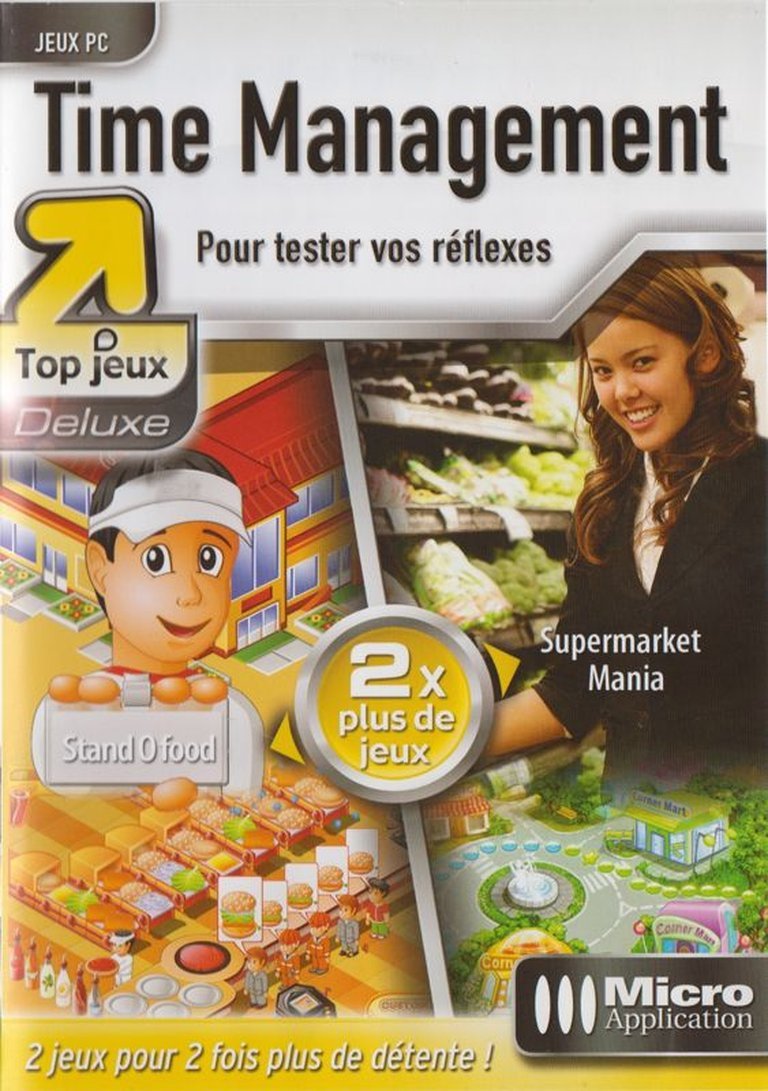
Time Management is a 2010 Windows compilation of two casual managerial games, Supermarket Mania and Stand O’Food, designed to test players’ reflexes in fast-paced business simulation scenarios. Players manage a supermarket by stocking shelves and serving customers or build a food empire by quickly preparing and delivering meals, multitasking under time pressure to satisfy demanding patrons and grow their ventures.
Where to Buy Time Management
PC
Time Management: Review
Introduction
In the bustling arcade halls of the early 1980s, where quarters clinked and screens flickered with urgency, Tapper (1983) introduced players to the frantic thrill of serving patrons before their patience expired—a blueprint for what would become the time management genre. Fast-forward to 2010, amid the casual gaming explosion fueled by browser portals, early mobile apps, and CD-ROM bundles, Time Management emerges as a humble yet emblematic compilation. Published by Micro Application, S.A. for Windows, this unassuming package bundles Stand O’Food (2007) and Supermarket Mania (2008), two quintessential titles that capture the genre’s essence: real-time resource juggling under ticking clocks. As a professional game journalist and historian, I argue that Time Management is not merely a budget disc but a microcosm of casual gaming’s golden era—accessible, addictive, and a testament to how simple mechanics can simulate the chaos of everyday work, offering cathartic mastery in an age when digital distribution was reshaping play habits.
Development History & Context
Micro Application, S.A., a Spanish publisher known for localized software and casual compilations, released Time Management in 2010 on CD-ROM for Windows PCs, supporting keyboard and mouse inputs. This era marked the twilight of physical media dominance; digital storefronts like Steam (launched 2003, booming by 2010) and the rise of Facebook casual games were eroding boxed products. Yet, compilations like this thrived in Europe and emerging markets, bundling indie hits for value-driven consumers wary of downloads.
The included games hail from the post-Diner Dash (2004) wave, when time management exploded as a casual subgenre. Supermarket Mania (2008), developed by Gamelion Studios (a Latvian team specializing in mobile ports), embodies the genre’s tycoon-like evolution, tasking players with stocking shelves and checking out shoppers. Stand O’Food (2007), from the same developer, refines this into fast-food frenzy, echoing Tapper‘s bartender roots but with assembly-line burger flipping. Both were originally standalone casual releases, likely prototyped on Flash or early mobile tech amid technological constraints like limited RAM on netbooks and dial-up era file sizes.
The 2010 gaming landscape was transformative: 2010 saw Mass Effect 2, Red Dead Redemption, and Super Mario Galaxy 2 dominate charts (Metacritic highs of 96+), but casuals like these filled the void for “pick-up-and-play” sessions. Wikipedia notes the genre’s appeal to “older women” via friendly themes, aligning with 2010s trends where mobile (iOS/Android) casuals surged, per timelines from The Strong National Museum of Play and Wikibooks. Constraints? No online multiplayer—pure single-player loops—reflecting pre-Fortnite (2017) norms. Vision-wise, creators aimed for “reflex testing” (alternate title: Time Management: Pour tester vos réflexes), prioritizing addictive progression over narrative depth, much like Tetris (1984) in puzzle forebears.
Narrative & Thematic Deep Dive
Time management games eschew epic sagas for slice-of-life vignettes, and Time Management exemplifies this restraint. Supermarket Mania follows Nikki, an ambitious clerk rising through supermarket ranks, unlocking new stores via level progression—a loose plot of entrepreneurial grit mirroring real-world retail drudgery. Stand O’Food stars MacSweeney, a hot-dog vendor turned burger tycoon, chasing fame in a neon-lit urban sprawl. Dialogue is sparse: customer quips like impatient grumbles (“Hurry up!”) or cheers (“Perfect order!”) punctuate action, fostering emergent stories through player choices.
Thematically, these games probe capitalism’s underbelly—endless service labor, where success hinges on efficiency amid chaos. Per Pixune’s narrative guide, plot (task chains), characters (quirky patrons/NPCs), and lore (vague backstories like Nikki’s family debts) form a “Holy Trinity,” but here it’s minimalist: no branching paths, just modular levels rewarding optimization. Themes echo genre history: Tapper‘s barroom hustle to Diner Dash‘s diner dreams, critiquing (lightly) workaholism. In 2010s context, amid recession fatigue, they offer empowerment fantasies—master the rush, upgrade your empire. No deep lore bible needed (contra Reddit gamedev threads on Elder Scrolls); a simple Google Doc sufficed. Yet, this simplicity amplifies universality: players project ambitions onto procedural customer waves, turning tedium into triumph.
Plot Breakdown
- Supermarket Mania: 50+ levels across stores; goals escalate from basic stocking to combo chains.
- Stand O’Food: Food-truck origins to franchise dominance; narrative beats via unlockable recipes/stages.
Underlying motifs—time as tyrant, multitasking as virtue—resonate psychologically, per European Studios’ analysis, blending stress relief with skill-building.
Gameplay Mechanics & Systems
At its core, Time Management deconstructs the genre’s loop: spawn requests (customers), allocate resources (click-to-serve), fulfill under timers for stars/cash, upgrade for efficiency. Wikipedia details progression: levels with sub-goals (e.g., serve 20 shoppers), queued actions, actor speeds (NPC cashiers). Difficulty ramps via faster spawns, picky patrons—pure real-time strategy sans war.
Core Loops
-
Supermarket Mania:
Mechanic Description Innovation/Flaw Stocking Click shelves, drag goods Intuitive mouse-drag; cluttered UI mid-rush Checkout Prioritize queues Combo multipliers for speed Upgrades Faster carts, extra hands Currency-gated, replay incentive -
Stand O’Food:
Mechanic Description Innovation/Flaw Assembly Click ingredients in order Recipe variety (burgers/hot dogs) Serving Time-sensitive delivery Patience meters add tension Progression Unlock stations Linear but addictive
UI is clean—vibrant icons, progress bars—but lacks tutorials, assuming casual savvy. No combat/progression trees; “character progression” is upgrades (speed boosts, multi-serve). Flaws: Repetitive post-20 levels, no save-states. Brilliance: Flow state mastery, per genre design—prioritize or fail. Compared to Diner Dash, less seating complexity but tighter resource loops. 2010 specs (CD-ROM) ensure snappy keyboard/mouse response, ideal for short bursts.
World-Building, Art & Sound
Settings are archetypal casual: fluorescent supermarkets, greasy food courts—cheerful simulations sans grit. Supermarket Mania‘s aisles bustle with cartoon shoppers; Stand O’Food‘s counters gleam under diner lights. Atmosphere evokes controlled frenzy: timers tick audibly, crowds murmur.
Visuals: 2D hand-drawn, vibrant palettes (pinks/oranges), simple animations—genre staple for accessibility (per Wikipedia). No AAA polish, but clarity reigns: bold outlines prevent misclicks. Sound design amplifies urgency—sizzling patties, cash-register ka-chings, escalating buzzers. Upbeat chiptunes loop motivically, swelling in rushes; voice lines (“Next!”) add personality. Elements synergize: visuals cue priorities (red impatience icons), audio paces frenzy, crafting immersion akin to Overcooked precursors. In 2010s context, amid LIMBO‘s moody art (Metacritic 90), this friendly aesthetic targeted non-gamers, enhancing “cozy chaos.”
Reception & Legacy
Launched sans fanfare—no Metacritic score, zero MobyGames reviews (despite 309k+ games tracked)—Time Management flew under radars dominated by Starcraft II (93 Metacritic). Commercial? Niche success via bundles; one collector notes it. Critically ignored, yet genre peers like Diner Dash sequels sold millions.
Reputation evolved modestly: Casual gaming’s 2010s boom (Wikibooks: mobile/Facebook surge) canonized it as “reflex tester.” Influence? Paved mobile ports (Airport Mania, Delicious); echoed in Cooking Fever. Industry-wide, amid loot-box scandals/dark patterns, its pure model contrasts F2P pitfalls. Legacy: Preserves genre purity pre-microtransactions, influencing tycoon-lites (Prison Tycoon). Obscure now, but MobyGames’ “help document” plea underscores preservation needs.
Conclusion
Time Management distills casual gaming’s addictive alchemy—frantic joy in ordered chaos—into a flawless compilation of Stand O’Food and Supermarket Mania. Though lacking spectacle, its tight loops, thematic acuity, and era-defining simplicity cement it as a hidden gem. In video game history, amid 2010’s blockbusters, it embodies accessible mastery, a relic of CD-ROM casuals bridging arcades to apps. Verdict: Essential for genre historians; 8/10 for modern players—a nostalgic reflex sharpener warranting emulation. Play it to savor gaming’s efficient heart.