
- Release Year: 1982
- Platforms: Arcade, Atari 2600, ColecoVision, MSX, Nintendo Switch, PlayStation 4, Windows, Xbox 360
- Publisher: Atari, Inc. (England), Centuri, Inc., Coleco Industries, Inc., Hamster Corporation, Konami, Inc., Konami Industry Co. Ltd., Microsoft Corporation, Stambouli Frères S.A.
- Developer: Konami Industry Co. Ltd.
- Genre: Action, Shooter
- Perspective: Side view
- Game Mode: Co-op, Single-player
- Gameplay: Arcade, Aviation, Flight, Shooter
- Setting: Futuristic, Sci-fi
- Average Score: 73/100
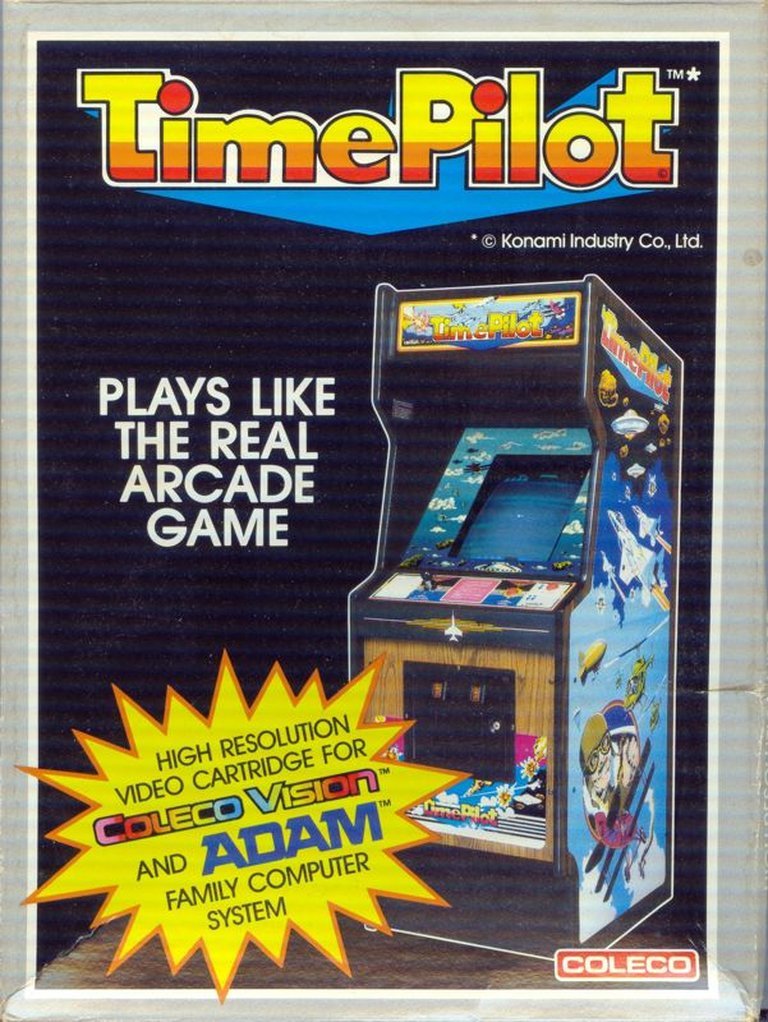
Description
Time Pilot is an arcade-style shooter where players pilot a spaceship through various time periods, starting in 1910 and advancing into the future. The goal is to destroy enemy squadrons, including biplanes, jets, helicopters, and flying saucers, with each level introducing tougher foes. After meeting a quota of enemies, players face a boss before progressing to the next era. The game features bonus points for collecting parachutes and a unique time-traveling premise that evolves the challenges with each completed level.
Gameplay Videos
Time Pilot Free Download
Atari 2600
Time Pilot Guides & Walkthroughs
Time Pilot Reviews & Reception
metacritic.com (63/100): A triumphant return to form for the series.
denofgeek.com : Of all of the most implausible video games ever made, Time Pilot is close to, if not on the top, of the list.
mobygames.com (66/100): One very hectic but fun game. What makes it addictive? You want to see and beat the next of 5 levels, eventually
gamesreviews2010.com (90/100): Time Pilot is a timeless arcade classic that remains enjoyable today.
Time Pilot: A Timeless Voyage Through Gaming History
Introduction
In the annals of arcade gaming, few titles have left as indelible a mark as Time Pilot. Released in 1982 by Konami, this multidirectional shooter transcended the limitations of its era, blending innovative gameplay mechanics with a captivating time-travel narrative. Time Pilot wasn’t just another shooter; it was a bold experiment in player agency, offering a sense of freedom and progression that set it apart from its contemporaries. This review delves deep into the game’s development, mechanics, cultural impact, and enduring legacy, exploring why it remains a beloved classic over four decades later.
Development History & Context
The Birth of a Classic
Time Pilot emerged from the creative mind of Yoshiki Okamoto, a designer who would later become one of the most influential figures in the gaming industry. Okamoto’s vision was initially met with resistance. According to multiple sources, including Wikipedia and Arcade History, Okamoto’s proposal for Time Pilot was rejected by his boss at Konami, who instead assigned him to work on a driving game. Undeterred, Okamoto secretly instructed his programmer to develop Time Pilot while he pretended to work on the driving game. This act of creative rebellion paid off when the game’s prototype was well-received in location tests, leading to its official greenlight.
The game’s development coincided with a golden age of arcade gaming. The early 1980s saw the rise of iconic titles like Pac-Man, Galaga, and Donkey Kong, each pushing the boundaries of what arcade games could achieve. Time Pilot entered this competitive landscape with a unique selling point: time travel. Unlike other shooters that confined players to a single setting, Time Pilot allowed players to traverse five distinct historical eras, each with its own enemies, challenges, and aesthetic.
Technological Constraints and Innovations
The arcade hardware of 1982 was limited by today’s standards, but Time Pilot made the most of its technical capabilities. The game ran on a Zilog Z80 CPU, a common choice for arcade games of the era, paired with dual AY-3-8910 sound chips to deliver its audio. The visuals, while simple by modern standards, were vibrant and functional, with colorful sprites and smooth scrolling that created a sense of dynamic movement.
One of the game’s most innovative features was its control scheme. Unlike traditional shooters that used a fixed-direction joystick, Time Pilot employed an eight-way rotating joystick. This allowed the player’s jet to face any direction, with the screen scrolling to match the jet’s orientation. This mechanic gave players unprecedented control over their movement, enabling them to dodge enemy fire and engage in aerial dogfights with precision. The controls were initially disorienting for some players, as noted in reviews from MobyGames and Den of Geek, but once mastered, they provided a level of maneuverability that was revolutionary for the time.
The Gaming Landscape of 1982
The early 1980s were a period of rapid evolution in the arcade scene. Games were transitioning from simple, single-screen experiences to more complex, multi-level adventures. Time Pilot fit squarely into this trend, offering a progression system that rewarded players for advancing through its time periods. The game’s release in November 1982 (Japan) and January 1983 (worldwide) placed it alongside other groundbreaking titles like Pole Position and Mr. Do!, each vying for players’ quarters in arcades around the world.
Konami’s decision to distribute Time Pilot through Centuri in North America and Atari in PAL regions ensured widespread availability. The game’s success was immediate, topping the Play Meter arcade earnings chart in February 1983 and becoming one of the highest-grossing arcade games of the year. Its appeal lay in its accessibility—easy to pick up but difficult to master—and its novel time-travel concept, which captured the imagination of players.
Narrative & Thematic Deep Dive
The Premise: A Pilot’s Journey Through Time
Time Pilot presents a deceptively simple premise: the player assumes the role of a futuristic fighter pilot tasked with rescuing fellow pilots trapped in different time eras. The narrative is minimal, with no cutscenes or dialogue, but the game’s structure tells a story of progression and escalation. Each level represents a distinct historical period, beginning in 1910 with biplanes and culminating in 2001 with UFOs. The player’s mission is to destroy enemy aircraft, defeat the mothership boss of each era, and rescue parachuting pilots for bonus points.
The game’s time-travel theme is more than just a gimmick; it serves as a framework for its difficulty curve. As players advance through the eras, the enemies become more technologically advanced and aggressive. The 1910 level features slow-moving biplanes that drop bombs, while the 2001 level pits players against fast-moving UFOs with rapid-fire lasers. This progression mirrors the evolution of aerial combat, creating a sense of historical narrative that unfolds as the player progresses.
Themes of Progress and Survival
At its core, Time Pilot is a game about survival and adaptation. The player’s jet, a futuristic craft, must contend with the limitations and challenges of each era. The game’s structure reinforces this theme: players must destroy a set number of enemies to summon the mothership, which requires seven direct hits to defeat. Once the mothership is destroyed, the player advances to the next era, where the cycle repeats with increased difficulty.
The parachuting pilots add a layer of urgency to the gameplay. These stranded allies must be rescued before they fall off-screen, rewarding players with bonus points. This mechanic introduces a moral dimension to the game, as players are not just destroying enemies but also saving lives. The absence of parachutists in the 2001 level—where the battle takes place in space—highlights the game’s attention to detail and internal consistency.
The Absurdity and Charm of Time Travel
While Time Pilot takes its time-travel premise seriously within the context of its gameplay, the concept is undeniably absurd when examined critically. As humorously dissected in Den of Geek’s article, the game’s narrative raises numerous logical inconsistencies. For instance, a futuristic jet engaging in dogfights with WWI biplanes stretches the suspension of disbelief, as does the idea of rescuing pilots from eras they shouldn’t logically inhabit.
However, these absurdities are part of the game’s charm. Time Pilot doesn’t aim for realism; it embraces the fantastical, creating a world where time travel is a gameplay mechanic rather than a narrative constraint. The game’s lighthearted approach to its premise allows players to focus on the action, making it an accessible and enjoyable experience.
Gameplay Mechanics & Systems
Core Gameplay Loop
Time Pilot‘s gameplay is built around a straightforward but addictive loop: destroy enemies, summon the mothership, defeat it, and advance to the next era. The player’s jet is always centered on the screen, with the background scrolling in the direction of movement. This design choice ensures that the player remains the focal point of the action, with enemies approaching from all sides.
The game’s controls are its most defining feature. The eight-way joystick allows the player’s jet to rotate freely, with the screen scrolling to match the jet’s orientation. This mechanic enables precise movement and targeting, allowing players to dodge enemy fire and engage in aerial combat with agility. The single fire button is used for both shooting and, in some versions, activating special maneuvers like loops.
Enemy Variety and Boss Battles
Each of Time Pilot‘s five eras features distinct enemy types, each with unique behaviors and attack patterns:
- 1910 (Biplanes): Slow-moving biplanes that drop bombs and fire slow bullets. The mothership is a blimp that requires seven hits to destroy.
- 1940 (Monoplanes): Faster WWII-era fighters that fire bullets and occasionally drop bombs. The mothership is a B-25 bomber.
- 1970 (Helicopters): Highly maneuverable helicopters that fire homing missiles and bullets. The mothership is a CH-46 Sea Knight.
- 1982/1983 (Jet Planes): Aggressive jets that fire homing missiles and bullets. The mothership is a B-52 bomber.
- 2001 (UFOs): Fast-moving UFOs that fire rapid lasers. The mothership is a large alien spacecraft.
The progression in enemy difficulty is well-paced, with each era introducing new challenges. The homing missiles in the 1970 and 1982 levels add a layer of tension, requiring players to constantly evade while maintaining offensive pressure. The 2001 level, set in space, removes the parachutists and introduces UFOs that blend into the starry background, increasing the difficulty.
Scoring and Progression
Time Pilot employs a scoring system that rewards both skill and strategy. Players earn points for destroying enemies, with bonuses awarded for defeating entire squadrons and rescuing parachutists. The mothership yields a substantial 3,000 points, while the rare supply planes in the 1940 level offer 1,500 points each.
Extra lives are awarded at 10,000 points and every 50,000 points thereafter, up to 960,000 points. Beyond this threshold, the game enters “survival of the fittest” mode, where no additional lives are granted. This mechanic encourages players to balance aggression with caution, as reckless play can quickly deplete their limited stock of lives.
Multiplayer and Competitive Play
Time Pilot supports two-player alternating play, allowing friends to compete for high scores. The game’s competitive mode is straightforward, with players taking turns to achieve the highest score. While the Xbox 360 version introduced a cooperative mode, it was criticized for its lack of interaction between players, as noted in reviews from GameSpot and Netjak.
The game’s leaderboard system, particularly in its arcade and Xbox 360 iterations, added a layer of replayability. Players could compete not only against their friends but also against a global community, striving to achieve the highest possible score.
Flaws and Limitations
Despite its innovations, Time Pilot is not without its flaws. The game’s difficulty curve can be punishing, particularly in the later levels, where enemy fire becomes overwhelming. The lack of an auto-fire option, as noted in GotNext’s review, can lead to hand fatigue during extended play sessions.
The home ports of Time Pilot, particularly the Atari 2600 and ColecoVision versions, suffered from technical limitations. The Atari 2600 version, for example, featured choppy scrolling and simplified graphics, leading to mixed reviews. The ColecoVision port fared better but still fell short of the arcade experience, as highlighted in reviews from The Video Game Critic.
World-Building, Art & Sound
Visual Design and Atmosphere
Time Pilot‘s visual design is a product of its time, featuring colorful, pixelated sprites and simple backgrounds. The game’s art direction is functional rather than elaborate, with each era distinguished by its enemy designs and color palette. The 1910 level, for instance, features brown and tan biplanes against a blue sky, while the 2001 level contrasts neon UFOs with a black, star-filled void.
The game’s scrolling mechanic is one of its most impressive visual achievements. The background moves in the opposite direction to the player’s jet, creating a sense of motion and immersion. This technique, while commonplace today, was innovative in 1982, helping to distinguish Time Pilot from other shooters of the era.
Sound Design and Music
The audio in Time Pilot is minimal but effective. The game’s sound effects—explosions, gunfire, and the hum of the player’s jet—are functional, providing feedback for the player’s actions. The mothership’s appearance is signaled by a distinctive engine sound, serving as a boss warning siren.
The game’s music is similarly understated, consisting of a simple, repetitive tune that plays during gameplay. While not as memorable as the soundtracks of contemporaries like Pac-Man or Galaga, the music in Time Pilot serves its purpose, adding to the game’s arcade atmosphere without distracting from the action.
The Arcade Experience
Time Pilot was designed with the arcade environment in mind. Its bright, colorful visuals and straightforward gameplay made it an attractive choice for arcade operators. The game’s cabinet, available in both upright and cocktail versions, featured eye-catching artwork that depicted the player’s jet engaging in aerial combat across different eras.
The arcade experience was further enhanced by the game’s competitive nature. Players could challenge their friends to beat their high scores, creating a social dynamic that extended beyond the screen. The game’s leaderboards, whether physical or digital, added a layer of prestige, encouraging players to return and improve their skills.
Reception & Legacy
Critical and Commercial Success
Time Pilot was a critical and commercial success upon its release. In Japan, it ranked as the fifth highest-grossing arcade game of 1982, according to Game Machine magazine. In the United States, it topped the Play Meter arcade earnings chart in February 1983 and was later listed among the highest-earning arcade games of the year by the Amusement & Music Operators Association (AMOA).
Reviews of the arcade version were generally positive. Computer and Video Games magazine praised its exciting gameplay and solid sound effects, while All Game Guide highlighted its innovative controls and time-travel concept. The game’s reception was bolstered by its inclusion in 1001 Video Games You Must Play Before You Die, cementing its status as a classic.
Home Ports and Re-Releases
Time Pilot was ported to several home platforms in 1983, including the Atari 2600, ColecoVision, and MSX. These ports varied in quality, with the ColecoVision version receiving the most favorable reviews. The Atari 2600 port, while playable, suffered from technical limitations, including choppy scrolling and simplified graphics.
The game has been re-released numerous times over the years, appearing in compilations like Konami Arcade Classics (PlayStation, 1999) and Konami Collector’s Series: Arcade Advanced (Game Boy Advance, 2002). The Xbox 360 version, released in 2006 as part of Xbox Live Arcade, introduced enhanced graphics and sound, as well as online leaderboards. While these updates were well-received, some critics, such as Eurogamer, argued that the game’s simplicity didn’t translate well to modern platforms.
Influence on the Genre
Time Pilot had a significant influence on the shooter genre, particularly in its use of time travel as a gameplay mechanic. The game’s multidirectional scrolling and rotating controls inspired later titles, including Gradius and R-Type, which built upon its foundation to create more complex shooting experiences.
The game’s boss battles were also groundbreaking. Time Pilot was one of the first arcade games to feature a boss at the end of every level, a concept that would become a staple of the genre. The mothership battles, requiring multiple hits to defeat, added a strategic element to the gameplay, rewarding players for precision and persistence.
Cultural Impact and Nostalgia
Time Pilot holds a special place in the hearts of retro gaming enthusiasts. Its time-travel premise and innovative gameplay have made it a beloved classic, often cited alongside other arcade greats like Galaga and Defender. The game’s inclusion in various “best of” lists and compilations has ensured its continued relevance, introducing new generations of players to its unique brand of action.
The game’s legacy is also tied to its creator, Yoshiki Okamoto. After leaving Konami, Okamoto went on to design other iconic titles, including Gyruss, 1942, and Street Fighter II. His work on Time Pilot marked the beginning of a storied career, and the game remains a testament to his creative vision.
Conclusion
Time Pilot is more than just a relic of the arcade era; it is a testament to the power of innovation and creativity in game design. Its time-travel premise, multidirectional scrolling, and rotating controls set it apart from its contemporaries, creating an experience that was both accessible and challenging. While its graphics and sound may seem primitive by modern standards, the game’s core mechanics remain engaging, offering a glimpse into the evolution of the shooter genre.
The game’s legacy is undeniable. It influenced countless titles that followed, from Gradius to R-Type, and its inclusion in compilations and re-releases has ensured its continued relevance. For retro gaming enthusiasts, Time Pilot is a must-play, a reminder of a time when arcade games were simple yet profound, offering endless hours of entertainment for the price of a quarter.
In the pantheon of classic arcade games, Time Pilot stands as a shining example of what the medium could achieve. It is a game that transcends its technical limitations, offering a timeless experience that continues to captivate players over four decades later. Whether you’re a seasoned veteran of the arcade scene or a newcomer to retro gaming, Time Pilot is a journey worth taking.