
- Release Year: 2007
- Platforms: PlayStation 3, Windows, Xbox 360, Xbox One
- Publisher: Activision Publishing, Inc., Sierra Entertainment, Inc.
- Developer: Saber Interactive Russia
- Genre: Action
- Perspective: 1st-person
- Game Mode: LAN, Online PVP, Single-player
- Gameplay: Puzzle, Shooter, Time manipulation
- Setting: Futuristic, Sci-fi, Steampunk
- Adult Content: Yes
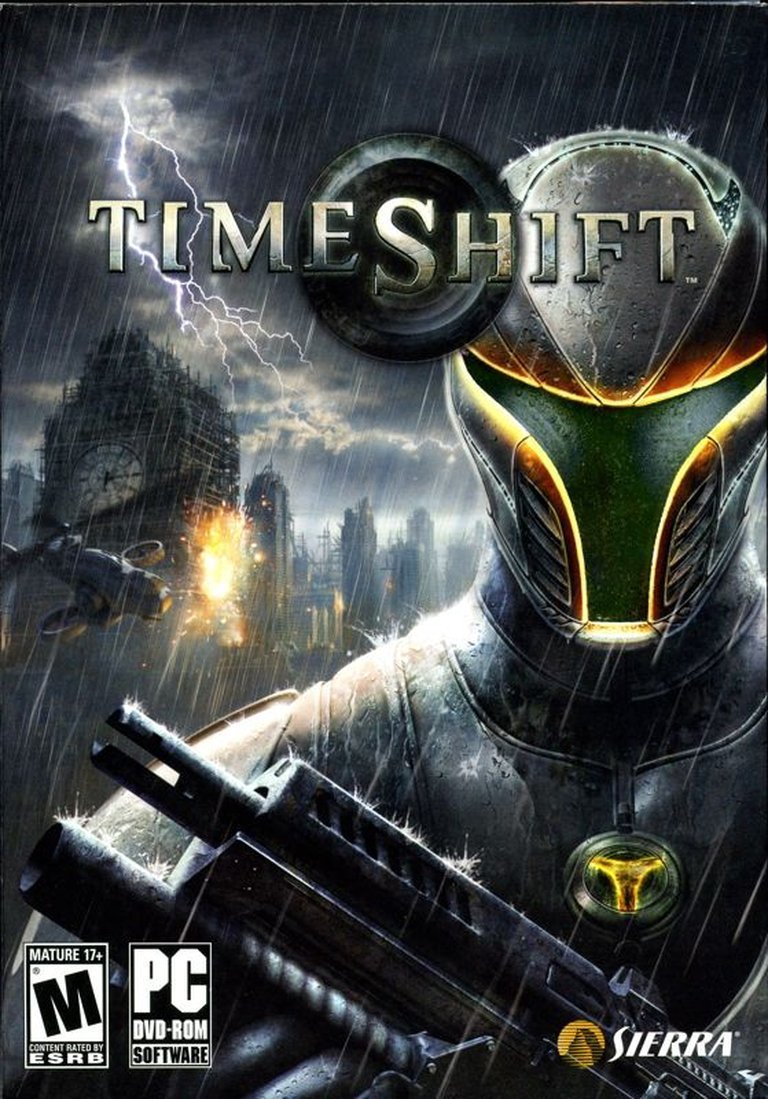
Description
In the near future, scientists develop a Quantum suit for time travel, but rogue scientist Aiden Krone steals the Alpha suit and destroys the lab, plunging the world into a dystopian future under his totalitarian rule. Players assume the role of a scientist who activates the damaged Beta suit, traveling to this alternate timeline where they must join rebels to stop Krone and restore the original timeline using the suit’s time-manipulation abilities to slow, rewind, or accelerate time while battling futuristic enemies and solving temporal puzzles.
Gameplay Videos
Where to Buy TimeShift
TimeShift Free Download
TimeShift Cracks & Fixes
TimeShift Patches & Updates
TimeShift Mods
TimeShift Guides & Walkthroughs
TimeShift Reviews & Reception
ign.com : TimeShift is a nice example of what developers can do with a game if given the proper amount of time to build on a game and improve its foundation.
TimeShift Cheats & Codes
PC
| Code | Effect |
|---|---|
| RXYMCPENCJ | Unlock Dr. Aiden Krone skin in Multiplayer mode |
Xbox 360
| Code | Effect |
|---|---|
| X, Y, Y, B, A, LB, R | Level Select at pause menu |
| X, B, B, Y, A, R, LB, Y | Level Select at pause menu |
| RXYMCPENCJ | Unlock Dr. Aiden Krone for use in multiplayer |
TimeShift: Review
1. Introduction
In the crowded pantheon of first-person shooters, few games have arrived with as much baggage or as singular a hook as TimeShift. Its premise—wielding a suit that can manipulate time itself—promised a revolutionary leap forward for the genre, yet its journey to store shelves was a labyrinth of developmental purgatory, corporate upheaval, and last-minute overhauls. From its initial 2005 debut to its 2007 release, TimeShift became a cautionary tale of ambition versus market realities, emerging not as a landmark title but as a fascinating, flawed anomaly. This review will dissect TimeShift through the lens of its tumultuous history, its gameplay innovations, its narrative ambitions, and its enduring legacy. Ultimately, while it never achieved the greatness its concept implied, TimeShift stands as a bold, misunderstood experiment—a testament to the creative potential and perilous pitfalls of game development in the mid-2000s.
2. Development History & Context
Saber Interactive, a then-fledgling Russian studio, first unveiled TimeShift in 2005 as a PC and original Xbox project. Led by designer Matthew Karch, the team’s vision was audacious: a shooter where time manipulation wasn’t a bullet-time gimmick but a core, physics-defying mechanic. Announced by Atari for a 2005 release, the game’s early builds showcased promise, with a steampunk aesthetic and a protagonist named Michael Swift. However, Atari’s financial woes forced a publisher switch to Sierra Entertainment in 2006, triggering a cascade of delays and radical redesigns.
By 2007, under Vivendi’s stewardship, TimeShift underwent a near-total overhaul. The steampunk art style was scrapped for a grittier, dystopian aesthetic; the protagonist was anonymized to “the Suiter” to enhance player immersion; and the entire codebase was rebuilt on Saber’s proprietary Saber3D Engine to support next-gen consoles (Xbox 360 and PlayStation 3). This pivot, though necessary for survival, came at a cost: three years of work were discarded, and the team endured a year of “crunch” to meet a November 2007 launch window. The result was a game caught between eras—technologically advanced for its time, yet arriving in a market saturated with titans like Halo 3, The Orange Box, and Call of Duty 4. Its release was overshadowed, but its journey—from budget title to AAA aspirant—remains a compelling narrative of industry pressures and creative resilience.
3. Narrative & Thematic Deep Dive
Saber Interactive’s narrative ambitions, while noble, ultimately faltered in execution. The plot revolves around Dr. Aiden Krone, a rogue physicist who steals the Alpha Suit, travels to 1939, and establishes a fascist dystopia called the Krone Magistrate. The player, as the Beta Suiter, follows him into this alternate timeline, allying with the Occupant Rebellion to dismantle Krone’s regime. Flashbacks reveal the protagonist’s hidden motives: seducing colleague Dr. Marissa Foster to access the suit and monitoring Krone as a pre-emptive strike against his treachery.
Thematically, TimeShift explores determinism versus free will. The player’s ability to alter time poses a paradox: can history be rewritten, or are events merely looping? Krone’s tyranny—complete with propaganda posters, surveillance drones, and totalitarian architecture—serves as a blunt allegory for authoritarianism, echoing themes from Half-Life 2 but lacking its nuance. Yet the narrative is undermined by poor pacing and underdeveloped characters. Commander Cooke, the resistance leader, devolves into a repetitive nag (“Get a move on, soldier!”), while Krone, voiced by Michael Ironside, is a one-note villain. The ending, which hints at a temporal paradox by transporting the player away after saving Foster, feels abrupt and unsatisfying. Ultimately, the story exists primarily as a framework for gameplay, failing to explore the philosophical weight of time manipulation beyond surface-level sci-fi tropes.
4. Gameplay Mechanics & Systems
Saber Interactive’s greatest triumph lies in TimeShift’s core mechanics. The Beta Suit grants three time-manipulation powers—Slow Time, Stop Time, and Reverse Time—each draining an energy meter that regenerates dynamically. These abilities are seamlessly integrated into combat and puzzles, offering unprecedented tactical freedom. Slow Time allows players to dodge bullets or flank enemies; Stop Time turns grenades into stationary targets; Reverse Time resurrects destroyed bridges or rewinds fatal mistakes. Unlike Prince of Persia: Sands of Time, the player remains active during these effects, creating a unique “fourth dimension” of strategy.
Combat is a masterclass in controlled chaos. Weapons like the rapid-fire Assault Shotgun and explosive Crossbow are satisfying, while environmental traps (flames, electricity) demand time-based solutions. Health is managed via a regenerating shield system, eliminating medkits but creating repetitive “hide-and-heal” loops. The UI is clean, though its omission of a health display was a contentious design choice. Multiplayer introduced innovative modes like King of Time (holding a time-immune sphere for kills) and Meltdown Madness (destroying enemy Chrono Grenade launchers). Yet these modes suffered from population issues, and the suite’s AI was inconsistent—sometimes brilliant, often suicidally aggressive. While the time powers never fully evolve beyond puzzle-solving tools, their polish and fluidity remain TimeShift’s enduring legacy.
5. World-Building, Art & Sound
TimeShift’s world-building is a blend of retro-futurism and dystopian decay. The alternate 1939 merges art deco machinery (gears, brass fittings) with Krone’s oppressive futurism—think towering propaganda screens, zeppelin factories, and monolithic Sentinels. The art direction, post-overhaul, favors muted browns and industrial grime, punctuated by the suit’s time-distorting effects: a blueshift for Slow Time, a yellow haze for Reverse, and a stark white filter for Stop. These visual cues are intuitive, immersing players in the physics of time.
Sound design is equally effective. Weapon impacts are visceral, and Michael Ironside’s gravelly menace as Krone anchors the villain. However, repetitive commander dialogue and sparse environmental audio mar immersion. The score, by Rebecca Kneubuhl and Gabriel Mann, is atmospheric but forgettable. Yet TimeShift’s greatest technical feat is its physics integration. Havok-powered destruction means shattered pillars and debris behave realistically during time reversals, while rain droplets “fall” upward during rewinds—a small detail that underscores the game’s meticulous attention to its core concept. Despite its flaws, TimeShift crafts a cohesive, oppressive world where time itself is both weapon and wonder.
6. Reception & Legacy
Upon release, TimeShift received mixed-to-average reviews. Critics lauded its time mechanics and technical polish but lamented its derivative story and linear design. GameSpot noted, “It’s not a bad game, but it’s also not a great one,” while Eurogamer criticized its “adequate but unremarkable” execution. Commercially, it was drowned out by AAA juggernauts, becoming a “sleeper hit” only after discounts and word-of-mouth spread.
Over time, TimeShift’s reputation has paradoxically improved. Its influence is evident in later games like SUPERHOT and Quantum Break, which expanded on time-manipulation mechanics. The modding community keeps its multiplayer modes alive, and its cult status endures on platforms like Steam. Saber Interactive’s subsequent work (World War Z, Hunter’s Arena) never revisited time control, but TimeShift remains a bold “what if”—a game that dared to redefine shooter combat even if it failed to redefine the genre. As The Escapist observed, it was “tough love” from publishers that forged a flawed gem, one whose ambition outshone its execution but whose core innovation still resonates.
7. Conclusion
TimeShift is a game of contradictions: a product of four years of development that feels rushed; a title with revolutionary mechanics constrained by traditional FPS design; a dystopian narrative that fails to explore its own themes. Yet its achievements are undeniable. The time manipulation system remains one of the most fluid, satisfying, and mechanically sound implementations in gaming history, offering a glimpse into a future where time itself is a playground. Its art direction, physics integration, and multiplayer innovations stand as testaments to Saber Interactive’s talent.
In the end, TimeShift is less a classic than a fascinating artifact—a reminder that greatness in game development requires not just ambition but timing, polish, and narrative cohesion. It is a flawed masterpiece, a diamond in the rough of the 2007 holiday season. For players willing to look beyond its shortcomings, it offers a unique, time-bending adventure that few shooters have dared to attempt. As a historical footnote and a cult favorite, TimeShift deserves not just a revisit, but a place in the conversation about gaming’s most innovative experiments. Its legacy isn’t in what it accomplished, but in the door it opened—one where time itself is the ultimate weapon.