
- Release Year: 2004
- Platforms: Windows
- Publisher: Matrix Games, Ltd.
- Developer: Koios Works, LLC
- Genre: Strategy, Tactics
- Perspective: 3rd-person
- Game Mode: LAN, Online PVP, Single-player
- Gameplay: Battle cards, Resource Management, Simultaneous turns, Turn-based combat, Unit recruitment
- Setting: Historical events
- Average Score: 77/100
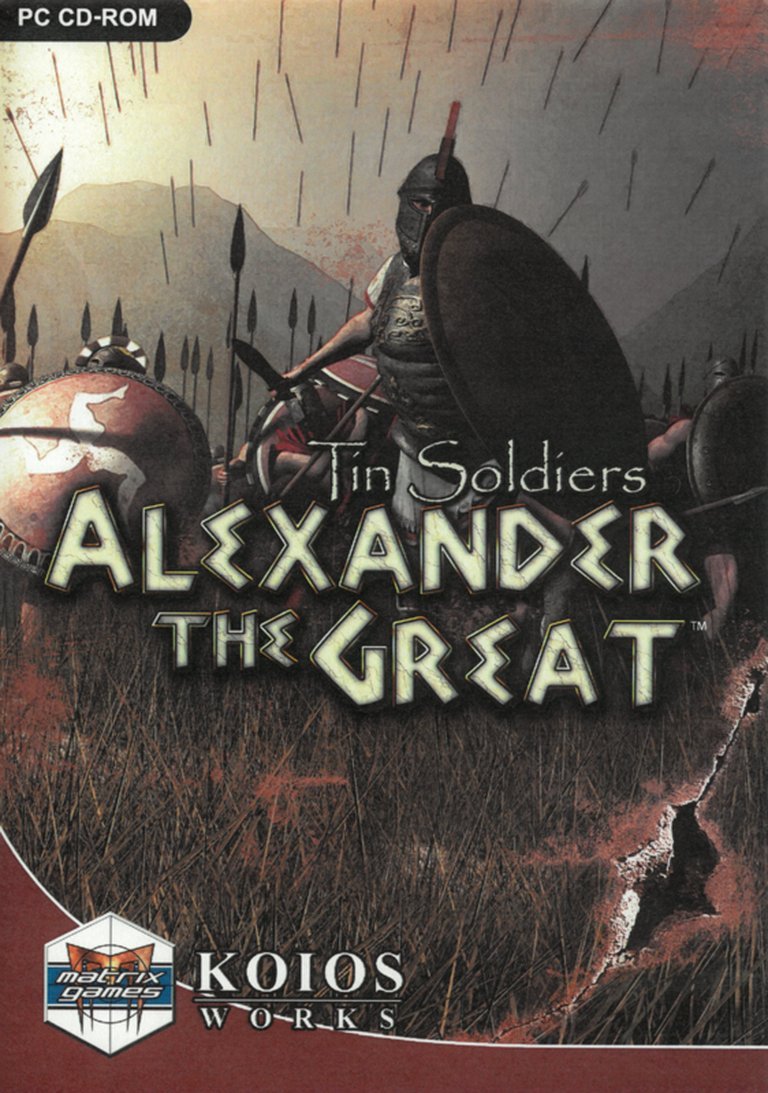
Description
Tin Soldiers: Alexander The Great is a simultaneous turn-based strategy game that places players in the role of Alexander the Great, commanding his Macedonian armies through historical battles against Greeks, Persians, Egyptians, and the Indian Army. Featuring a unique reaction system for mid-turn tactical adjustments, a campaign with persistent decisions between battles for unit recruitment and resource management, and multiplayer support via LAN and online, the game is visually presented with tin soldier-style icons without animation, capturing the essence of ancient warfare.
Gameplay Videos
Tin Soldiers: Alexander The Great Patches & Updates
Tin Soldiers: Alexander The Great Reviews & Reception
metacritic.com (77/100): A treasure of a wargame.
gamewatcher.com : Each unit is as completely accurate as possible, and the attention to uniform detail and weapons is outstanding.
Tin Soldiers: Alexander The Great: A Wargame Forged in Miniature
Introduction: The Clatter of Plastic on a Digital Battlefield
In the early 2000s, the strategy wargame landscape was dominated by two poles: the complex, data-heavy simulations of developers like Strategic Simulations, Inc. (SSI) and the increasingly cinematic, real-time accessible titles like Total War or Warcraft. Into this divide stepped a small studio with a singular, almost anachronistic vision. Tin Soldiers: Alexander The Great (2004) was not merely another game about the ancient world; it was a deliberate, almost defiant, love letter to the tabletop. It sought to capture the tactile pleasure of moving hand-painted miniatures across a felt-lined table, the strategic depth of a board wargame, and the convenience of a digital opponent, all while wrapping it in the epic narrative of history’s most celebrated conqueror. This review argues that Tin Soldiers, while flawed and niche, represents a pivotal and philosophically distinct moment in strategy game design—a bridge between the physical and digital, which prioritized systemic clarity and historical flavor over the graphical realism and complexity that defined its contemporaries. Its legacy is not in blockbuster sales, but in proving that a “classic style” could be intellectually rigorous and deeply engaging in the digital age.
Development History & Context: Wisdom and Invention in a Niche Market
The Studio and the Vision: The game was developed by Koios Works, LLC, a studio whose name derives from the Titan of Wisdom and Invention—a fitting moniker for their stated mission. Led by Executive Producer Kevin Albright and Producer/Designer Russ Pearlman, with Marshall Belew as Lead Developer, Koios Works was a small, dedicated team focused on innovation. Their philosophy, as stated in official materials, was revelatory: “Favoring the grandeur and hand crafted look of miniature figures we are eschewing the current gaming trend toward ultra realism. Our artists spend their time drawing hundreds of individually adorned soldiers rather than countless hours animating clones of identically clad animations scratching their backsides!” This was a direct rebuttal to the era’s push for 3D animated units and photo-realism. They believed the idea of the miniature—its iconic, static, information-dense representation—was superior for a wargame’s core function: clear visual communication of unit type, formation, and status.
Publisher and Market Context: Koios Works found a perfect partner in Matrix Games, Ltd. (now Slitherine). In 2004, Matrix was establishing itself as the premier publisher for hardcore, historically-minded computer wargames (Highway to the Reich, Korsun Pocket). They catered to a “grognard” audience that often felt underserved by the mainstream. Tin Soldiers fit this mold perfectly: it was complex but accessible, historically grounded, and unapologetically a game for enthusiasts. It was released on October 6, 2004, for Windows, distributed on CD-ROM. The system requirements (Pentium II 550 MHz, 128 MB RAM, 64MB video card) were modest for the time, reflecting its 2D-icon-on-3D-terrain aesthetic. The gaming world in 2004 was seeing the rise of the Total War series (Rome: Total War released that same year) and the continued dominance of real-time strategy. A turn-based, miniature-inspired game was a conscious counter-programming, targeting a specific, underserved subset of strategy fans.
Technological Constraints & Artistic Choice: The “tin soldier” visual style was both a creative and practical decision. By using pre-rendered 3D models flattened into icons (with no in-battle animation), the team could render hundreds of individually detailed figures—Persian Immortals, Macedonian phalangites, Indian war elephants—without the computational cost or artistic challenge of smooth animation. The “terrain” was presented as a tabletop board with plastic-looking trees and Styrofoam-like hills. This was not a technical limitation but an aesthetic manifesto. It communicated the game’s board-game heart immediately.
Narrative & Thematic Deep Dive: History as a Campaign Framework
Tin Soldiers does not have a traditional narrative with cutscenes starring a protagonist. Instead, its narrative is * Systemic and Experiential*, built directly into the campaign structure and its framing.
Historical Scope and Structure: The campaign guides the player from the Battle of Thebes (335 BC), where a young Alexander secures his Greek inheritance, through the decisive Battle of Issus (333 BC) and Gaugamela (331 BC) against Darius III, to the final, brutal confrontation at the Hydaspes River (326 BC) against King Porus of the Indian Punjab. This trajectory is not just a series of battles; it is the arc of Alexander’s historical conquest, from consolidating power in Greece to the easternmost limits of his empire. The game’s manual and in-game text provide extensive historical context, treating the player as a student-commander.
Themes: The Burden of Command and the Fog of War: The core theme is command under uncertainty. Unlike a scripted action game, the player’s “story” is written by their tactical decisions. Do you risk your elite Companion Cavalry in a flanking charge, potentially losing the unit but achieving a swift victory? Do you husband your veterans for future, harder battles? The campaign meta-game—where units gain experience, where you allocate gold to recruit, reinforce, or train, and where you can replace generals—makes the consequences of each battle palpable. Losing a seasoned unit at Granicus means facing Darius with a weaker army. This creates a profound sense of historical weight: you are not just winning a map, you are managing the very instrument of Alexander’s legacy.
Characterization Through Mechanics: Alexander himself is an off-map commander unit, a powerful force whose death often means defeat, but who is not directly controllable in a hero-combat sense. His presence is felt in the army’s cohesion and the historical objectives. The “characters” are the unit types and their historical roles: the Sarissa-wielding Macedonian phalanx as an unbreakable anvil, the light Peltasts and Archers as skirmishing harassers, the Indian War Elephants as terrifying, morale-shattering chaos agents. The game’s historical “characters” are thus the tactical doctrines of the era.
Underlying Philosophical Theme: The game subtly argues for historical determinism tempered by tactical agency. The scenarios are historically set-pieces with set deployments and objectives (e.g., hold the center at Gaugamela, capture the Indian camp at Hydaspes). You cannot change the context of the battle, only your response within it. Victory feels earned not by rewriting history, but by applying sound, period-appropriate generalship within constrained circumstances. This is a wargame that respects history’s shape while testing the player’s skill within it.
Gameplay Mechanics & Systems: The WEGO Revolution
This is where Tin Soldiers stakes its claim to innovation. Its core is a Simultaneous Turn-Based (WEGO) System married to a multi-phase reaction structure.
The Turn Cycle: Command, Reaction, Reserve: A single turn is divided into three sequential, real-time execution phases, but planning is simultaneous:
1. Command Phase: Both players (or player vs. AI) issue all orders for the turn to their entire force: move, attack, rotate, etc. This is done in a paused, strategic view.
2. First Execution Phase: All orders from the Command Phase are executed simultaneously in real-time. Units move and fight based on the situation at the start of the phase.
3. Reaction Phase: Here is the genius. Units in specific terrain (e.g., hills, forests), or with high leadership, or that have certain commander traits, are granted a reaction. The player can issue new, limited orders to these reactive units for a mini-Command Phase. This allows for crucial mid-battle adjustments—sending reserves to plug a breach, ordering archers to fall back as cavalry closes, or having a unitDash to a key hex.
4. Second Execution Phase: The Reaction Phase orders are executed simultaneously.
5. Reserve Phase: Units held in reserve (by not giving them orders in the initial Command Phase) can now be given full orders and execute them.
This system creates a mesmerizing, fluid turn-based experience that mimics the chaos and command dilemmas of real battle. You plan, you see your plan partially executed and the enemy’s plan unfold, you react to the emerging crisis, and then you commit your held-back reserves. It’s “like RTS, but for the twitch impaired,” as the developers quipped, demanding foresight and adaptability over micro-management speed.
Campaign Meta-Game: Between battles, the player manages a strategic layer. Gold earned from victories (based on victory points from objectives and unit survival) funds:
* Recruitment: Buying new regiments.
* Reinforcement: Adding manpower to existing units.
* Training: Improving unit morale, melee, or missile stats.
* Commander Replacement: Dismissing poor generals and hiring better ones.
* Battle Cards: One-time-use tactical cards (e.g., “Feigned Retreat,” “Enraged Charge,” “Stones Rain”) that can be stockpiled and played during the Reaction Phase to dramatically swing a battle’s tide. These add a unique card-driven layer, reminiscent of board wargame event decks.
Victory Conditions: Most scenarios offer dual paths: Break the Enemy Army (reduce morale below a threshold) or achieve Historical Objectives (capture specific hexes, hold positions, eliminate key units for a set time). This encourages different strategies—a war of attrition versus an objectives rush—and enhances replayability.
AI and Difficulty: The AI is widely praised by critics (GameWatcher calls it “one of the best I have ever seen”). It effectively uses the terrain, defends victory points tenaciously, and manages its reaction phases to launch counter-attacks. The learning curve is described as “easy to learn, difficult to master” due to the systemic depth of the WEGO/reaction system and the fog of war, which hides enemy deployments until units engage.
Flaws and Omissions: The most cited criticisms are the lack of a scenario or campaign editor, severely limiting community content and long-term replayability. Players noted that once you “learn the tricks” of a map, victory becomes too easy. Some also felt the ruleset was shallower than dedicated miniature rulebooks, and the lack of unit customization or era-modding tools locked the game into its specific historical period.
World-Building, Art & Sound: The Beauty of the Static Tabletop
Visual Direction: The Un-Animated Icon: The entire presentation is a masterclass in stylistic commitment. The battlefield is a static, beautifully rendered tabletop. Units are detailed 3D models (by lead artist Keith Kapple and 3D lead Joel Christiansen) that are rendered as 2D sprites/icons. A Persian Immortal is instantly recognizable by his wicker shield and spear-carrying pose; a Macedonian phalangite by his long sarissa and helmet. There is no walking animation; units slide smoothly. When a unit is destroyed, a photorealistic human hand reaches into the frame and plucks the figure from the board—a charming, meta-tabletop touch that reinforces the fiction. The 3D panoramas of battlefields between campaign scenarios are simple but effective, setting the historical scene.
This style achieves what it sets out to do: maximal visual information with minimal cognitive load. You can instantly assess unit type, facing, and density. It avoids the “realism” trap where units in a chaotic melee become visually indecipherable blurs. The art is a celebration of the object, not the motion.
Sound Design: Authentic Ambiance: The audio, by Will and Rick Loconto, is functional and atmospheric. The soundtrack is described as “hauntingly Mediterranean,” using traditional instruments to evoke the ancient world. Battle sounds—clashing steel, arrows, elephant roars, screams—are clear and positional, providing vital feedback during the real-time execution phases. Voice work (by D.C. Douglas) is limited to brief intro/outro narration and historical blurbs, fitting the documentary-like tone.
Atmosphere and Cohesion: The synergy between art and sound creates a unique atmosphere: the quiet intensity of a board wargame punctuated by the sudden, brutal cacophony of a simulated clash. The lack of flashy animations or explosions keeps the focus squarely on tactical positioning and unit integrity. It feels less like an “epic movie” and more like being there, commanding a real force on a real (if stylized) field.
Reception & Legacy: A Cult Classic’s Measured Triumph
Critical Reception (2004-2005): The game was generally well-received by the specialist press, with a Metacritic score of 77 and a MobyGames average of 74% from 5 critic reviews.
* Praise consistently highlighted its unique WEGO system (innovative and engaging), accessible yet deep gameplay, excellent AI, and strong historical feel. GameSpot (83%) called it “the perfect introduction to PC wargaming,” while PC Gamer (UK, 89%) hailed it as “a treasure of a wargame.”
* Criticisms focused on the lack of an editor (a major blow to replayability), limited campaign length, and for some (PC Format, 69%), “claustrophobic” map design with “dead ends” that hindered maneuver. The minimalist art was a point of division: praised for its clarity by wargamers, but seen as unattractive by those expecting modern 3D graphics.
Commercial Performance: As a niche title published by Matrix/Slitherine, sales were modest but respectable within its target market. Its subsequent availability on digital platforms like GOG.com (as noted in the dreamlist) indicates a steady, low-volume cult following.
Legacy and Influence: Tin Soldiers did not spawn a massive franchise. Its direct legacy is the “Tin Soldiers” series, followed by Tin Soldiers: Julius Caesar (2005), which refined the formula. Its true influence is conceptual:
1. Proof of Concept for WEGO: It demonstrated that simultaneous turn resolution with a reaction phase could create deeply thoughtful, less-random combat than IGO-UGO (traditional alternating turns) and less frantic than real-time. This system influenced later designs in the genre, such as some modes in the Command: Modern Operations series.
2. Aesthetic Validation: It validated the “iconic, non-animated” representation for serious wargames. Later titles, particularly in the “serious simulation” space (e.g., some scenarios in Unity of Command), use similar abstract visual languages for clarity.
3. The Niche Boardgame-Digital Hybrid: It stands as a successful case study in adapting a specific tabletop feel (not just mechanics) to digital, prioritizing information hierarchy and historical flavor over cinematic presentation. It catered to the board wargamer who wanted the convenience of AI and campaign progression.
4. Cult Status: For a small group of enthusiasts, it remains a beloved, peerless title for its specific fusion of Alexander’s campaigns, its brilliant turn system, and its unabashedly “geeky,” miniature-centric presentation.
Its reputation has stabilized rather than grown. It is remembered fondly by those who played it as a clever, stylish, and deeply satisfying tactical experience, but it is rarely cited in broader discussions of “greatest strategy games” due to its narrow scope, limited tools, and the subsequent dominance of the Total War and Hearts of Iron paradigms.
Conclusion: A Perfectly Crafted Artifact for a Specific Age
Tin Soldiers: Alexander The Great is not a perfect game. It is constrained by its lack of mod tools, its campaign is relatively short, and its aesthetic will be a turn-off to anyone expecting Age of Empires or Rome: Total War. Yet, within its self-defined boundaries, it is an exceptionally well-executed artifact.
Its genius lies in its unwavering commitment to a single, coherent design philosophy: that a wargame should feel like commanding real historical armies, where clarity of information, the weight of command decisions, and the grand narrative of conquest are paramount. The WEGO + Reaction system remains a brilliant design solution to simulating the friction and tempo of ancient battle. The tin soldier aesthetic is not a compromise but a statement—a prioritization of historical iconography and tactical readability over visceral spectacle.
In the pantheon of video game history, Tin Soldiers does not occupy a throne. Instead, it sits at a beautifully crafted, secluded table in the wargaming wing—a table populated by enthusiasts who value the clack of a well-thrown miniature dice over the roar of a 3D-rendered explosion. It is a game for the historian who is also a strategist, for the board gamer who wishes the computer would just play fair and by the rules, and for anyone who believes that the deepest strategic insights often emerge from the simplest, clearest representations.
Final Verdict: A flawed gem, essential for connoisseurs of historical strategy and a fascinating case study in design coherence. It is a testament to the idea that in game development, as in history, the right constraints can foster profound creativity. Its place in history is secure as a brilliant, niche experiment that proved a powerful alternative to the wargame mainstream could exist, and be deeply rewarding, for those willing to pick up its plastic—or rather, pixelated—figures.