
- Release Year: 2006
- Platforms: Windows
- Publisher: phenomedia publishing gmbh
- Genre: Compilation
Description
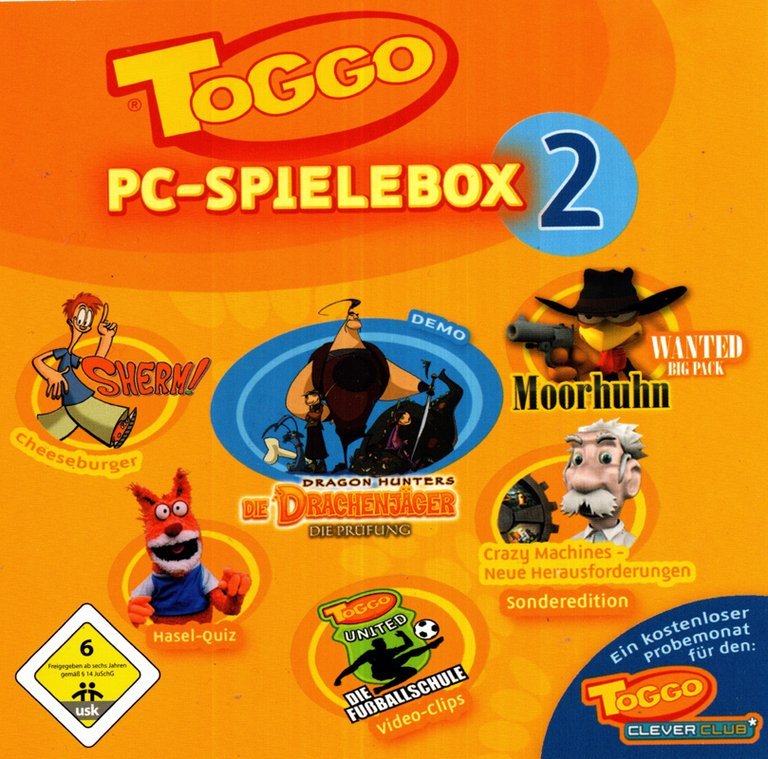
Toggo PC-Spielebox 2 is a 2006 Windows compilation published by phenomedia publishing gmbh, featuring a mix of four games—including a special edition of Crazy Machines, flash games like Hasel-Quiz and Sherm! Cheeseburger, and Morhuhn Wanted—alongside a demo for Dragon Hunters and a Toggo United football school video, offering varied entertainment likely aimed at children through puzzle, quiz, and action gameplay.
Toggo PC-Spielebox 2: A Fossil from the Mid-2000s Kids’ Media Landscape
Introduction: The Curious Case of the Compilation
In the vast and meticulously cataloged history of video games, certain titles exist not as pillars of innovation or cultural milestones, but as fascinating, ephemeral artifacts of their specific time and place. Toggo PC-Spielebox 2 is precisely such an artifact. Released in 2006 for Windows by phenomedia publishing gmbh, this compilation is not a coherent game but a curated bundle—a “Spielebox” (game box) targeting a specific demographic: German children familiar with the Toggo brand from the Super RTL television channel. To analyze Toggo PC-Spielebox 2 is therefore to perform an archaeological dig into a slice of early-21st-century European childhood entertainment, a period teetering between the physical media dominance of the 1990s and the digital on-demand future. My thesis is this: Toggo PC-Spielebox 2 represents a final, concerted effort by a broadcast brand to cement its relationship with its young audience through a physical, PC-centric product in an era where that model was rapidly becoming obsolete. Its value lies not in artistic merit or gameplay depth, but in its function as a perfectly preserved snapshot of transitional media consumption, branding synergy, and the eclectic, often disjointed, nature of children’s software compilations.
Development History & Context: phenomedia, Moorhuhn, and the Toggo CleverClub
To understand Toggo PC-Spielebox 2, one must first understand its publisher, phenomedia publishing gmbh.Operating from the German town of Knittlingen, phenomedia was not a traditional game developer but a publisher with a very specific and wildly successful niche: the Moorhuhn (Crazy Chicken) franchise. Originating as a 1999 shareware game (Moorhuhn 1), the series exploded into a cultural phenomenon in Germany and much of Europe, spawning dozens of sequels, spin-offs (racing, adventure, pinball), and endless compilations. By 2006, phenomedia had mastered the art of the budget compilation, releasing multiple “Spielebox” and “Total” packages that bundled older Moorhuhn titles with other licensed or original properties.
The Toggo brand was the other half of the equation. Toggo was the children’s programming block on Super RTL, a major German commercial television channel. In the mid-2000s, broadcasters like Super RTL were aggressively expanding their “brand ecosystems” beyond the screen. They offered magazines, websites (the Toggo CleverClub), and physical products like this CD-ROM box to create touchpoints, foster loyalty, and generate ancillary revenue. The stated purpose of the Toggo PC-Spielebox series was to offer “Futter für eure PCs” (food for your PCs) – a tangible piece of the Toggo universe kids could interact with at home.
Technologically, 2006 sits at a fascinating inflection point. The fifth console generation (PlayStation 2, Xbox, GameCube) was mature, and the sixth (Xbox 360, PS3, Wii) was launching. On PC, broadband internet was common in many households, but physical retail media—CD-ROMs sold in plastic shells on newsstands or in toy stores—remained a primary distribution method for casual and children’s software. Digital storefronts like Steam were gaining traction for hardcore gamers, but for a child asking a parent to buy something from a supermarket checkout aisle, a shiny box with a recognizable TV character on it was the norm. Phenomedia, with its low-cost, high-volume compilation model, was a perfect fit for this distribution channel.
The gaming landscape was also defined by the rise of casual and browser-based games. Flash was at its absolute zenith, powering countless simple, free-to-play games on sites like Newgrounds and Miniclip. Toggo PC-Spielebox 2 directly taps into this with the inclusion of two Flash games (Hasel-Quiz and Sherm! Cheeseburger), likely ported from the Toggo CleverClub website to provide a bridge between the online and offline Toggo experience.
Narrative & Thematic Deep Dive: A Collage of Fragmented Worlds
As a compilation, Toggo PC-Spielebox 2 presents no unified narrative. Instead, it offers a thematic collage reflecting the disparate properties under the Toggo umbrella. Its “story” is one of brand synergy:
-
The Moorhuhn Wild West: Moorhuhn Wanted (Big Pack / XXL) is the flagship title. The Moorhuhn series always presented a minimalist, humorous premise: a hunter (the player) trying to shootaddlefowl (Huhn) in various absurd scenarios. Wanted leans into a Wild West motif, with wanted posters, saloons, and dirt roads. The narrative is purely environmental and ludic—it exists to justify the shooting gallery gameplay. The theme is simple, chaotic fun, with a strong dose of German-specific humor (the chickens are Moorhuhn, a specific breed).
-
The Crazy Machines Laboratory: Crazy Machines: Neue Herausforderungen (TOGGO-Labor-Sonderedition) is a reskinned version of the popular physics-based puzzle series. Here, the theme is overtly educational/scientific (“Labor” = laboratory). The narrative is implicit: you are a student or assistant in a wacky lab, building Rube Goldberg machines to solve problems. It represents a “good, clean fun” educational counterpoint to the mindless shooting of Moorhuhn.
-
The Toggo CleverClub Quizzes: The two Flash games, Hasel-Quiz (featuring the mascot Haselhörnchen, a squirrel) and Sherm! Cheeseburger, are pure branded mini-games. Hasel-Quiz is a straightforward trivia game, likely with questions about animals, nature, or Toggo shows. Sherm! Cheeseburger is an arcade-style assembly game. Their narratives are nonexistent; they are interactive advertisements for the Toggo brand and its associated online club, emphasizing knowledge (quiz) and simple dexterity (burger building).
-
The Dragon Hunters Demo: Dragon Hunters: Die Drachenjäger – Die Prüfung is a playable demo of a full game based on the French animated series Chasseurs de Dragons. It introduces a narrative of monster hunting in a medieval fantasy setting. As a demo, it offers a tantalizing, incomplete slice of a more traditional adventure game, standing out from the purely arcade-oriented compilation.
-
The Football School Videos: The three Toggo United: Die Fußballschule videos (“Finten,” “Kopfball,” “Torschuss”) are pure instructional content. They break down soccer skills. Here, the “narrative” is pedagogical. They reinforce Toggo‘s positioning as a brand that is not just entertaining but also “active” and sporty, aligning with the Toggo United segment of the TV channel.
The overarching theme is one of versatile citizenship for the child consumer: be a Wild West hunter, a lab scientist, a trivia expert, a fast-food chef, a dragon slayer, and a soccer star—all within one branded ecosystem. The compilation doesn’t tell a story; it sells a lifestyle identity subsumed under the Toggo logo.
Gameplay Mechanics & Systems: A Jarring Spectrum of Genres
The gameplay experience of Toggo PC-Spielebox 2 is inherently disjointed, moving from one genre to another with no through-line. The installation process itself, as noted in the Internet Archive description, installs all content without selection, forcing the player to navigate a simple launcher menu to choose their activity.
-
Moorhuhn Wanted: This is a light gun shooter without the light gun. Players use the mouse to aim and click to shoot Moorhuhn that pop up from behind obstacles in static 2D scenes. The mechanics are simple: accuracy and speed. Progression is score-based, with limited ammo and penalties for shooting non-targets (like cows). It’s a direct descendant of 1980s arcade light gun games like Duck Hunt, repackaged for mouse-driven PC play. The “Big Pack/XXL” implies a large number of levels/scenes.
-
Crazy Machines: Neue Herausforderungen: A stark contrast. This is a physics-based puzzle game where players are given a set of components (gears, levers, pipes, balloons, electrical parts) and must construct a convoluted machine to achieve a simple goal (e.g., pop a balloon, turn on a light, deliver an egg to a basket). The core loop is trial-and-error experimentation within the constraints of the given parts and a limited “budget.” The TOGGO-Labor-Sonderedition likely just changes the visual skin to a lab theme.
-
Hasel-Quiz & Sherm! Cheeseburger: As Flash games, these are simplistic and web-native. The quiz is a multiple-choice knowledge test. The cheeseburger game is a timed assembly line where players click ingredients in the correct order as they move along a conveyor. Both have minimal mechanics, high replayability through procedural content (random quiz questions, random burger orders), and are designed for short, 5-10 minute sessions.
-
Dragon Hunters Demo: Presumably a top-down or isometric action-adventure demo. Limited in scope, it would showcase basic combat, movement, and perhaps a simple puzzle within a small section of the game’s world, designed to entice a purchase.
-
Videos: Non-interactive, but part of the package’s value proposition. They are consumed passively.
The compilation’s design philosophy is one of maximum variety to capture the widest possible interest. There is no cohesive progression system linking these games. The only “meta” element is the implied membership in the Toggo CleverClub, where the CD-ROM came with a one-month free voucher. This was the real product: a physical gateway to a subscription-based online community for kids.
World-Building, Art & Sound: A Patchwork of Aesthetics
The visual and auditory experience is a study in contrasts, reflecting the compilation’s disparate sources.
-
Moorhuhn Wanted & Crazy Machines: These are full, native PC games from phenomedia. Their art is in the low-poly, cheerful 3D style of mid-2000s European casual games. Moorhuhn features bright, saturated colors, cartoonish Moorhuhn models, and humorous, exaggerated animations (chickens squawking, running in panic). The Wild West environments are pastel and caricatured. Crazy Machines, meanwhile, uses a cleaner, more technical lab aesthetic with shiny metallic components and clear visual feedback for physics (e.g., turning gears, flowing liquids). Sound design for both is bubbly, non-intrusive synth music and comedic sound effects (boings, clanks, cartoonish gunshots).
-
Flash Games (Hasel-Quiz, Sherm!): These are instantly recognizable as early-2000s Flash. The art is simpler, often 2D vector or raster, with limited animation. Hasel-Quiz likely uses the characteristic Toggo squirrel mascot in a static background. Sherm! probably employs a simple, cartoony style. The audio is typically repetitive looping MIDI-style tunes or short, digitized voice snippets (“Cheeseburger!”).
-
Dragon Hunters Demo: This would mirror the art style of the animated series—more detailed 2D or early 3D with a distinct European cartoon aesthetic, possibly more serious and “epic” than the Moorhuhn world.
-
Toggo United Videos: These are real-world, low-budget instructional soccer videos. The aesthetic is entirely different: live-action, filmed on a field or in a gym, with a presenter demonstrating techniques. The sound is straightforward narration and ball impacts.
The compilation’s overall atmosphere is one of cheerful, branded chaos. There is no attempt at a unified visual language. You jump from a pastel Wild West to a sterile lab to a Flash quiz to a soccer pitch. This reflects the reality of a TV channel’s brand: it hosts wildly different shows (cartoons, live-action, game shows) under one banner. The Spielebox 2 is simply an extension of that onto the PC.
Reception & Legacy: The Silence of Niche Success
Critical reception for Toggo PC-Spielebox 2 is virtually non-existent. On aggregators like MobyGames, it has no critic reviews and only a handful of player entries, all added years later by archivists. This silence is the compilation’s most telling historical data point. It was not reviewed by mainstream or hardcore gaming press; it existed entirely in the ecosystem of children’s media, supermarket shelves, and TV advertising breaks. Its success was measured not in Metacritic scores but in sales volume at kiosks and its effectiveness as a Toggo CleverClub acquisition tool.
Commercially, it was likely a modest success within its narrow lane. Phenomedia’s business model of prolific compilations suggests these products turned a profit on low development costs (repackaging existing IP) and high distribution reach. For Toggo, it was a successful brand extension. For the child of 2006, owning the Toggo PC-Spielebox 2 was a status symbol within the peer group of Toggo viewers.
Its legacy is threefold:
- As a Period Piece: It is a perfect textbook example of the “retail compilation” era for casual and children’s games. It predates the dominance of app stores and the decline of the physical CD-ROM in this market by about 5-7 years.
- As a Branding Artifact: It demonstrates the峰值 of the broadcast-channel-to-multi-platform brand strategy that was common in the 2000s (Club Disney, Nickelodeon did similar things). The voucher for the online CleverClub shows the strategic push to migrate young audiences from passive TV watching to active, registered, and data-generative online participation.
- As a Pedagogical Snapshot: The included content reveals a specific, mid-2000s German cultural understanding of “good” children’s entertainment: a mix of mindless fun (Moorhuhn), intellectual challenge (quiz), creativity/learning (physics puzzles), and healthy activity (soccer instruction). It’s a curated experience reflecting parental and educational values of the time.
Conclusion: Verdict and Historical Placement
To judge Toggo PC-Spielebox 2 by the standards of a standalone video game is to miss the point entirely. It is not intended to be a cohesive artistic statement or a technological marvel. It is, fundamentally, marketing collateral—a physical, interactive brochure for the Toggo brand and its associated online community.
Within the canon of video game history, it is a footnote, a data point in the story of:
* The casual/children’s game market before smartphones.
* The European (specifically German) distinctiveness of the casual game space, dominated by phenomedia’s Moorhuhn.
* The business strategy of broadcasters expanding into interactive media.
* The final gasps of the PC CD-ROM compilation as a mass-market retail format for kids.
Its gameplay is erratic, its presentation disjointed, and its artistic ambition negligible. Yet, as a cultural artifact, it is remarkably informative. It tells us about the media diet of a German child in 2006, the technologies that mediated that diet (TV, PC, Flash, physical media), and the commercial engines driving children’s entertainment at the time. For the game historian, its value lies not in the playing, but in the opening of the package: the cardboard insert, the registration voucher, the mix of a best-selling local IP with imported Flash games and TV show tie-ins. Toggo PC-Spielebox 2 is a charming, chaotic, and perfectly preserved time capsule—a testament to an era when a child’s journey into a brand’s world began not with an app store tap, but with the satisfying clack of a CD-ROM being lowered into a drive bay, and the hopeful promise of a month’s free access to an online club. It is, in its own way, a minor but piece of the puzzle that is our shared digital history.