
- Release Year: 2009
- Platforms: OnLive, PlayStation 3, Windows, Xbox 360
- Publisher: ak tronic Software & Services GmbH, Game Factory Interactive Ltd., Ubisoft Entertainment SA
- Developer: Ubisoft SRL
- Genre: Action
- Perspective: 1st-person, Behind view
- Game Mode: Online Co-op, Single-player
- Gameplay: Arcade physics, Flight Simulation, Loadout customization, Rank Progression, Squad Commands, Voice recognition
- Setting: Africa, North America, South America
- Average Score: 74/100
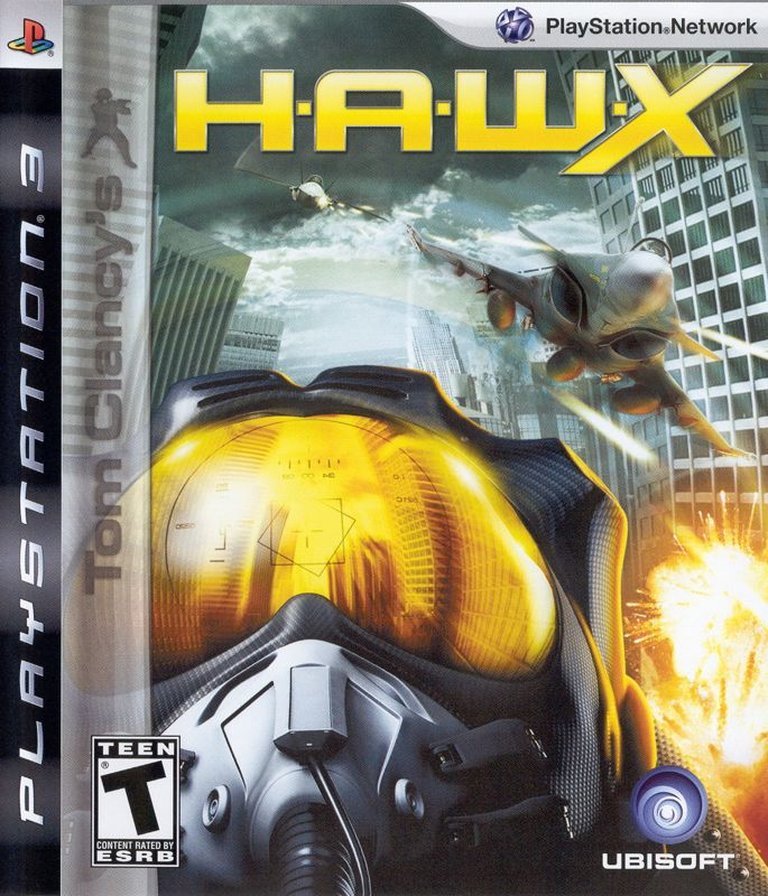
Description
Set in 2014, Tom Clancy’s H.A.W.X follows former US Navy pilot David Crenshaw as he becomes a mercenary for private military companies, undertaking high-risk aerial missions across global hotspots like Chicago, Rio de Janeiro, and Washington, D.C., in a escalating conflict that pits him against his old employer and forces him to shape the outcome of a war for military domination.
Gameplay Videos
Tom Clancy’s H.A.W.X Free Download
Tom Clancy’s H.A.W.X Patches & Updates
Tom Clancy’s H.A.W.X Guides & Walkthroughs
Tom Clancy’s H.A.W.X Reviews & Reception
ign.com (79/100): HAWX is a good game with a dumb name.
smh.com.au (70/100): the repetitious nature of closing in for target lock and firing your payload takes its toll.
Tom Clancy’s H.A.W.X Cheats & Codes
PC
Go to the Hangar and enter the following codes while holding Shift.
| Code | Effect |
|---|---|
| xaxdqx | Unlocks A-12 Avenger II |
| aqaqax | Unlocks F-18 HARV |
| dxdxdq | Unlocks FB-22 Strike Raptor |
PlayStation 3
Enter codes in the Hangar while holding L2.
| Code | Effect |
|---|---|
| square, L1, square, R1, triangle, square | Unlocks A-12 Avenger II |
| L1, triangle, L1, triangle, L1, square | Unlocks F-18 HARV |
| R1, square, R1, square, R1, triangle | Unlocks FB-22 Strike Raptor |
Xbox 360
Enter codes in the Hangar while holding LT.
| Code | Effect |
|---|---|
| X, LB, X, RB, Y, X | Unlocks A-12 Avenger II |
| LB, Y, LB, Y, LB, X | Unlocks F-18 HARV |
| RB, X, RB, X, RB, Y | Unlocks FB-22 Strike Raptor |
Tom Clancy’s H.A.W.X: A Maverick Missile in a Saturated Sky
Introduction: The Clancy Canon Takes Flight
In the late 2000s, the Tom Clancy brand was synonymous with gritty, tactical, ground-oriented realism—Rainbow Six’s room-clearing, Ghost Recon’s squad-based brushfire, Splinter Cell’s shadowy stealth. To launch an aerial combat title into this ecosystem was a bold, almost heretical, pivot. Tom Clancy’s H.A.W.X (High-Altitude Warfare eXperimental), released in March 2009, was that pivot. It was Ubisoft’s audacious attempt to translate the Clancy aesthetic—geopolitical tension, near-future tech, licensed hardware—into the skies, a domain historically ruled by the fantastical Ace Combat series or hardcore sims like Falcon 4.0. This review argues that H.A.W.X is a fascinating, flawed, and ultimately defining experiment: a game that successfully grafted Clancy’s narrative template onto an arcade flight skeleton but failed to resolve the fundamental tension between mass-market accessibility and genre depth. It is a title remembered not for revolutionizing the flight genre, but for perfectly capturing a specific moment where “accessible” did not necessarily mean “substantial,” and where a powerful license could both elevate and constrain a creative vision.
Development History & Context: Bucharest’s Skyward Ambition
Developed by Ubisoft Bucharest, with the PC version handled by Ubisoft Kyiv, H.A.W.X emerged from a studio with a specific pedigree. The Bucharest team had previously worked on Blazing Angels 2: Secret Missions of WWII, a historically-themed arcade flyer. This lineage is critical; H.A.W.X feels less like a sim and more like a spiritual successor to that WWII arcade action, merely reskinned with modern and prototype jets and a Clancy veneer. The game was announced as Tom Clancy’s Air Combat at E3 2008, a title that more honestly described its core loop before the branding was solidified.
The technological context was defined by a ambitious, double-edged sword: the use of commercial satellite imagery from GeoEye’s Ikonos system. This was a headline-grabbing feature promised to deliver “photo-realistic” real-world locations—flying over the precise grids of Chicago, Rio de Janeiro, or Washington D.C. In practice, this created a stunning visual identity at high altitudes but became a glaring weakness at low levels, where pixelation and texture pop-in were recurrent issues, a point nearly every critic noted.
The 2008-2009 gaming landscape was dominated by the seventh-generation console transition. Arcade flight games on consoles were a niche genre, with Ace Combat 6: Fires of Liberation (2007) as the premier, Japan-flavored competitor. H.A.W.X entered this space aiming for a more “Western,” grounded aesthetic, directly competing with Namco’s series while trying to carve a distinct identity. Its development was also intertwined with other Clancy titles; the narrative was explicitly set between Ghost Recon Advanced Warfighter 2 (2006) and EndWar (2008), necessitating plot elements like the S.L.A.M.S. missile shield. This interconnection was a novel attempt at a transmedia universe but inevitably created constraints on the story’s independence.
Narrative & Thematic Deep Dive: A Script Written by Algorithm
The plot of H.A.W.X is a masterclass in Clancy-esque efficiency, for better and worse. In 2014, protagonist Major David Crenshaw, an elite U.S. Air Force pilot from the disbanded H.A.W.X. squadron, is recruited into the private military corporation Artemis Global Security after providing air support for Captain Scott Mitchell’s Ghost Recon team in Juárez, Mexico—a direct sequel hook to GRAW2. For six years, Crenshaw and his flight (Reaper Flight) execute Artemis contracts worldwide. The inciting incident comes in 2021 when Artemis, having defended Brazil from the rival PMC Las Trinidad, is undercut by a U.S. intervention, causing its stock to plummet. In retaliation, Artemis attacks a U.S. carrier group, forcing Crenshaw’s first act of defiance.
What follows is a three-day global war narrative thatLashes from the Strait of Magellan to Washington D.C., Chicago, Norfolk, Tokyo, the Nevada desert, and finally Los Angeles. The central theme is the danger of the privatization of force. Artemis, a corporation with a relaxed view of the law, uses its military might to bully nation-states, ultimately launching a full-scale invasion of the United States itself. The resolution requires restoring the EndWar-era S.L.A.M.S. shield, recovering stolen tactical nukes, and a final desperate bomb disposal over Los Angeles.
Thematically, it’s standard Clanty fare: techno-thriller realism (real jet names, real cities), corporate villainy, and unquestioned American patriotism—Crenshaw’s ultimate loyalty is to the U.S. flag, not his paycheck. Where it stumbles is in character and dialogue. Crenshaw is a blank-slate protagonist, defined only by his career trajectory. His wingmen—Casper, Talon, Jester—are archetypes with zero development. The antagonists, notably Artemis CEO Adrian DeWinter, are moustache-twirling corporate caricatures. The story’s “twist” (the PMC betrayal) is telegraphed from the first mission. As the user review from MobyGames sharply notes, it is a “shallow American gung ho flag waving story” with “cliches.” The brief, fan-service appearances of Scott Mitchell (via radio chatter) are the only narrative highlights for franchise loyalists, underscoring that this is a side-adventure, not a central saga.
Gameplay Mechanics & Systems: The ERS as a Double-Edged Sword
The core gameplay of H.A.W.X is a deliberate, almost radical, departure from simulation toward pure arcade action. It explicitly channels Top Gun and After Burner more than Falcon. The genius and flaw of the game is the Enhanced Reality System (ERS).
-
The ERS Suite: This is the game’s defining feature. It overlays the HUD with:
- Optimal Intercept Trajectories: A bright, glowing path showing how to get behind a target.
- Missile Evasion Routes: Red triangular markers guiding you through a corkscrew to shake a lock.
- Tactical Map & Target Reticle: Simplifies target selection.
- Damage Control & Anti-Crash: Reduces consequences for poor flying.
When fully active, the ERS makes the game feel like an interactive action movie. Dogfights become a matter of following the line, firing when the reticle solidifies. It is immediately accessible and viscerally satisfying for newcomers. Critically, the system can be selectively turned off—players can disable the flight path, the evasion cues, or all assistance (“Assistance Off” mode). This is where the game attempts to cater to the “sim-curious,” granting true maneuverability and 360-degree dogfighting freedom. However, as 4Players.de noted, turning ERS off makes the game significantly harder and can lead to disorientation, a “spectacular but challenging” experience that many found frustratingly imprecise.
-
Controls & Aircraft: The game supports keyboard/mouse, gamepad, joystick, and even voice commands (a legacy of EndWar). The voice control (“Fire Missiles,” “Target That”) is a neat novelty but rarely practical in heat-of-battle. The 50+ licensed aircraft (from the A-10 Thunderbolt II to the F-22 Raptor, Su-47 Berkut, and Harrier Jump Jet) are unified by a “feel”—a common criticism is they all handle similarly, lacking the distinct performance characteristics a sim would simulate. Loadouts are predefined per aircraft, chosen before missions, and unlocked via an experience point (XP) system tied to kills and objectives.
-
Mission Design & Progression: The 15-mission campaign is a mixed bag of variety and repetition. Objectives include: standard dogfights, ground strike runs (using cluster bombs on tanks), defending static targets (Air Force One), escort missions, and stealth infiltrations (flying through “safe zones”). The variety is praised, but the execution is often criticized as formulaic. As * Eurogamer* stated, the “limited multiplayer options” and “too little difference between the aircraft” dull the experience. The mid-mission, unskippable cutscenes are a notorious pain point, frequently interrupting a chase and causing your target to vanish, as the user review lamented.
-
Multiplayer: This is a significant weak point relative to the era. Co-op for the entire campaign (up to 4 players) is the standout feature, correctly hailed by many reviewers as a major strength that extends replayability. However, the competitive multiplayer is shallow—primarily basic deathmatch with limited maps and modes. The promise of a robust online community never materialized, and the Windows servers were shut down in 2015. This left the game’s long-term prospects bleak.
World-Building, Art & Sound: A Photorealist’s Dream (From 30,000 Feet)
H.A.W.X’s greatest unequivocal triumph is its visual presentation, built on that GeoEye satellite data.
-
Setting & Atmosphere: The game’s “real-world” setting—cities like Chicago, Los Angeles, Rio de Janeiro, Washington D.C., Tokyo, and the Nevada desert—is its core selling point. Flying over a recognizably rendered downtown Chicago or the Christ the Redeemer statue in Rio creates a powerful sense of place and scale rarely achieved in arcade flyers. The near-future 2014-2021 setting allows for sleek, modern aircraft against these familiar backdrops, selling the “Tom Clancy” speculative realism. The atmosphere is one of techno-paranoia and global crisis, though the narrative doesn’t always support the scale of the environments.
-
Visual Direction: The satellite imagery is stunning at high altitude. The aircraft models are beautifully detailed and licensed, a point of pride for the developers and a major draw for aviation enthusiasts. The cockpit views (where available) are functional and immersive. The failure is in low-level flight: when skimming streets or canyons, the textures blur and pop, destroying the illusion. The explosion effects and missile trails are spectacular, providing the “Hollywood” feedback loop the game aims for.
-
Sound Design: The soundscape is competent. Jet engine roars are aggressive, missile launches have a satisfying whoosh, and explosions are weighty. The radio chatter (between Crenshaw and AWACS or wingmen) is standard military boilerplate but helps maintain a sense of squadron cohesion. The soundtrack by Tom Salta is energetic, modern, and fittingly patriotic, though not particularly memorable.
Reception & Legacy: A Solid But Stalled Flight
Upon release, H.A.W.X received mixed-to-positive reviews, aggregating to a 73% on Metacritic (Xbox 360) and a 7.3/10 user score on MobyGames. The critical divide was clear:
- Praised For: Accessibility/Arcade Fun, Aircraft Selection and Visuals, Co-op Campaign, ERS Innovation (when used as intended), and its successful Tom Clancy aesthetic.
- Game Informer (8.75/10): “Big thrills.”
- Official Xbox Magazine UK (8/10): Highlighted its fun factor.
- XboxAchievements (85%): Called the ERS “spectacular” and co-op “must-play.”
- Criticized For: Shallow/Repetitive Mission Design, Weak Narrative/Characters, Poor Multiplayer Depth, Lack of Aircraft Differentiation, ERS making the game too easy (or too hard when off), and technical issues like radar beeping and target cycling.
- IGN (6.7/10): “The mission design is lacking, the combat is unimaginative, and the multiplayer is shallow.”
- Eurogamer (6/10): “A victim of the high standards set by other Clancy titles… it’s hard to recommend as a must-buy.”
- 4Players.de (72%): Dismissed any simulation claims, calling it a “simple arcade-shootout.”
Commercially, it was a solid, mid-tier performer for Ubisoft, likely profitable but not a blockbuster. Its most lasting impact was as a proof-of-concept for a console-based, story-driven arcade flight game. It directly competed with, and was often unfavorably compared to, Ace Combat 6. Where Ace Combat offered a wildly fantastical, anime-inspired narrative and distinct plane handling, H.A.W.X offered realism, real jets, and a more “serious” plot—but at the cost of the sheer style and depth that made Ace Combat a cult favorite.
Its legacy is bifurcated:
1. Within the Clancy Universe: It stands as a curious, one-off experiment. The franchise did not continue strongly in this vein; H.A.W.X 2 (2010) attempted to add more “sim” elements and a global conflict stage but was similarly received and the series fizzled. The more successful Clancy titles remained terrestrial (Ghost Recon Wildlands/Breakpoint, The Division) or tactical (Rainbow Six Siege). H.A.W.X remains a standalone anecdote.
2. Within the Flight Genre: It demonstrated a market for accessible, visually spectacular arcade flight on consoles, but its execution showed the genre’s pitfalls: repetitive gameplay and shallow systems. It arguably stifled demand for a true successor by showing that a major publisher’s attempt could be so merely adequate. The genre on consoles has largely been left to Ace Combat (which refined its own formula) and indies. The PC sim market continued its deep, niche path.
Conclusion: A Clouded Judgment, But a Clear Flight Path
Tom Clancy’s H.A.W.X is not a great game, but it is a good and important one. Its importance lies not in its mechanics—which are often shallow and repetitive—but in its positioning. It was the first major attempt to bring the Tom Clancy “brand” of speculative realism, geopolitical narrative, and licensed hardware to the aerial arcade space, a domain previously owned by the fantastical Ace Combat.
Its strengths are undeniable: the thrill of flying real, beautiful jets over photorealistic cities, the satisfying pop of a missile hit, and the accessible fun of co-op dogfights. Its weaknesses are equally glaring: a derivative plot with cardboard characters, mission designs that wear thin quickly, multiplayer that lacked longevity, and an ERS system that solved the accessibility problem but created a new “dumbing down” critique.
Ultimately, H.A.W.X is a product of its specific design mandate and time. It successfully made the player feel like a Hollywood hero in a Clancy thriller, but failed to build a world worth spending more than a dozen hours in. It is a fascinating bug in the Clancy universe’s code—a game that wore the brand’s skin but played a different genre’s tune. For the historian, it’s a crucial case study in franchise expansion and genre hybridization. For the player today, it’s a curiously shallow but undeniably fun diversion, best experienced in short bursts with a friend in co-op, its potential forever trapped just above the clouds, glimpsed but never fully reached. Its place in history is as a bold, beautiful, and ultimately flawed experiment—a supersonic jet with a great view but a destination that never quite justified the journey.