
- Release Year: 1997
- Platforms: Macintosh, Windows
- Publisher: Red Storm Entertainment, Inc.
- Developer: Red Storm Entertainment, Inc.
- Genre: Strategy, Tactics
- Perspective: Top-down
- Game Mode: Single-player
- Gameplay: Business simulation, Managerial, Turn-based strategy
- Setting: Contemporary
- Average Score: 69/100
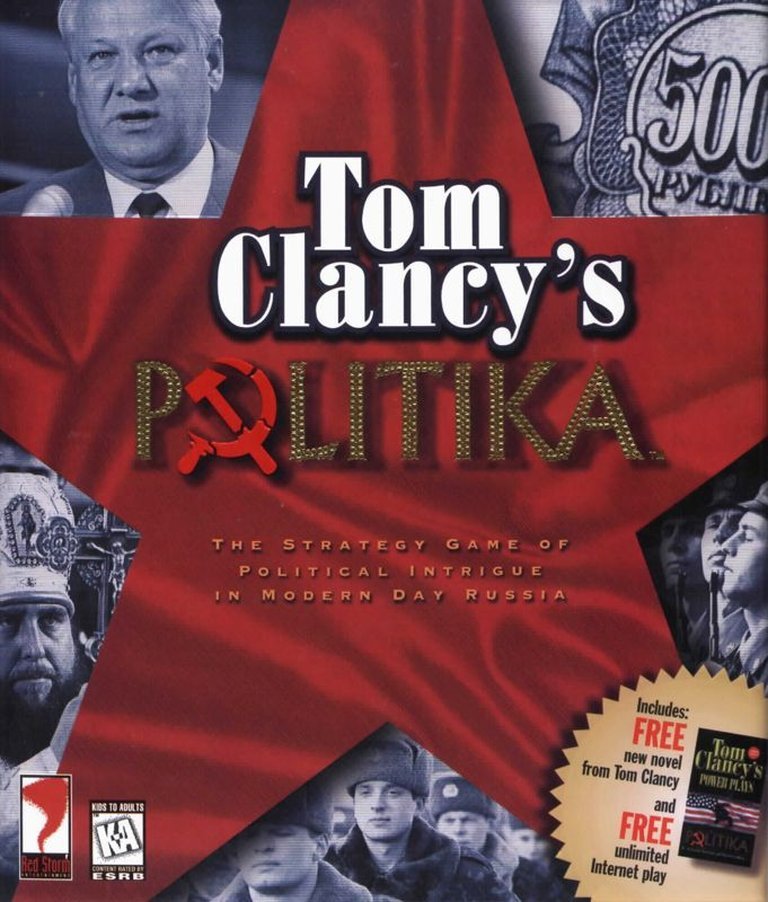
Description
Set in the chaotic aftermath of Russian President Yeltsin’s sudden death without an heir, Tom Clancy’s Politika is a turn-based strategy game where players choose one of eight factions—including the KGB, Mafia, Military, or Church—to vie for control of Russia by accumulating influence and navigating complex political machinations.
Gameplay Videos
Tom Clancy’s Politika Free Download
Tom Clancy’s Politika Guides & Walkthroughs
Tom Clancy’s Politika Reviews & Reception
myabandonware.com (84/100): Both games have the WORST computer AI in solo mode I have EVER seen!
Tom Clancy’s Politika: Review
Introduction
In the pantheon of Tom Clancy-branded video games, titles like Splinter Cell, Ghost Recon, and Rainbow Six stand as titans of the tactical shooter genre. However, buried deep within the annals of late 90s PC gaming lies a curious, largely forgotten anomaly: Tom Clancy’s Politika. Released in 1997 by the nascent Red Storm Entertainment, this title eschewed the high-octane action of its siblings in favor of a turn-based, Risk-style board game simulation. It was an experiment in transmedia storytelling, launched alongside a paperback novel and a physical board game, attempting to digitize the complex, treacherous world of post-Soviet political intrigue. While it is often remembered today as a footnote in the franchise’s history—or a cautionary tale about the limitations of early Java programming—Politika remains a fascinating artifact. It is a game defined by a stark duality: a disastrous single-player experience undermined by primitive artificial intelligence, juxtaposed against a multiplayer engine that fostered one of the most engaging diplomatic “backstabbing” simulators of its era.
Development History & Context
The Birth of Red Storm Entertainment
Tom Clancy’s Politika holds the distinction of being one of the very first titles released by Red Storm Entertainment, a company co-founded by Tom Clancy himself. Released on November 5, 1997, the game arrived during a transitional period for PC strategy gaming. The industry was moving away from purely text-driven wargames toward more graphical interfaces, yet the hardware constraints of the era often limited the scope of such ambitions.
A Java Experiment and Transmedia Vision
Technically, Politika was a bold endeavor. It was advertised on its back cover as “the first major title” to utilize the Java programming language. While this allowed for cross-platform compatibility between Windows and Macintosh, it resulted in performance hitches and a dependency on the now-archaic Microsoft Internet Explorer 4.0 with a specific Java plug-in. Today, running the game requires virtual machines, a testament to its brittle coding foundation.
Red Storm’s vision was not merely to release a game, but to create a multimedia event. The game was developed in tandem with the novel Tom Clancy’s Power Plays: Politika (though Clancy did not write the entirety of the book himself). In a marketing move that inadvertently signaled the game’s future bargain-bin fate, retail copies included a free paperback version of the novel, valued at $7.50. This bundle aimed to immerse players in a “what-if” scenario that felt ripped from the headlines of the late 90s, capitalizing on contemporary anxieties regarding the instability of the Russian Federation.
Narrative & Thematic Deep Dive
The Death of Yeltsin and the Power Vacuum
The narrative premise of Politika is grounded in the political realism that defined Clancy’s work. The game is set in an alternate 1999 where Russian President Boris Yeltsin dies suddenly without naming a successor. This event triggers a catastrophic power vacuum, exacerbated by a devastating crop failure and widespread famine.
The game’s plot, expanded upon in the accompanying novel, involves a terrorist bombing in the United States that implicates the new Russian leadership, threatening to plunge the world into a second Cold War. While the novel follows American billionaire Roger Gordian as he unravels a transnational conspiracy across Moscow and Turkish deserts, the game focuses on the domestic struggle within Russia itself.
Eight Factions of the New Russia
The thematic core of the game is the fragmentation of the Russian state. Players do not command armies in the traditional military sense, but rather lead one of eight distinct political factions:
* The KGB: Espionage experts capable of stealing cards.
* The Church: Representing the resurgence of the Russian Orthodox faith.
* The Reformers: The pro-democracy, pro-West remnants of the old administration.
* The Mafia: Organized crime syndicates that can extort money.
* The Communists: Seeking a return to the Soviet era.
* The Military: Hardline generals with superior mobilization.
* The Nationalists: Right-wing extremists.
* The Separatists: Regional powers earning double income in their territories.
The dialogue and text are minimal within the game engine itself, but the underlying theme is one of survival of the fittest. It captures the paranoia of the era, where money and influence were the true weapons of mass destruction.
Gameplay Mechanics & Systems
A Digital Board Game
Politika is, for all intents and purposes, a direct translation of a board game. The interface is a static, top-down map of Russia divided into regions. Each region contains three control slots, and players place influence tokens (Workers, Students, Demonstrators) to assert dominance.
The gameplay loop is strictly turn-based and broken into distinct phases:
1. Income: Players collect money based on regional control.
2. Movement: Representatives and uprising tokens are deployed.
3. Conflict: Players spend money to buy dice. Combat is resolved by rolling these dice against opponents, modified by action cards.
4. Card Purchase: Players can buy tactical cards that offer bonuses, such as defense boosts or free attacks.
The “Backstabbing” Multiplayer Experience
The game’s mechanics shine brightest in multiplayer, which supports up to 8 players via LAN or online. Politika introduces mechanics specifically designed to foster paranoia. Players can trade money, cards, and tokens. They can form alliances, but these are brittle.
* Private Messaging: Players can whisper to one another, plotting in secret.
* Eavesdropping: A risky mechanic allows players to spy on private conversations, though the targets are alerted if the attempt fails.
* The Tiebreaker: Perhaps the game’s most brilliant rule is its victory condition. If the game ends in a tie, “Russia collapses,” and no one wins. This forces players to actively sabotage the leader, often resulting in chaotic betrayals in the final turns to ensure a sole victor emerges.
The AI Failure
Conversely, the single-player mode is widely considered a failure. Contemporary reviews and retrospective analyses universally condemn the Artificial Intelligence. The AI is predictable, passive, and easily exploited. Once a human player understands the basic logic of the computer opponents, the challenge evaporates, rendering the solo campaign a tedious exercise.
World-Building, Art & Sound
Visual Direction
Visually, Politika is a product of its time, adhering to a “function over form” aesthetic. The graphics are pre-rendered and top-down, presenting a flat map that looks exactly like a board game board. Critics at the time noted the lack of “bells and whistles.” There are no cinematic battle animations; conflicts are resolved through abstract dice rolls and shifting colored borders. However, the art direction successfully conveys a drab, austere atmosphere fitting for a collapsing superpower.
The Score of Bill Brown
The auditory experience is spearheaded by composer Bill Brown, who would go on to score major titles in the Tom Clancy franchise. The main menu music is frequently cited as a highlight, establishing a mood of tension and geopolitical gravity. Unfortunately, this high-quality score is largely isolated to the menu; in-game sound effects are limited, consisting mostly of interface clicks and simple cues, which some reviewers found disappointing given the immersive potential of the setting.
Reception & Legacy
Critical and Commercial Response
Upon release, Politika received mixed to negative reviews, holding an average critical score of roughly 55%.
* GameSpot (4.5/10): Criticized the game for low production values and the lack of personality in computer opponents, calling it “obsolete as the Iron Curtain.”
* Computer Gaming World (1.5/5): lambasted the “dry” source material and “backwards” interface, noting that the game was devoid of character.
* PC Player (Germany, 61%): Acknowledged the “board game sluggishness” but praised the tactical balance.
However, some outlets saw the potential in the multiplayer design. Computer Games Magazine gave it a 3/5, noting that despite the “interface fiasco,” the underlying card and trading systems were sleek and innovative.
The Bargain Bin
Commercially, the game struggled. It was not long before Politika, along with its bundled paperback novel, began appearing in bargain bins for under $5. The ambitious online tournament organized by Red Storm attracted initial interest, but the player base dwindled rapidly once the contest ended.
Historical Significance
Despite its commercial failure, Politika is historically significant. It demonstrated the difficulty of porting complex social-deduction board games (like Diplomacy) to PC without robust AI. It also served as a precursor to the Rainbow Six franchise, proving that Red Storm was willing to take risks with the Clancy license beyond simple shooters. Today, it is viewed by abandonware enthusiasts as a “cult classic”—a game with the “worst solo AI” but perhaps the “best multiplayer board game feel” of its generation.
Conclusion
Tom Clancy’s Politika is a game of contradictions. It is a high-tech thriller license applied to a slow-paced board game; a game with a brilliant multiplayer design hamstrung by a non-existent single-player mode. As a piece of software, it was fragile, built on a Java foundation that makes it nearly unplayable on modern systems without emulation. Yet, as a historical artifact, it succeeds. It captures the specific geopolitical anxiety of the late 1990s better than many of its peers. For the game journalist or historian, Politika serves as a reminder that innovation often lies in the attempt, even if the execution lands in the bargain bin. It is a flawed, frustrating, but occasionally brilliant experiment in digital diplomacy.
Final Verdict: A fascinating failure. Essential study for genre historians, but a frustrating experience for the modern solo gamer.