
- Release Year: 2004
- Platforms: GameCube, PlayStation 2, PlayStation 3, Windows, Xbox One, Xbox Series, Xbox
- Publisher: ak tronic Software & Services GmbH, Game Factory Interactive Ltd., NMG, Ubisoft Entertainment SA
- Developer: Shanghai UBIsoft Computer Software Co., Ltd., Ubisoft Annecy SAS
- Genre: Action
- Perspective: Behind view
- Game Mode: LAN, Online PVP, Single-player
- Gameplay: Body dragging, Infiltration, Lock picking, Stealth
- Setting: Europe, Middle East, North America
- Average Score: 87/100
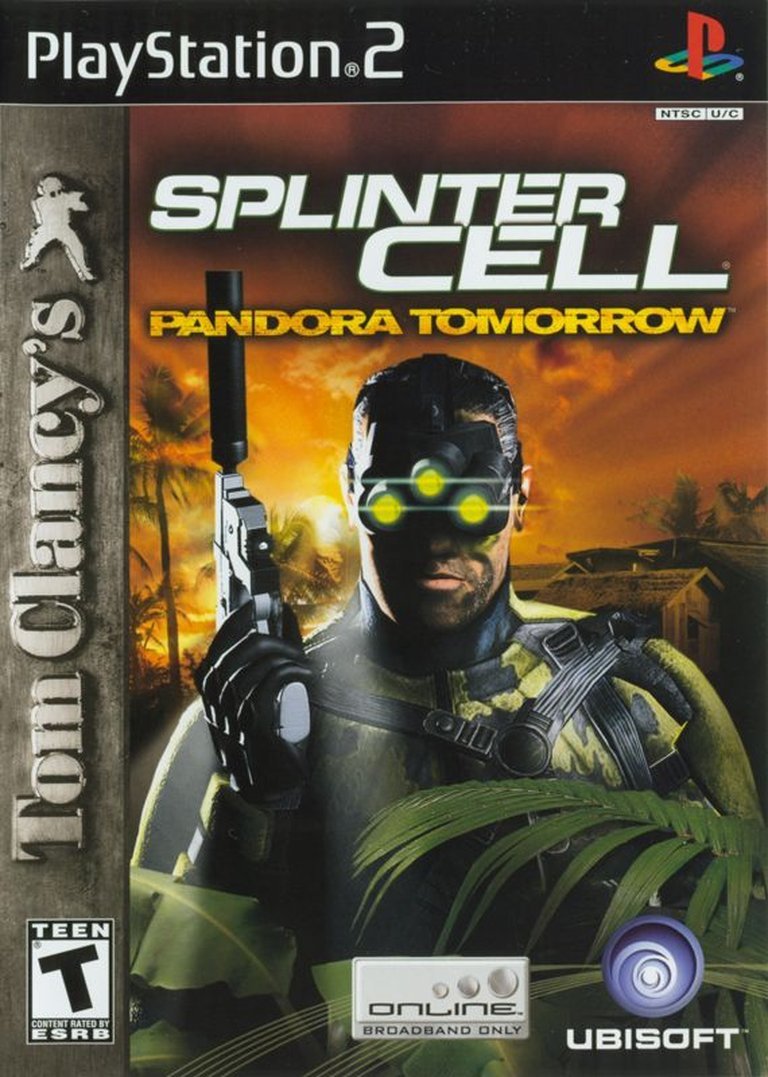
Description
In Tom Clancy’s Splinter Cell: Pandora Tomorrow, players return as the elite spy Sam Fisher, tasked with infiltrating global hotspots—from Paris to Jerusalem and beyond—to uncover and stop a terrorist who plans to unleash a deadly disease across the United States. Fisher relies on enhanced stealth moves, improved equipment like the SC-20K rifle, and tactical gadgets to navigate treacherous environments and prevent a catastrophic bioterrorist attack.
Gameplay Videos
Where to Buy Tom Clancy’s Splinter Cell: Pandora Tomorrow
PC
Tom Clancy’s Splinter Cell: Pandora Tomorrow Free Download
Tom Clancy’s Splinter Cell: Pandora Tomorrow Patches & Updates
Tom Clancy’s Splinter Cell: Pandora Tomorrow Reviews & Reception
ign.com : It’s the all-new online multiplayer mode that steals the show for Pandora Tomorrow and makes this a must own videogame experience.
metacritic.com (93/100): Pandora Tomorrow flirts tantalizingly close to gaming perfection.
imdb.com (82/100): Pandora Tomorrow wasn’t just a follow-up to the original Splinter Cell – it was a declaration that stealth had evolved.
Tom Clancy’s Splinter Cell: Pandora Tomorrow Cheats & Codes
PC
Edit the SplinterCell2User.ini file and bind cheat codes to function keys, then press the key during gameplay to activate.
| Code | Effect |
|---|---|
| fly | Flight mode |
| playersonly | Freeze enemies |
| health | Gives health |
| invincible 1 | God mode |
| invincible 0 | God mode off |
| ammo | More ammo |
| killpawns | Kills all enemies |
| ghost | No clip mode |
| walk | Disable flight and no clipping modes |
| invisible 1 | Sam is invisible |
| invisible 0 | Turns off invisible |
| playersonly 0 | Unfreeze enemies |
| summon echeloningredient.eringairfoilround | Spawn airfoil round |
| summon echeloningredient.edisposablepick | Spawn disposable pick |
| summon echeloningredient.eflashbang | Spawn flashbang |
| summon echeloningredient.efraggrenade | Spawn frag grenade |
| summon echeloningredient.esmokegrenade | Spawn smoke grenade |
| summon echeloningredient.estickycamera | Spawn sticky camera |
| summon echeloningredient.estickyshocker | Spawn sticky shocker |
| summon echeloningredient.ewallmine | Spawn wallmine |
| stealth | View stealth amount |
| preferences | Modify settings |
| mission win | Complete current mission |
| quit | Quickly quit game |
Game Boy Advance
Enter codes using a CodeBreaker or Gameshark device.
| Code | Effect |
|---|---|
| 00003989 000A | Mastercode |
| 1007A340 0007 | Mastercode |
| 33003FE9 000A | Invulnerability |
| 330077AC 0091 | All Missions Unlocked |
| 330077AA 000A | Unlimited Health |
| 330077C2 0099 | Unlimited Bullets |
| 630077C2 0800 | Unlimited Gas Grenades |
| 330077C3 004D | Unlimited Keys (And Grenades) |
| 330077C2 0063 | Unlimited Gun Ammo |
| 330076BF 0006 | Alarms Are Faulty |
| 330076C0 0000 | Alarms Are Faulty |
Tom Clancy’s Splinter Cell: Pandora Tomorrow: The Shadow That Forged a Genre
Introduction: The Weight of a Sequel
When Tom Clancy’s Splinter Cell: Pandora Tomorrow launched in 2004, it carried an immense burden. It was the first sequel to a game that had, in just two years, redefined the stealth-action genre, dethroning Metal Gear Solid as the undisputed king of tactical espionage. The original Splinter Cell was a masterpiece of atmospheric tension, a game where light was a currency and sound a death sentence. The question on every gamer’s mind was not if Ubisoft would make a sequel, but how they could possibly improve upon perfection. Developed not by the Montréal team that created the original, but by Ubisoft Shanghai, Pandora Tomorrow faced skepticism. Yet, it emerged not as a radical revolution, but as a masterclass in refinement—a game that tightened every bolt, deepened every system, and, in a landmark decision that would echo for decades, introduced a multiplayer mode so ingenious it would spawn a new subgenre entirely. This is the story of that shadow, a game that proved sometimes, walking the same path but with surer steps is the most profound progress of all.
Development History & Context: A New Hand at the Helm
The development of Pandora Tomorrow represents a pivotal moment in the Splinter Cell franchise’s evolution. While the original was crafted by the visionary team at Ubisoft Montréal under the direction of Mathieu Ferland, the sequel’s primary development was handed to Ubisoft Shanghai, a studio that had previously assisted on ports and expansions. This shift was not a demotion but a strategic expansion; Montréal’s team used the interval to begin work on the subsequent, genre-defining Chaos Theory. The Shanghai team, led by producer Domitille Doat-Le Bigot and designer Denis Muffat-Meridol, was tasked with the delicate job of iterating on a proven formula.
Technologically, the game was built upon a modified Unreal Engine 2, the same core engine as its predecessor. The constraints of the era—particularly the looming specter of the PlayStation 2’s hardware limitations compared to the Xbox—were a defining challenge. The Wikipedia entry notes that the PS2 and GameCube versions required “abridged” gameplay, necessitating the creation of a unique, platform-exclusive Jungle mission for those ports to compensate. This reveals a development philosophy pragmatic yet dedicated to parity: provide a distinct feature to offset technical compromises. The PC version, meanwhile, broke from console conventions by offering a traditional save-anywhere system and mouse/keyboard controls, acknowledging a different player expectation.
The gaming landscape of early 2004 was ripe for a stealth sequel. Metal Gear Solid 3: Snake Eater had raised the bar for narrative and setting, but Splinter Cell’s brutally realistic, modern-day aesthetic filled a vacuum. The Tom Clancy license was a powerhouse, synonymous with tactical grit. Pandora Tomorrow entered this arena not as a revolutionary, but as a refinement—a promise that the series’ foundational pillars were solid, and now it was time to build a cathedral upon them.
Narrative & Thematic Deep Dive: The Price of Prevention
Where the first Splinter Cell dealt with a rogue Georgian general and a loose nuke, Pandora Tomorrow trades in a more insidious, globally pervasive threat: bioterrorism. The plot is a taut, globe-hopping thriller that leverages real-world anxieties post-9/11 and during the War on Terror. The antagonist, Indonesian guerrilla leader Suhadi Sadono, is a magnet for U.S. military intervention, his cause complicated by the fact he was once a CIA asset. His “Pandora Tomorrow” plan is a masterpiece of narrative tension: sleeper cells equipped with ND133 cryogenic containers holding smallpox will detonate on U.S. soil if he is killed or captured.
This “dead man’s switch” creates the game’s central, relentless dramatic irony. Sam Fisher’s orders evolve from the standard “neutralize the threat” to the maddeningly precise “capture Sadono alive.” As Lambert chillingly references the “Nikoladze affair” from the first game, the political cost of a messy kill becomes palpable. Sam isn’t just fighting terrorists; he’s navigating a diplomatic minefield where his success is measured not in bodies, but in containment. This theme peaks in the optional yet infamous mission in Jerusalem, where a Shin Bet agent asks Sam to preemptively assassinate an Israeli double-agent. The player is given the agency to pull the trigger or show restraint, a rare moment of moral choice that haunts the otherwise linear narrative.
The secondary villain, Norman Soth, a rogue CIA agent with a grudge and a prosthetic leg, personalizes the betrayal. His deal with Syrian terrorists adds a layer of intra-agency treachery that feels ripped from Clancy’s page. The narrative structure, delivered through crisp, in-mission comms and polished cutscenes (criticized by some for a sterile “gleaming” aesthetic), is efficiently paced. It’s a geopolitical thriller that, while perhaps lacking the philosophical weight of Metal Gear, excels in its procedural realism. The stakes are constant, global, and terrifyingly plausible.
Gameplay Mechanics & Systems: The Refinement of the Perfect Stealth
Gameplay in Pandora Tomorrow is the epitome of “if it ain’t broke, don’t fix it,” but with meticulous, meaningful enhancements. The core loop—observe, plan, execute, vanish—remains sacred. The innovations are surgical:
-
Movement & Maneuverability: Sam gains three critical new moves. The SWAT Turn allows him to quickly and silently peek around corners or cross doorways, a quintessential stealth-patrol tool. The Half-Split Jump refines the iconic split-jump, offering more flexible verticality. Most significantly, whistling (a mapped button) becomes a primary tactical tool for luring enemies into traps or away from posts, adding a layer of active misdirection previously only possible with noisy distractions.
-
Weapons & Gadgets: The SC-20K receives a crucial laser sight for the pistol, providing absolute accuracy certainty. The gadget wheel remains deep, with Sticky Shockers, Diversion Cameras, and Frag/Flash/Smoke grenades returning. The integration is smarter; missions are designed to showcase new moves and gadgets in concert, such as using thermal vision to spot enemies behind walls in a power plant, then whistling to isolate them.
-
AI & Tension: Enemy AI is perceptibly sharper. Patrols are less predictable, investigation states are more thorough, and the alarm escalation system is punishing. Trigger an alert, and guards don’t just become aware—they don enhanced armor and heightened senses, turning a recoverable mistake into a likely death sentence. This reinforces the game’s core mantra: perfection is the only option.
-
* interface & QoL:* Health kits are replaced by wall-mounted dispensers, a change that drew mixed reactions (see critical reviews). While removing inventory management, the associated animation can be a fatal vulnerability. The save system on consoles uses frequent checkpoints with a prompt, a doubling down on the “permanent tension” philosophy. The PC version’s free save system was a notable, player-friendly divergence.
The most profound gameplay evolution, however, arrives not in the single-player campaign but in the multiplayer suite, which fundamentally altered the series’ legacy.
World-Building, Art & Sound: A Universe of Shadows
Pandora Tomorrow’s greatest atmospheric triumphs are its environments. Abandoning the first game’s heavy reliance on generic office buildings and warehouses, the sequel offers a dazzling geographical tour: the rainy, clutter-filled docks of East Timor, the neo-classical grandeur of the U.S. Embassy in Dili, the claustrophobic, steam-filled belly of the Eurostar tunnel, the sun-dappled, lethal jungles of Indonesia, and the holy, contested spaces of Jerusalem. Each location is a character, rendered with a crystalline, high-contrast aesthetic that makes light and shadow not just mechanics, but narrative devices. The Unreal Engine 2 is pushed to its limit, with dynamic lighting (especially the iconic sunset LAX mission) and detailed textures creating a world that feels tangible and hostile.
Sound design is equally paramount. The soundtrack, composed by Guy Dubuc and Marc Lessart with a theme by legendary composer Lalo Schifrin, is a tense, ambient symphony that swells with suspicion and recedes into silence. The audio feedback loop is the player’s lifeline: the distinct thump of a guard’s footsteps on different surfaces, the radio static of the OPSAT, the satisfying click of a perfect lockpick, and the heart-stopping, discordant “Discovery” theme that signals catastrophic failure. Michael Ironside’s weathered, sardonic delivery as Sam Fisher remains the iconic anchor of the audio experience, perfectly complemented by Dennis Haysbert’s calm, authoritative Lambert (a singular replacement for Don Jordan). The world feels real because it sounds real—every creak, footsteps, and radio transmission is a clue.
Reception & Legacy: The Asymmetrical Revolution
Upon release, Pandora Tomorrow met with universal acclaim on its lead platform, the Xbox (Metascore 93), and “generally favorable” reviews on others. Critics universally praised the tightened single-player campaign but were often swept away by the multiplayer mode. It was consistently hailed as “revolutionary,” “genius,” and the “best reason to get online.” The “Spies vs. Mercs” mode was a revelation: a perfectly asymmetrical, 4-player (2v2) contest where the tactical, gadget-dependent spies had to hack ND133 canisters while the heavily armed mercenaries defended them using motion and EM sensors. This wasn’t tacked-on multiplayer; it was a cohesive, tactical masterpiece that translated the single-player’s core tension—stealth vs. force, cat vs. mouse—into a competitive, social crucible. It predated and arguably inspired the design of later asymmetrical hits like Evolve and Dead by Daylight.
The single-player campaign was sometimes critiqued as “more of the same” or slightly shorter/linear than the original. Some found its difficulty spikes reliance on trial-and-error frustrating, and the PS2/GameCube versions, while impressive ports, were recognized as technically inferior. Yet, the overall consensus was clear: this was a definitive refinement. Its legacy is secured by two monumental achievements:
1. It perfected the Splinter Cell single-player blueprint that would carry through Chaos Theory and influence countless stealth games.
2. It invented one of gaming’s most influential multiplayer modes. The “Spies vs. Mercs” formula became a beloved staple, returning in modified forms in Chaos Theory, Double Agent, and Blacklist, and its DNA is visible in modern tactical shooters and asymmetrical horror games. For a generation of Xbox Live users, it was the reason to own the console.
Conclusion: The Pillar of Shadows
Tom Clancy’s Splinter Cell: Pandora Tomorrow is not the flashiest sequel, nor the most narratively ambitious. It does not seek to reinvent its genre from the ground up. Instead, it performs a more difficult and artistically significant feat: it deepens and perfects what its predecessor established. It sharpened Sam Fisher’s repertoire into an instrument of exquisite precision. It globalized the stakes with a plot that tapped into contemporary fears with chilling plausibility. And, in a move of sheer, unforeseen genius, it expanded the definition of what a Splinter Cell game could be by forging one of the most enduring and influential multiplayer experiences in history.
Its minor flaws—the occasional linearity, the rigid checkpoint system, the abridged nature of non-Xbox ports—are eclipsed by the sheer confidence of its execution. It stands as the pivotal bridge between the groundbreaking original and the pinnacle of Chaos Theory. Pandora Tomorrow is the game that proved the shadow was not a limitation, but a rich, deep canvas upon which to paint infinite tension. It is the stone upon which the modern era of tactical stealth—both single and multiplayer—was firmly set. A masterpiece of iteration, and a cathedral built in the dark.