
- Release Year: 2024
- Platforms: Nintendo Switch, PlayStation 4, PlayStation 5, Windows, Xbox One, Xbox Series
- Publisher: Aspyr Media, Inc.
- Developer: Aspyr Media, Inc.
- Genre: Action, Compilation
- Perspective: Behind view
- Game Mode: Single-player
- Gameplay: Puzzle elements, Shooter
- Setting: Africa, Asia, Europe, North America, Oceania
- Average Score: 75/100
Description
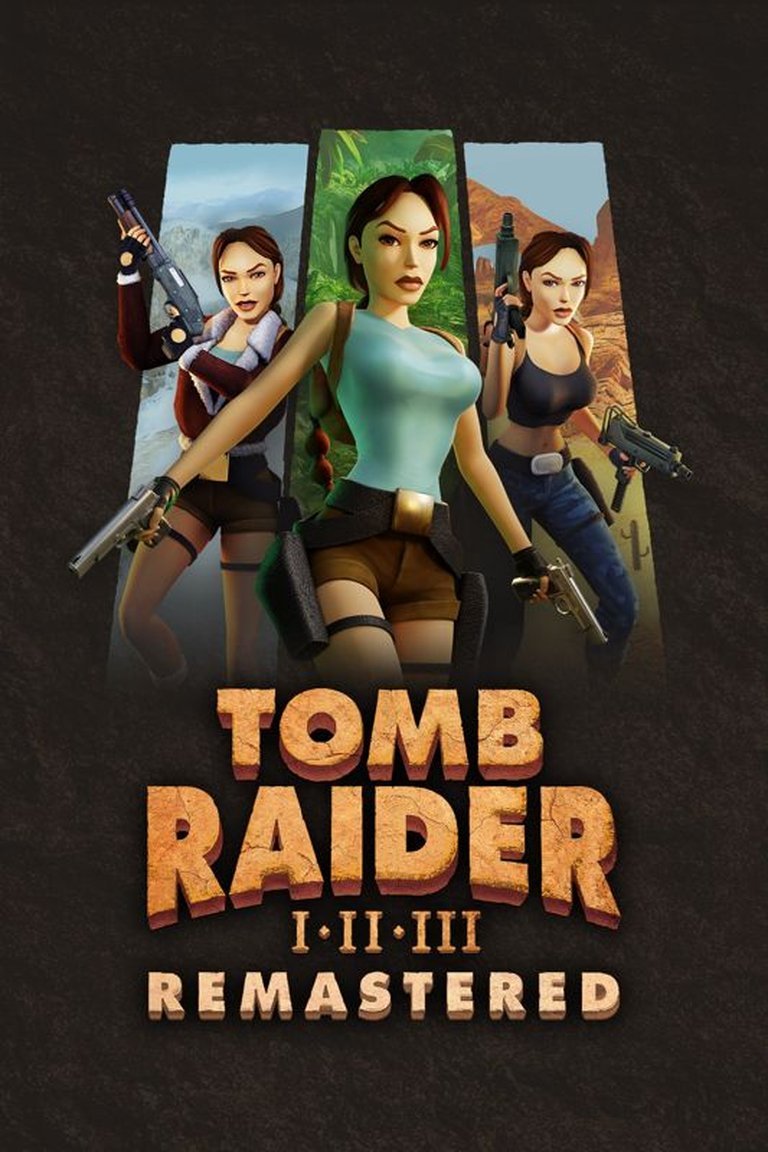
Tomb Raider I•II•III: Remastered is a compilation that brings the first three classic Tomb Raider games—Tomb Raider (1996) with Unfinished Business, Tomb Raider II with Golden Mask, and Tomb Raider III: Adventures of Lara Croft—along with Tomb Raider: The Lost Artifact to modern platforms. Players follow Lara Croft on her treasure-hunting quests through diverse settings spanning continents like Africa, Asia, and Europe, featuring iconic locations such as ancient Egyptian tombs, the city of Venice, the Scottish Highlands, and mythical realms like Atlantis, all enhanced with toggleable remastered graphics, a photo mode, and both classic and modern control presets.
Gameplay Videos
Where to Buy Tomb Raider I•II•III: Remastered
Tomb Raider I•II•III: Remastered Free Download
Tomb Raider I•II•III: Remastered Guides & Walkthroughs
Tomb Raider I•II•III: Remastered Reviews & Reception
thesixthaxis.com : Tomb Raider I-III Remastered beams us back to a time when it was all much simpler.
metacritic.com (75/100): Generally Favorable
nintendolife.com : What developer Aspyr has done here, however, is give all three titles a much-needed lick of paint, boosting the visuals significantly.
eurogamer.net : These classic games remain as ingenious, memorable and frustrating as ever.
Tomb Raider I•II•III: Remastered Cheats & Codes
Tomb Raider I Remastered
Ensure Tank Controls are enabled. Input the sequence during gameplay.
| Code | Effect |
|---|---|
| One step forward, One step backward, Turn around 3 times counter-clockwise, Jump forward | Skips to the next level |
| One step forward, One step backward, Turn around 3 times counter-clockwise, Jump backwards | Grants unlimited ammo and all guns |
| R, L, L, L, R, L, L, L, L, L, L, R, L, L, L, L, L, R, L, L | Unlocks the racetrack key in Lara’s home |
Tomb Raider II Remastered
Ensure Tank Controls are enabled. Input the sequence during gameplay.
| Code | Effect |
|---|---|
| Pull out a flare, One step forward, One step backward, Turn around 3 times counter-clockwise, Jump forward | Skips to the next level |
| Pull out a flare, One step forward, One step backward, Turn around 3 times counter-clockwise, Jump backwards | Unlocks all guns with max ammo, max health packs, and max flares |
| One step forward, One step backward, Turn around 3 times counter-clockwise, Jump backwards | Makes Lara explode immediately |
Tomb Raider III Remastered
Ensure Tank Controls are enabled. Input the sequence during gameplay.
| Code | Effect |
|---|---|
| Draw pistols, Walk one step back, One step forward, Crouch, Release crouch, Turn around three times, Jump forward | Skips to the next level |
| Draw pistols, Walk one step back, One step forward, Crouch, Release crouch, Turn around three times, Jump backwards | Unlocks all guns with max ammo and max med kits |
| One step forward, One step backward, Turn around 3 times counter-clockwise, Jump backwards | Makes Lara explode immediately |
| R2, R2, L2, R2, L2, L2, L2, L2, L2, L2, R2, L2, L2, L2, R2, L2, L2, L2, L2, L2 | Grants maximum health |
| RT, RT, LT, RT, LT, LT, LT, LT, LT, LT, RT, LT, LT, LT, RT, LT, LT, LT, LT, LT | Grants maximum health |
| ZR, ZR, ZL, ZR, ZL, ZL, ZL, ZL, ZL, ZL, ZR, ZL, ZL, ZL, ZR, ZL, ZL, ZL, ZL, ZL | Grants maximum health |
Tomb Raider I•II•III: Remastered: A Monumental Restoration of Gaming’s Original Icon
As a historian of interactive entertainment, few compilation releases carry the same dual weight of cultural preservation and direct lineage as Tomb Raider I•II•III: Remastered. This is not merely a nostalgic cash grab; it is the digital repatriation of a foundational trilogy that defined a genre, birthed an icon, and charted the treacherous early waters of 3D game design. Developed by Aspyr Media, with critical assistance from series co-creator Paul Douglas and OpenLara lead Timur “XProger” Gagiev, this collection represents a deliberate, reverent, and fiercely debated intervention in gaming’s canon. Its core achievement—and its most profound point of contention—lies in a single, radical philosophy: to preserve the original 1996-1998 source code and design intact, merely draping it in a new, optional visual skin and providing quality-of-life toggles. This review will argue that Tomb Raider I•III: Remastered is an indispensable, if deeply flawed, historical artifact. It succeeds supremely as a museum-grade restoration but stumbles when judged as a modernized product, exposing the unbridgeable gap between the meticulous puzzle-platforming of the mid-90s and the fluid, guided experiences of 2024.
1. Introduction: The Weight of a Legend
In the pantheon of video game icons, Lara Croft occupies a unique position. Launched in 1996, Tomb Raider was not just a game; it was a seismic cultural event. It sold millions, spawned films, and cemented the third-person action-adventure as a dominant genre. Yet, to access this legacy in the 21st century required emulation, aging hardware, or tolerate increasingly creaky ports. Tomb Raider I•II•III: Remastered seeks to change that, offering the complete, original trilogy—including all official expansion packs (Unfinished Business, The Golden Mask, The Lost Artifact)—on modern platforms with a toggleable graphical overhaul, dual control schemes, and a suite of modern features. The thesis is straightforward: this remaster is a masterclass in preservation that, by its very nature of authenticity, cannot escape the intrinsic design limitations of its era, creating a体验 that is ultimately defined by the player’s relationship with gaming history. For the veteran, it is a time capsule; for the newcomer, it is often a frustrating archaeology lesson.
2. Development History & Context: From PS1 Polygons to Modern Code
The original trilogy was the product of Core Design, a Derby-based studio operating under immense technological constraints. The 1996 original was a groundbreaking feat of software engineering, using a proprietary engine to render complex 3D environments on PlayStation and DOS hardware with a mere 640KB of RAM for level data. Its iconic “tank controls” (where up moves Lara relative to the camera’s current orientation) were a pragmatic solution to 3D orientation on a controller with a single analog stick, later a d-pad. The subsequent games iterated on this formula: Tomb Raider II expanded scope and spectacle, Tomb Raider III introduced non-linear level selection and vehicle sections, but all were bound by the same hard-won, often cumbersome, core mechanics.
The path to this remaster was fraught. In 2018, Realtech VR announced PC remasters, only for Square Enix to disavow them, stating they were never approved. This highlighted the precarious state of legacy code. The project ultimately landed with Aspyr, a studio with a long history with the franchise, having ported earlier titles to Mac. Crucially, Aspyr’s philosophy was one of “faithful restoration over reinvention.” As Product Director Chris Bashaar stated, they wanted the games “to look the way they did in your mind.”
A “dream team” of true fans was assembled, including Paul Douglas (who located the original source code and assets from floppies and Zip disks) and Timur Gagiev, the creator of the fan-made OpenLara engine. Their technical approach was revolutionary: they used the original, unmodified source code and engine. The “modern” graphics are not a rebuild but a high-resolution texture upscale (using AI tools, as confirmed by Crystal Dynamics), new character models, and dynamic lighting effects layered on top of the original geometry and logic. This allows the instant, seamless toggle between original and remastered visuals—a feature of profound importance for preservation and critical analysis. The modern control scheme was inspired by Crystal Dynamics’ later Legend, Anniversary, and Underworld reboots, attempting to decouple movement from camera orientation.
3. Narrative & Thematic Deep Dive: The Archaeology of a Story
The narrative thread of the original trilogy is a bizarre, globetrotting patchwork of pulp adventure and nascent conspiracy, reflecting its time.
- Tomb Raider (1996): The foundational myth. Lara, a young heiress and archaeologist, is hired by the mysterious Natla to recover the Scion artifact from the lost city of Vilcabamba. The plot is a straightforward MacGuffin chase through Peru, Greece, Egypt, and the mythical Atlantis, revealing Natla as a remnant of the ancient Atlantean “Three Rulers” seeking to rebirth her civilization. Themes are simple: colonialist treasure hunting (framed as “preservation”), lone female agency in a male-centric world, and ancient astronaut theory. The dialogue is sparse and functional, with Lara’s iconic one-liners (“.45s are a girl’s best friend”) feeling separate from her silent in-game protagonist.
- Tomb Raider II (1997): Shifts to a more serialized adventure. Lara pursues the Dagger of Xian across the Great Wall of China, Venice, an offshore oil rig, and a Tibetan monastery. The antagonist, Italian mobster Marco Bartoli, is a more grounded foe, but the dagger’s dragon-transformation power reintroduces the supernatural. The narrative is more cohesive, with a clearer through-line, but still a series of disconnected locales. It introduces the infamous Croft Manor training level, a precursor to the “home base” concept.
- Tomb Raider III (1998): The most ambitious and disparate. Lara investigates a meteorite fragment, leading to four distinct, non-linear hubs: India, Nevada (Area 51-style), the South Pacific, and London. The Lost Artifact expansion continues this, adding a Scotland/France storyline involving a Nazi scientist’s legacy. The plot becomes a messy collage of aliens, mutants (the “SLInc” creatures), and corporate intrigue (RX-TECH). It lacks a singular villain, reflecting a “monster-of-the-week” structure that diluted the series’ early mythos.
Underlying Themes: Across all three, the dominant theme is “exploration as puzzle-solving.” The world is a museum of dangerous curiosities. There’s a persistent, unexamined colonial gaze—Lara enters tombs and natural habitats, plunders artifacts, and fights indigenous or monstrous guardians. This is the “treasure hunter” fantasy, unadorned. A more progressive (if unintentional) theme is female competence and autonomy. Lara is never a damsel; she is the sole agent, solving environmental puzzles and dispatching foes with cool efficiency. The 2024 release adds a mandatory, contemporary content warning about “offensive depictions of people and cultures rooted in racial and ethnic stereotypes,” acknowledging the era’s problematic troping (e.g., the “Indian” thug enemies in TR3, the Inuit spirits in Golden Mask). This is a crucial, if ethically complex, addition that frames the games as historical documents rather than endorsements.
4. Gameplay Mechanics & Systems: The Unforgiving Geometry of Fun
The core loop remains brutally simple: navigate 3D environments, avoid traps (spikes, boulders, blades, drowning), solve block-pushing and key-finding puzzles, and shoot enemies with an ever-expanding arsenal. The genius of the original design is in its environmental storytelling through geometry. Levels like TR1‘s “Palace Midas” or TR2‘s “Opera House” are not just mazes but crafted narratives of ancient booby traps and architectural logic.
The Tank Control Schism: This is the collection’s most defining—and divisive—feature. The classic “tank” controls are an acquired taste, demanding spatial memory and patience. Moving “up” on the stick moves Lara forward relative to the camera’s facing, not her own. This created a visceral, physical connection to the space but also immense frustration with fixed camera angles that would suddenly reorient, sending Lara leaping to her death. The “modern” controls, inspired by the later Crystal Dynamics games, allow Lara to move relative to her own orientation, with right-stick camera control. Critically, this is a half-measure. The level geometry, enemy placement, and puzzle solutions were all designed for tank controls. The modern scheme often leads to mis-jumps in precise platforming sections and feels like fighting the level design itself. As multiple critics (e.g., Hardcore Gamer, NintendoWorldReport) noted, it’s a “misunderstanding” of why the original controls existed. The true genius is the instant toggle—a museum curator’s dream, allowing direct comparison and letting players choose their preferred historical artifact.
Systems, Old and New:
* Combat: Simple, often clunky. Auto-aim assisted but lacked lock-on. Enemies had simple AI patterns. The addition of boss health bars in the remaster is a universally praised quality-of-life improvement, as the original games provided no feedback during lengthy boss fights.
* Progression: Purely level-based. No character stats or skill trees. Progression is measured in keys, artifacts, and secrets found.
* UI: Minimalist to a fault. No map (relying on memory and landmarks), limited ammo/health indicators. The remaster’s photo mode is a brilliant addition, leveraging the fixed camera angles to compose stunning shots, acting as both a tool and a new lens to appreciate the architecture.
* New Game+: Added for all three games, allowing carry-over of weapons/items for a second playthrough—a significant perk for speedrunners and completionists.
* Survival Elements: Limited oxygen, burn damage, and a single save point system (a brutal legacy of the PS1 memory card) remain untouched in the base mode. This is a point of extreme friction for modern audiences.
5. World-Building, Art & Sound: The Polygonal Epoch
Original Artistic Vision: Core Design’s greatest triumph was creating a sense of vast, believable, and deadly places from minimal polygons. The blocky, textured geometry of TR1‘s St. Francis’ Folly or TR2‘s Bartoli’s Hideout felt immense and real because the imagination filled the gaps. The pre-rendered, fixed camera angles were not a limitation but a directorial choice, framing shots like a film and controlling pacing and tension. The sound design was equally iconic: Nathan McCree’s atmospheric, synth-driven score, the distinct thwack of Lara’s pistols, the roar of a T-Rex, the ominous creak of shifting stone. These audio cues were pure, unadulterated Tomb Raider.
The Remastered Visuals: Aspyr’s approach was “baked and real-time” lighting, higher-resolution textures (upscaled via AI), and new, more detailed character and enemy models. The result is stylistically consonant but technically inconsistent. Lara’s new model is widely praised—she retains the classic proportions but with smoother, more expressive features, reminiscent of her early 2000s design. However, many critics (Eurogamer.de, Vandal Online) noted that the new textures can be “goofy-looking” or clash with the low-poly environments, sometimes breaking the carefully crafted atmosphere (e.g., making a dark, ominous cavern feel brighter and less threatening). The lighting can be uneven, and some 2D sprite items (like flies on corpses) were replaced with 3D models that sometimes look out of place. The brilliance is the toggle. It allows players to see the original, artistically intentional blockiness and the remaster’s attempt at realism side-by-side, making it clear that the original’s aesthetic was a cohesive whole, while the remaster is an additive layer. The upscaled FMV cutscenes are a notable low point, looking blurry but untouched.
Sound: The original score and sound effects are preserved perfectly. This is a win for authenticity. No new soundtrack was composed.
6. Reception & Legacy: A Definitive But Divided Collection
Critical Reception: The collection received “generally favorable” scores on PS5/Xbox Series X (Metacritic ~75) but “mixed or average” on Switch/PC (Metacritic ~71-73). The critical consensus is remarkably consistent in its praise and its complaints.
- Praised: Unwavering faithfulness to the source material, the inclusion of all expansion content, the graphical toggle (seen as a preservationist’s tool), the photo mode, the value (three full games + expansions for $30/$12 on PC), and the pure nostalgic power for veteran players. Push Square called it “the new standard for PS1 re-releases.” Nexus Hub highlighted its “labour of love” energy.
- Criticized: The modern control scheme is almost universally panned as “disastrous” (Kotaku), “annoying” (Push Square), and a “misunderstanding” (NintendoWorldReport). The graphical upgrade is seen as uneven, sometimes harming the original’s atmosphere (The Verge, Vandal). The retention of archaic design—manual saving, no rewind, punishing instant-death traps—is a barrier for new players (Eurogamer.de‘s warning to “throw all thoughts of comfort overboard” is telling). Some noted minor glitches introduced by the port.
Commercial Performance: It debuted at #4 in the UK physical charts (for its later Limited Run Games release), indicating strong demand from a dedicated fanbase. The 20% loyalty discount for owners of the original Steam/GoG versions was a smart, community-friendly touch.
Legacy and Influence: Tomb Raider I-III Remastered does not seek to influence future game design; it seeks to preserve a past one. Its legacy will be twofold:
1. As a Benchmark for Preservation: It sets a high bar for how to handle legacy code. Using the original source, providing toggles for graphics and controls, and including all official content is a model for respectful re-releases. It proves that “remaster” can mean “faithful restoration” rather than “full remake.”
2. As a Historical Document: It starkly illustrates how far game design, particularly in the action-adventure genre, has evolved. The contrast between Lara’s tank controls and the fluidity of Rise of the Tomb Raider is educational. It highlights the trade-offs: the original’s cryptic, rewarding exploration vs. the modern genre’s waypoint-driven clarity.
3. For the Franchise: It serves as a reset button, reminding players and Crystal Dynamics of the series’ roots: puzzle-platforming exploration over cover-based combat. The critical discussion around it has repeatedly mentioned hopes that future entries would “take notes” from these originals’ sense of discovery (ZTGameDomain, GameSpew).
The随后 announcement of Tomb Raider IV-VI Remastered just one year later confirms this is now an official preservation track for the “Classic Era,” a direct result of this first collection’s reception and commercial viability.
7. Conclusion: The Uncompromising Time Capsule
Tomb Raider I•II•III: Remastered is, ultimately, a masterpiece of curation and a flawed artifact of its time. It is the definitive way to experience the original trilogy because it presents them with scholarly thoroughness: untouched at their core, enhanced superficially, and documented with extras (achievements, photo mode). For the historian or nostalgic fan, this is a pantheon-grade release. The toggles are not just features; they are philosophical statements, allowing the player to inhabit two simultaneous realities—the 1996 vision and the 2024 interpretation.
However, its very fidelity is its greatest weakness for the uninitiated. The games are hard. They are cryptic, punishing, and control schemes—even the “modern” one—feel clunky by today’s standards. The lack of a rewind function, the brutal save system, and the trial-and-error platforming are not “features” to be celebrated in 2024; they are genuine barriers. As Game Rant astutely noted, it requires two review scores: one for veterans, and a far lower one for newcomers.
Final Verdict: Tomb Raider I•II•III: Remastered earns its place in history not as a perfect game, but as a perfect preservation project. It is a lovingly assembled museum exhibit where you can touch the artifacts. It is a crucial, accessible bridge to a seminal moment in gaming. But it is also a stark reminder that not all classics age gracefully, and that “faithful” does not always mean “enjoyable” for those without the lens of nostalgia. Its value lies in its existence as a complete, authentic time capsule. Whether you choose to spend 60+ hours inside that capsule depends entirely on your appetite for the challenging, opaque, and strangely poetic design philosophy of the mid-1990s. For those who do, the adventure remains as potent, frustrating, and awe-inspiring as it was in 1996. For everyone else, it remains a vital, but potentially alienating, lesson in where we came from.