
- Release Year: 2013
- Platforms: Macintosh, PlayStation 3, Windows, Xbox 360
- Publisher: Eidos, Inc., Feral Interactive Ltd., Square Enix, Inc.
- Genre: Compilation
- Game Mode: Online PVP
- Average Score: 95/100
Description
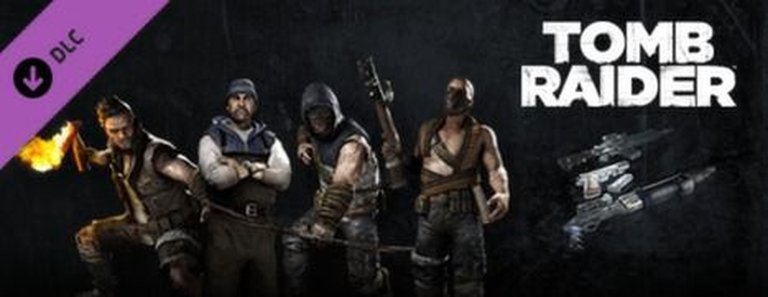
Tomb Raider: Online Survival Pack is a downloadable content (DLC) expansion for the 2013 Tomb Raider reboot, augmenting the game’s multiplayer mode with new playable characters—including the Fisherman, Scavenger Bandit, Scavenger Executioner, and Scavenger Scout—alongside exclusive weapons like the Agency SPS 12 and Silverballer, all set on the hostile Yamatai island where survivors compete in intense, competitive matches.
Tomb Raider: Online Survival Pack Reviews & Reception
imdb.com (100/100): What a fantastic game this is.
ign.com : It is a greatly successful origin story, a series reboot that feels both authentic and hugely exciting.
pocg.net (90/100): Tomb Raider (2013) redefines Lara Croft with a gritty, emotional origin story and tight, survival-focused gameplay.
Tomb Raider: Online Survival Pack: A Fractured Reflection of a Reboot’s Ambition
Introduction: The Unseen Appendix
In the annals of Tomb Raider‘s tumultuous history, 2013 marks a definitive schism—a violent, rain-lashed, and emotionally raw rebirth for Lara Croft. The critical and commercial triumph of Crystal Dynamics’ Tomb Raider reboot was built on a singular, focused vision: a harrowing origin story of survival on the island of Yamatai. Yet, appended to this singular narrative campaign was a contradictory, almost schizophrenic element: an online multiplayer mode. The Tomb Raider: Online Survival Pack is not a standalone game, but a modest compendium of downloadable content (DLC) for this multiplayer component. Released in mid-2013, it represents a fascinating, if flawed, footnote—Square Enix’s attempt to graft the burgeoning “games as a service” model onto a franchise built on solitary, cinematic adventure. This review argues that the Online Survival Pack is less a cohesive expansion and more a collection of cosmetic and map-based trifles that, by its very existence, highlights the profound disconnect between the profound, personal journey of the single-player campaign and the generic, throwaway nature of its multiplayer counterpart. It is a testament to the era’s DLC proliferation that such a minor package warranted a distinct MobyGames entry, yet a deep dive reveals it as a curious artifact of a pivotal moment where a legacy franchise tentatively, and ultimately unsuccessfully, explored communal play.
Development History & Context: Outsourced Ambition in the Shadows of a Reboot
The development history of the Online Survival Pack is inseparable from the broader development of Tomb Raider (2013) itself. Following the release of Tomb Raider: Underworld in 2008, Crystal Dynamics was split into two teams. One focused on the next mainline entry, which would become the 2013 reboot, while the other tackled the spin-off Lara Croft and the Guardian of Light. This division speaks to a franchise at a crossroads, seeking to revitalize its core while experimenting with new formats.
The decision to reboot was monumental. Studio head Darrell Gallagher described it as “an origin story… a new way,” moving away from the confident, dual-pistol-wielding icon toward a vulnerable, newly-minted survivor. The technological canvas was the mature, widely-installed hardware of the Xbox 360 and PlayStation 3, with Crystal Dynamics pushing its in-house “Foundation” engine to its limits, achieving visuals that “had no business looking as good” on those consoles, as noted by fan-technical analyst Matt. The team employed performance capture, with Camilla Luddington’s embodiment of Lara becoming a watershed for character animation and voice acting in the series.
Crucially, the multiplayer mode was not developed by Crystal Dynamics. It was outsourced to Eidos-Montréal, the studio then celebrated for the impeccably crafted single-player RPG Deus Ex: Human Revolution. This decision is the key to understanding the Online Survival Pack‘s nature. It situates the multiplayer as a parallel project, developed with a different philosophy and set of priorities, grafted onto a game whose soul was being meticulously reforged in California. The “Survival” moniker of the pack, then, is ironic—it attempts to apply the single-player’s survivalist theme (salvage, crafting, desperation) to a sterile PvP environment. The pack’s release timeline, shortly after the base game’s launch in March 2013, follows a now-standard model: use the core campaign to drive player engagement, then monetize the multiplayer layer with small, incremental content drops. The Online Survival Pack—with its specific listing of four scavenger/bandit character skins and seven weapon skins (Agency SPS 12, HX AP-15, etc.)—is a pure transaction. It offers no narrative, no new mechanics, but merely aesthetic variety within the established modes: Team Deathmatch, Private Rescue, and Cry for Help. It is the digital equivalent of a uniform change for a soldier in a war they didn’t write.
Narrative & Thematic Deep Dive: Ghosts in the Multiplayer Machine
A review of the Online Survival Pack must confront a glaring absence: it has no narrative of its own. Its “story” is the story of Yamatai as translated into a PvP arena. The single-player campaign is a tightly wound thriller about a specific cast—Lara, Roth, Sam, Jonah, Reyes, Grim, Alex, and the villainous Mathias—stranded on an island governed by the supernatural legacy of the Sun Queen, Himiko. Themes of cultish fanaticism (the Solarii Brotherhood), the corrupting pursuit of power (the Ascension ritual), and the forging of identity through trauma (“A Survivor is Born”) are meticulously plotted.
The multiplayer, and by extension the Online Survival Pack, reduces this rich tapestry to a branding exercise. The maps—Shanty Town, Scavenger Caverns, Burning Village, Cliff Shantytown, Dogfight, Forest Meadow, Lost Fleet, Himiko’s Cradle—are named after locations and concepts from the single-player world, but they are stripped of all context. The “Scavenger” character classes directly reference the island’s native, predatory inhabitants, but in a multiplayer match, they are simply one team versus another. The thematic heart of the single-player—Lara’s visceral, reluctant journey from scholar to killer—is entirely absent. The pack’s “Fisherman” skin nods to Jonah Maiava, but his gentle, spiritual presence is lost; he is just another avatar for a player to shoot.
The most profound disconnect lies in the core activity: rampant, repetitive killing. As critic Justin Speer noted, there is a “paradoxical approach” where “the story attempted to characterise Lara Croft as vulnerable and uncomfortable with killing, the player was encouraged to engage enemies aggressively and use brutal tactics to earn more experience points.” The Online Survival Pack exacerbates this. The weapons it adds (like the Silverballer from Hitman: Absolution, a cross-promotional oddity) and the character models are tools for thisKilling spree, devoid of the weight Lara’s first kill carried in the narrative. The pack does not engage with Yamatai’s lore; it merely appropriates its iconography for a generic shooter experience. It creates a cognitive dissonance: you can use a “Scavenger Executioner” skin to kill another player’s “Agency” operative on the “Himiko’s Cradle” map, all while the single-player Lara is, moments before or after in your playtime, desperately trying to prevent a sacrificial ritual on that very site. The pack is thematically hollow, a collection of ghosts wearing the masks of a story they do not inhabit.
Gameplay Mechanics & Systems: Cosmetic Trivialities in a Ill-Fated War
The base game’s gameplay was a revelation for the series, blending Uncharted-style cinematic action with a new survivalist lexicon. The “Survival Instinct” highlighting system, the resource-based weapon upgrades, the visceral close-quarter kills, and the interconnected, Metroidvania-esque hub structure of Yamatai all served the narrative of evolution under duress. The bow, in particular, became an iconic tool, enabling stealth and precision that felt earned.
The multiplayer, conceived by Eidos-Montréal, was a competent but unremarkable asymmetrical team-based shooter. The three modes were standard fare: straight-up Team Deathmatch, an objective-based “Private Rescue” (delivering meds), and the more unique “Cry for Help” (retrieving batteries for radio beacons). Its connection to the single-player was superficial: shared map layouts and the ability to destroy environmental objects (a feature highlighted in E3 2012 demos).
The Online Survival Pack adds nothing to these systems. It is a purely cosmetic layer.
* Character Skins: Four new operator looks for the Scavenger and Survivor teams (“Fisherman,” “Scavenger Bandit,” “Scavenger Executioner,” “Scavenger Scout”). These are reskins with no statistical differentiation, merely visual variety for identification or aesthetic preference.
* Weapon Skins: Seven weapon appearances (“Agency SPS 12,” “HX AP-15,” “JAGD P22G,” “M590 12ga,” “Silverballer,” “STG 58 Elite,” plus the implied base variants). They change the look of existing guns but do not alter stats like damage, fire rate, or recoil.
* Map Pack: The core of the pack is the “Shanty Town” map, originally a pre-order bonus, now bundled. The other listed maps (Caves & Cliffs, 1939, Shipwrecked) were separate DLC releases, but the pack’s MobyGames entry seems to catalog all multiplayer additions under one umbrella, creating confusion. Functionally, they add arena geometry but no new mechanics.
There is no new progression system, no new game mode, no survival-specific toggle. The pack is a statement of abundance, not innovation. In an era where multiplayer DLC often meant new operators with unique abilities (Rainbow Six Siege) or new maps with exotic mechanics (Destiny), the Online Survival Pack feels antiquated and cheap. It speaks to a time when publishers believed that even minor visual additions for a secondary mode were marketable as a distinct “pack.” Its “systems” are nonexistent; its design philosophy is purely extractive, offering zero meaningful choice or strategic depth.
World-Building, Art & Sound: Appropriation Without Atmosphere
The Yamatai of the single-player campaign is a character itself. Based on a fictionalized “Dragon’s Triangle” off Japan, it blends lush, rain-swept jungles, WWII relics, Japanese architectural ruins, and the stark, brutalist fortress of the Solarii Cult. The art direction, led by Brian Horton, was praised for its detailed environmental storytelling—clues about Portuguese traders, U.S. Marines, and Japanese experiments litter the island. The sound design, by Jason Graves, was a masterpiece of atmospheric dread, using unconventional percussion (created with architect Matt McConnell) to evoke a sense of primal, found-sound unease rather than stereotypical Japanese instrumentation.
The multiplayer maps, and thus the Online Survival Pack‘s contribution, exist in a state of parody. “Shanty Town” is literally a slum of scrap metal and tents, a thematic dead-end that has none of the narrative weight of the single-player’s scavenger settlements. “Himiko’s Cradle” places the sacred ritual chamber in a deathmatch arena, trivializing its significance. The “Burning Village” and “Scavenger Caverns” are generic environments re-skinned with Yamataian props. There is no environmental narrative, no sense of place or history. The soundscapes, presumably reusing assets, are reduced to the echo of gunfire and footsteps, devoid of Graves’ haunting score or the ambient howls of wolves and patter of rain that defined the campaign’s tension.
The character skins further this disservice. The “Scavenger” models are meant to evoke the island’s feral inhabitants, but in motion, they are just another shooter archetype—tattered clothes, crude weapons. The “Fisherman” skin on a Survivor class is a laughable nod to Jonah, stripped of his warmth and imposing physique. The art that made Lara’s journey so immersive—the weathering on her clothes, the realistic mud and blood, the expressive face captured by Megan Farquhar’s model—is utterly absent. These are flat, low-poly models designed for clarity at a distance, not for emotional connection. The Online Survival Pack does not build the world of Yamatai; it violates it, turning its sacred spaces into kill-boxes and its traumatized survivors into interchangeable pawns.
Reception & Legacy: The Sound of One Hand Clapping
The critical reception of the base Tomb Raider (2013) was resounding, with Metacritic scores in the high 80s. Praise was heaped on Lara’s characterization, the graphics, the gameplay fusion, and Jason Graves’ soundtrack. The multiplayer, however, was a consistent point of criticism. As summarized, critics like IGN’s Keza MacDonald, GameTrailers’ Justin Speer, and Game Informer’s Matt Miller found it “lackluster,” noting the “difference between the developer’s vision for the game mode and the finished product.” The consensus was that it felt tacked-on, a contractual obligation or a box-ticking exercise for the era’s demand for online components.
Against this backdrop, the Online Survival Pack received no independent critical coverage. It was not reviewed. It is a ghost in the machine, a piece of commercial content that existed to be purchased by players already invested in the multiplayer’s shallow loop. Its legacy is twofold:
1. A Symptom of the Times: It epitomizes the early-2010s trend of “multiplayer DLC” for single-player focused games—a practice largely abandoned as developers realized the resources were better spent on core experiences or dedicated live-service models. The pack’s obscurity contrasts sharply with the celebrated single-player DLC, like the “Caves & Cliffs” map pack which was at least new geography to explore.
2. An Amputation in the Franchise’s Body: The 2013 reboot’s multiplayer was quietly jettisoned for the superior, more integrated asymmetrical multiplayer in Rise of the Tomb Raider (2015). That game’s “Legacy” mode had its own DLC, but it was conceptually richer. By Shadow of the Tomb Raider (2018), the focus was purely single-player. The Online Survival Pack is thus a relic of a failed experiment—a franchise’s awkward first step into communal play that contributed to the decision to abandon the model after one iteration. Its legacy is one of silence; it is not mourned, not remembered, and not referenced.
From a fan perspective, as seen in the Tomb Raider Horizons testimonials, the impact of the 2013 reboot was almost exclusively through the single-player campaign. Fans spoke of Lara’s emotional journey inspiring creativity, life changes (“Live More Lara”), academic pursuits in archaeology, and deep engagement with the narrative and lore. The multiplayer, and by extension the Online Survival Pack, is absent from these stories. It is the forgotten half of the game, an experience players may have dabbled in but one that left no lasting impression. It could not capture the magic of Yamatai because it was never designed to; it was designed to be a cycle of spawns and kills, a contrast so stark to the campaign that it highlighted the campaign’s strengths by sheer, miserable deficiency.
Conclusion: The Definitive Verdict on a Trivial Expansion
The Tomb Raider: Online Survival Pack is not a bad product in the traditional sense; it is a non-product. It delivers exactly what it promises: a handful of new visual options for a multiplayer mode few cherished. Its value is entirely contingent on a pre-existing addiction to a fundamentally flawed component of a otherwise brilliant game. Evaluating it on gameplay, narrative, or artistic merit is like critiquing the paint on a lifeboat—the concern is misaligned with its purpose and its context.
Its true significance is as a historical artifact. It marks a moment when a major, legacy single-player franchise, undergoing a daring and successful reboot, felt industry pressure to include a modern multiplayer component. The outsourcing to Eidos-Montréal, the generic shooter mechanics, and the纯粹 cosmetic DLC strategy together paint a picture of a “value-add” that was never meant to be integral, only existent. The pack’s utter forgettability is the final judgment. While Lara Croft’s origin on Yamatai is discussed in academic papers, celebrated in anniversary retrospectives, and inspiring to countless fans, the right to wield a “Silverballer” pistol as a “Scavenger Scout” on the “Shanty Town” map has left no trace. It dissolved into the ether of server shutdowns (assuming the multiplayer was ever active) and the march of time.
In the scope of Tomb Raider history, the Online Survival Pack is a null set. It adds nothing of substance to the 2013 reboot’s legacy, nor does it meaningfully extend its multiplayer life. It is the game industry’s equivalent of a promotional keychain—an object meant to signal participation in a larger ecosystem but possessing no inherent value or story of its own. For the historian, it is a crucial data point about the pervasive, often misguided, expectations of the early 2010s. For the player, it is irrelevant. For Lara Croft, the true survivor of 2013, it is merely noise she never had to hear. The pack’s most accurate review is its own obscurity. ★★☆☆☆ (2/5) — Exists only as a commercial footnote, offering cosmetic trifles for a multiplayer mode that fundamentally misunderstood the spirit of the reboot it accompanied.