
- Release Year: 2006
- Platforms: Game Boy Advance, Windows
- Publisher: THQ Inc., ValuSoft, Inc.
- Developer: Webfoot Technologies, Inc.
- Genre: Simulation
- Perspective: Diagonal-down
- Game Mode: Single-player
- Gameplay: City building, construction simulation, Vehicle simulator
- Setting: Cities, Dirt yards, Forests, Gravel pits
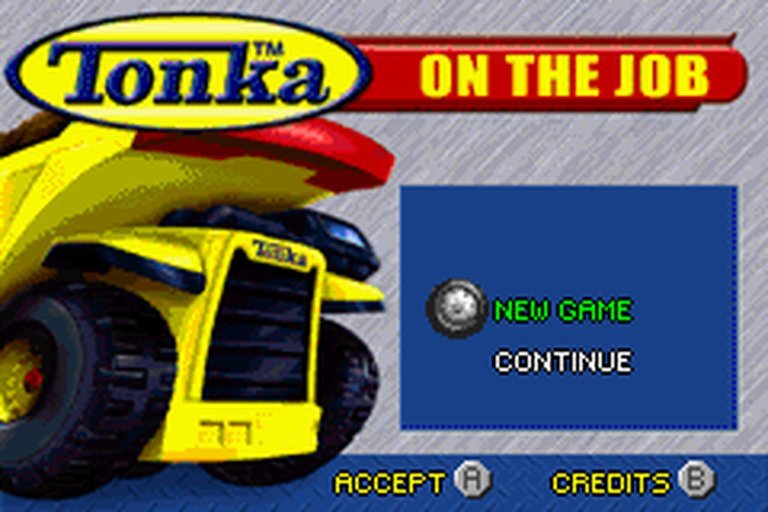
Description
Tonka On the Job is a light simulation game where players construct and operate various Tonka-branded toy trucks, such as the Mighty Dump and Mighty Front Loader, to complete tasks like building foundations, digging canals, and clearing trees. The game features a bird’s-eye view of 2D-scrolling environments, including dirt yards, cities, and forests, with each vehicle serving a specific purpose. Players must strategically switch between vehicles to efficiently complete jobs, which become increasingly complex as more trucks are unlocked. The game includes a performance rating system based on fuel efficiency and task completion, as well as optional time-limited challenges like extinguishing fires. It offers both a structured job mode and a freeplay mode for unlimited construction and destruction.
Gameplay Videos
Tonka On the Job Free Download
Tonka On the Job Cracks & Fixes
Tonka On the Job Cheats & Codes
Game Boy Advance
At the ‘Main’ menu select ‘Continue’ and enter the following codes followed by the ‘A’ button.
| Code | Effect |
|---|---|
| 2WOWCR3YLV | Big Mountain Way Start |
| 4.6.2FZ8J9 | Lazy ‘T’ Ranch Complete |
| 4.PBWZ.J9 | New Park City Complete |
| 2WOW.5FWLV | Old Town Complete |
| KCHCMRYC3B | Petey’s Gravel Pit Complete |
| 0HMQ83CYNX | Training Complete |
Tonka On the Job: A Forgotten Gem of Construction Simulation
Introduction: The Unsung Hero of Toy-Based Simulators
In the mid-2000s, licensed games were often dismissed as shallow cash grabs, but Tonka On the Job (2006) defied expectations. Developed by Webfoot Technologies and published by THQ, this construction simulation game transformed the beloved Tonka toy trucks into a surprisingly deep, strategic experience. While it lacked the mainstream acclaim of contemporaries like SimCity or RollerCoaster Tycoon, Tonka On the Job carved out a niche as a charming, accessible, and deceptively complex vehicle simulator. This review explores its development, mechanics, legacy, and why it remains a fascinating relic of its era.
Development History & Context: Building on a Toy Empire
The Tonka Legacy and Licensing Power
Tonka, the iconic American toy brand, had been a household name since the 1940s, synonymous with durable, yellow construction vehicles. By the 2000s, the brand had expanded into video games, with titles like Tonka Construction (1996) and Tonka Space Station (2000) testing the waters of digital play. Tonka On the Job was part of this push, aiming to capitalize on the brand’s nostalgic appeal while introducing a new generation to virtual construction.
Webfoot Technologies: The Studio Behind the Wheels
Webfoot Technologies, a Seattle-based developer, was no stranger to licensed children’s games. Their portfolio included My Little Pony: Crystal Princess and American Girl: Julie Finds a Way, but Tonka On the Job stood out for its focus on simulation mechanics rather than pure edutainment. The team, led by Callum Davies (Head Foreman) and Jim Grant (Design/Art), sought to create a game that was both kid-friendly and engaging for older players who enjoyed logistical challenges.
Technological Constraints and Platform Differences
Released first on the Game Boy Advance (GBA) in November 2006 and later on Windows (2007), the game faced hardware limitations that shaped its design:
– GBA Version (2006):
– Limited to 11 vehicles due to cartridge space.
– 2D diagonal-down perspective with simple, functional sprites.
– No voice acting, relying on text prompts.
– PC Version (2007):
– Expanded to 13 vehicles with higher-resolution graphics.
– More detailed environments and smoother animations.
– Identical core gameplay, proving the design’s adaptability.
The game’s deformable terrain and multi-vehicle coordination were ambitious for the GBA, requiring clever optimization. The PC version, while visually superior, retained the same mission structure and physics, making it a rare case where a handheld port wasn’t a watered-down experience.
The Gaming Landscape of 2006-2007
At the time, construction simulators were a niche genre. SimCity 4 (2003) and RollerCoaster Tycoon 3 (2004) dominated the broader simulation market, while Construction Simulator (2012) was still years away. Tonka On the Job filled a gap for younger audiences and casual players who wanted hands-on vehicle operation without complex city management. Its accessibility and licensed appeal made it a unique entry in the genre.
Narrative & Thematic Deep Dive: More Than Just Digging Dirt
Plot and Structure: A Job-Based Progression
Tonka On the Job eschews a traditional narrative in favor of a mission-based structure. Players assume the role of a construction foreman, tasked with completing jobs across various environments:
– Dirt yards (basic excavation)
– Cities (roadwork and traffic navigation)
– Gravel pits (resource gathering)
– Forests (tree clearing and land preparation)
Each job begins at the Tonka Garage, where players select and deploy vehicles. The Foreman (a faceless authority figure) provides objectives via text prompts, reinforcing the game’s worksite aesthetic.
Themes: Teamwork, Efficiency, and Problem-Solving
While superficially a “kids’ game,” Tonka On the Job subtly teaches:
1. Resource Management:
– Fuel efficiency is graded—wasting movements lowers your score.
– Vehicles have specific roles, forcing players to plan sequences (e.g., using the Mighty Front Loader to scoop dirt before the Mighty Dump transports it).
2. Adaptability:
– Missions often allow multiple solutions—players can clear land before or after grading, encouraging experimentation.
– Emergency tasks (e.g., fires, injured workers) test quick thinking.
3. Progression and Reward:
– Unlocking new vehicles (Helicopter, Tough Bulldozer, Rescue Fire Truck) feels like earning promotions.
– The three-star rating system (based on speed, fuel use, and completeness) adds replayability.
Characters and Tone: Wholesome Worksite Vibes
The game’s cheerful, utilitarian tone mirrors the Tonka brand’s identity:
– Vehicles are the “characters”—each has distinct abilities and visual personalities (e.g., the Mighty Crane’s precision vs. the Toughest Mighty’s brute force).
– No dialogue or cutscenes, but the sound design (engine revs, hydraulic hisses) gives life to the machines.
– The Free Play mode embodies childhood fantasy—unrestricted destruction and creation, akin to a digital sandbox.
Gameplay Mechanics & Systems: A Masterclass in Simplified Depth
Core Gameplay Loop: Deploy, Operate, Optimize
The game’s brilliance lies in its easy-to-learn, hard-to-master design:
1. Vehicle Selection & Deployment:
– Players choose from 11-13 trucks, each with unique functions:
– Mighty Dump: Hauls dirt (4-load capacity).
– Mighty Front Loader: Scoops and loads dirt.
– Mighty Cement Mixer: Pours foundations.
– Rescue Fire Truck: Extinguishes fires (bonus objectives).
– Switching vehicles on the fly is seamless, allowing dynamic problem-solving.
2. Mission Execution:
– Tasks range from digging canals to building roads, with multi-step processes (e.g., clear → grade → construct).
– Traffic and obstacles (rocks, trees) add complexity in later levels.
3. Scoring and Efficiency:
– Three-star ratings reward optimal routes, minimal fuel use, and speed.
– Bonus objectives (e.g., rescuing workers) provide extra fuel, enabling higher scores.
Innovative Systems
- Deformable Terrain:
- Digging, grading, and dumping physically alter the environment, a rare feature in 2D simulators.
- Dynamic Emergencies:
- Random fires or blocked paths force ad-hoc strategy shifts.
- Free Play Mode:
- A pure sandbox where players can build, destroy, and experiment without constraints.
Flaws and Limitations
- Repetitive Mission Design:
- Later jobs feel like reskinned early tasks with added vehicles.
- GBA Controls:
- The d-pad + button layout makes precise vehicle maneuvering clunky.
- Lack of Depth in Progression:
- No persistent upgrades—vehicles remain static, limiting long-term engagement.
World-Building, Art & Sound: A Love Letter to Construction Sites
Visual Design: Functional and Charming
- GBA Version:
- Blocky, colorful sprites with clear silhouettes for easy identification.
- Isometric environments convey depth despite 2D limitations.
- PC Version:
- Crisp, detailed vehicles with smoother animations.
- More vibrant backgrounds (e.g., bustling cities vs. GBA’s static layouts).
Sound Design: The Symphony of Heavy Machinery
Composer Yannis Brown crafted a minimalist but effective audio experience:
– Engine hums, hydraulic lifts, and crunching gravel sell the construction fantasy.
– Upbeat, looped workplace tunes reinforce the game’s energetic tone.
– No voice acting, but text prompts are clear and concise.
Atmosphere: A Digital Playground
The game’s wholesome, industrious vibe makes it feel like a virtual Tonka playset. The lack of pressure (no fail states, just ratings) encourages experimentation, aligning with the toy-like freedom the brand represents.
Reception & Legacy: The Overlooked Builder
Critical and Commercial Reception
- No Metacritic scores or major reviews exist, suggesting limited marketing.
- Player reception (where documented) was positive but niche—praised for its accessibility but criticized for repetition.
- Commercial performance is undocumented, but its budget pricing ($19.99 new) suggests it was a mid-tier licensed title.
Legacy and Influence
- Paved the way for later construction sims like Construction Simulator (2012) by proving vehicle-specific gameplay could work.
- Demonstrated that licensed games could have depth—unlike many tie-ins, it wasn’t a shallow cash grab.
- Cult following among retro collectors, especially for its GBA rarity.
Conclusion: A Hidden Blueprint for Fun
Tonka On the Job is a flawed but fascinating relic—a game that respected its source material while delivering surprising strategic depth. Its vehicle-switching mechanics, deformable terrain, and efficiency-based scoring were ahead of their time for a licensed title. While it lacks the polish of modern simulators, its charm, accessibility, and clever design make it a worthy footnote in simulation history.
Final Verdict: 7.5/10 – “A Diamond in the Dirt”
- Pros:
- Intuitive yet deep vehicle mechanics.
- Encourages creativity in problem-solving.
- Nostalgic Tonka appeal with surprisingly robust gameplay.
- Cons:
- Repetitive mission structure.
- Clunky GBA controls.
- Lack of long-term progression.
For fans of construction sims, retro GBA gems, or underrated licensed games, Tonka On the Job is a hidden treasure—proof that even a toy-based title could build something meaningful.
Would you dig it? If you enjoy logistical puzzles with a side of nostalgia, this one’s worth excavating. 🚜💨