
- Release Year: 2003
- Platforms: PlayStation 2, Windows, Xbox
- Publisher: 2K Games, Inc., Atari, Inc., Microsoft Corporation
- Developer: Indie Built, Inc., Power and Magic Development
- Genre: Sports
- Perspective: Behind view
- Game Mode: Online PVP, Single-player
- Gameplay: Career mode, Exhibition mode, Skill progression, Tournament Play
- Setting: City – Lisbon, Real-world tennis tournaments
- Average Score: 84/100
Description
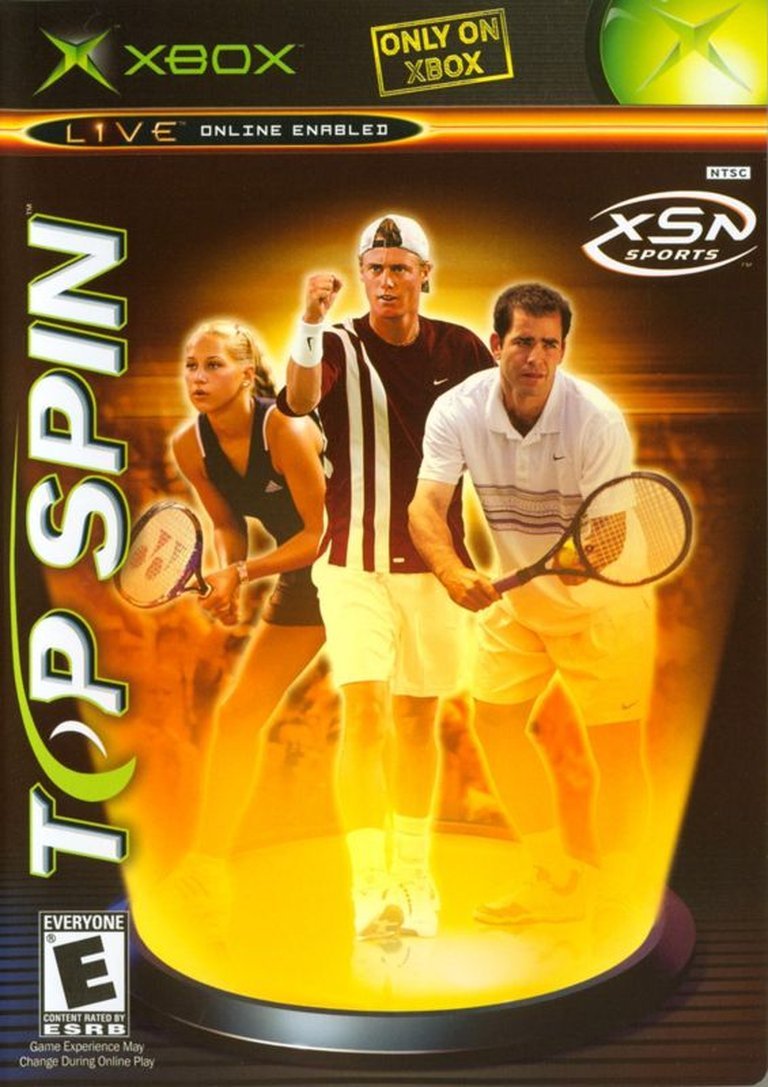
Top Spin is a tennis video game released in 2003 for Xbox, featuring online play over Xbox Live, a career mode where players can create and develop their own character, and real-life professional tennis players. The game allows for singles and doubles matches, with rankings and stats tracked on XSNsports.com.
Gameplay Videos
Where to Buy Top Spin
PC
Top Spin Free Download
Top Spin Cracks & Fixes
Top Spin Patches & Updates
Top Spin Mods
Top Spin Guides & Walkthroughs
Top Spin Reviews & Reception
metacritic.com (89/100): Come game time, stellar graphics – easily the best ever for any tennis game – are center court, along with astutely tuned AI – staunch but never frustrating, always in league with your rank.
en.wikipedia.org : Top Spin is a 2003 tennis video game developed by Salt Lake Games Studio and PAM Development and published by Microsoft Game Studios for the Xbox in October 2003.
mobygames.com (79/100): Top Spin is the Xbox’s first tennis game, and it’s playable over Xbox Live, allowing the player to compete in the XSN Sports Network.
games.criticker.com : Top Spin is the complete tennis experience. Define your tennis playing style, take risks, pull off world-class shots, and work the crowd to develop a unique image on the court.
Top Spin Cheats & Codes
Xbox
Enter codes at the main menu.
| Code | Effect |
|---|---|
| Left Thumbstick Up + Black/White | Unlock more random varieties of taunts |
| Left Thumbstick Down + Black/White | Unlock more random varieties of taunts |
| Left Thumbstick Left + Black/White | Unlock more random varieties of taunts |
| Left Thumbstick Right + Black/White | Unlock more random varieties of taunts |
Top Spin: The Definitive Tennis Simulation That Redefined the Genre
In the pantheon of sports video games, few titles have managed to capture the essence of their chosen sport as completely as Top Spin did for tennis in 2003. When Microsoft Game Studios released this groundbreaking title for Xbox, it didn’t just offer another tennis game—it delivered an authentic, nuanced simulation that would influence the genre for years to come.
Development History & Context
Top Spin emerged from an unlikely partnership between French developer PAM Development and Microsoft’s Salt Lake City division, known as Indie Built. This collaboration brought together PAM’s expertise in sports game development with Microsoft’s technical prowess and vision for the Xbox platform. The timing was perfect—2003 marked the first full year of Xbox Live, and Microsoft was eager to establish exclusive titles that could showcase their online capabilities.
Program manager Matthew Seymour envisioned Top Spin as an Xbox competitor to the reigning tennis champions of the era: Sega’s Virtua Tennis and Nintendo’s Mario Tennis. However, the development team had a different philosophy. Rather than creating another arcade-style experience, they aimed to craft an “immersive tennis game” with “in-depth and realistic tactical elements” that were absent from contemporary tennis titles.
The developers experimented extensively with control schemes, ultimately settling on what they called a “balance between ease of play and depth.” This manifested in the game’s innovative risk/reward system, where players could execute more difficult shots with higher stakes. The team also leveraged motion capture technology to create realistic player animations, modeling movements after actual professional tennis players to ensure authenticity in every swing and serve.
Narrative & Thematic Deep Dive
While Top Spin doesn’t feature a traditional narrative in the sense of a story-driven campaign, its career mode presents a compelling thematic journey from amateur obscurity to professional stardom. The game’s central narrative arc follows the player’s created character as they rise from rank 100 in the world to the coveted number one position.
This progression isn’t just about winning matches—it’s a simulation of the professional tennis lifestyle. Players must manage their time between training sessions, tournaments, and sponsorship obligations. The game captures the grind of professional tennis, where success requires not just talent but dedication, strategic planning, and the ability to handle pressure in crucial moments.
Thematically, Top Spin explores the tension between risk and reward that defines competitive tennis. Every shot becomes a calculated decision: play it safe with a reliable return, or attempt a risky winner that could swing the momentum of the match? This mirrors the real-world psychology of professional tennis, where players must constantly balance aggression with consistency.
The game also touches on themes of identity and self-improvement. As players progress through their career, they can customize their character’s appearance, equipment, and play style, creating a sense of personal investment in their journey. The training minigames serve as metaphors for the discipline required to excel at the highest levels of sport.
Gameplay Mechanics & Systems
At its core, Top Spin features a sophisticated control system that distinguishes it from arcade-style tennis games. The face buttons correspond to different shot types: flat shots for reliable placement, topspin for higher bounces and control, slice for low trajectories and defensive angles, and lob for countering net approaches. The left analog stick controls both movement and shot direction, while the right trigger activates the risk shot system.
The risk shot mechanic is perhaps the game’s most innovative feature. When activated, an oscillating power meter appears, and players must time their shot to land in the center for maximum effectiveness. This adds a layer of tension to every risky attempt, as mistimed shots can result in easy points for opponents. The “In the Zone” meter builds momentum as players win points, increasing the chances of successful risk shots and creating dynamic momentum swings during matches.
Serving in Top Spin uses a similar power meter system, with players choosing between flat, slice, and kick serves. The timing of the serve affects both power and accuracy, rewarding players who master the rhythm of different serve types. This system creates a satisfying learning curve where players gradually develop the muscle memory needed for consistent serves.
The career mode features a robust progression system where players earn “coin” from tournament victories and sponsorship deals. This currency can be spent on training sessions that improve four core statistics: serve, backhand, forehand, and volley. Each statistic has a skill tree-like structure, allowing players to specialize in certain aspects of their game. Additional skills like “risk” and “ace” can be unlocked to enhance specific abilities.
Training minigames provide focused practice on different skills, from serving accuracy to volley consistency. These minigames are more than just tutorials—they’re integral to character development, allowing players to strategically allocate their training time based on their play style and upcoming tournament surfaces.
World-Building, Art & Sound
Top Spin excels in creating an authentic tennis atmosphere through its attention to detail in presentation. The game features 16 licensed professional players, including legends like Pete Sampras, rising stars like Lleyton Hewitt, and popular figures like Anna Kournikova. Each player is rendered with realistic proportions and movements, thanks to motion capture technology that captured the nuances of professional tennis technique.
The venues in Top Spin span the globe, from small practice facilities to grand slam stadiums. Each court surface—grass, clay, and hard court—affects ball physics differently, with realistic variations in bounce height, speed, and player movement. The developers paid particular attention to environmental details, such as dust kicking up on clay courts and skid marks that persist throughout matches.
Crowd animations add to the immersive atmosphere, with spectators reacting to key moments in matches. While the crowd models are relatively simple by today’s standards, they were impressive for the time and contribute to the feeling of playing in front of a live audience. The camera work during matches is dynamic, switching between broadcast-style angles and close-ups that highlight the intensity of rallies.
Audio design plays a crucial role in Top Spin‘s authenticity. Ball impact sounds vary based on shot type, power, and court surface, creating a rich auditory landscape that helps players gauge the quality of their shots. The crowd reacts dynamically to the flow of the match, with increased excitement during long rallies and appropriate responses to winners and errors. While the game features a basic soundtrack of licensed rock and electronic tracks, the focus remains on creating an authentic tennis atmosphere through sound effects and crowd noise.
Reception & Legacy
Upon release, the Xbox version of Top Spin received universal acclaim from critics. It holds an impressive 89/100 score on Metacritic based on 44 critic reviews, with many reviewers praising it as the best tennis simulation of its generation. IGN awarded it a 9.3 out of 10, calling it “the best overall tennis game out there,” while GameSpot gave it a 9.1 out of 10, describing it as “the most well-rounded, feature-rich game of tennis to be found anywhere, on any system.”
Critics particularly praised the game’s intuitive control scheme and learning curve. Electronic Gaming Monthly highlighted the “easy access,” noting that “the game’s intuitive controls mean anyone can pick up the controller and play competitively.” GameZone found the controls to be accessible yet evolving in difficulty, presenting a challenge for players of all skill levels.
The visual presentation received widespread acclaim, with GamePro praising the “slick” camera and eye-catching graphics. GameSpot wrote that “the look of the game is unmatched,” particularly highlighting the “realistically rendered” courts and “fluid” player animations. The inclusion and implementation of online play through Xbox Live was another major selling point, with reviewers noting that it put the game “head and shoulders above the competition.”
However, the game wasn’t without its critics. Some reviewers felt the career mode could use more depth, with IGN describing it as “competent and enjoyable” but lacking the “great mini-games” of Virtua Tennis. Eurogamer noted that the career mode “could have been a lot better,” citing the limited tournament pool of sixteen players and “lack of real competitions.”
The PlayStation 2 port, released in 2005, received mixed reviews due to graphical downgrades. IGN noted that while the game was “wholly the same” as the Xbox release, “its presence on the PlayStation 2 is marred a bit by the PS2’s lesser hardware.” GameSpot dismissed the port as a “half-hearted translation,” criticizing the “bland visuals” and “dumbed down” character models.
Despite these criticisms, Top Spin achieved commercial success, selling approximately 460,000 units worldwide on Xbox. The game’s success helped establish 2K Sports as a major player in the sports gaming market after they acquired the publishing rights for subsequent platforms and entries.
Conclusion
Top Spin represents a watershed moment in tennis video game history. It successfully bridged the gap between arcade accessibility and simulation depth, creating an experience that appealed to both casual players and hardcore tennis enthusiasts. The game’s innovative risk/reward system, comprehensive career mode, and online multiplayer capabilities set new standards for the genre.
More than just a great tennis game, Top Spin demonstrated that sports simulations could offer depth and strategy without sacrificing accessibility. Its influence can be seen in subsequent tennis titles that adopted similar mechanics and approaches to career progression and online play.
Today, Top Spin is remembered not just as a great game, but as a pioneer that helped establish realistic sports simulation as a viable and popular genre. Its legacy lives on through the sequels it spawned and the countless sports games that followed in its footsteps, proving that with the right combination of innovation, authenticity, and accessibility, a sports video game can capture the true essence of its sport while providing hours of engaging gameplay.