
- Release Year: 1999
- Platforms: Windows
- Publisher: Acer TWP Corp, Akella, Humongous Entertainment, Inc., Infogrames, Inc., Sold Out Sales & Marketing Ltd.
- Developer: Cavedog Entertainment
- Genre: Strategy, Tactics
- Perspective: Top-down
- Game Mode: LAN, Online PVP, Single-player
- Gameplay: Base building, Fog of war, Leveling system, Real-time strategy (RTS), Resource Management, Special abilities, Unit control
- Setting: Fantasy, Medieval
- Average Score: 73/100
Description
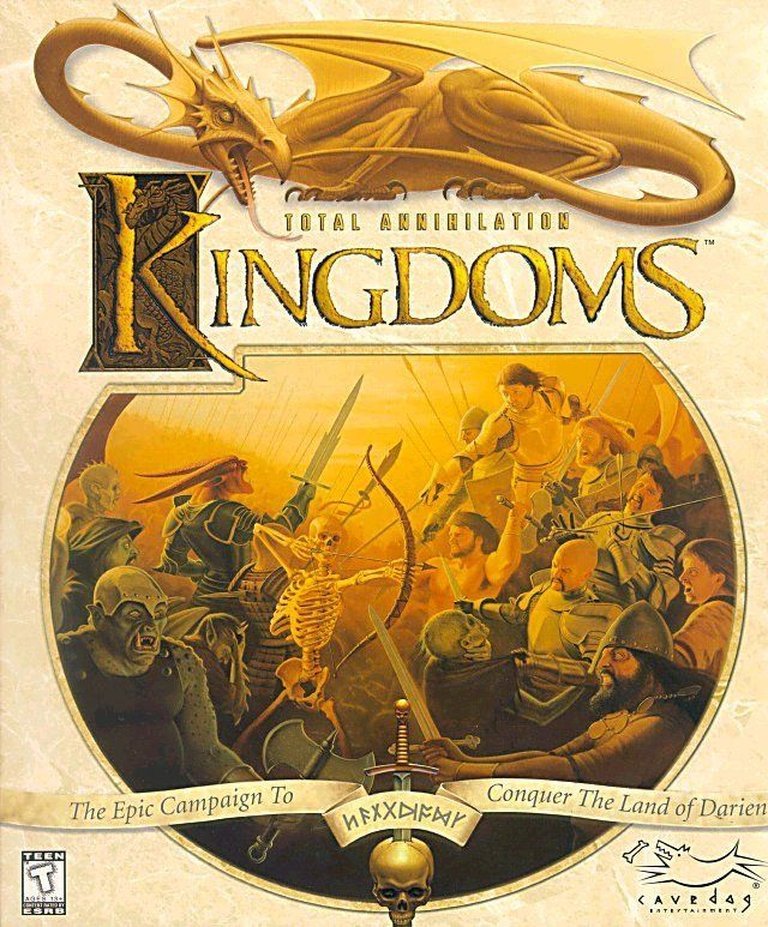
Total Annihilation: Kingdoms is a fantasy-themed real-time strategy game and a spin-off of the original Total Annihilation. Set in the land of Darien, the game follows four sibling monarchs—Elsin, Lokken, Kirenna, and Thirsha—each leading a distinct faction (Aramon, Taros, Veruna, and Zhon) in a brutal war for supremacy after their father’s disappearance. Players command their chosen faction, utilizing unique units, structures, and special abilities tied to their monarch, while managing mana as the sole resource. The game features a deep single-player campaign with 48 missions, asymmetrical faction designs, and a summoning mechanic where units materialize gradually, adding strategic depth to battles.
Gameplay Videos
Where to Buy Total Annihilation: Kingdoms
PC
Total Annihilation: Kingdoms Free Download
Total Annihilation: Kingdoms Patches & Updates
Total Annihilation: Kingdoms Mods
Total Annihilation: Kingdoms Guides & Walkthroughs
Total Annihilation: Kingdoms Reviews & Reception
metacritic.com (74/100): A solid RTS with 5 factions and immense unit diversity.
gamespot.com : Kingdoms suffers from a long list of problems that collectively prevent it from exceeding its ancestor or from rejuvenating a tired genre.
ign.com (69/100): Cavedog’s me-too fantasy game is beautiful, but the gameplay leaves a lot to be desired.
mobygames.com (76/100): If you liked Total Annihilation, you won’t likely be disappointed with this game.
Total Annihilation: Kingdoms Cheats & Codes
PC
Begin a game in skirmish or multiplayer mode. Press [Enter] to display the message box. Press [Plus] and enter one of the following codes.
| Code | Effect |
|---|---|
| zipper | Faster unit building |
| halfshot | Half damage weapons |
| clock | In-game clock |
| kill (1-4) | Kill indicated player |
| combustion | Kill opponents |
| lushee | Limited resource increase |
| ilose | Lose mission |
| tilt | Maximum men and material |
| lotsablood | More blood |
| nanolathing | Nanolathing and metal usage doubled |
| meteor | Random meteor shower |
| nameunit (unit) | Rename indicated unit |
| makeposter | Screen shot |
| cdstart | Toggle CD music |
| infrared | Toggle fog of war |
| rollingfog | Toggle rolling fog effects |
| wackyfog | Toggle wavy fog effects |
| wackywater | Toggle wavy water effects |
| bigbrother | Units say new phrases |
| iwin | Win mission |
| fogcolor (1-256) | Alternate fog color |
| logo (1-9) | Alternate race color |
| lightrange (1-20) | Change render lighting |
| vidmode | Change screen resolution |
| atm | Completely fill mana |
| selectunits | Deselect selected units |
| f2menu | Display menu |
| dither | Dither replaces line of sight |
| doubleshot | Double damage weapons |
| quit | Exit to Windows |
| light 1000 | Darker Structures |
| light | Black Structures |
| mapping | Cover the Screen in Black |
| noenergy | Decrease Energy |
| nometal | Decrease Metal |
| noshake | Disable Explosion Screen Effect |
| nowisee | Full Map, Disable Line of Sight |
| radar | Full Radar |
| shadow | Toggle Object Shadowing |
| share radar | Share Radar (Multiplayer Only) |
| share metal | Share Metal (Multiplayer Only) |
| share energy | Share Energy (Multiplayer Only) |
| share all | Share All Resources (Multiplayer Only) |
| shootall | Also Shoot Buildings |
| showranges | Display Ranges by Holding Shift when Pointer is Over Unit |
| sing | Units Sing when Highlighted |
| sound3d | Toggle 3D sound |
| switchalt | Switch Units by Pressing Alt[number] |
| view [0-3] | View Opponents Energy, Metal |
| contour[1-15] | View 3D Contour Mesh |
| control[0-3] | Control Skirmish AI |
| bps | Display Data Transfer in Multiplayer |
| cdstop | Stop CD Music |
| reloadaiprofiles | Reload AI |
| screenchat | Toggle chat text in multi-player |
| seti | Toggle radar mini-map |
| sfx | Toggle sound effects |
| sharemapping | Share radar information |
| shareradar | Share radar information |
| honk | Units honk when stopping |
| reloadaiprofiles | Reload AI |
Total Annihilation: Kingdoms: A Forgotten Masterpiece of Fantasy RTS
Introduction
In the pantheon of real-time strategy (RTS) games, few titles are as revered—or as overlooked—as Total Annihilation: Kingdoms (TA:K). Released in 1999 by Cavedog Entertainment, this fantasy spin-off of the groundbreaking Total Annihilation (1997) dared to defy conventions, blending medieval warfare with deep strategic mechanics, a rich narrative, and an aesthetic sensibility that remains unmatched. Yet, despite its ambition and innovation, Kingdoms has languished in the shadows of its contemporaries, overshadowed by the likes of Warcraft III and Age of Empires II. This review seeks to rectify that oversight, offering an exhaustive analysis of Kingdoms as both a historical artifact and a timeless gaming experience.
Development History & Context
The Studio and the Vision
Cavedog Entertainment, founded in 1996, was a subsidiary of Humongous Entertainment and a rising star in the RTS genre. Under the leadership of Chris Taylor, the studio had already made waves with Total Annihilation, a game that revolutionized RTS design with its fully 3D units, expansive maps, and emphasis on large-scale warfare. Kingdoms was conceived as a spiritual successor rather than a direct sequel, shifting the setting from sci-fi to fantasy while retaining the core philosophy of strategic depth and player freedom.
The development team, led by Clayton Kauzlaric (lead design) and Brian W. Brown (lead programming), sought to create a game that would stand apart from the crowded RTS market of the late 1990s. Key figures included producer Ron Gilbert, known for his work on Monkey Island, and composer Jeremy Soule, who would later become famous for his work on The Elder Scrolls series. Soule’s haunting, orchestral score for Kingdoms remains one of the game’s most enduring legacies, elevating its medieval atmosphere to cinematic heights.
Technological Constraints and Innovations
Kingdoms was built on an enhanced version of the Total Annihilation engine, which was already pushing the limits of late-1990s hardware. The game’s 3D units and pre-rendered landscapes were a technical marvel, but they also posed significant challenges. The engine’s reliance on software rendering meant that 3D acceleration (via Direct3D or Glide) was optional and often problematic, with many players reporting performance issues. The developers eventually released patches to address these problems, but the game’s reputation for being hardware-intensive persisted.
One of the most innovative aspects of Kingdoms was its approach to unit design and physics. Unlike many RTS games of the era, which treated units as abstract entities, Kingdoms simulated a true 3D space where melee attacks could miss if the target moved, projectiles could be blocked by walls, and flying units behaved realistically. This attention to detail extended to the game’s sound design, where weapon impacts varied depending on the material they struck—flesh, stone, or wood—adding an unprecedented layer of immersion.
The Gaming Landscape of 1999
Kingdoms arrived at a pivotal moment in RTS history. StarCraft (1998) had set a new standard for competitive multiplayer, while Age of Empires II (1999) and Warcraft III (2002) were on the horizon, promising to redefine fantasy RTS gameplay. In this context, Kingdoms was something of an outlier: a game that prioritized single-player depth and narrative over multiplayer balance, and that embraced asymmetry in faction design long before it became a trend.
The game’s release was met with a mix of enthusiasm and skepticism. Critics praised its ambition and aesthetic qualities but often criticized its performance issues and perceived lack of innovation. Commercial success was modest, and Cavedog’s financial struggles culminated in the studio’s closure in 2000, shortly after the release of Kingdoms’ expansion, The Iron Plague. Despite this, the game developed a cult following, with fans praising its unique blend of strategy, storytelling, and atmosphere.
Narrative & Thematic Deep Dive
The Story of Darien
Kingdoms is set in the fictional land of Darien, a world steeped in magic and conflict. The narrative revolves around four sibling monarchs—Elsin of Aramon, Lokken of Taros, Kirenna of Veruna, and Thirsha of Zhon—who are locked in a brutal struggle for dominance following the disappearance of their father, Garacaius. The story is presented as a war chronicle, with each mission advancing the plot through in-game cutscenes and a detailed HTML atlas included with the game.
The narrative is notable for its moral ambiguity and political intrigue. Unlike many fantasy RTS games, which often rely on simplistic good-vs.-evil dichotomies, Kingdoms presents a world where each faction has its own motivations, strengths, and flaws. Aramon and Veruna, for instance, are portrayed as more “civilized” but are not without their own internal conflicts and ethical compromises. Taros and Zhon, meanwhile, embrace darker aspects of magic and warfare, making them formidable but morally complex adversaries.
Themes of Power and Legacy
At its core, Kingdoms is a story about power—its acquisition, its corruption, and its consequences. The disappearance of Garacaius serves as the catalyst for the conflict, but the game’s deeper themes explore how each monarch grapples with their inheritance. Elsin and Kirenna, who initially adhere to their father’s prohibition on magic, find themselves forced to adapt as their siblings exploit forbidden powers. Lokken’s necromancy and Thirsha’s reliance on ancient, primal forces reflect a rejection of their father’s ideals, leading to a fracturing of the once-united kingdom.
The game’s expansion, The Iron Plague, deepens these themes by introducing Creon, a technologically advanced faction founded by Garacaius himself. The revelation that Garacaius abandoned Darien to create a nation free of magic adds a layer of tragedy to the narrative, as his children’s war is revealed to be a direct consequence of his own disillusionment. This twist underscores the game’s central question: Is power a means of control, or is it inherently corrupting?
Character Depth and Faction Identity
Each of the four monarchs is a fully realized character, with distinct personalities, abilities, and narrative arcs. Elsin, the ruler of Aramon, is a pragmatic leader who balances military prowess with diplomatic acumen. His ability to raise the dead and wield gunpowder-based weaponry reflects his adaptability, but also his willingness to embrace morally ambiguous tactics. Lokken, the necromancer of Taros, is a more sinister figure, whose invisibility and control over undead forces make him a terrifying adversary. His storyline explores themes of betrayal and obsession, as his quest for power leads him to increasingly desperate measures.
Kirenna of Veruna is perhaps the most sympathetic of the monarchs, ruling over a seafaring nation that values commerce and innovation. Her ability to swim and command naval forces underscores her connection to the natural world, but her storyline also highlights the vulnerabilities of her people, as they are caught between the aggression of Taros and the isolationism of Zhon. Thirsha, the queen of Zhon, is the most enigmatic of the four, ruling over a jungle kingdom that rejects traditional structures in favor of mobile, unit-based warfare. Her ability to fly and summon ancient beasts reflects her deep connection to the primal forces of Darien, but also her detachment from the political intrigues of her siblings.
The factions themselves are meticulously designed to reflect their leaders’ identities. Aramon’s units are a mix of traditional medieval soldiers and early gunpowder weapons, reflecting Elsin’s blend of old and new. Taros’ forces are dominated by undead and dark magic, embodying Lokken’s necromantic powers. Veruna’s navy and coastal defenses highlight Kirenna’s maritime focus, while Zhon’s reliance on mobile units and lack of permanent structures mirror Thirsha’s nomadic leadership.
Gameplay Mechanics & Systems
Core Gameplay Loop
Kingdoms retains the core RTS mechanics of resource gathering, base building, and unit production, but with several key innovations. The most significant departure from Total Annihilation is the simplification of resource management. Instead of juggling metal and energy, players gather a single resource: mana. Mana is harvested from sacred stones via lodestones, which must be placed strategically to maximize income. This streamlined system allows players to focus more on strategy and less on micromanagement, though it also introduces a unique challenge: mana is infinite but must be carefully managed to avoid shortages during critical moments.
The game’s tech tree is divided into three tiers, with each faction requiring specific structures to unlock higher-tier units. This system encourages players to plan their expansions carefully, as rushing to higher tiers without adequate defenses can leave them vulnerable to early-game attacks. The monarchs themselves serve as the primary construction units, but their abilities are limited, requiring players to build additional constructors to access the full tech tree.
Combat and Unit Design
Combat in Kingdoms is a blend of traditional RTS mechanics and innovative features. Units are divided into melee, ranged, and magical categories, with each faction offering a unique mix of strengths and weaknesses. For example, Aramon’s trebuchets can fire over walls, making them ideal for sieges, while Taros’ ghost ships can phase through obstacles, allowing for surprise attacks. Zhon’s lack of permanent structures forces players to rely on mobile units, creating a highly dynamic playstyle that rewards adaptability.
One of the game’s most distinctive features is its unit-leveling system. Units gain experience through combat, becoming more powerful as they survive battles. This system adds a layer of tactical depth, as players must decide whether to preserve veteran units or sacrifice them for strategic gains. The monarchs themselves are the most powerful units in the game, with abilities that can turn the tide of battle. Elsin’s ability to raise the dead, for instance, allows him to convert fallen enemies into allies, while Thirsha’s flight enables her to scout and harass enemy positions with impunity.
AI and Multiplayer
The game’s AI is a mixed bag. In the single-player campaign, the AI is capable of mounting credible defenses and launching coordinated attacks, particularly in later missions where it builds extensive tower networks. However, in skirmish mode, the AI tends to be less aggressive, often sending lone units to wander the map rather than forming cohesive armies. This inconsistency has been a point of criticism, though it does not detract significantly from the campaign experience.
Multiplayer in Kingdoms was ahead of its time, supporting up to eight players via LAN, modem, or the now-defunct Boneyards online service. The game’s asymmetric factions and deep strategic mechanics made for intense multiplayer battles, though balance issues—particularly with Zhon’s weak early-game units—often led to frustration. The release of The Iron Plague expansion addressed some of these concerns by introducing new units and factions, but the closure of Cavedog meant that further refinements were never realized.
Interface and Controls
Kingdoms features one of the most advanced interfaces of its era, with a fully playable mini-map, infinite production queues, and non-linear build orders. The game’s control scheme is highly customizable, with support for both single-click and right-click actions (a rarity in late-1990s RTS games). Players can assign multiple factories to control groups, create patrol paths for automated attacks, and even drag-select areas for builders to clear. The game’s speed can be adjusted on the fly, allowing players to slow down the action for precise micromanagement or speed it up for faster decision-making.
Despite these innovations, the interface is not without its flaws. Unit pathfinding can be inconsistent, particularly in dense forests or around complex terrain. The game’s top-down perspective, while immersive, can make it difficult to gauge unit elevations, leading to occasional frustration in battles involving flying units or elevated defenses. These issues are minor, however, and do not detract from the overall depth of the gameplay.
World-Building, Art & Sound
The World of Darien
Darien is a richly detailed world, with maps that range from lush forests and rolling hills to desolate wastelands and coastal islands. Each mission is set in a distinct location, with settlements, wildlife, and environmental hazards that add to the immersion. The game’s pre-rendered 3D landscapes are a technical achievement, offering a level of detail that was rare in late-1990s RTS games. The maps are not merely battlefields but living, breathing environments, with NPCs and animals that react to the player’s presence.
The game’s art direction is equally impressive. Unit designs are varied and distinctive, with each faction boasting a unique visual identity. Aramon’s soldiers are clad in plate armor, while Taros’ undead are skeletal and grotesque. Veruna’s naval units are sleek and functional, while Zhon’s beasts are primal and ferocious. The game’s spell effects—from Elsin’s lightning bolts to Thirsha’s summoning rituals—are visually stunning, adding a layer of spectacle to the combat.
Sound Design and Music
The sound design in Kingdoms is a masterclass in immersion. Weapon impacts vary depending on the material they strike, with distinct sounds for flesh, stone, and wood. Unit voices are clear and expressive, with each faction offering unique battle cries and taunts. The ambient sounds—from the rustling of leaves to the distant roar of dragons—further enhance the game’s atmosphere, making Darien feel like a living world.
The game’s soundtrack, composed by Jeremy Soule, is one of its most enduring legacies. Soule’s orchestral score is haunting and epic, with themes that reflect the game’s medieval setting and the grandeur of its conflicts. Tracks like “The Heart of Thesh” and “The Siege of Kaluen” are standout pieces, blending melancholic melodies with triumphant crescendos. The music is not merely background noise but an integral part of the storytelling, heightening the emotional impact of key moments in the campaign.
Reception & Legacy
Critical and Commercial Reception
Kingdoms received a mixed but generally positive reception upon release. Critics praised its ambitious narrative, deep strategic mechanics, and stunning presentation, but many also noted its performance issues and occasional balance problems. The game’s Metascore of 74 on Metacritic reflects this divide, with some reviewers hailing it as a masterpiece and others dismissing it as a flawed experiment.
Commercially, Kingdoms was a modest success, reaching the top of the weekly sales charts but failing to match the longevity of its contemporaries. The game’s hardware requirements and niche appeal likely contributed to its limited mainstream success, though it developed a dedicated fanbase that continues to celebrate its unique qualities.
Influence and Legacy
Despite its commercial underperformance, Kingdoms has had a lasting impact on the RTS genre. Its emphasis on asymmetric factions, deep narrative integration, and immersive world-building paved the way for later games like Warcraft III and Rise of Nations. The game’s unit-leveling system, in particular, was a groundbreaking feature that has since become a staple of modern RTS and RPG hybrids.
The closure of Cavedog in 2000 marked the end of an era, but Kingdoms has endured through fan modifications, online communities, and digital re-releases. The game’s expansion, The Iron Plague, added a fifth faction (Creon) and new missions, further enriching the lore of Darien. While official support for Kingdoms has long since ended, its legacy lives on in the hearts of those who recognize it as one of the most ambitious and underrated RTS games of all time.
Conclusion
Total Annihilation: Kingdoms is a game that defies easy categorization. It is at once a strategic masterpiece, a narrative tour de force, and a technical marvel. Its blend of deep gameplay mechanics, rich storytelling, and immersive world-building sets it apart from its contemporaries, even as its performance issues and balance quirks hold it back from true greatness. Yet, for those willing to look past its flaws, Kingdoms offers an experience that is as rewarding today as it was in 1999.
In the annals of RTS history, Kingdoms occupies a unique and often overlooked place. It is a game that dared to be different, that embraced complexity and asymmetry at a time when the genre was moving toward standardization. Its legacy is not one of commercial triumph or critical acclaim, but of quiet innovation and enduring passion. For fans of deep strategy, rich narratives, and immersive worlds, Total Annihilation: Kingdoms remains a hidden gem—a forgotten masterpiece that deserves to be rediscovered.
Final Verdict: 9/10 – A flawed but brilliant masterpiece of fantasy RTS, Total Annihilation: Kingdoms is a game that rewards patience, strategy, and imagination. Its legacy may be overshadowed by its contemporaries, but its depth and ambition ensure its place in gaming history.