
- Release Year: 2014
- Platforms: Linux, Macintosh, Ouya, PlayStation 4, PS Vita, Windows, Xbox One
- Publisher: Matt Makes Games Inc.
- Developer: Matt Makes Games Inc.
- Genre: Action
- Perspective: Side view
- Game Mode: Co-op, Single-player
- Gameplay: Archery, Arena combat, Platform, Shooter
- Average Score: 87/100
Description
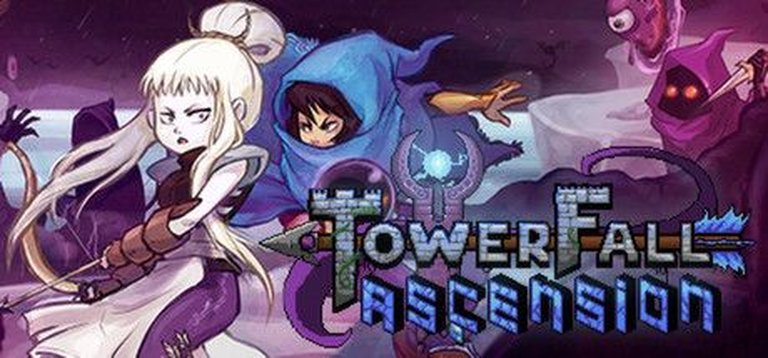
TowerFall: Ascension is an enhanced version of the arrow-based arena fighting game, set in fantastical tower environments where players engage in intense, local multiplayer archery combat. It expands on the original with a cooperative quest mode for one or two players, a massive versus mode featuring over 120 maps, new unlockable characters, and innovative power-ups like drill arrows that penetrate walls.
Gameplay Videos
Where to Buy TowerFall: Ascension
PC
TowerFall: Ascension Free Download
TowerFall: Ascension Mods
TowerFall: Ascension Guides & Walkthroughs
TowerFall: Ascension Reviews & Reception
metacritic.com (87/100): One of the best local multiplayer games ever made.
ign.com (89/100): Towerfall’s fun multiplayer sets up hilarious face-offs with your friends.
imdb.com (90/100): Towerfall is on crack. There is no getting around it. It’s fast, frenetic, and utterly insane.
opencritic.com (84/100): This is the type of game that creates memories and dissolves friendships, soundtracked by the pained swears of the defeated and the uproarious cheers of the victors.
gamesbeat.com : TowerFall: Ascension is the Super Smash Bros. of the indie scene.
TowerFall: Ascension Cheats & Codes
PC
Enter cheat codes at the credits screen for unlock codes, or at the Archives menu for the Ascension code.
| Code | Effect |
|---|---|
| Left, Right, Tab, Shift, Up, Up, Down, Left, Shift, C | Unlock all archers and levels |
| Left, Right, Up, Up, Down, A | Unlock Gunn Style variant |
| Right, Up, Left, Right, Right, Down, Down, Up, Down | Unlock the Ascension level |
PlayStation 4
Enter cheat codes at the credits screen for unlock codes, or at the Archives menu for the Ascension code.
| Code | Effect |
|---|---|
| Left, Right, L2, R2, Up, Up, Down, Left, R2, X | Unlock all quest levels, the four archers, the four hidden towers, and the Gunn Style variant |
| Right, Up, Left, Right, Right, Down, Down, Up, Down | Unlock the Ascension level |
Nintendo Switch
Enter the Ascension code at the Archives menu after unlocking all bonus levels.
| Code | Effect |
|---|---|
| right, up, left, right, right, down, down, up, down | Unlock the Ascension level |
TowerFall: Ascension: The Couch-Based Arrow Ballet That Redefined Indie Multiplayer
Introduction: The Unassuming Sovereign of Couch Competitive Gaming
In an era dominated by sprawling online ecosystems, photorealistic graphics, and labyrinthine monetization schemes, a quiet revolution simmered in the corners of living rooms. It arrived not with a cinematic trailer or a celebrity endorsement, but with the crisp thwip of an arrow, the panicked scramble for ammunition, and the uproarious laughter of friends piled on a couch. That revolution was TowerFall: Ascension, a game so fiercely focused on pure, unadulterated local multiplayer mayhem that it single-handedly justified the purchase of extra controllers and revitalized a dormant genre. Its thesis is elegantly simple: supreme depth can emerge from minimalist mechanics, and the most profound gaming memories are forged not through anonymous online matchmaking, but through the shared, physical space of competitive camaraderie. This review will dissect how a deceptively simple archery deathmatch, born from a game jam and nurtured in a legendary Vancouver “Indie House,” became a canonical text in the history of competitive game design—a game where every pixel, sound effect, and system serves the singular, glorious goal of creating indelible moments of triumph and betrayal.
Development History & Context: From Ouya Oddity to Cross-Platform Classic
The Genesis in Indie House: TowerFall was the first commercial project of Maddy Thorson (then operating as Matt Makes Games), developed against the backdrop of a singularly fertile indie hub: the “Indie House” in Vancouver. This residence, shared with developers like Alec Holowka (composer), Noel Berry, and Rami Ismail, was more than just shared accommodation—it was a 24/7 playtesting lab. As Thorson detailed in a post-launch Polygon feature, the game’s evolution was intrinsically tied to these constant, impromptu local multiplayer sessions with housemates. The social dynamics of this living arrangement directly shaped the game’s DNA as a “party game,” where the goal was to create an experience so compelling that friends would repeatedly ask, “When can we play again?”
From Game Jam Prototype to Ouya Launch Title: The core concept emerged from the June 2012 Vancouver Full Indie Game Jam. Initial prototypes explored a Zelda-inspired single-player platformer, but the multiplayer mode quickly stole the spotlight. Thorson has frequently cited inspirations like the tense one-hit-kill duels of Bushido Blade, the chaotic item-catching of Super Smash Bros., and the precise platforming of Yoshi’s Island. The decision to limit arrows to a finite supply and restrict aiming to eight cardinal directions (rather than 360-degree freedom) was a deliberate design choice to slow the pace, enforce strategic positioning, and make projectile management the central tactical loop. After six months of iteration, the game “started to come together,” as Thorson put it.
The Ouya, a new Android-based microconsole courting indie developers with an open model, provided the perfect, low-pressure launchpad. Thorson signed an exclusivity agreement, and TowerFall debuted as a system-seller on June 25, 2013. Critics instantly anointed it the Ouya’s “killer app.” Its success on the struggling platform—selling approximately 7,000 copies in its first year for roughly $105,000—was a testament to its design, not the hardware. This proved Thorson could build a viable commercial product outside the AAA system.
Ascension and the PlayStation 4 Partnership: Following the Ouya exclusivity period, Sony pursued the game aggressively. The result was TowerFall: Ascension (released March 11, 2014), a significantly expanded version for PlayStation 4, Windows (via Steam), Linux, and macOS. Porting was handled by Sickhead Games using MonoGame (an open-source XNA rewrite). Thorson praised the DualShock 4’s directional pad as “perfect for TowerFall,” and Sony’s proactive stance allowed for the crucial addition of a robust single-player/co-op “Quest Mode” and a wealth of new content. By April 2014, Ascension had grossed over $500,000, with the PS4 version leading sales, demonstrating the power of a curated platform for a niche title.
Narrative & Thematic Deep Dive: Lore in the Margins
TowerFall is not a narrative-driven game in the traditional sense; its plot is a skeletal framework delivered through brief, poetic character introductions and environmental storytelling. Yet, this minimalism is a strength, allowing the emergent drama of each match to become the primary narrative.
The World and Its Conflict: The kingdom of TowerFall is besieged by monsters, a calamity precipitated by the King’s descent into madness. This premise sets the stage for a classic archetypal conflict: order versus chaos, corruption versus redemption. The world is rendered through exquisite, atmospheric pixel art that suggests a once-great civilization now in ruin—castle walls draped in moss, lava-filled dungeons, and submerged cities (Sunken City). The aesthetic draws from a contemporary zeitgeist (notably Game of Thrones) but feels timeless, evoking the fantasy of early NES and SNES eras.
The Archers as Archetypal Foes: The playable characters are not differentiated by stats or movesets—their identical core mechanics are a deliberate design pillar—but through distinct personalities and visual identities, each implying a different motivation for entering the tower:
* The Last of the Order: The canonical protagonist, a knight sworn to purge the corruption. His noble, straightforward design aligns with the player’s potential heroic self-image.
* The Vigilante Thief: A rogue motivated by profit and altruism, suggesting opportunistic pragmatism.
* The Assassin Prince: A glory-seeking royal, blinded by ambition. His introduction reads like a tragic prophecy.
* The Turncloak Soldier: A former guardian seeking regicide, representing betrayal and righteous rebellion.
* Expanded Roster (Ascension): Ascension adds four more: the Ancient Exile, the Forgotten Master, the Prancing Puppet, and the Vicious Vessel. Their unlock conditions are often cryptic, integrated into gameplay (e.g., hitting a specific rock in a specific stage), weaving their acquisition into the player’s personal journey. The lore, intended for a non-existent manual, creates a sense of a larger, untold story—a world worth saving (or dominating).
Themes: The Honesty of Competition and the Value of Shared Space. The game’s core theme is the raw, unmediated social experience of competition. There is no anonymity, no text chat, no leaderboard toxicity. Victory is witnessed firsthand; defeat is accompanied by the immediate, visceral reaction of the person beside you. This creates a unique emotional contract. The game’s simplicity strips away all excuses—loss is a direct result of one’s own action or inaction, fostering a sense of personal accountability and, consequently, a more profound sense of mastery when victory is achieved. It is, as one critic noted, “a powerful distillery of childlike glee,” where the stakes feel high precisely because the consequences are local and personal.
Gameplay Mechanics & Systems: Elegance in Economy and Movement
TowerFall: Ascension is a masterclass in “easy to learn, difficult to master.” Its brilliance lies in a handful of interlocking systems that generate near-infinite tactical possibility.
Core Movement & Combat Loop: The control scheme is minimalist:
* Left Stick: Move character.
* X (Jump): Essential for verticality and platforming precision.
* Square (Fire Arrow): Fires an arrow in one of eight directions. Holding it steadies aim but leaves the player vulnerable.
* R2 (Dodge/Dash): A short, invincible-leap in the chosen direction. This is the single most important mechanic.
The arrow economy is the game’s heartbeat. Players start with only three arrows. Fired arrows stick to walls, floors, or players and can be retrieved. This creates a constant risk/reward calculus: shooting depletes your primary resource but potentially eliminates a threat or denies an arrow to an opponent. Ammo management is a primary skill, separating novices from experts.
The Dodge-Cancel and Advanced Tech: The dash is not merely an evasion tool. Dodge-canceling allows players to initiate a dash, then immediately input a second dash, retaining the momentum of the first. This technique extends travel distance beyond a normal dash and is essential for advanced maneuvering. Crucially, dodge-canceling prevents arrow catching. The standard dash into an incoming arrow allows the player to catch it, instantly replenishing ammo. This “arrow catch” is a defensive and offensive powerhouse—it negates an attack, turns the enemy’s resource against them, and can be used for stunning comebacks. Mastering the precise timing and directional prediction for catches versus dodges is the game’s highest skill ceiling.
Head-Stomping and Environmental Interaction: Arrows are not the only kill vector. A well-timed jump onto an opponent’s head results in an instant Goomba Stomp kill. This adds a critical close-range layer to combat, forcing players to guard against both projectile and vertical assaults. Stages are filled with hazards (spikes, lava) and dynamic elements like screen-wrap (exiting one side reappears on the other, a la Pac-Man), which enables flanking attacks and arrow shots through walls.
Versus Mode & The Power of Variants: The core competitive mode supports 2-4 players. Three official mutators exist:
* Headhunters: Free-for-all point-based matches (the most popular and chaotic).
* Team Deathmatch: 2v2 (red vs. blue).
* Last Man Standing: Classic eliminate-all style.
The true depth, however, emerges from the 67+ Versus Variants. These are modular rule changes that can be combined: limited arrows, infinite arrows, fire arrows (set opponents ablaze), shield power-ups, wings (double jump), “ghost” mode (dead players return as specters that can kill), “no head-stomping,” and drastically altered win conditions. Each variant reshapes the meta-strategy. A “drill arrow” power-up, added in Ascension, burrows through walls, adding a new layer of spatial awareness and defensive prediction.
Quest Mode & Trials: Ascension’s major addition is Quest Mode, a 1-2 player co-op campaign on a world map. Players battle waves of monsters (slimes, harpies, ghosts, knights) across themed towers (Sunken City, King’s Court, etc.). Waves increase in difficulty, and the co-op revive/resurrection mechanic (stealing a partner’s extra life) fosters teamwork. While criticized by some as a “low point” or mere “practice mode,” it is a surprisingly deep, arcade-style score-attack experience with its own progression and themes. Trials Mode is a pure time-attack puzzle, challenging players to eliminate target dummies with optimal routes—a niche but beloved mode for speedrunners.
World-Building, Art & Sound: Personality Through Pixels and Chiptunes
Visual Design: Intentional Retroism: The graphics, created by MiniBoss, are a masterclass in expressive limitation. Using a constrained 16-bit-style palette, the art conveys immense personality through animation and detail. Character sprites have distinct silhouettes and idle animations (the Prancing Puppet’s silly jig, the Vicious Vessel’s menacing hover). Stages are vibrant and thematically rich—the King’s Court glitters with gold and banners, Thornwood is a haunting purple forest, Dreadwood (from Dark World) is its corrupted, darker counterpart. The pixel art is not nostalgic for nostalgia’s sake; it is a functional choice that prioritizes clarity of read (critical in a fast-paced arena) and creates a cohesive, iconic visual language. Screen-shaking visual effects on major events (like a power-up spawn or the final boss’s attack) provide crucial feedback and amplify the chaos.
Sound Design & Music: Thepercussive Heartbeat: Sound effects from Power Up Audio are crisp, satisfying, and mechanically informative. The metallic shing of an arrow release, the heavy thud of a body hitting the wall after being shot, the distinct pop of catching an arrow—each is an audio cue that communicates game state instantly. The iconic “ding!” of a power-up chest is a Pavlovian call to scramble.
The soundtrack by Alec Holowka is a standout achievement. Each tower has a unique, looping chiptune-inspired track that matches its theme and energy—from the regal, pompous fanfare of the King’s Court to the eerie, ambient tones of the Sunken City. The music is never intrusive but always present, elevating the tension or underscoring the whimsy. It etches the stages directly into memory, making the auditory experience inseparable from the gameplay one.
Atmosphere of Playful Severity: The world of TowerFall feels simultaneously weighty and playful. The somber lore and dark environments contrast with the goofy character designs and the sheer, unadulterated fun of the gameplay. This tonal duality—a “serious” fantasy world housing a profoundly silly party game—is part of its unique charm. It never takes itself so seriously that it becomes grim, but it respects the player’s intelligence enough to trust them with complex systems.
Reception & Legacy: The Couch-Potato’s Canonization
Critical Acclaim and Universal Themes: Upon the release of Ascension, critics were nearly unanimous in their praise. It holds Metascores of 87 on PC and PS4. Reviews consistently used language that placed it in the pantheon of great local multiplayer titles. Electronic Gaming Monthly gave it a perfect 100, calling it “aggressively focused, humbly spectacular.” Polygon’s 9.5 declared it “never not fun.” Eurogamer’s 10/10 review famously stated, “This is the type of game that creates memories and dissolves friendships… If that’s not worth moving your life around for, then what is?”
The praise centered on three pillars:
1. Mechanical Depth from Simplicity: Frequent comparisons to Super Smash Bros. Melee were shorthand for acknowledging a seemingly simple exterior masking immense tactical depth.
2. Perfection of a Niche: Critics acknowledged its single-player modes as “afterthoughts” but argued that, like a great board game, its value is intrinsically tied to local human interaction. As PC Gamer wrote, “When a game is this precisely considered… you owe it that” to play it as intended—on a couch.
3. The Joy of Shared Physical Space: The lack of online play, a point of contention for some, was framed by many as a philosophical strength. Destructoid noted the game存档 “hidden secrets” as a reward for dedicated play. GameSpot highlighted the constant “mad scramble for ammo, powerups, and survival.”
Commercial Success and Platform Journey: Financially, Ascension was a significant indie success. Thorson revealed it grossed over $500,000 within a month of release, with PS4 sales leading despite the smaller install base. This proved a premium-priced ($14.99), niche local multiplayer game could find a substantial audience. Its journey across platforms—PS4, Xbox One (2017), Nintendo Switch (2018, with Celeste cameos)—cemented its status as a timeless classic rather than a console-specific curio.
Cultural Impact and Legacy:
* Revival of Couch Co-op: TowerFall is consistently cited, alongside games like Samurai Gunn and Nidhogg, as a flagship title in the “local multiplayer renaissance” of the 2010s. It provided a modern, flawlessly-tuned answer to the question, “Whatever happened to good old-fashioned split-screen?”
* Design Influence: Its arrow economy, dodge mechanics, and variant system have influenced countless subsequent arena fighters. The philosophy of “one-hit kill + resource management + high-skill movement” is now a recognizable sub-genre.
* Competitive Scene: The game fostered a dedicated competitive community, with tournament rulesets and strategies that explored its deep meta. The “Tournament Handbook” on its official wiki is a testament to its longevity as a competitive pursuit.
* The “Indie House” Mythos: Its development story became a parable for the power of collaborative, in-person indie game culture—a romantic counter-narrative to remote, corporate development.
Conclusion: An Enduring Masterpiece of Social Game Design
TowerFall: Ascension is not merely a great game; it is a definitive argument for a specific, increasingly rare kind of play. Its legacy is secured not by narrative ambition or graphical fidelity, but by an unwavering commitment to a singular, profound experience: the white-knuckle thrill of outsmarting a friend in the same room, the shared eruption of laughter after a ridiculous play, the silent, focused intensity of a high-stakes final round.
Its flaws—the weak single-player offering, the absence of online play, the homogeneous character roster—are not oversights but inherent to its design philosophy. To add online netcode would be to fundamentally alter the intimate, pressure-cooker atmosphere it cultivates. To deepen single-player would dilute the focus on the human friction that is the game’s true engine. These “flaws” are, in fact, the price of admission to its unique magic.
In the grand tapestry of video game history, TowerFall: Ascension will be remembered as a touchstone—a game that reminded the industry and players alike that the most powerful technology in gaming is often the simplest, and that the most valuable online connection is the one made eye-to-eye across a living room. It is the Super Smash Bros. of the indie era, a timeless arena where every arrow loosed, every dodge executed, and every victorious stomp writes a new, shared story. To own it is to possess a key to a specific, irreplaceable kind of joy. Its place in the canon is not just secure; it is foundational.
Final Verdict: 9.5/10 – A flawless execution of a focused vision. An essential artifact of modern local multiplayer design.