
- Release Year: 2003
- Platforms: Windows
- Publisher: ScottTown Software
- Developer: ScottTown Software
- Genre: Action
- Perspective: 3rd-person (Other)
- Game Mode: Single-player
- Gameplay: Aiming, Launching, Timing, Toasting
- Setting: Town Hall
- Average Score: 80/100
Description
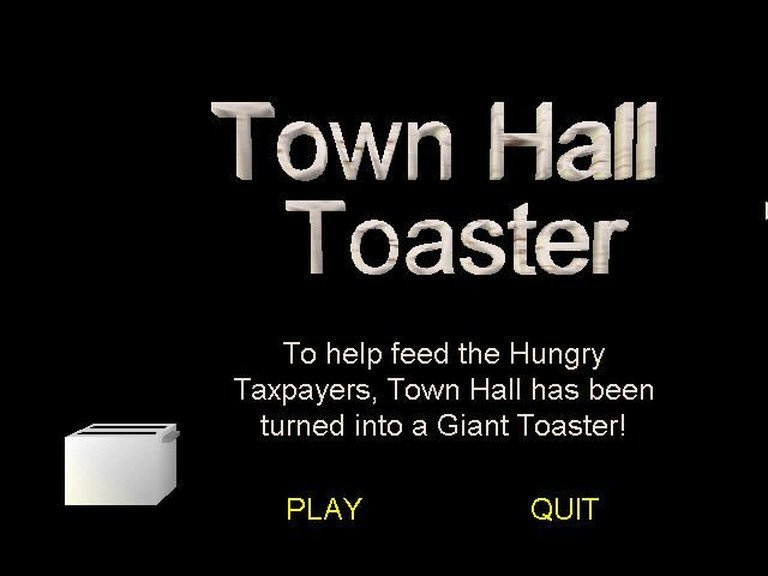
In the quirky game ‘Town Hall Toaster’, players take on the absurd yet delightful task of transforming a government building into a giant toaster to solve the city’s hunger crisis. Operating the massive toaster, players must launch bread products like waffles and bagels onto rotating plates across the city. Success hinges on achieving the perfect toast color—golden brown yields higher points—while avoiding missed shots. With simple mouse-click controls for loading and ejecting, this freeware action game blends surreal humor with addictive gameplay.
Town Hall Toaster Reviews & Reception
mobygames.com (80/100): Average score: 80%
goldenageofgames.com : Fun, addictive, and unique, Town Hall Toaster is a neat little freeware underdog you shouldn’t miss.
retro-replay.com : It’s a delightfully absurd premise that mashes up fast-paced action with zany humor.
Town Hall Toaster: A Toast to Absurdist Bureaucratic Satire
Introduction
In the annals of early 2000s freeware oddities, few titles capture the sheer whimsy of Town Hall Toaster (2003). Developed by solo creator Scott Nelson under ScottTown Software, this Windows oddity melds civic satire with arcade-flavored chaos, tasking players with operating a municipal building-turned-giant toaster to feed a populace of “hungry taxpayers.” While overshadowed by AAA releases of its era, Town Hall Toaster has quietly cultivated a cult following for its irreverent humor and deceptively deep gameplay loop. This review argues that the game is a masterclass in micro-scale absurdism—a quirky time capsule that rewards patience with surprising strategic depth.
Development History & Context
The One-Man Bakery
Scott Nelson, the mind behind Town Hall Toaster, operated as a lone developer in an era before indie game tools democratized creation. Unlike the flashy 3D shooters dominating 2003 (Half-Life 2, Call of Duty), Nelson leaned into low-poly accessibility, designing for Windows XP’s modest hardware demands (128MB RAM, 16MB graphics cards). The game’s freeware model—a precursor to today’s free-to-play experiments—let it thrive on niche portals like Home of the Underdogs and Caiman Free Games.
A Post-9/11 Comfort Food
Released amidst global uncertainty, Town Hall Toaster’s lighthearted premise offered escapism. Its core joke—bureaucratic inefficiency solved via breakfast—riffed on early 2000s political fatigue while avoiding overt cynicism. Mechanically, it drew inspiration from Japan’s BBQ (a freeware toast-launching game), but Nelson expanded the concept with progression systems and thematic layering.
Narrative & Thematic Deep Dive
Plot as Performance Art
Storytelling here is minimalist yet sharp: taxpayers are starving, so the town hall becomes a toaster. Absurd? Yes. But beneath its doughy surface lies a satire of municipal bloat. Each level opens with fictional budget reports (“Deficit: $10,000 in burnt waffles”) and deadpan mayor speeches (“Our infrastructure is crumbling, but our toast is golden”).
Thematic Loaves
– Resource Management as Farce: Players “fund” the city via perfectly toasted bread—a jab at tax-dollar waste.
– Bureaucratic Theater: Random events (e.g., rival mayors deploying competitive toasters) mock political grandstanding.
– Communal Hunger: The game’s rotating plates symbolize unequal resource distribution—some plates move faster, demanding precision to “feed” them fairly.
Gameplay Mechanics & Systems
Core Loop: Toast, Launch, Repeat
The game’s genius lies in its simplicity:
1. Load bread/waffles/bagels via mouse clicks.
2. Toast by timing heating elements (hold too long, and it burns).
3. Eject onto one of four rotating plates, each with unique speeds.
Strategic Layers
– Bread Physics: Different items have unique weights and arcs. Bagels fly flatter; waffles require higher launches.
– X-Ray Gimmick: A poorly implemented “X-Ray” button lets players peek inside the toaster, though critics noted it often obscured visibility (GameHippo.com).
– Economy of Error: Missed plates deduct funds, while golden-brown toasts net $1,000. Balancing speed and perfection is key.
Flaws in the Dough
– Repetitive UX: No keyboard shortcuts or controller support limited long-term engagement.
– Opaque Progression: Later levels introduced unexplained mechanics (e.g., sudden plate speed spikes), frustrating casual players.
World-Building, Art & Sound
Aesthetic Charm
Nelson embraced a cartoonish 3D style:
– Toaster-as-Architecture: The town hall gleams with anthropomorphic vents and oversized levers.
– Crumb FX: Toast emits steam trails and shadows mid-flight, aiding depth perception.
– Plate Dynamics: Rotating platforms resemble vinyl records, contrasting against chunky cityscapes.
Sound Design
– ASMR Governance: The boing of ejecting toast and crunch of perfect landings deliver tactile satisfaction.
– Muted Ambiance: Minimal music keeps focus on gameplay, though some players lamented the lack of a whimsical soundtrack.
Reception & Legacy
2003 Reviews: A Toasty Niche
Critics praised its “addictive, unique” core (GameHippo), but limited press coverage led to obscurity. Home of the Underdogs’ 8.2/10 review called it “a freeware gem” despite visibility issues. Player scores averaged 3.8/5, with fans citing its “easy to learn, hard to master” appeal.
Cult Revival
By the 2010s, Town Hall Toaster resurfaced in retro forums and inspired indies like Toaster Jam (2018). Its DNA is detectable in:
– Physics-Based Comedy: Human: Fall Flat’s janky slapstick.
– Municipal Satire: Cities: Skylines’ disaster scenarios.
Conclusion
Town Hall Toaster is neither a masterpiece nor a forgotten relic—it’s a lovable oddity, a breakfast-themed Ubu Roi for the PC gaming crowd. Its flaws (clunky UI, uneven difficulty) are outweighed by sheer audacity: where else can you fund infrastructure via airborne Pop-Tarts? For historians, it’s a testament to early 2000s indie creativity; for players, it’s a 10-minute joyride best enjoyed with coffee and a smirk.
Final Verdict: A quirky but essential footnote in gaming history—proof that great ideas can rise from the smallest ovens.