
- Release Year: 2012
- Platforms: Browser, Macintosh, Windows
- Publisher: U.S. Department of State
- Developer: Supergroup
- Genre: Adventure, Educational
- Perspective: 3rd-person
- Game Mode: Single-player
- Gameplay: Dialogue choices, Language Practice, Mini-games, Phrases in Space, Word Soup
- Setting: North America
- Average Score: 25/100
Description
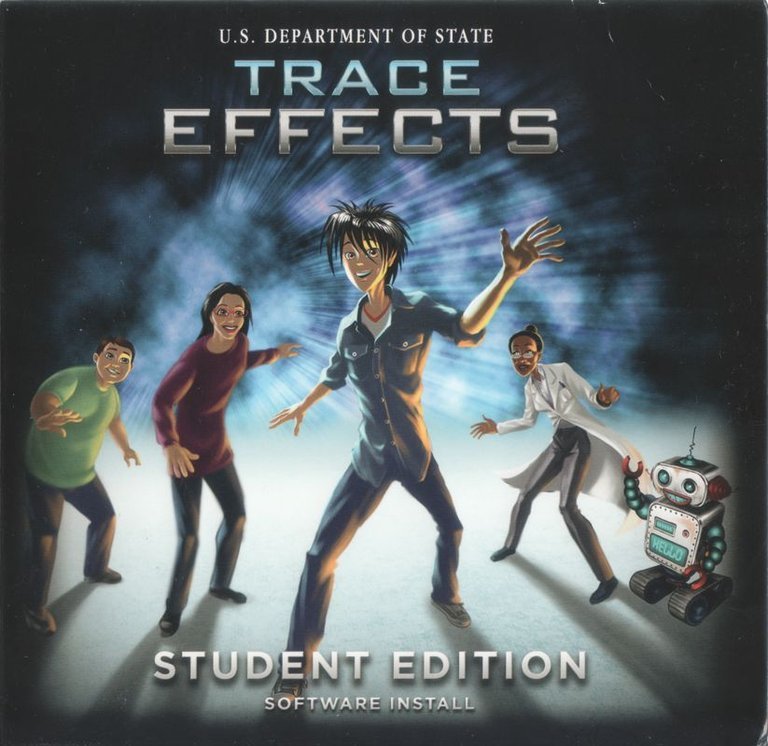
Trace Effects is an educational 3D adventure game designed to teach English in an interactive way. Players assume the role of Trace, a student who accidentally travels back in time and must navigate through seven chapters to return to his own era. The game emphasizes language learning through dialogue choices, mini-games, and activities that improve reading, listening, and writing skills. Players’ decisions influence the tone of conversations and their score, while completing chapters unlocks graphic novel summaries and additional language practice exercises.
Trace Effects Guides & Walkthroughs
Trace Effects Reviews & Reception
commonsense.org (25/100): A positive story and interesting word-collection challenge help students develop skills in English.
englishatsandvika.blogspot.com : The idea of the game is good, but the game is not. I would not recommend this game to anyone, since it’s a complete waist of time you could have used either to play a good game, or to actually learn English instead.
Trace Effects: A Pioneering Experiment in Educational Gaming
Introduction
In the vast and ever-evolving landscape of video games, few titles dare to blend entertainment with education as boldly as Trace Effects. Released in 2012 by the U.S. Department of State and developed by Supergroup, this 3D adventure game was designed with a singular, ambitious mission: to teach English in a modern, interactive way. Unlike traditional language-learning software, Trace Effects leverages the immersive power of gaming to engage players in a narrative-driven experience where language acquisition is seamlessly woven into gameplay. This review explores the game’s development, narrative depth, gameplay mechanics, and its lasting impact on the educational gaming genre.
Development History & Context
The Studio and Vision
Trace Effects was developed by Supergroup, a studio known for its innovative approach to interactive media. The game was commissioned by the U.S. Department of State, reflecting a broader initiative to use digital tools for cultural and educational outreach. The vision was clear: create a game that could teach English to non-native speakers while also fostering cultural understanding. This was not merely an educational tool but a soft diplomacy effort, using gaming as a medium to bridge linguistic and cultural gaps.
Technological Constraints and Era
Released in 2012, Trace Effects was built using the Unity engine, a choice that allowed for cross-platform compatibility (Windows, Macintosh, and browser-based play). The Unity engine was still in its relative infancy at the time, but it provided the flexibility needed to create a 3D adventure game that could run on a variety of systems, including lower-end hardware. The game’s visuals, while not cutting-edge, were functional and served the educational purpose well.
The Gaming Landscape
The early 2010s were a transformative period for educational games. Titles like Minecraft: Education Edition and Kerbal Space Program were beginning to demonstrate the potential of games as learning tools. However, Trace Effects stood out for its focus on language acquisition, a niche that had seen limited exploration in mainstream gaming. The game’s release coincided with a growing recognition of the power of gamification in education, making it a timely and relevant experiment.
Narrative & Thematic Deep Dive
Plot Overview
Trace Effects follows the story of Trace, a university student who accidentally sends himself into the past while working on a time-travel experiment. Stranded in an unfamiliar era, Trace must navigate a series of challenges to return to his own time. The narrative is divided into seven chapters, each presenting a unique set of obstacles that require players to use their English language skills to progress.
Characters and Dialogue
The game features a cast of characters that Trace interacts with, each with distinct personalities and roles in the story. The dialogue is designed to be educational, with players required to choose responses that demonstrate their understanding of English vocabulary and grammar. The tone of the dialogue varies depending on the player’s choices, ranging from happy and friendly to unsure or hesitant, adding a layer of emotional depth to the interactions.
Themes
At its core, Trace Effects explores themes of time, consequence, and the power of communication. The time-travel premise allows the game to introduce players to different cultural contexts, reinforcing the idea that language is a bridge between people and eras. The game also subtly emphasizes the importance of perseverance and problem-solving, as Trace must overcome linguistic and cultural barriers to achieve his goal.
Gameplay Mechanics & Systems
Core Gameplay Loop
The gameplay in Trace Effects revolves around exploration, dialogue, and puzzle-solving. Players control Trace in a third-person perspective, navigating through environments and interacting with objects and characters. The primary mechanic is the use of action words and objects in the correct context to progress through the story. For example, players might need to select the right verb to complete a sentence or choose the appropriate object to solve a puzzle.
Dialogue and Choice
Dialogue choices are central to the gameplay experience. Players must select responses that fit the context of the conversation, with the game providing hints about the tone (e.g., happy, friendly, unsure). These choices affect the player’s score for each chapter, incentivizing careful consideration of language use. Additionally, characters occasionally ask players to answer questions related to the story, further reinforcing language comprehension.
Mini-Games and Activities
Beyond the main narrative, Trace Effects includes a variety of mini-games and activities designed to improve reading, listening, and writing skills. These include:
– Language Practice Activities: Based on the seven chapters, these activities reinforce vocabulary and grammar concepts introduced in the main game.
– Word Soup: A timed game where players must form as many words as possible from a given set of letters.
– Phrases in Space: A game where players take turns choosing consonants and buying vowels to complete phrases.
These mini-games provide a welcome break from the main narrative while reinforcing the educational goals of the game.
Character Progression and UI
As players progress through the game, they unlock graphic novel-style summaries of each chapter, allowing them to review what they’ve learned. The UI is straightforward, with a direct control scheme that makes it accessible to players of all ages. The game’s interface is designed to be intuitive, ensuring that the focus remains on language learning rather than complex controls.
World-Building, Art & Sound
Setting and Atmosphere
Trace Effects is set in a fictionalized version of North America, blending contemporary and historical elements to create a unique atmosphere. The game’s environments are designed to be immersive but not overwhelming, with a focus on clarity and accessibility. The art style is simple yet effective, using bright colors and clear visual cues to guide players through the world.
Visual Direction
The game’s visuals are functional rather than groundbreaking. The 3D models and environments are designed to be easily navigable, with a focus on readability and user-friendliness. The character designs are expressive, helping to convey emotions and reactions during dialogue sequences. While the graphics may not compete with AAA titles, they serve the game’s educational purpose well.
Sound Design
The sound design in Trace Effects is minimal but effective. The game features a light, upbeat soundtrack that complements the adventurous tone of the narrative. Sound effects are used sparingly, primarily to provide feedback during interactions and mini-games. The voice acting, while not professional-grade, is clear and helps to reinforce the language learning aspects of the game.
Reception & Legacy
Critical and Commercial Reception
Trace Effects received limited critical attention upon release, likely due to its niche appeal as an educational tool rather than a mainstream game. However, within the educational gaming community, the game was praised for its innovative approach to language learning. Players and educators appreciated the game’s ability to make language acquisition engaging and interactive, though some criticized the simplicity of the gameplay and visuals.
Evolution of Reputation
Over time, Trace Effects has gained recognition as a pioneering title in the educational gaming genre. Its use of narrative-driven gameplay to teach language skills has influenced subsequent educational games, particularly those focused on language learning. The game’s legacy is evident in the growing number of titles that blend storytelling with educational content, demonstrating the potential of games as powerful learning tools.
Influence on the Industry
Trace Effects contributed to the broader trend of gamification in education, demonstrating that games could be more than just entertainment. Its success helped pave the way for other educational games, particularly those focused on language learning. The game’s use of narrative and interactive gameplay to teach English has inspired developers to explore similar approaches in other subjects, from math to history.
Conclusion
Trace Effects is a remarkable experiment in educational gaming, blending narrative, gameplay, and language learning into a cohesive and engaging experience. While its visuals and gameplay may not rival those of mainstream titles, its innovative approach to teaching English through interactive storytelling sets it apart. The game’s legacy lies in its demonstration of the power of games as educational tools, influencing a new generation of titles that seek to make learning both fun and effective.
Final Verdict: Trace Effects is a pioneering title in the educational gaming genre, offering a unique and engaging way to learn English. While it may not appeal to traditional gamers, its innovative approach to language learning makes it a valuable tool for educators and students alike. 8/10