
- Release Year: 1998
- Platforms: Windows
- Developer: David Bernazzani
- Genre: Board game, Puzzle
- Perspective: 1st-person
- Game Mode: Single-player
- Gameplay: Word construction
Description
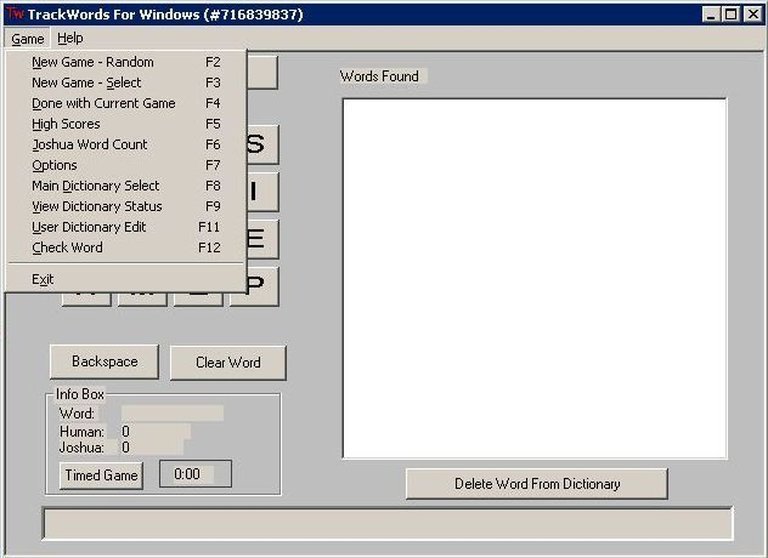
TrackWords is a freeware single-player word puzzle game where players construct words from adjacent letters on a grid (available in 3×3, 4×4, or 5×5 sizes). Featuring a built-in dictionary of over 87,000 words and the ability to add custom words, players are scored based on the percentage of discoverable words found via the game’s ‘Joshua’ function. Additional options include timed challenges, minimum word length settings, and access to billions of unique grid configurations.
TrackWords Free Download
PC
TrackWords Reviews & Reception
myabandonware.com : I’ve been playing this for years, a nice way to kill time during a lunch hour.
TrackWords: Review
Introduction
In the annals of video game history, 1998 stands as a landmark year defined by narrative epics and technological leaps. The Legend of Zelda: Ocarina of Time, Half-Life, and Metal Gear Solid redefined interactive storytelling, yet amidst this cinematic revolution, a quiet outlier emerged: TrackWords. Created by solo developer David Bernazzani, this freeware Windows title offered a starkly different experience—an unapologetic word puzzle devoid of plot, characters, or graphical spectacle. Adapted from The Oxford A to Z of Word Games, TrackWords distilled gameplay to its purest form: the cerebral thrill of linguistic discovery. Its legacy lies not in blockbuster acclaim but in its enduring appeal as a timeless intellectual exercise, a digital equivalent of a crossword puzzle or Scrabble board that has quietly captivated players for over two decades. This review deconstructs TrackWords as a cultural artifact—a testament to minimalist design and the timeless allure of the word game genre.
Development History & Context
TrackWords was conceived by David Bernazzani, a developer whose sole documented credits include this title and one other game. Bernazzani’s vision was rooted in a dissatisfaction with traditional word games: the original Oxford-inspired “TrackWords” used a 3×3 grid, which he deemed insufficiently challenging. His solution was a digital expansion featuring 3×3, 4×4, and 5×5 grids—a radical escalation in complexity that turned a casual pastime into a rigorous mental workout.
The 1998 technological context is crucial. Windows 95/98 dominated PC gaming, and while titles like Half-Life pushed graphical boundaries, Bernazzani prioritized efficiency and accessibility. The game’s 300 KB size (as documented on MyAbandonware) and reliance on a built-in dictionary of over 87,000 words underscore the era’s constraints: storage was premium, and algorithms had to be lean. The inclusion of “Joshua,” an internal word-search function that validated words and calculated scores, reflects Bernazzani’s focus on computational elegance—a necessity for a solo developer working without a team.
The gaming landscape of 1998 was saturated with narrative-driven experiences. While Final Fantasy VII and Grim Fandango blended storytelling with gameplay, TrackWords deliberately eschewed this trend. Its freeware model—pioneered by early PC pioneers like Apogee Software—further distanced it from commercial pressures. Bernazzani wasn’t chasing blockbuster success; he was crafting a niche tool for linguophiles, a philosophy that aligns with the burgeoning abandonware movement of the late 90s, where gameplay purity trumped commercial viability.
Narrative & Thematic Deep Dive
TrackWords is a paragon of ludonarrative dissonance by omission. It contains no plot, dialogue, characters, or overarching themes—a deliberate choice that positions it as an anti-narrative in an era obsessed with cinematic storytelling. Its “story” is one of pure abstraction: the player confronts a grid of letters and derives meaning from the act of word construction itself. This absence of narrative is not a flaw but a feature, inviting players to project their own cognitive processes onto the experience.
The game’s thematic core is the relationship between chaos and order. Random letters generate infinite permutations, yet the player imposes structure by identifying valid words. This mirrors linguistic theories of emergence—the idea that complex systems (like language) arise from simple rules. Joshua, the word-search function, embodies this duality: it quantifies the player’s success as a percentage of possible words found, transforming abstract creativity into measurable precision.
In contrast to contemporaries like Amnesia (1996), which used text for atmospheric storytelling, TrackWords weaponizes language as a gameplay mechanic. It echoes the minimalist ethos of text adventures like Colossal Cave Adventure (1976) but strips away fantasy trappings, leaving only the raw challenge of the lexicon. The result is a game that feels less like entertainment and more like a linguistic gymnasium—a space where the joy of discovery derives not from plot, but from the moment a jumble of letters coalesces into a meaningful word.
Gameplay Mechanics & Systems
TrackWords’ gameplay is a masterclass in elegant simplicity. The core loop revolves around constructing words from adjacent letters on a grid (3×3 to 5×5), with no letter reuse—a rule borrowed directly from its Oxford origins. Bernazzani’s key innovation was scalability: the 5×5 grid transforms the game from a casual diversion into a formidable test of vocabulary and pattern recognition.
Core Systems:
– Word Validation: Joshua, the game’s internal engine, cross-references player input against an 87,000-word dictionary. Invalid words trigger a query; players can add them to a custom list, fostering a sense of ownership.
– Scoring: Success is measured as a percentage of possible words—a brutal metric that rewards comprehensive discovery over high-scoring “bingo” words.
– Customization: Options include timed modes, minimum word length settings, and “fast game” toggles. The ability to replay specific numbered games (up to 4 billion variants) ensures infinite replayability.
UI and Controls:
The interface is utilitarian: a fixed/flip-screen grid displays letters, with keyboard/mouse input for word entry. Joshua’s real-time feedback (e.g., highlighting found words) creates a tactile rhythm akin to solving a physical puzzle. The lack of graphical flair is intentional; focus remains entirely on the letters and their relationships.
Flaws and Innovations:
While the scoring system encourages thoroughness, it can feel punitive for casual players. The absence of hints contrasts with modern puzzle games but aligns with 1998’s “figure it out yourself” ethos. Joshua’s algorithm, while efficient, occasionally misses obscure words—a trade-off for its small footprint.
World-Building, Art & Sound
TrackWords rejects traditional world-building in favor of a “world” of pure abstraction. The grid is both environment and antagonist—a sterile, letter-filled void where meaning is imposed, not inherent. This absence of narrative space is mirrored in its visual design: monochrome letters on a plain background, with no sprites, environments, or thematic textures. The 1st-person perspective fixes the player’s gaze on the grid, creating a sense of intimate focus akin to peering through a microscope at linguistic DNA.
Artistically, the game is a study in functional minimalism. The letter tiles resemble Scrabble pieces but lack tactile detail; their purpose is purely functional. The UI’s sparse layout—menu options, score displays, and the grid itself—echoes the utilitarian aesthetic of early Windows applications. There are no animations or transitions, reinforcing the game’s static, cerebral nature.
Sound design is absent. Unlike contemporaries like Tetris or Puzzle Bobble, which use audio cues to enhance feedback, TrackWords relies on silence. This void amplifies the player’s internal monologue, turning every keystroke into a moment of intense concentration. The absence of sound underscores the game’s purity: it is a dialogue between mind and letters, uninterrupted by auditory distraction.
Reception & Legacy
TrackWords launched into a gaming landscape dominated by narrative giants. Unlike Half-Life (1998), which revolutionized storytelling, it received no mainstream critical coverage. MobyGames and MyAbandonware list no professional reviews, and its Metacritic page remains empty—a fate shared with many freeware titles of the era. Its commercial impact was negligible, yet its legacy endures in the niches it cultivated.
Cult Following:
On platforms like Reddit and abandonware forums, players laud its “pure puzzle” ethos. A MyAbandonware user (2022) noted, “I’ve been playing this for years, a nice way to kill time during a lunch hour.” The game’s portability—still playable via Wine on Linux—speaks to its timeless design. Its ability to run on minimal hardware (8MB RAM, Windows 95) made it a staple for office workers and students seeking mental respite.
Influence:
TrackWords anticipated modern word games like Wordscapes (2017) but with greater depth. Its Joshua-inspired scoring system—quantifying linguistic discovery—foreshadowed analytics-driven puzzle apps. The game’s emphasis on replayability (4 billion variants) also prefigures procedurally generated content, though without the algorithmic complexity of modern titles.
Historical Significance:
In 2024, TrackWords stands as a relic of pre-narrative gaming. It embodies the ethos of early PC shareware: accessibility, creativity, and gameplay purity. Its survival in abandonware archives—not as a curiosity, but as a functional tool—highlights the word game genre’s resilience. Unlike ephemeral AAA titles, TrackWords endures because it solves no problem other than the human need to find order in chaos.
Conclusion
TrackWords is a paradox: a product of 1998 that feels timeless, a freeware gem with no commercial footprint but a devoted following. It eschews the cinematic ambitions of its contemporaries to deliver a raw, unfiltered puzzle experience—one where the joy of discovery lies not in plot twists, but in the moment “CAT” materializes from a jumble of letters. Bernazzani’s creation is a testament to the power of constraint: in an era of bloated narratives, TrackWords thrives on its simplicity.
Its place in history is secure not as a trendsetter, but as a cultural touchstone—a reminder that video games need not tell stories to be profound. TrackWords is a linguistic gym, a digital crossword, and a monument to the beauty of the lexicon. For players who seek challenge over spectacle, it remains not just playable, but essential. In a world saturated with interactive narratives, TrackWords stands as a quiet, brilliant reminder that sometimes, the most compelling games are the ones that let language speak for itself.