
- Release Year: 2007
- Platforms: Windows
- Publisher: Halycon Media GmbH & Co. KG
- Developer: Auran Games Pty Ltd.
- Genre: Simulation
- Perspective: 1st-person, 3rd-person
- Game Mode: Single-player
- Gameplay: Cargo delivery, Passenger transport, Scenario-based, Train driving
- Setting: Germany, Railroad
- Average Score: 72/100
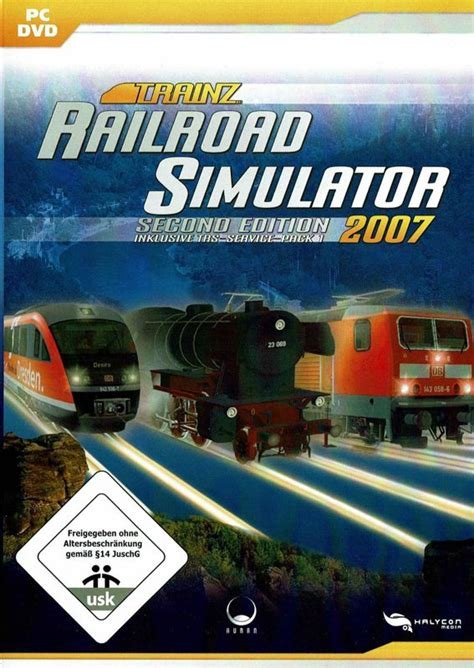
Description
Trainz Railroad Simulator 2007 is a railroad simulation game where players assume the role of a train engineer, completing scenarios such as timely cargo deliveries and passenger transport across various routes. As an updated version of Trainz Railroad Simulator 2006, it focuses on German region content, introducing 40 new locomotives and 80 new wagons, while supporting the import of custom trains and scenery from an active community.
Gameplay Videos
Trainz Railroad Simulator 2007 Reviews & Reception
gamesreviews2010.com (80/100): Trainz Railroad Simulator 2007 is the ultimate railroading experience.
retro-replay.com : Trainz 2007 Deluxe Edition offers a deep and rewarding simulation experience that appeals to both casual train enthusiasts and veteran railroad simmers.
Trainz Railroad Simulator 2007: A Bridge Over Troubled Water – An Historical Review
Introduction: The Last Stop Before a New Era
In the sprawling and often convoluted cosmos of train simulation, few franchises have navigated as many corporate derailments, technical upgrades, and regional re-routings as Trainz. Sitting awkwardly between the solid foundation of Trainz Railroad Simulator 2006 and the ambitious engine overhaul of Trainz Simulator 2009: World Builder Edition, Trainz Railroad Simulator 2007 (TRS2007) is a title defined less by revolutionary features and more by its existence as a strategic, and somewhat desperate, release. For the uninitiated, it is a seemingly minor, region-specific compilation. For historians, it is a crucial artifact of a studio in crisis—Auran Games—on the brink of collapse, and the nascent stewardship of its unlikely savior, N3V Games. This review posits that Trainz Railroad Simulator 2007 is not a game to be judged on its standalone merits, but as a pivotal bridge product. Its primary legacy is twofold: first, as a financial lifeboat for a bleeding studio, and second, as the vehicle that delivered the seminal Service Pack 1 (SP1) content and stability improvements to a fragmented European audience, thereby preserving the integrity of the Trainz ecosystem during its most vulnerable period. It represents the last, tangible breath of the JET2 engine era before the franchise’s技术和philosophical reset.
Development History & Context: A Studio on the Brink and a New Conductor
To understand TRS2007, one must first understand the catastrophic context of its creation. The Australian developer Auran Games, after nearly a decade of projects, had staked its entire future on the massively multiplayer online role-playing game Fury. Described in contemporary news accounts as one of the most expensive games developed in Australia, Fury was a commercial and critical disaster that left Auran financially ruined and seeking bankruptcy protection in 2007.
Within this maelstrom, the Trainz franchise was Auran’s lone, shining revenue stream. Enter Tony Hilliam and his company, initially N3VRF41L Games (later N3V Games). Hilliam, a long-time rail enthusiast and pre-beta collaborator on the original Trainz, was brought in as a principal investor and given operational control. His mission was immediate and stark: generate cash flow to stave off creditors and reorganize the shattered company.
TRS2007 was born from this desperate pragmatism. Unlike a true sequel, it was not a project of creative ambition but of market segmentation and content repackaging. The game is fundamentally Trainz Railroad Simulator 2006 with its Service Pack 1 applied, bundled with a specific set of regional content. As documented in the Trainz Wikibooks, there were distinct regional variants:
* A French/Belgian/Swiss version distributed by Anuman Interactive.
* A German-speaking version (for Germany, Austria, Switzerland) distributed by Halycon Media, which is the version most commonly referenced by the MobyGames entry. This version included 40 new locomotives and 80 new wagons focused on European (primarily German, Austrian, Swiss) rolling stock.
This “regional classics” strategy, later expanded into the Trainz Classics series (TC1, TC2, TC3), was a low-cost, high-margin tactic. It required minimal new development—primarily new 3D models for region-specific locomotives and some route adjustments—while selling a “new” product to different markets. The underlying engine, JET2 (from TRS2004/TRS2006), was already four years old, and Auran’s downsizing from over 100 employees to under 20, as noted in the Wikibooks article, meant resources for a full engine overhaul were nonexistent. TRS2007, therefore, is a snapshot of a studio in cost-cutting survival mode, using proven technology to ship a product that could be quickly turned around for international markets.
Narrative & Thematic Deep Dive: The Story is the Schedule
Trainz Railroad Simulator 2007 does not possess a narrative in the conventional sense—there are no voiced characters, cutscenes, or scripted plotlines. Its “story” is emergent, systemic, and entirely player-generated, a defining trait of the Trainz series since its inception. However, to dismiss it as lacking theme would be a profound misreading of its design philosophy.
The core theme is operational realism and historical evocation. The game’s primary storytelling mechanism is the Driver Session. These are not mere missions; they are carefully crafted vignettes that simulate the pressures and rhythms of railway operation. A session titled “Brenner Pass Freight” does not tell a story about a freight train; it is the story. The “plot” is written in the timetable: depart Innsbruck by 08:00, navigate the steep grades of the Alpine pass, manage brake temperatures on the descent, arrive at Verona before the 14:00 slot, and avoid delaying the opposing passenger service. The conflict is man (the player) versus physics, schedule, and signal logic. The “characters” are the locomotives themselves—a powerful DB Class 218 diesel has a different “personality” and capability than a delicate Swiss Re 4/4 electric—and the environments they traverse.
The German regional content of the Halycon version deepens this historical texture. Scenarios set on the Rhine Valley or through the Bavarian Alps are implicitly themed around post-war European railroading—the era of dieselization, the persistence of steam in some pockets, the precise, clockwork efficiency of Deutsche Bahn. The included documentation and scenario descriptions (like those mentioned in the forum posts referencing the Montparnasse route) provide just enough contextual flavor to anchor the player in a specific time and place. This is environmental storytelling at its finest: the grime on a 1970s-era wagon, the specific architectural style of a Baden-Württemberg station, the sound of a diesel-electric’s turbocharger spooling up—all work in concert to suggest a history and a operational culture.
Thus, the narrative of TRS2007 is a procedural one. The drama emerges from the interplay between the player’s execution, the game’s physics engine, and the rigid constraints of the session. It is a game about responsibility, timing, and mastery of complex machinery within a living, breathing (if simulated) world. The lack of a traditional plot is not a failing but a fundamental design choice that places the player squarely in the engineer’s cap, making their performance the sole source of meaning.
Gameplay Mechanics & Systems: The JET2 Engine’s Last Stand
The gameplay of TRS2007 is a direct inheritance from its immediate predecessor, TRS2006, with the crucial addition of SP1’s fixes and features. The experience is bifurcated into two primary, interconnected modules: Surveyor (the world-building editor) and Driver (the operational simulator).
1. The Driver Module (The Heart of the Experience):
This is where the player interacts directly with the railway. The player assumes the role of the driver, operating a locomotive (or a consist of multiple locomotives and cars) from either a first-person cab view or an external chase camera. The control scheme is rich and simulation-oriented.
* Physics Model: The JET2 engine’s physics model, updated in SP1, handles adhesion, momentum, braking distances, and—critically for steam and some older diesels—wheel slip. Players must learn to apply throttle and brake gradually, especially on gradients. The weight of the consist directly impacts acceleration and stopping.
* Control Modes: The game distinguishes between “DCC” mode (a simplified, direct-control model akin to a model railway) and “CAB” mode (the full simulation with independent controls like regulator, brake valve, sanding, and sometimes even cylinder cocks for steam). Serious players live in CAB mode.
* Tasks & Sessions: Gameplay revolves around completing Driver Sessions, which are pre-scripted objectives with goals, time limits, and failure conditions. These range from simple “drive from Point A to Point B” to complex shunting (switching) puzzles in freight yards, requiring precise coupling/uncoupling and track routing. The 40 new locos and 80 new wagons from the German edition expanded the roster for these tasks, introducing more European prototypes.
* AI Traffic: A key improvement in SP1 was enhanced AI train operations. AI-driven trains will follow their own schedules on the network, requiring the player to be aware of signal aspects and potential conflicts, simulating a dynamic dispatching environment.
2. The Surveyor Module (The Creative Powerhouse):
This is where Trainz transcends being a mere driver sim and becomes a sandbox creation tool. Surveyor is a powerful, if archaic by modern standards, isometric world editor.
* Terrain Sculpting: Players can raise, lower, smooth, and texture terrain with a brush-based system. Mountains, valleys, and plains are molded manually.
* Track Laying: The core mechanic. Track is placed as splines (curved or straight), with a vast library of track pieces (straights, curves, crossings, junctions, turntables). Track must be connected properly for trains to run. Signaling is a separate, complex layer.
* Asset Placement: Thousands of scenery objects—buildings, trees, roads, bridges, stations, industries—are placed from a hierarchical palette. The “German” and “Expansion Pack” content would have added region-specific assets like alpine huts, specific European station buildings, and industrial structures.
* Session Creation: Surveyor is also where Driver Sessions are authored. Players set up consists (train compositions), define start/end points, set speed limits, place “hotspots” that trigger scripted events or instructions, and write the objective text. This is the key to custom storytelling.
3. Systems & Flaws:
* The JET2 Limitation: By 2007, the JET2 engine was showing its age. It was not built for modern multi-core CPUs or advanced GPUs. Graphics, while serviceable, lacked true shader model 3/4 support, had limited draw distances, and featured primitive water and lighting. The infamous rußige Fensterchen (sooty little windows) mentioned in the GameStar review were a literal graphical limitation of the cab views.
* The Content Manager (CM/CMP): This was the game’s database browser and content management system. It was powerful but clunky, often requiring manual “commits” to fix database errors after adding new assets. The SP1 update likely improved its stability, but the core workflow was always a hurdle for new users.
* Community & Modding: This is the system that saved TRS2007. The Trainz community was (and is) phenomenally active. The Download Station (DLS) was the lifeblood, allowing users to upload and download tens of thousands of user-created locomotives, routes, and scenery objects. TRS2007, being SP1-compliant and widely distributed in Europe, became a hub for this content. The game’s true longevity was not in its boxed content, but in its ability to ingest and display community assets, a trait inherited from TRS2006.
In essence, TRS2007’s gameplay is a robust, deep, but technically dated simulation toolkit. Its innovation had plateaued with the JET2 engine. What it offered was unparalleled creative agency within a specialized domain, powered by a world-class (for its time) editor and sustained by one of gaming’s most dedicated modding communities.
World-Building, Art & Sound: Functional Realism in a Digital Europe
The artistic presentation of TRS2007 is a study in functional realism versus graphical generation. Its goal is not to awe with spectacle but to convincingly replicate the experience of railroading.
- Visual Direction & Environment: The German regional content focused on Central European landscapes: the dense forests and rolling hills of Bavaria, the dramatic peaks of the Alps, the Rhine river valleys, and the urban sprawl of cities like Frankfurt or Munich. The asset library included period-appropriate (late 20th century) European architecture, from half-timbered houses to 1970s brutalist station buildings. The visual style is representational, not photorealistic. Textures are clear but low-resolution by today’s standards. The use of Level of Detail (LOD) models is critical; distant scenery uses simpler, lower-polygon versions to maintain performance on the sprawling routes the engine could create.
- Locomotive & Rolling Stock Modeling: This is where the new content shined. The 40 new locomotives for the German edition would have included iconic DB, ÖBB, and SBB types like the DB Class 101 (modern electric), the ÖBB Class 2016 (diesel-hydraulic), and various steam engines like the DRG Class 52. The models are accurate in form, with moving parts like rods, pistons, and fans. The sound packs are arguably more important than the visuals for immersion. Each loco type has a distinct audio signature—the chuffing of a steam blast, the growl of a V12 diesel, the whine of an electric motor under load—sourced from real recordings and meticulously implemented. The Retro Replay review correctly notes that dynamic smoke and exhaust effects, while modest, add to the atmosphere.
- Atmosphere & Weather: SP1 introduced enhanced weather effects. Rain wets the rails (affecting adhesion), fog reduces visibility on mountain passes, and day/night cycles change lighting and traffic patterns. These are not just visual; they impact gameplay, forcing players to adapt braking distances and signal observation. The atmosphere is one of operational immersion, where the environment is a active participant in the simulation.
- Sound Design: The soundscape is layered and crucial. Beyond loco sounds, there are the clicks of jointed rail, the rumble over bridges, the horn/bl whistle at crossings, the PA announcements at stations, and the ambient sounds of yards and depots. The sound design prioritizes positional accuracy and fidelity to the real-world reference, creating a convincing aural bubble inside the cab.
Overall, the art and sound of TRS2007 succeed by being competently authentic. They avoid cartoonish exaggeration but also cannot compete with the polygon counts and ray-traced lighting of modern sims. Their success is measured in how well they support the core gameplay loop: driving a believable train through a believable environment.
Reception & Legacy: A Critical Afterthought with a Lasting Impact
Contemporary Reception:
Trainz Railroad Simulator 2007 received almost no critical attention as a standalone title. The single critic score listed on MobyGames is a 65% from the German magazine GameStar, which famously reviewed it as: “Trainz 2007 is basically like its predecessor—only spruced up with a service pack and community content. It wouldn’t be so bad if Auran had given the graphics an overhaul. So I quickly hide myself in the cab, where I can only see the surroundings through the small sooty windows of my steam locomotive. Despite all this, you can currently drive a train better nowhere else, not least because of the constant supply of new material from the very active community.”
This review is a perfect capsule summary: it acknowledges the game’s bare-minimum nature (“spruced up service pack”), laments the outdated graphics, but delivers a ultimate compliment on the depth and quality of the simulation and its ecosystem. The user “score” on sites like VGtimes (5.5/10) reflects a similar ambivalence—it’s a competent but aged product.
Commercial & Strategic Legacy:
The game’s true significance lies in its business and franchise role:
1. The SP1 Standard-Bearer: For European markets, TRS2007 was the definitive, stable version of the JET2 engine. It bundled all the crucial bug fixes and minor improvements of SP1, making it the preferred platform for European modders and players during the 2007-2008 period.
2. A Financial Stopgap: As detailed in the Wikibooks entry, sales of Trainz titles like TRS2007 and the Complete Collection provided the essential cash flow that allowed Auran to navigate bankruptcy and restructure. It kept the lights on long enough for N3V to solidify control.
3. Content Bridge: The new German and French content—locomotives, wagons, and route assets—was later integrated into the much more advanced Trainz Simulator 2009 and its successors. These regional assets became permanent fixtures in the Trainz universe, accessible via the Download Station.
4. Proof of Concept for Regionalized Releases: The formula of a core engine + region-specific content pack proved successful enough to spawn the official Trainz Classics (TC1, TC2, TC3) line. These were more ambitious curated packages but followed the same philosophy: sell the same software engine with high-value, professionally made route and session content.
5. Precursor to the “Driver”-Only Trend: TRS2007 itself contained the full suite (Surveyor + Driver). However, its existence as a re-skinned, content-focused package foreshadowed N3V’s later strategy of releasing “Driver Edition” titles (like Trainz Driver for mobile) that stripped out the creation tools to lower cost and simplify for a casual audience.
Its legacy, therefore, is not one of acclaim but of essential utility. It was a placeholder that held the franchise’s place in the market, stabilized its user base with a working product, and ensured the pipeline of community content continued uninterrupted during a corporate earthquake.
Conclusion: The Definitive Verdict
Trainz Railroad Simulator 2007 is not a great game by any traditional metric. Its graphics are dated even for 2007, it introduces no meaningful gameplay innovations, and its existence is fundamentally that of a repackaged, region-specific SKU born from corporate desperation. A critical review, focusing solely on its boxed features, would (and did) find it lacking.
However, as a work of video game history, TRS2007 is fascinating and important. It is the last stand of the JET2 engine in a mainstream retail release, the final product of the original Auran era before the N3V Games stewardship fully took over. It represents a critical juncture: the point where a niche simulation series, facing annihilation, was kept alive not by a majestic new sequel but by strategic repackaging and the unwavering loyalty of its community.
Its final verdict must be bifurcated:
* As a player experience in 2024: It is a curated historical artifact. Its value lies in its stability as an SP1-compliant JET2 platform, its specific European content roster, and its status as a time capsule of a particular era in Trainz development. For a dedicated railfan wanting to experience the “classic” Trainz workflow without the more modern toolchains of TS2009+, it has a niche appeal. Its score would be a 6/10, praised for its deep simulation and content, penalized for its technical obsolescence.
* As a historical document: It is essential. It physically embodies the survival strategy that saved the franchise. It is the concrete bridge between the Trainz of the early 2000s and the modern Trainz of A New Era and TRS2022. Without the sales of products like TRS2007, the subsequent evolution of the series—with its 64-bit engines, modern graphics, and subscription models—might never have happened.
In the grand, winding schedule of the Trainz series, Railroad Simulator 2007 is not a flagship express so much as a reliable, unglamorous shunter. Its job was to move the vital cargo of stability and cash flow from the railyard of bankruptcy to the mainline of future development. It performed that task admirably, and for that, it deserves recognition far beyond its modest 65% review score. It is, in the end, a testament to the fact that in simulation gaming, as in railroading, sometimes the most important vehicle is not the fastest or the newest, but the one that keeps the line running.