
- Release Year: 2019
- Platforms: Linux, Macintosh, PlayStation 4, PlayStation 5, Windows
- Publisher: Good Shepherd Entertainment, Nacon S.A.
- Developer: Urban Games
- Genre: Simulation, Strategy, Tactics
- Perspective: Third-person
- Game Mode: Single-player
- Gameplay: Business simulation, Managerial
Description
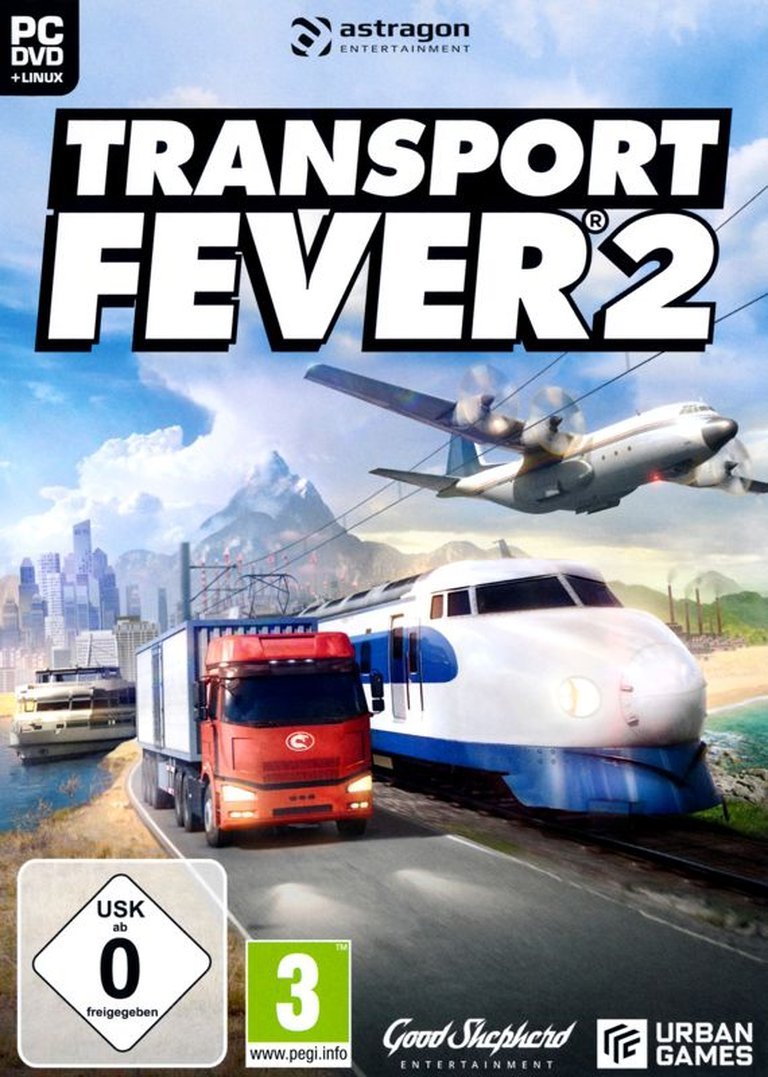
Transport Fever 2 is a comprehensive simulation and strategy game that allows players to build and manage complex transportation networks across various eras. Set in a dynamic and evolving world, players can design and optimize routes for trains, buses, trucks, ships, and airplanes, ensuring the efficient movement of goods and passengers. The game’s free camera perspective and real-time gameplay provide an immersive experience, challenging players to adapt to changing demands and technological advancements.
Gameplay Videos
Where to Buy Transport Fever 2
Transport Fever 2 Free Download
Transport Fever 2 Cracks & Fixes
Transport Fever 2 Mods
Transport Fever 2 Guides & Walkthroughs
Transport Fever 2 Cheats & Codes
PC
To activate Debug Mode, change the value in settings.lua to debugMode = true, or toggle the option in the game’s advanced options. Once activated, use the following hotkeys:
| Code | Effect |
|---|---|
| AltGr + a | Reload sound sets |
| AltGr + g | Toggle GUI visibility |
| AltGr + l | Toggle Lane visibility |
| AltGr + m | Add 500k money to the account |
PC (Console Commands)
Enable the console by editing settings.lua to include console = true, then press the ~ or ¬ key during gameplay to open the console. Enter the following commands:
| Code | Effect |
|---|---|
| money [amount] | Adds the specified amount of money to your account |
| unlockAll | Unlocks all vehicles, buildings, and technologies |
| graphics.quality [0-5] | Changes the graphics settings (0 = lowest, 5 = highest) |
| debug [0/1] | Enables or disables debug mode (1 = on, 0 = off) |
| game.config.money = [amount] | Sets your money to the specified amount |
| game.speed = [value] | Changes the game speed (default is 1) |
| game.config.freeBuild | Enables free construction mode |
| game.interface.hide_tutorial | Toggles tutorial popups (set to false to turn back on) |
PC (Debug Mode in Campaign)
Edit the base_config.lua file in the game’s res/config folder to enable debug mode in campaign. Replace the specified lines with the following:
| Code | Effect |
|---|---|
| game.config.earnAchievementsWithMods = true | Enables earning achievements with mods |
| game.config.industryButton = true | Enables industry button |
| game.config.sandboxButton = true | Enables sandbox button |
| game.config.noCosts = true | Enables no costs mode |
Transport Fever 2: A Masterclass in Iterative Refinement and Transport Simulation
Introduction
Transport Fever 2, the 2019 sequel to Urban Games’ transportation management simulation, arrives as both a love letter to logistics enthusiasts and a polished iteration of its predecessor’s ambitious vision. Set against the backdrop of industrial revolutions and global urbanization, the game challenges players to weave intricate networks of trains, trucks, ships, and planes across centuries. While not revolutionary, it represents a culmination of the studio’s decade-long refinement of the genre—a thesis underscored by its razor-sharp focus on accessibility, depth, and the eternal thrill of watching a digital world come alive under your stewardship.
Development History & Context
Urban Games, a Swiss studio founded in 2015, carved a niche with 2016’s Transport Fever, itself a spiritual successor to the cult classic Train Fever (2014). The team’s philosophy hinges on creating management sims that balance technical complexity with approachability—a response to the often-opaque mechanics of competitors like Cities in Motion or A-Train.
Released in December 2019, Transport Fever 2 emerged during a renaissance for simulation games, with titles like Cities: Skylines and Factorio dominating the market. Technological constraints from the original—notably poor optimization and a cluttered interface—were addressed through Unity Engine upgrades, enabling larger maps (1:5 scale) and mod-friendly architecture. The developers’ post-launch support, including a 2023 console port, reflects their commitment to longevity in a genre where player-driven content is king.
Narrative & Thematic Deep Dive
Unlike story-driven games, Transport Fever 2 derives its narrative from emergent storytelling—players witness towns evolve from 19th-century hamlets to sprawling metropoluses, fueled by their logistical prowess. The campaign’s 12 scenarios (praised by PC Games Germany for their variety) serve as thinly veiled tutorials but cleverly contextualize historical shifts: laying railroads during the American Gold Rush, or rebuilding Europe’s bombed infrastructure post-WWII.
Themes of progress vs. sustainability linger beneath the surface. Early-game coal-powered trains spew smoke over idyllic countryside, while later missions demand eco-friendly trams and electric trucks—a subtle nod to modern climate crises. While character-driven plotlines are absent, the dialogue between player and systems speaks volumes: a misrouted cargo train can bankrupt a fledgling city, echoing real-world dependencies on efficient transport.
Gameplay Mechanics & Systems
Core Loop & Economics
The gameplay hinges on a supply-chain domino effect: raw materials (e.g., lumber) must reach factories (e.g., sawmills), which then ship goods (e.g., tools) to cities, stimulating population growth and demand for more routes. Digitally Downloaded praised the automated timetable system, which eliminates micromanagement hell but still punishes poor planning—overloaded stations grind networks to a halt.
Innovations & Flaws
- Modular Stations: Unlike the rigid hubs of Transport Fever, stations can now be expanded piecemeal, allowing organic growth.
- Enhanced Terraforming: Players sculpt landscapes with dynamite or bulldozers, though awkward track-laying tools (4Players.de noted “finicky” curvature controls) occasionally frustrate.
- Dynamic Pricing: Cargo fees fluctuate based on delivery speed, adding strategic nuance absent in earlier entries.
Critics divided on the campaign’s pacing—Gameplay (Benelux) called it “repetitive”—and the lack of AI competitors (MKAU Gaming lamented the “lonely tycoon” feel). However, the free play mode and procedurally generated maps offer near-infinite replayability.
World-Building, Art & Sound
Visual Design
The game’s hyper-detailed diorama aesthetic mesmerizes: tiny pedestrians board trams, while individual trees sway in the breeze. The shift from the original’s drab palette to vibrant, region-specific biomes (European alpine valleys, arid Asian deserts) creates a travelogue-like diversity. GameStar Germany applauded the “postcard-perfect” vistas, though dense urban areas still tax lower-end hardware.
Soundscapes
Ambient audio—a symphony of clattering rails, ship horns, and bustling stations—grounds the experience. Vehicle sounds evolve authentically: steam trains chug laboriously, while modern diesels hum with efficiency. The minimalist score, blending folksy guitars with electronic motifs, mirrors the game’s industrial progression.
Reception & Legacy
At launch, Transport Fever 2 earned 81% from critics (aggregated via MobyGames), with praise for its “user-friendly complexity” (Indie Game Website) and “vorbildliche Mod-Unterstützung” (“exemplary mod support,” 4Players.de). However, QUICK-SAVE.de highlighted its steep learning curve for newcomers, while PC Games Germany noted sporadic crashes.
Commercially, it outperformed Transport Fever, bolstered by a vibrant modding community—over 10,000 Steam Workshop items, from historically accurate locomotives to Star Wars-themed maps. Its 2023 console ports (scoring 90% on PS5) introduced the franchise to a broader audience, proving that intricate sims can thrive beyond PC.
Legacy-wise, Transport Fever 2 cemented Urban Games as the studio for transport purists, influencing successors like Railway Empire 2. Yet its true impact lies in democratizing the genre: by streamlining systems without sacrificing depth, it bridged the gap between hardcore strategists and casual builders.
Conclusion
Transport Fever 2 is not a revolution. It is a celebration—of meticulous engineering, of historical progress, and of the quiet joy in watching a pixelated train inch across a mountain pass you spent hours terraforming. While its flaws (absent AI, uneven campaign) prevent it from dethroning titans like OpenTTD, the game stands as a high-water mark for iterative design, proving that refinement can be as vital as innovation. For simulation aficionados, it’s an essential play; for Urban Games, it’s a testament to their mastery of a genre they helped redefine.
Final Verdict: ★★★★☆ (4/5) — A robust, lovingly crafted simulation that rewards patience and creativity, even if it occasionally stalls on the tracks of ambition.