
- Release Year: 1992
- Platforms: DOS, Macintosh, Windows 16-bit, Windows
- Publisher: The Learning Company, Inc.
- Developer: The Learning Company, Inc.
- Genre: Adventure, Educational
- Perspective: Side view
- Game Mode: Single-player
- Gameplay: Puzzle elements, Scuba diving, Snorkeling
- Setting: Aquatic, Underwater
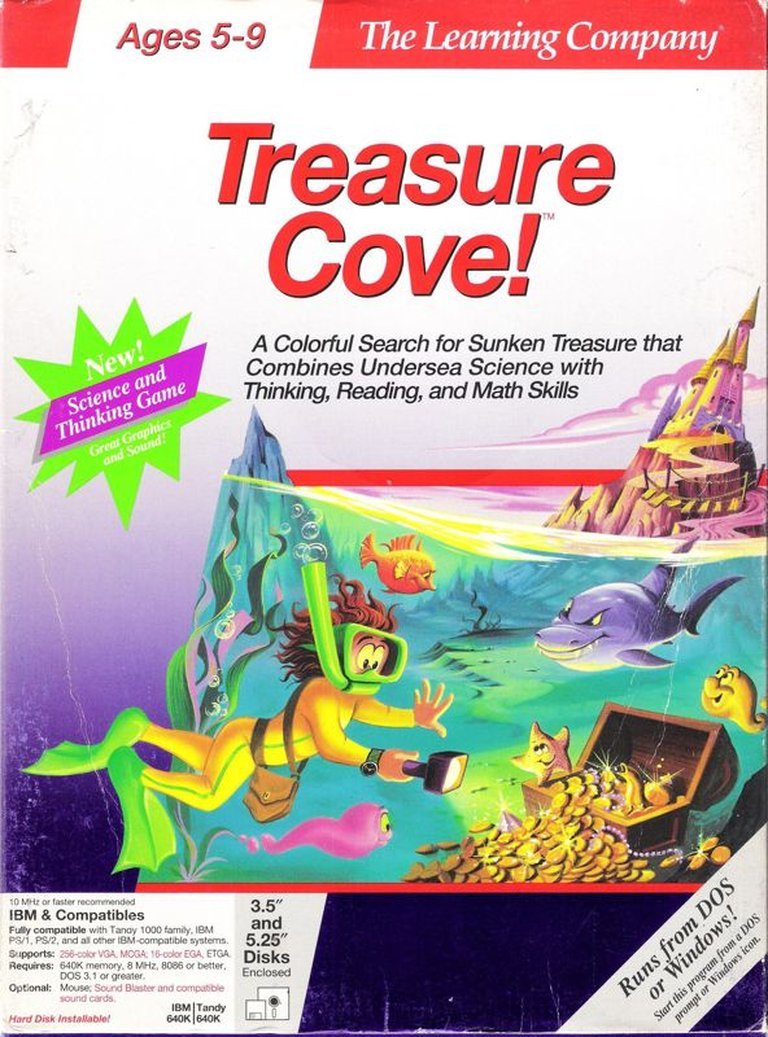
Description
Treasure Cove! is an educational adventure game where players, as the Super Seeker, explore an underwater setting to rebuild the Rainbow Bridge after it’s sabotaged by the Master of Mischief. By collecting scattered gems and capturing Goobies with a bubble pump, children ages 5-9 learn science, reading, phonetics, vocabulary, and math skills through interactive puzzles and encounters with sea creatures.
Gameplay Videos
Treasure Cove! Free Download
Treasure Cove! Reviews & Reception
classicreload.com : Treasure Cove! remains a nostalgic favorite among those who grew up with early PC learning games.
Treasure Cove!: A Sunken Treasure of Educational Gaming
Introduction: Diving into a Classic
In the early 1990s, the personal computer underwent a quiet revolution within America’s households and elementary school computer labs. It was an era of burgeoning “edutainment,” a portmanteau that often promised more than it delivered. Yet, amid a sea of digitized flashcards and repackaged drill-and-practice software, a distinct current flowed from one studio: The Learning Company. Their Super Solvers series stood apart, and Treasure Cove! (1992) represents a crystalline peak of this philosophy—a game that didn’t just teach but immersed. This review argues that Treasure Cove! is more than a nostalgic artifact; it is a masterclass in pedagogical design, a seamless fusion of narrative, environmental theming, and incremental challenge that created a template for engaging educational gameplay. Its legacy is not in flashy graphics or complex mechanics, but in its proof that learning could be the reward, not the chore, within a compelling interactive loop.
Development History & Context: The Learning Company’s Golden Age
The Studio and the Vision
The Learning Company (TLC), founded in 1980, was by the early 90s the undisputed titan of quality educational software. Their philosophy centered on “discovery learning”—the idea that children learn best by exploring, experimenting, and solving problems within a meaningful context. Treasure Cove! was developed during the studio’s creative zenith, a period that also saw gems like Reader Rabbit and the Super Solvers titles Midnight Rescue! and Gizmos & Gadgets!. The game was conceived as part of a “Treasure” sub-series within the Super Solvers franchise, following Treasure Mountain! (1990) and preceding Treasure MathStorm! (1992), each transplanting the core “collect items to rebuild something” mechanic into a new themed world. Treasure Cove!‘s explicit shift to an underwater setting was a deliberate choice to tap into children’s natural fascination with the ocean and to introduce basic marine biology and ecology concepts.
Technological Constraints and Opportunities
The game was initially developed for MS-DOS in 1992, a platform with significant limitations. Developers worked within 320×200 or 640×480 resolutions, a 256-color palette (in VGA mode), and the memory constraints of floppy disks. The side-scrolling perspective was not just an aesthetic choice but a technical necessity, allowing for simple, tile-based background rendering and smooth sprite movement without taxing the CPU. The value of this constraint was clarity: the underwater world, while graphically simplistic by modern standards, was rendered with a clear, cartoonish aesthetic where hazards (black “Goobies”), clues (orange starfish), and interactive objects (pufferfish) were instantly identifiable. The sound design relied on the PC speaker or early Sound Blaster-compatible cards for basic MIDI-like tunes and distinctive sound effects (bubbles, a satisfying “click” for correct answers, a ominous tone for losing light).
The mid-90s CD-ROM boom prompted two enhanced versions: a 1994 CD-ROM edition for Windows 3.1/Macintosh and a 1997 Windows 95 remake. These weren’t mere re-releases; they leveraged the new medium’s capacity for voice acting (the starfish’s questions were now spoken), higher-resolution graphics, and smoother animations. This evolution shows TLC’s commitment to polishing its flagship titles as technology advanced, a stark contrast to many of its contemporaries that were abandoned after their floppy-disk lifespans.
The Gaming Landscape
Treasure Cove! arrived at a curious intersection. The edutainment market was massive, but often divided into two camps: dry, curriculum-focused software from companies like Davidson & Associates (Math Blaster!) and more冒险-oriented titles from TLC and Minnesota Educational Computing Consortium (MECC, The Oregon Trail). Meanwhile, the mainstream gaming world was exploding with Sonic the Hedgehog 2, Ecco the Dolphin (a fascinating contemporary with a serious ecological subtext), and the dawn of the CD-ROM adventure game (Myst). Treasure Cove! didn’t compete on graphical fidelity or action speed with these titles. Instead, it carved a niche where the “gameplay” was inherently educational, and the “fun” was derived from the satisfaction of puzzle-solving and environmental stewardship, not combat or high-score chasing. It existed in a pure space where the learning objective was not a veneer but the core mechanic itself.
Narrative & Thematic Deep Dive: Pollution, Puzzles, and a Persistent Villain
Plot Deconstruction
The narrative is delivered with the efficiency of a children’s picture book, yet it establishes clear stakes. The antagonist is the perennial Master of Mischief, a chaotic force who appears across TLC’s series (most famously in the Super Solvers games and the Treasure series). Here, his mischief has ecological consequences: he has destroyed the Rainbow Bridge, the vital link between Treasure Mountain and his lab on Invention Isle. This act is not mere vandalism; it has released the Goobies—slimy, black, light-sucking creatures—from the sea floor, causing oil pollution to seep into the cove. The bridge’s jewels (gems) are scattered, and without it, the elves cannot reach the Master to stop him.
The player becomes the Super Seeker (an intentionally gender-neutral or customizable avatar in some versions, with the Wikipedia/IMDb note highlighting an interesting evolution in character depiction from female to male across versions). The mission is dual-purposed:
1. Environmental Remediation: Plug the “Goobie tubes” (oil leaks) by finding and deploying pufferfish.
2. Infrastructure Restoration: Rebuild the Rainbow Bridge by collecting the scattered gems.
This creates a powerful, age-appropriate thematic loop: you are not a warrior defeating a boss, but a restorer healing an ecosystem. The Goobies are not “enemies” to be killed but hazards to be managed (bubbled away). The pollution is a tangible, visual blight on the once-vibrant cove.
Characters and Dialogue
The cast is archetypal but effective:
* The Master of Mischief: An unseen, narrativized force. His presence is felt through the damage he causes, making him a context for action rather than a direct antagonist to confront. This is a subtle but crucial design choice—the conflict is with his pollution, not him.
* The Sea Stars: The primary pedagogical NPCs. The orange starfish are the “quizmasters.” Their dialogue is simple, rhymed, and instructional: “I am an orange starfish, and I have a clue for you. What word rhymes with cat?” or “What is 5 + 3?” The pink starfish serve a utilitarian function, offering light-replenishment tips. The starfish are allies, reinforcing the theme of the ocean as a community to be worked with.
* The Goobies: Representations of pollution. Their design—simple, black, amorphous—visually associates them with oil slicks and darkness. Their mechanic (stealing light units) ties the abstract concept of pollution directly to a core gameplay resource.
* The Pufferfish: Neutral actors. They are tools. Finding them by solving starfish clues turns them into a reward for learning, not a random encounter.
Underlying Themes
- Environmental Stewardship as Gameplay: This is the game’s most profound and forward-thinking layer. Pollution is not a background set-dressing; it is the central problem. The act of plugging leaks is framed as a positive, restorative act. The cove visibly “improves” as you progress, a powerful feedback loop. This predates the more explicit environmental messages of games like EcoQuest or Final Fantasy VII‘s core concept by several years, making it remarkably prescient for a children’s game.
- Learning as Exploration & Reward: Knowledge is literally the key to navigation. You cannot find the pufferfish or gems without first earning the clues from starfish by answering questions correctly. There is no separation between “learning time” and “playing time.” The educational content is the key that unlocks the next part of the adventure.
- Scalable Challenge & Self-Efficacy: The “star rank” system is genius. Completing areas at one-star is achievable for a 5-year-old. The three-star challenge requires finding nearly everything, with harder riddles and faster Goobies. This allows the game to grow with the child, a feature rarely seen in linear edutainment titles. It frames difficulty not as a barrier but as a mark of growing skill.
- Non-Violent Conflict Resolution: The “bubble pump” is a perfect non-violent tool. It stuns Goobies, captures starfish, and interacts with the environment. It reinforces problem-solving over destruction, a deliberate and commendable design choice for its target audience.
Gameplay Mechanics & Systems: The Engine of Discovery
Core Loop and Structure
The overarching loop is Explore -> Learn -> Apply -> Progress.
1. Swim through one of three areas (The Cove, The Depths, The Abyss) in a side-scrolling format.
2. Capture orange starfish to receive three single-word clues (e.g., “three”, “swimming”, “eels”).
3. Use your flashlight to shine on groups of sea creatures that match at least two of the three clues. A correct match reveals a hidden gem or a pufferfish.
4. Collect gems to rebuild the bridge and find pufferfish to plug oil leaks blocking exit caves.
5. Manage your light units (flashpower), which are drained by touching Goobies and certain actions, and replenished by pink starfish or sometimes by correct answers. Running out of light ends the dive.
6. Complete all three areas to surface, add gems to your total, and increase your star rank if you met the threshold.
7. Restart with increased difficulty (more gems needed, harder riddles, faster Goobies).
Gem Collection and Clue System
This is the game’s central puzzle mechanic. The clues are descriptive terms. The player must mentally process: “The clue is ‘three’ and ‘swimming’ and ‘eels’. I need to find a group of sea creatures that is swimming eels and there must be three of them.” This integrates:
* Reading/Word Recognition: Understanding the clue words.
* Logic/Classification: Matching descriptors to visual groups.
* Vocabulary/Observation: Knowing what an “eel” looks like vs. a “fish.”
* Basic Math: For clues like “three” or “five,” requiring counting.
The system is elegant because it forces active observation of the vibrant, detailed background art. The environment isn’t just scenery; it’s a lab full of data points.
The Bubble Pump and Resource Management
The spacebar-activated bubble pump is the sole interaction tool. Its uses are context-sensitive:
* On starfish: Capture to get clues/light.
* On Goobies: Stun them temporarily, preventing light drain.
* On pufferfish: Capture after finding them via clues.
* On seahorses (in some versions): Shine light to refill air supply.
This “one tool, many uses” design simplifies the control scheme for young children while deepening the strategic implications. Managing light becomes a tense resource-management mini-game. Do I chase that distant glowing object (likely a pink starfish for light) or avoid that cluster of Goobies? Every movement has a cost.
Progression and Replayability
The three-area structure (Cove -> Depths -> Abyss) provides a clear geographic and difficulty progression. The true longevity comes from the star rank system. A child can have a “complete” game at 1 star per area. The pursuit of 2 or 3 stars transforms the experience into a mastery challenge, requiring near-perfect gem collection and efficient navigation. This design cleverly hides a lack of raw content behind a system of escalating personal goals, a precursor to modern ” platinum” or “100%” completion systems.
Innovative and Flawed Systems
- Innovation: The seamless integration of educational assessment (the starfish quizzes) into the exploration and clue-deduction loop is its greatest strength. Failure on a quiz doesn’t stop the game; it just means you don’t get that clue, forcing you to find another starfish. It removes the “test” anxiety.
- Flaws: The reliance on reading can be a barrier for the youngest players (age 5). While some later versions added voice for questions, the original DOS version required literacy or parental help. The movement, while simple, can feel slightly sluggish, and the collision detection with small, fast-moving Goobies in the Abyss can be frustrating. The game also has no explicit save function; progress is per-session, which was standard but could be disheartenging after a long dive lost to a Goobie swarm.
World-Building, Art & Sound: A Vibrant, Living (Polluted) Ocean
Setting and Atmosphere
Treasure Cove is not a realistic ocean simulation; it is a storybook ocean. The color palette is rich and varied—bright blues and teals for healthy areas, murky greens and browns where pollution has spread. The three areas are visually distinct: the shallow, sun-dappled Cove with friendly fish; the darker, cavern-filled Depths; and the near-total darkness of the Abyss, lit only by bioluminescent creatures and your flashlight. This visual progression tells the story of ecological degradation. The atmosphere is one of peaceful exploration punctuated by mild tension (managing light, avoiding Goobies). The pollution isn’t just a plot point; it’s a visual blight you are motivated to heal.
Visual Direction and Character Design
The pixel art, constrained by DOS/VGA, is exceptionally charming and clear. Key character designs are iconic:
* The Super Seeker: A simple, colorful diver suit, allowing for easy projection.
* Orange Starfish: Big, friendly faces with clear “speech” bubbles.
* Goobies: Simple black oil-slick shapes with beady white eyes. They are more mischievous than terrifying.
* Pufferfish: Round, spiky, and clearly distinct from other fish.
* Sea Life: A menagerie of beautifully drawn, if not scientifically accurate, fish, eels, sharks, and crustaceans that populate the background. Their animations—swimming, pulsing—are smooth and add life to the world. The use of color for categorization (all clues involve looking for groups of similarly colored or shaped creatures) is a subtle but brilliant UI/UX decision.
Sound Design
The audio is functional and atmospheric. The background music is a simple, looping, cheerful underwater-themed melody. Sound effects are critical:
* The bubble pump has a satisfying pfft.
* The flashlight has a distinct mechanical click-whirr.
* A correct answer yields a positive, ascending chime.
* A wrong answer or Goobie hit yields a descending buzz or a drain sound.
* The light meter has a subtle, increasing hum as it depletes, creating subconscious tension.
In the CD-ROM versions, the addition of voice acting for the starfish questions was a game-changer, removing the reading barrier and adding personality. The voice is clear, friendly, and child-appropriate.
Reception & Legacy: Niche Acclaim and Enduring Influence
Contemporary Reception
Critical reception was positive but not ubiquitous, reflecting the niche nature of edutainment.
* AllGame gave it 3.5/5 stars, summarizing its appeal perfectly: “it’s a fun game young kids will love to play” that effectively teaches reading, science, and math.
* SuperKids (a review by children) was harsher (2/5), finding the questions boring and the graphics dated even in 1995. This highlights a common tension in edutainment: the disconnect between a parent/teacher’s pedagogical goals and a child’s desire for pure, unfettered fun.
* The most telling praise came from the Home of the Underdogs community, which awarded it 8.91/10 and the legendary tagline: “one of the best math games ever made for 5-8 year olds, bar none.” This grassroots, player-focused acclaim is perhaps the highest honor.
* The 1993 Summer CES Innovations Software Showcase Honor was a significant industry recognition, placing it among the most innovative software of its year.
Commercial Performance and Distribution
Treasure Cove! was a commercial success in its specific market. It sold through retail chains, educational catalogues, and, most importantly, was widely bundled in school software packages and pre-installed on the “computers for schools” that many districts purchased in the 90s. This bundling strategy gave it a reach and generational penetration that few narrative-driven games achieve. It became a shared cultural experience for a cohort of American children.
Evolution of Reputation
Its reputation has only grown in retrospection. Modern retrospectives on 90s edutainment consistently rank the Super Solvers and Treasure series at the top. The game is praised for:
* Its cohesive design: Every element serves the core educational and narrative goals.
* Its lack of condescension: It didn’t talk down; it challenged.
* Its thematic depth: The environmental message was rare and impactful.
* Its replay value via the star rank system.
YouTube playthroughs of the 1997 version garner tens of thousands of views, primarily from millennials experiencing nostalgia. It is now preserved as abandonware, easily playable via DOSBox or browser emulators (like ClassicReload), ensuring its accessibility.
Influence and Legacy
Treasure Cove!‘s influence is diffuse but profound:
1. Blueprint for Integrated Learning: It cemented the formula of “exploration -> puzzle -> resource -> progression” that would be used in countless later edutainment titles, including the later JumpStart and ClueFinders series from Knowledge Adventure.
2. Elevating the “Edutainment” Genre: It demonstrated that educational games could have genuine adventure-game sensibilities—atmosphere, exploration, a consistent world—without sacrificing learning integrity. It was a step beyond the “game-ified quiz” model.
3. Environmental Education Pioneer: Its seamless integration of ocean ecology and pollution awareness was years ahead of its time in the gaming space, predating the broader “green gaming” movement.
4. The Learning Company’s Legacy: It was part of the portfolio that made TLC a powerhouse, eventually acquired by Mattel in 1998 for $3.8 billion—a valuation built on the trusted quality of series like Treasure Cove!.
Conclusion: A Timeless Depths
Treasure Cove! is a masterpiece of its genre and era. Its technical limitations are now part of its retro charm, but its design brilliance is timeless. It understood that for a child, the ocean is a realm of wonder and mystery, and it leveraged that wonder to create a compelling reason to learn. The game’s genius lies in its unification of disparate elements: the Super Seeker’s quest, the ecological parable, the logic puzzles, the light-management tension, and the sheer joy of discovering a glowing gem in a sun-drenched coral cave. It never felt like a chore because the learning was the key, the reward, and the narrative progression all at once.
In the pantheon of video game history, Treasure Cove! does not sit alongside Super Mario or Final Fantasy in terms of cultural omnipresence. Instead, it occupies a quieter, more profound hall of fame: the game that proved education and joy are not opposites. It is a foundational text for anyone studying the evolution of games as a medium for learning, a testament to an era when a simple idea—”What if learning was an adventure?”—was executed with such focus and heart that its ripples are still felt today. Dive into its depths, and you will find not just a game, but a philosophy: that the most valuable treasures are not jewels, but the knowledge and environmental consciousness we carry with us to the surface. For that reason, Treasure Cove! earns its place as an enduring, unsung classic of the medium.
Final Verdict: 9/10 – A pinnacle of intelligent, heartfelt edutainment whose design clarity and thematic cohesion remain a benchmark decades later.