
- Release Year: 2004
- Platforms: Windows
- Publisher: Hi-Rez Studios, Inc., Sierra Entertainment, Inc.
- Developer: Irrational Games Australia Pty. Ltd.
- Genre: Action
- Perspective: First-person
- Game Mode: LAN, Online PVP, Single-player
- Gameplay: Jetpack, Mod support, Shooter, Skiing, Team-based, Vehicles
- Setting: Futuristic, Sci-fi
- Average Score: 83/100
Description
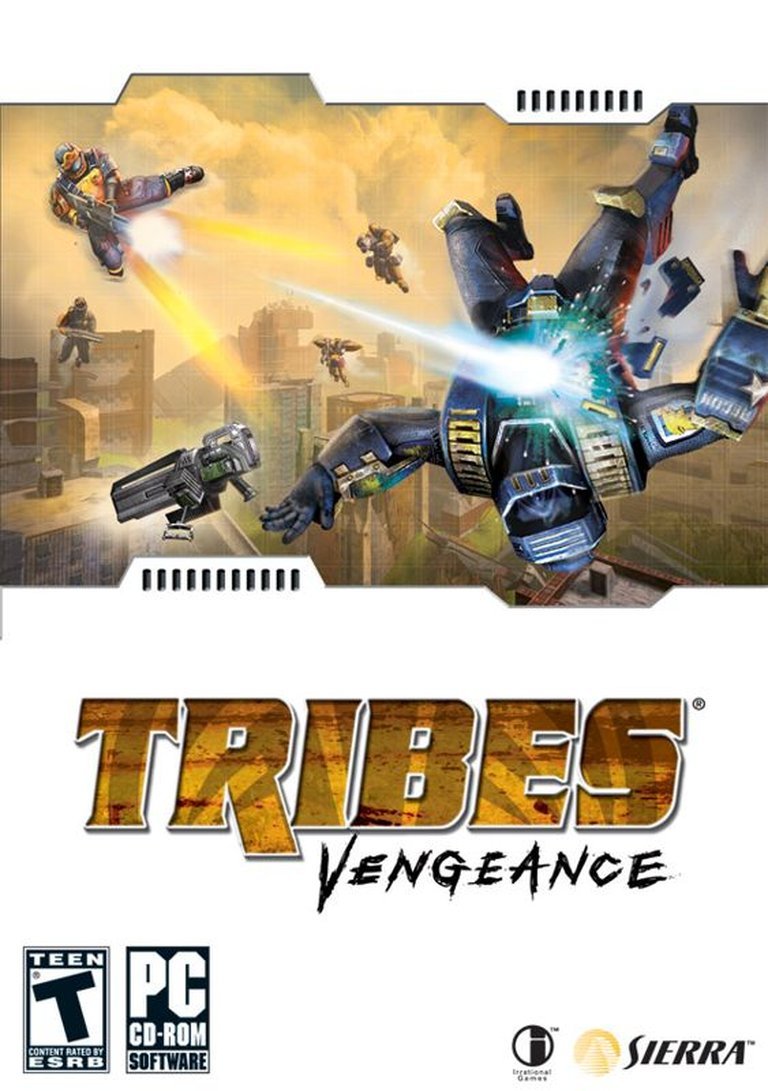
Tribes: Vengeance is a first-person shooter set in a sci-fi futuristic world where players utilize jetpack-equipped armor and a unique ‘skiing’ movement mechanic to traverse vast landscapes. The single-player campaign unfolds a multi-generational revenge narrative, beginning with the Phoenix Tribe’s raid on the Imperial palace and the abduction of Princess Victoria, then following her daughter Julia’s quest for justice two decades later, all through the perspectives of six characters across two time periods, complemented by large-scale multiplayer combat for up to 32 players with vehicles and diverse game modes.
Gameplay Videos
Tribes: Vengeance Free Download
Tribes: Vengeance Cracks & Fixes
Tribes: Vengeance Mods
Tribes: Vengeance Guides & Walkthroughs
Tribes: Vengeance Reviews & Reception
metacritic.com (83/100): Hardcore action gamers can expect 12-15 hours of intense combat for the single-player campaign, but once you go online there is no limit to the fun you can have with this game.
cnet.com : Fans of the Tribes series will love this game, but newcomers may struggle with some of the controls.
Tribes: Vengeance Cheats & Codes
PC
Start the game with the ‘-console’ command line parameter. During gameplay, press Tab to open the console and enter codes.
| Code | Effect |
|---|---|
| god | God mode |
| allammo | Full ammo for weapons and grenades |
| stat fps | Display framerate |
| stat net | Display network stats |
| stat all | Display all stats |
| stat none | Remove all stat display |
| fov | Field of view by number |
| fly | Flight mode |
| ghost | No clipping mode |
| walk | Disable fly and ghost modes |
| summon | Spawn indicated object |
| allweapons | Three weapons with full ammo |
| changesize | Change your size |
| lockcamera | Unlock/lock camera |
| killpawns | Kill all except player |
| fastweapons | Fast weapons |
| ReplaceWeapon | Replace current weapon with specified one |
| CampaignNext | Skip to next mission |
Tribes: Vengeance: A Review
Introduction: The Dynasty of Flight
To understand Tribes: Vengeance is to understand a paradox. It is a game born of legacy yet defined by departure; a prequel that sought to explain a mythos yet fragmented the community it aimed to serve; a technical marvel of kinetic freedom shackled byPublisher neglect. Released in October 2004 by Irrational Games Australia—the studio better known for narrative-heavy titles like System Shock 2 and, later, BioShock—Tribes: Vengeance (often abbreviated T:V) stood at a crossroads for one of PC gaming’s most fiercely beloved franchises. The Tribes series was synonymous with a specific, sublime alchemy: the breathtaking, momentum-driven ballet of “skiing” and jetpack flight, combined with objective-based, large-scale team combat on colossal maps. It was a hardcore, impenetrable, and deeply rewarding experience. With Vengeance, the franchise attempted its most audacious feat yet: to translate that quintessential multiplayer DNA into a full, story-driven single-player campaign while streamlining the famously complex tactics for a broader audience. My thesis is this: Tribes: Vengeance is a flawed masterwork—a game whose profound ambition in narrative and mechanical design was ultimately compromised by a rushed development cycle, fundamental design compromises that alienated veterans, and catastrophic corporate mismanagement. Yet, within its contradictory shell lies perhaps the most compelling and thematically rich story the series ever attempted, and a multiplayer core that, for all its simplifications, still captures the exhilarating, sky-bound spirit that made Tribes immortal.
Development History & Context: The “Down Under” Assault on a Legacy
The Tribes series was the brainchild of Dynamix, a studio under the Sierra On-Line banner. Starsiege: Tribes (1998) and Tribes 2 (2001) were cult phenomena, revered for their deep tactical systems, massive maps, and unparalleled sense of three-dimensional freedom. Following Sierra’s closure of Dynamix in 2001 and the cancellation of Tribes 2: Fast Attack (which promised a single-player campaign), the IP was adrift. It eventually landed at the Canberra branch of Irrational Games, led by Ken Levine and Jonathan Chey, a team with a pedigree in immersive sims and narrative design (System Shock 2, * Freedom Force*), not twitch multiplayer arenas.
The technological context was the Unreal Engine 2.5, a powerful but aging framework. Irrational heavily modified it, dubbing their iteration the “Vengeance Engine,” to handle the game’s signature vast landscapes and fast-paced physics. The year 2004 was a titanic one for PC shooters: Doom 3, Far Cry, Half-Life 2, and Halo 2 (on console) dominated the conversation. Tribes: Vengeance launched quietly in October, sandwiched between these behemoths, with almost no marketing—a death knell for a game needing to attract a new audience. Furthermore, the relationship between Irrational and publisher Vivendi Universal Games (Sierra’s parent) shatteredpost-launch. As Ken Levine later stated, Vivendi ceased all support in March 2005, cancelling the critical 1.1 patch (meant to fix bugs and add PunkBuster anti-cheat). This corporate abandonment condemned the game to a life of unpatched issues and a dwindling player base, a ghost haunting the franchise until Hi-Rez Studios eventually released it as freeware in 2015.
Narrative & Thematic Deep Dive: A Saga of Blood and Dynastic Trauma
Where Tribes: Vengeance achieved legendary status was in its narrative, a bold experiment that remains uniquely compelling. Unlike every other Tribes game, which were purely multiplayer, Vengeance presented a full single-player campaign told through the eyes of five playable protagonists across two generations, in an intentional anachronic order. The story is a prequel to the entire series, set centuries before Starsiege: Tribes, depicting the “birth of the Tribal War.”
The Plot: The “Past” timeline follows Princess Victoria of the Galactic Empire, abducted by the noble Phoenix tribe leader Daniel. Through a classic “rescue romance” turned true love, Victoria sees the Empire’s oppression of the tribes. Daniel, aiming for diplomacy, is viciously betrayed. The Blood Eagle tribe (Imperial-aligned enforcers) stages a false-flag raid on a Phoenix base, making it look like an Imperial attack. In his rage and grief, Daniel kills the Imperial King, Tiberius. Victoria, torn between love and duty, kills Daniel in vengeance, unaware she is pregnant with his child—Julia.
The “Present” timeline, twenty years later, follows a hardened Julia (now a formidable Imperial commander with artificial gold eyes housing a HUD). Witnessing her mother’s death at the hands of Daniel’s brother, the brutal General Jericho, she becomes an anti-Tribal extremist. Her quest for revenge against Jericho is manipulated from the shadows by the coolly manipulative Olivia (Victoria’s sister), the Blood Eagle leader Seti, and the enigmatic cybrid assassin Mercury (posing as Imperial General Albrecht). The narrative’s genius lies in its structure: by playing both timelines, the player pieces together the tragic, cyclical nature of the conflict. Julia’s mission of vengeance in the Present directly mirrors and is caused by Victoria’s actions in the Past.
Themes & Characters: The game is a meticulous deconstruction of the “Cycle of Revenge.” Every act of violence begets another, across generations. Key themes include:
* Identity & Heritage: Julia’s journey forces her to confront her dual heritage—the Imperial power she wields and the Tribal blood she despises. Her “rediscovering roots” trip, undergoing Phoenix initiation trials, is the game’s justified tutorial and a profound spiritual moment.
* Betrayal & Manipulation: The central tragedy is not just personal but political. Olivia and Seti’s conspiracy to engineer a genocidal “freighter accident” reveals the Tribal War as a manufactured resource/power conflict.
* The Feminine & The Imperial: The Empire is explicitly modeled on Rome (names: Tiberius, Victoria, Julia; “games” as gladiatorial spectacles). The Phoenix tribe, with names like Daniel, Jericho, Esther, carries subtle Jewish/Biblical allusions (Daniel as “judgment”). This frames the conflict as a colonialist, patriarchal empire versus a dispossessed, mythologized people.
* The Cybrid Question: Mercury, the “Implacable Man,” represents the lingering, alien Cybrid threat from the Earthsiege series. His presence hints at a larger, older conflict humanity has suppressed, a thread later picked up in the series.
Flaws: The narrative’s execution was widely panned. Critics and players alike condemned the over-acted, B-movie quality dialogue and the stiff, uncanny valley character animations in cutscenes (famously mocked as worse than Doom 3’s). The nonlinear structure, while brilliant on paper, could be confusing. However, the plot’s mystery and tragic irony were praised by many, with IGN noting the story “unravels beautifully” despite some disjointedness.
Gameplay Mechanics & Systems: The Physics of Vengeance
Tribes: Vengeance’s gameplay is a direct evolution and simplification of Tribes 2’s infamous depth.
Core Loop & Mobility: The soul of the game remains the jetpack and skiing. The jetpack uses an energy meter that regenerates when idle. Skiing, activated on foot, makes the player frictionless, allowing them to gain incredible speed downhill and, with enough initial momentum, “ski” across flat terrain. This creates the iconic Tribes sensation of gliding over battlefields at 200+ mph. The grappler gun, a franchise-first, was a revolutionary addition. It could be used to swing, redirect mid-air, perform hairpin turns, and “slingshot” oneself, adding a new vertical and acrobatic layer to navigation and combat.
Combat & Classes: Three armor classes return:
* Light: Fast, weak, low health. Julia’s unique light armor has jets on her calves and minimal plating, making her an “Action Girl” and “Lady of War” archetype.
* Medium: Balanced.
* Heavy: Slow, tanky, with integrated Arm Cannon weaponry.
Weapons include the classic Spinfusor (disc launcher), Chain Gun, Blaster, Grenade Launcher, Rocket Pod, Burner (flamethrower), Sniper Rifle, Mortar, and the unique Buckler (a thrown energy shield that one-shots). The Buckler is an 11th-Hour Superpower, learned during Julia’s Phoenix trials, after which the game locks you into light armor, meaning you rarely use it again—a frustrating design quirk.
Progression & Systems: Inventory stations allow loadout selection. Deployables like turrets and repair stations are key. Repair packs and medkits (dropped by dead players) sustain teams. The scoring system awards offensive (kills, flag captures), defensive (returns, repairs), and style points (mid-air kills, headshots), encouraging creative play.
The Great Simplification: Compared to Tribes 2, Vengeance dramatically reduced tactical depth. Maps were smaller. The heavy reliance on large, crewed vehicles (bombers, tanks) was curtailed; vehicles like the slow tank were criticized as “poor variety” and contrary to the fast-paced ethos. Teamwork and coordinated vehicle use were de-emphasized in favor of individual “Rambo-style” heroics, a point of contention for veterans. The infamous “shrike” (a fast, one-man aircraft) became the iconic vehicle of Vengeance, symbolizing this shift toward personal, high-speed combat over large-scale coordinated assaults.
Single-Player Specifics: The campaign’s 18 missions serve as an extended tutorial, introducing weapons and mechanics unintrusively. However, AI was noted as “too aware” in some scenarios, and missions often devolved into one-man army scenarios, lacking the squad-based feel the series’s multiplayer fostered.
Multiplayer: This was the saving grace. Five core modes:
1. Capture the Flag (CTF): The series staple.
2. Rabbit: A chaotic free-for-all with a single flag.
3. Arena: Team-based deathmatch with no respawns between rounds.
4. Ball: Original to Vengeance. A single ball must be thrown into an enemy goal, resembling Unreal Tournament 2004’s Bombing Run.
5. Fuel: Another original mode. Two teams collect fuel from neutral and enemy depots; dying costs your team fuel. A brilliant, tense resource-war mode.
Maps were diverse but generally smaller, favoring the faster gameplay. The modding scene was strong, with community projects like ReVengeance and the x2 Bonus Pack adding maps, modes (Race Mod), and balance tweaks long after official support died.
World-Building, Art & Sound: A Gritty, Romanesque Future
Setting & Factions: The world is a science-fiction vision of a fractured human empire. The Galactic Empire is a Roman analogue: imperial, cultured, and cruel, viewing the “Tribals” as barbarians. The Children of Phoenix are the primary rebel tribe, descended from the mythologized Harabec Weathers (from Starsiege). The Blood Eagles are the antagonist tribe, originally Imperial knights who assimilated Tribal culture, now sadistic enforcers with ties to Empire conspirators. The Cybrids (like Mercury) are the genocidal AI threat from the Earthsiege series, lurking as a “Remnant.” The mysterious Alaxians are a shadowy faction mentioned in passing.
Visuals: Powered by Unreal Engine 2.5, the game was “slightly above par” for 2004. Art design favored a dilapidated, lived-in aesthetic—scrap-metal fortresses, dusty canyons, industrial bases. Character models were a weak point, often “bulky” and stiff, with facial animations criticized as “overacted” and “cartoonish.” Julia’s mechanical gold eyes were a standout, visually signifying her hybrid identity. The ragdoll physics were praised for their chaotic, morbid satisfaction when players were killed by explosions.
Sound: The sound design was a high point. Weapon sounds were punchy and distinct. The iconic shink of the spinfusor, the roar of jetpacks, and the whistle of skis created an immersive 3D soundscape crucial for spatial awareness. The soundtrack by Eric Brosius was atmospheric and well-received. However, the voice acting, while featuring talents like Tara Strong (Julia) and Steve Blum (Jericho), was let down by a script critics called suitable for “Mystery Science Theatre 3000.”
Reception & Legacy: Critical Favorite, Commercial Ghost
Launch Reception: Tribes: Vengeance was a critical success, holding an 84/100 on Metacritic (from 44 critics at the time, higher in some aggregations). It won Australian Game Developer Awards for Best PC Game and Game of the Year (2004). Reviews consistently praised:
* The “Tribes feel”—the joy of flight and skiing.
* The excellent single-player campaign as a surprisingly effective gateway for newcomers.
* The multiplayer as a potent, accessible alternative to Unreal Tournament 2004.
* Strong presentation and varied mission design.
Criticisms were consistent:
* The story’s acting and presentation were frequently called cheap and melodramatic.
* Simplified tactics and smaller maps alienated Tribes 2 veterans who felt the soul of the series was “dumbed down.”
* Vehicle variety was lacking, and some were underpowered.
* The lack of in-game voice chat (a growing standard) was noted.
* “Rambotic” solo missions in single-player.
Commercial Failure & Corporate Abandonment: Sales were disastrous. Estimates suggest only ~47,000 copies sold in six months. The game launched in a crowded window with zero marketing. Then, the bombshell: Vivendi cancelled the 1.1 patch in March 2005. This act of corporate sabotage (as the community saw it) killed the game’s momentum. Server browsers became unstable, bugs went unfixed, and the small player base hemorrhaged. Levine’s later comments implied a simple business decision, not a personal feud, but the damage was irreversible.
Legacy & Cult Status: Vengeance’s legacy is split.
1. The Narrative Precedent: It proved a hardcore multiplayer franchise could support a thoughtful, complex single-player story with a non-linear structure. Its focus on dynastic tragedy and morally grey politics remains the most sophisticated lore the series has seen.
2. The Divisive Middle Child: For years, it was considered non-canon by hardcore fans who saw it as a simplified, “Unreal Tournament with jetpacks.” Its faster pace and reduced scale became a different subgenre within Tribes.
3. The Community Lifeline: The ReVengeance and x2 Bonus Pack mods are legendary. They fixed countless issues, added content, and kept the multiplayer alive for a dedicatedcore for years. Hi-Rez’s 2015 freeware release, while legal, came too late to revive the mainstream player base.
4. Influence on Hi-Rez & Tribes: Ascend: Hi-Rez’s 2012 free-to-play successor, Tribes: Ascend, directly inherited Vengeance’s class system, faster pace, smaller maps, and vehicle design (like the slower tank vs. the fast “shrike” dichotomy). Ascend’s commercial model and balancing issues drew constant comparisons to Vengeance’s own perceived missteps.
5. Historical Footnote: It is the prequel that explained the origin of the Tribal Wars, connecting the Earthsiege Cybrid narrative to the Tribes tribal conflict—a lore link later games downplayed.
Conclusion: The Unfulfilled Promise of the Vengeance Engine
Tribes: Vengeance is a game of magnificent, almost tragic, contrasts. It is home to one of the most clever and emotionally resonant narratives in the shooter genre, yet it is shackled to some of the worst cutscene direction of its era. It perfected the feeling of soaring, skiing, and grappling through alien worlds with unparalleled grace, yet it simplified the deep, systemic teamwork that gave that movement meaning. It was shepherded by a studio with a stellar reputation for story and design, yet it was abandoned by its publisher at the first sign of commercial stumble.
Its place in history is secure but complicated. It is not the pinnacle of the Tribes series—that title belongs to Tribes 2 for its majestic scale and Starsiege: Tribes for its pure, focused invention. Instead, Vengeance is the ambitious, flawed, and fascinating pivot. It is the game that dared to give the Tribes universe a cinematic, generational saga. It is the game that made the series’s most iconic movement mechanics accessible, at the cost of some strategic depth. And it is the game whose story of cyclical vengeance was cruelly mirrored by its own corporate fate—a promising new beginning cut short by betrayal, leaving only fragments and memories for its loyalists to scavenge.
For the historian, Tribes: Vengeance is an essential case study: a testament to the creative risk of grafting a single-player narrative onto a multiplayer-focused franchise, a victim of the brutal 2004 release calendar, and the most stark example of how publisher support can make or break even the most skilled developer’s vision. It is a game you must play to understand the full arc of the Tribes legacy—a flawed, beautiful, and ultimately soaring monument to what could have been. Its true verdict lies not in its Metacritic score, but in the enduring passion of the modders who kept its skies open for over a decade, and in the DNA of every fast-paced, jetpack-laden shooter that followed. Shazbot.