
- Release Year: 2011
- Platforms: Linux, Macintosh, PlayStation 3, Windows, Xbox 360
- Publisher: Akella, Frozenbyte Oy, Index Digital Media, Inc.
- Developer: Frozenbyte Oy
- Genre: Action, Platformer, Puzzle
- Perspective: Side view
- Game Mode: Co-op, Online Co-op
- Gameplay: Character Switching, Physics, Platform, Puzzle, RPG, Skill Tree
- Setting: Fantasy
- Average Score: 85/100
Description
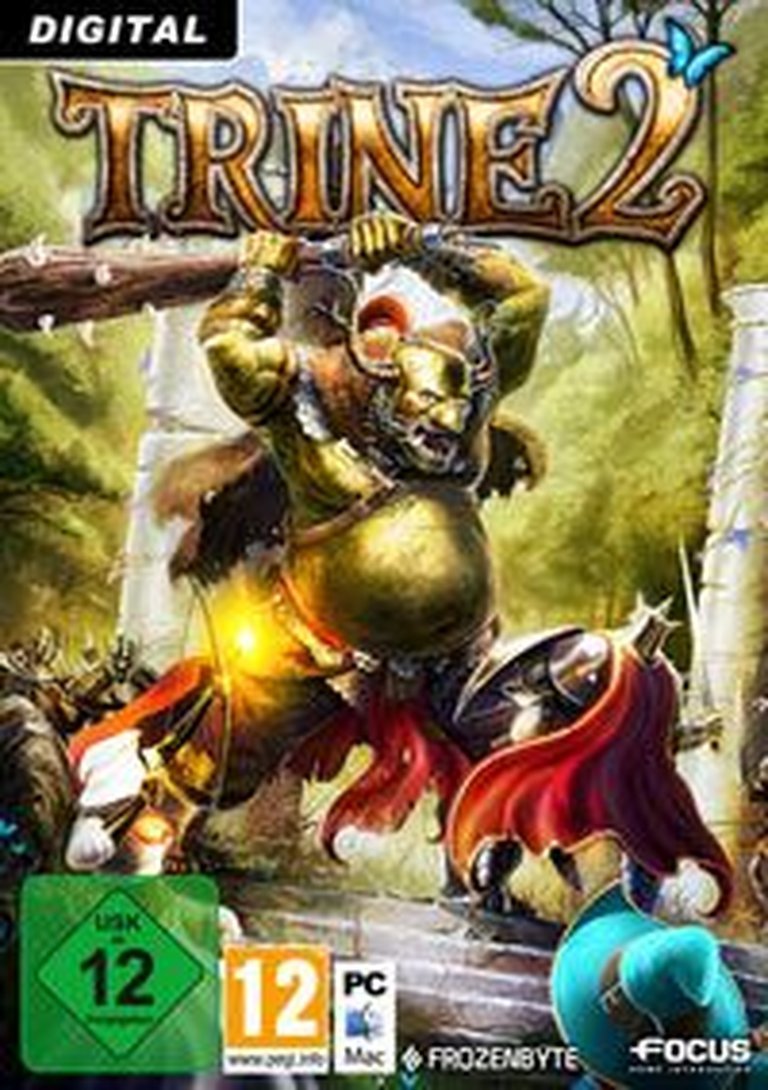
Trine 2 is a sequel to the action puzzle platformer Trine, bringing together three heroes—Amadeus the wizard, Zoya the thief, and Pontius the knight—after their trine is rediscovered and transports them to an unknown world. They must use complementary skills to navigate levels filled with enemies and physics-based puzzles, confronting threats like The Witch, the Goblin King, and two princess sisters. Players switch between characters with unique abilities—wizard’s magic, thief’s agility, and knight’s combat—unlock new skills via a shared skill tree, and enjoy cooperative play for up to three players offline or online, with modes like Game+ and Unlimited Character Mode offering flexible approaches to challenges.
Gameplay Videos
Where to Buy Trine 2
Trine 2 Cracks & Fixes
Trine 2 Patches & Updates
Trine 2 Mods
Trine 2 Guides & Walkthroughs
Trine 2 Reviews & Reception
metacritic.com (84/100): Alone or with friends, Trine 2 is simply one of the best PC games you can play this year.
ign.com : A delightfully open-ended sequel that shouldn’t be missed by any puzzle fan.
opencritic.com (87/100): It may no longer be essential, but Trine 2: Complete Story is excellent nonetheless.
Trine 2 Cheats & Codes
PC
Open options.txt in %UserProfile%\AppData\Roaming\Trine2 using Notepad. Find setOption(trine2Module, “CheatsEnabled”, false) and change false to true. Save the changes, exit and start the game. Activate the console with the F12 key to enter the following codes.
| Code | Effect |
|---|---|
| [F5] | No clip forward |
| [F6] | Air jump |
| [F7] | Full health |
| [F9] | Full skills |
| [F10] | Invincible |
| 7 | Health |
| 9 | Skills |
| 0 | Immortality |
| 5 | movement on the map |
| 6 | movement on the map |
Trine 2: Review
Introduction
In the pantheon of indie puzzle-platformers, few titles radiate the same charm and meticulous craft as Trine 2. As the sequel to Frozenbyte’s 2009 breakout hit, Trine didn’t merely iterate on its predecessor—it refined every facet of the experience into a dazzling, cohesive whole. Here, in a world where physics and fantasy intertwine, three unlikely heroes—a bumbling knight, a cunning thief, and a vain wizard—are bound by an ancient artifact, forced to collaborate through lush hand-painted landscapes and devious environmental puzzles. Trine 2 stands as a paragon of cooperative design, a love letter to fairytales, and a testament to how indie developers could outshine AAA titles in pure creative ingenuity. This review will dissect its development, narrative, gameplay, artistry, and enduring legacy to argue why Trine 2 remains not just a sequel, but a masterpiece of its genre.
Development History & Context
Emerging from Finland’s Frozenbyte studio, Trine 2 was born from a confluence of creative ambition and pragmatic necessity. The original Trine (2009) had sold over 1.1 million copies by late 2011, driven by its physics-based puzzles and whimsical art style. When lead developer Mike Donovan proposed a sequel, the studio leveraged the financial windfall of the Humble Frozenbyte Bundle (April 2011)—a pay-what-you-want promotion that grossed over $900,000—to fund Trine 2’s production without publisher constraints. This autonomy allowed Frozenbyte to expand their vision, particularly by adding the online multiplayer mode fans had craved since the first game’s local-only co-op.
Technically, the game built upon a proprietary Storm3D engine, rewritten between 2009–2010 to support dynamic lighting, intricate physics, and 2.5D visuals. Notably, the Linux port (March 2012) was the studio’s first in-house effort, with lead programmer Jukka Kokkonen noting it was “easier than expected” to port, though testing proved challenging. For the Wii U’s Director’s Cut (2012), Frozenbyte achieved a rapid two-day port, exclusive touch-screen controls, and a new level, “Dwarven Caverns,” showcasing Nintendo’s early outreach to indie devs. The game’s development also emphasized iterative design—playable demos at E3 2011 and community feedback loops ensured puzzles balanced solo and co-op play, though one physics puzzle involving frogs reportedly took two weeks to debug. This meticulous process yielded a game that felt both expansive and polished, a rarity for mid-budget titles in 2011’s crowded indie landscape.
Narrative & Thematic Deep Dive
Trine 2’s narrative weaves a fairy tale of sibling rivalry and redemption, framed by the return of its iconic trio: Amadeus the wizard, Zoya the thief, and Pontius the knight. The Trine artifact reunites them, transporting them to an enchanted forest ravaged by a curse. Here, they discover the conflict between Princess Rosabel, consumed by jealousy of her sister Isabel’s magical powers, and the resulting goblin invasion. Rosabel imprisons Isabel in an enchanted tree, causing the forest to overgrow and chaos to reign. The heroes confront Rosabel, only to witness Isabel’s selfless act of saving her sister despite years of imprisonment, symbolizing the story’s core theme: unity amid division. The resolution—Isabel’s magic restoring the land—underscores a broader meditation on environmental balance and forgiveness.
The expansion, Trine 2: Goblin Menace, deepens these themes through a new quest: rescuing Amadeus’s wife, Margaret, from goblin inventor Wheeze. This arc explores protective sacrifice (the Trine shields Margaret due to her resemblance to a goblin deity) and the cyclical nature of conflict. Character dynamics are equally rich: Amadeus’s vanity contrasts with Pontius’s loyalty, while Zoya’s pragmatism bridges their extremes. Narrated by Terry Wilton with dry wit, the story unfolds through environmental storytelling and collectible poems, enriching lore without exposition. This thematic cohesion—fantasy tropes repurposed for introspection—elevates Trine 2 beyond a simple adventure, making its characters feel like flawed, relatable beings in a world where magic carries heavy consequences.
Gameplay Mechanics & Systems
Trine 2’s brilliance lies in its seamless fusion of action, platforming, and physics puzzles. Players control three distinct heroes, each with complementary abilities:
– Amadeus conjures boxes, planks, and floating platforms to manipulate the environment. New upgrades enable telekinetic projectiles and explosive objects.
– Zoya wields a bow with charged shots and a grappling hook for traversal. Arrow upgrades (e.g., ice arrows) add combat depth.
– Pontius excels in melee combat, using a sword, hammer, and shield to deflect projectiles and bash obstacles. His charge attack breaks barriers.
The skill tree system, fueled by blue vials (50 points per upgrade), encourages experimentation. Shared across characters, it allows synergistic builds—e.g., enhanced wizard conjuration enabling complex knight/Thief combos. Puzzles demand lateral thinking: in the “Swamp” level, players might use Pontius to redirect fire with his shield, conjure platforms for Zoya’s grapple, or freeze water with arrows. Critically, Trine 2 embraces non-linearity, offering multiple solutions to challenges. A single puzzle might be solved via brute force (Pontius), agility (Zoya), or creativity (Amadeus), rewarding player ingenuity.
Combat is secondary to puzzles but polished. Goblins—spiders, archers, and the hulking Goblin King—serve as obstacles rather than threats. Boss fights, though visually stunning, are mechanically simplistic, relying on pattern recognition. This design choice preserves the game’s focus on environmental interaction, though some critics noted the lack of enemy variety.
Multiplayer transforms Trine 2 into a cooperative symphony. Up to three players control each hero simultaneously, online or locally. Coordination is key: one player might shield teammates while another builds platforms. Death is forgiving—revives occur at checkpoints—encouraging risk-taking. Modes like Game+ (replay with upgrades) and Unlimited Character Mode (e.g., three Thieves) extend replayability. Yet, occasional AI glitches (e.g., companions getting stuck) marred the solo experience. Despite this, the fluid character-switching and physics engine create a gameplay loop that feels both intuitive and endlessly inventive.
World-Building, Art & Sound
Trine 2’s world is a triumph of environmental storytelling. The 13 base-game levels—from the bioluminescent “Deadly Dustland” to the snow-capped “Frozen Village”—are rendered in a stunning 2.5D hand-painted style. Critics universally lauded the visuals: IGN called it “one of the prettiest games ever made,” praising its “lush, hand-painted art style” and dynamic weather effects. Curlicued vines, shimmering water, and atmospheric lighting create a fairy-tale ambiance that feels alive. The use of NVIDIA 3D Vision further enhanced depth, turning puzzles into dioramas of wonder.
The sound design is equally evocative. Composer Ari Pulkkinen’s orchestral score—sweeping strings, medieval brass, and woodwinds—elevates each level. Tracks like the “Trine 2 Main Theme” and “Muddy” (for swamps) dynamically shift from serene to tense, adapting to gameplay. Voice acting, absent in the first game, adds personality: Terry Wilton’s deadpan narration contrasts with the heroes’ banter—Amadeus’s boasts, Pontius’s bumbling, Zoya’s quiet resolve. This audio-visual harmony creates an immersive experience where every rustle of leaves or musical swell reinforces the fantasy.
Level design encourages exploration. Hidden chests containing poems and paintings reward thoroughness, while branching paths offer secret areas. The “Goblin Menace” expansion introduces new mechanics (e.g., low-gravity puzzles), maintaining freshness. Together, these elements forge a world that feels cohesive, mysterious, and brimming with charm—a digital storybook brought to life.
Reception & Legacy
Upon release, Trine 2 was hailed as a benchmark for indie excellence. It garnered a Metacritic score of 84% (PC) with 93% positive reviews, praised for its puzzles, art, and co-op. IGN awarded it 9/10, lauding its “delightfully open-ended” design, while GameSpy called it a “genuinely lovable game.” Critics noted minor flaws: short campaign (~8–9 hours), simplistic combat, and occasional AI hiccups. Yet, the consensus was resoundingly positive: Trine 2 refined its predecessor into a near-flawless experience.
Commercially, it fueled the Trine series’ success, contributing to over 7 million sales by 2014. The Steam version alone sold ~3.4 million, with digital bundles like the Complete Story (2013) expanding its reach. Awards included “Best Artistic Achievement” at the Nordic Game Awards, cementing its cultural impact.
Trine 2’s legacy extends beyond sales. It set a standard for cooperative puzzle-platformers, influencing titles like Ori and the Blind Forest. Its art style inspired developers seeking painterly aesthetics, while its physics-based puzzles remain a model for environmental interaction. The series continued with Trine 3 (2015, a divisive 3D shift), Trine 4 (2019, a return to 2.5D), and Trine 5 (2023), but Trine 2 remains the franchise’s apex—a game where creativity, challenge, and beauty converge. Ports to platforms like the Nintendo Switch (2019) ensured its relevance, proving that fairytales never fade.
Conclusion
Trine 2 is more than a sequel; it is a distillation of indie game design at its finest. Frozenbyte took the blueprint of its predecessor and polished it into a gem—visually breathtaking, mechanically inventive, and emotionally resonant. Its puzzles demand creativity without frustration, its world invites exploration, and its co-op transforms collaboration into art. While its brevity and simplicity hold it back from perfection, these flaws are overshadowed by its unwavering charm and cohesion.
In a gaming landscape often dominated by scale and spectacle, Trine 2 endures as a reminder that ingenuity and heart trump brute force. It is a fairy tale told in code, a testament to the power of physics and friendship, and a masterpiece that elevated puzzle-platformers forever. For anyone seeking a game that delights the mind and the soul, Trine 2 is not just essential—it is timeless.