
- Release Year: 1999
- Platforms: Windows
- Publisher: Virgin Interactive Entertainment (Europe) Ltd.
- Genre: Compilation
- Game Mode: LAN, Online PVP, Single-player
- Average Score: 81/100
Description
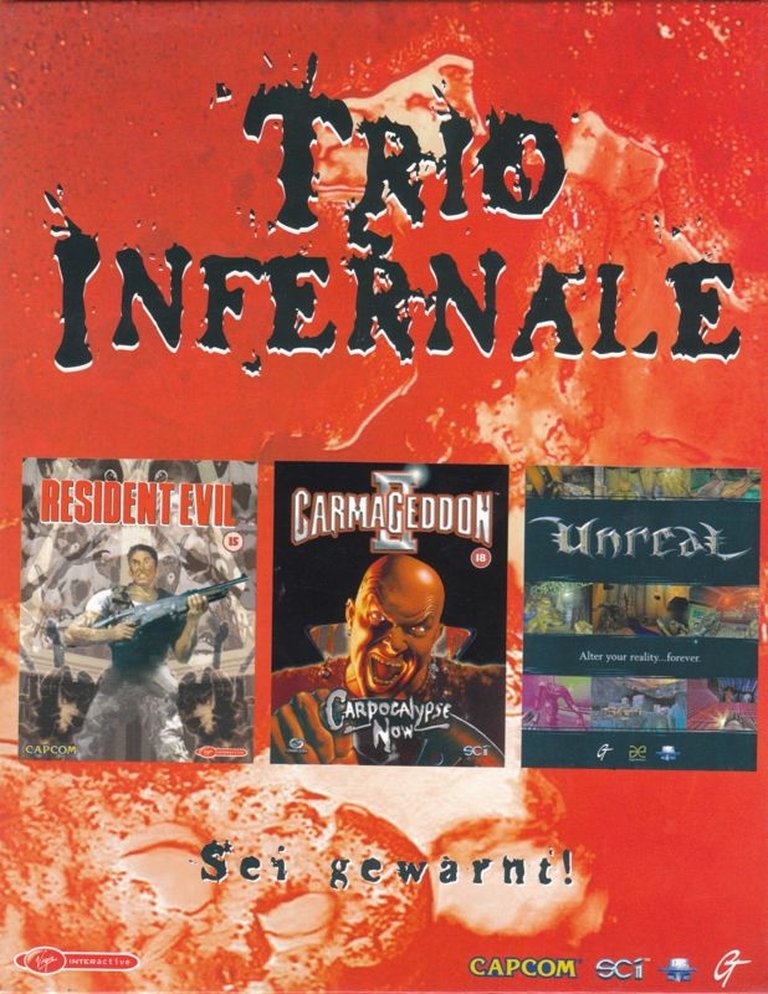
Trio Infernale is a 1999 Windows compilation released by Virgin Interactive Entertainment, bundling three intense action titles: the survival horror adventure Resident Evil, the chaotic vehicular combat game Carmageddon 2: Carpocalypse Now, and the groundbreaking 3D shooter Unreal, offering players a shocking mix of high-difficulty challenges across horror, destruction racing, and first-person shooting genres.
Trio Infernale: Review
Introduction
Imagine unboxing a single CD-ROM jewel case in late 1999, only to discover not one, but three genre-shattering masterpieces crammed onto its shimmering surface—a survival horror cornerstone, a vehicular bloodbath on wheels, and a sci-fi shooter that redefined graphical fidelity. Trio Infernale, Virgin Interactive Entertainment’s audacious European compilation release for Windows PCs, bundled Resident Evil (1996), Carmageddon 2: Carpocalypse Now (1998), and Unreal (1998) into what German critics dubbed a “trio of shocking titles.” At a time when PC gaming was exploding with 3D accelerators and broadband dreams, this pack wasn’t just value gaming; it was a time capsule of late-’90s excess, blending heart-pounding horror, chaotic demolition derbies, and alien-slaying spectacle. My thesis: Trio Infernale endures not as an innovative original, but as a brilliant curatorial triumph—a budget-friendly gateway that immortalized three disparate icons, challenging players with unrelenting difficulty and cementing its place as a hidden gem in compilation history.
Development History & Context
Virgin Interactive Entertainment (Europe) Ltd., a subsidiary of the storied Virgin empire known for publishing hits like The 7th Guest and Command & Conquer, spearheaded Trio Infernale without a named developer studio—its “creation” was pure publishing alchemy. Released in December 1999 exclusively for Windows PCs (catalog SBX-W95-1816-G), the pack arrived amid Germany’s strict USK 18 rating, reflecting its gore-heavy lineup in a censored “überarbeitet” (revised) form. The vision? Capitalize on lingering hype from these titles’ individual launches, bundling them at a “moderate price” to lure value-conscious gamers into marathon sessions.
The era’s tech constraints shaped everything: Minimum specs demanded a Pentium CPU, 16MB RAM, 2MB VRAM, DirectX 6, and a 4X CD-ROM drive—humble by 1999 standards but taxing on budget rigs. Windows 95/98 dominated, with input via keyboard/mouse and multiplayer via Internet/LAN (courtesy of Unreal‘s bots and servers). The gaming landscape was a powder keg: Quake III Arena loomed, survival horror gripped consoles via Resident Evil, and vehicular mayhem like Carmageddon courted controversy with pedestrian-splattering violence. Post-Columbine moral panics amplified Carmageddon 2‘s notoriety, forcing edits, while Unreal‘s Unreal Engine dazzled with vast, seamless worlds. Trio Infernale thrived in this chaos, offering a “knackig-schwere” (tight and tough) antidote to casual play, as GameStar noted, amid a market shifting from DOS to DirectX and LAN parties to online deathmatches.
Narrative & Thematic Deep Dive
As a compilation, Trio Infernale‘s “narrative” is a trifecta of standalone epics, united by themes of visceral survival, moral transgression, and technological hubris—each a masterclass in late-’90s storytelling.
Resident Evil (Capcom, 1996 PC port): The crown jewel, Chris Redfield or Jill Valentine’s tale unfolds in the Spencer Mansion, ground zero for Umbrella Corporation’s T-Virus catastrophe. Plot beats escalate masterfully: S.T.A.R.S. team investigates cannibal murders, only to face zombies, Lickers, and tyrant Nemesis prototypes. Dialogue crackles with B-movie cheese—”Jill, here’s a lockpick!”—punctuated by typewriter saves and item puzzles. Themes probe corporate greed (Umbrella’s bioweapons), human fragility (fixed camera angles mirror panic), and redemption (Wesker’s betrayal). Subtextually, it’s eco-horror: mutated nature rebels against hubris.
Carmageddon 2: Carpocalypse Now (Torosoft/Salesie, 1998): No linear plot here—just a post-apocalyptic “Carpocalypse” where drivers like Max Damage race to checkpoints or massacre 23 pedestrians within razor-thin time limits. Narrative emerges via radio banter, cutscenes of irradiated wastelands, and power-ups like “solid granite car.” Themes revel in anarchic nihilism: society’s collapse into vehicular Darwinism, satirizing road rage and consumerism. German censorship toned down splatter, but the “chaotic” core persists, critiquing violence as addictive catharsis.
Unreal (Digital Extremes/Epic MegaGames, 1998): Prisoner 849 crash-lands on Na Pali, fighting Skaarj aliens amid Vortex Rikers wreckage. The campaign spans 17 levels of escalating dread: from beaches to temples, allying with Nali priests against genocidal invaders. Dialogue is sparse but poignant—Gina’s distress calls, announcer quips—building a lore-rich universe via logs and murals. Themes explore isolation (lone human vs. empire), imperialism (Skaarj conquest), and transcendence (Unreal tech’s godlike power). It’s existential sci-fi: survival as rebellion against cosmic indifference.
Collectively, Trio Infernale weaves dread, destruction, and discovery, with high lethality underscoring mortality.
Gameplay Mechanics & Systems
Trio Infernale‘s loops shine through synergy: horror tension, racing frenzy, shooter precision—flawed UI be damned.
Resident Evil: Fixed cameras and tank controls define survival horror. Core loop: explore, solve puzzles (herb-mixing, key hunts), manage inventory amid tanky zombies. Combat punishes ammo waste; progression via typewriters/rankings. Innovative: live selection (partner AI like Barry aids/damages). Flaws: clunky 3D, instant deaths. UI: grid inventory genius for scarcity.
Carmageddon 2: Checkpoint races devolve into ped-killing sprees—solidarity bonuses for check-ins, multipliers for gore. Cars upgrade via scrap; 30 vehicles, multiplayer deathmatches. Innovative: physics-based carnage (ragdolls pre-GTA). Flaws: tight timers “strapaziert die Nerven” (fray nerves). UI: cheeky HUD with pedestrian counters.
Unreal: Fluid first-person shooter with swimming, jetpacks, and botmatches. Loop: scavenge weapons (Flak Cannon, Redeemer nuke), flank Skaarj via verticality. Progression: skill-less linear campaign, endless multiplayer. Innovative: seamless open levels, smart AI ambushes. Flaws: no vehicles (fixed in Tournament). UI: minimap, weapon wheel—pioneering.
Multiplayer bridges all: Unreal‘s LAN/Internet shines, Carmageddon‘s splitscreen chaos, RE’s solo focus. Exhausting difficulty unites them: “one screen death after another.”
World-Building, Art & Sound
Each game’s atmosphere is immersive, leveraging ’90s limits for mood.
Resident Evil: Raccoon Forest to mansion labyrinth—gothic opulence via pre-rendered backgrounds, foggy nights. Art: FMV cutscenes elevate B-horror. Sound: creaking doors, zombie moans, Adon’s piano score—pure dread.
Carmageddon 2: Mutated cities, deserts—cartoonish polygons hide gore. Art: punk vehicles, splatter effects. Sound: thrash metal soundtrack, screams/crunch SFX amplify mayhem.
Unreal: Na Pali’s alien vistas—craggy cliffs, bioluminescent ruins—Unreal Engine’s draw distance stuns. Art: painterly skies, Nali architecture. Sound: Tim Larkin’s industrial score, alien howls, echoing gunplay.
In tandem, Trio Infernale evokes a hellish multiverse: mansion haunts, highways burn, planets conquer—CD-ROM spins conjure nightmares.
Reception & Legacy
Launch reception skewed German: PC Player’s 100% hailed “schockierende Titel” (Unreal graphics, RE success, Carmageddon blood), GameStar’s 83% praised “höllisch” (infernal) challenge for masochists. Average 92% MobyScore reflects value; commercial success murky (niche bundle, 1 Moby collector), but it preserved PC ports amid piracy.
Legacy evolved from obscurity to cult relic: introduced Resident Evil PC widely (post-PS1), boosted Carmageddon 2‘s notoriety, popularized Unreal Engine (foundation for Gears/Epic). Influences: compilations like Humble Bundles echo its model; high-difficulty echoes in Soulslikes. Today, emulation/GOG revives it—obscure yet foundational, a “Trio” bridging eras.
Conclusion
Trio Infernale transcends its compilation roots, distilling 1999’s PC zenith into a brutal, brilliant trifecta: Resident Evil‘s tense puzzles, Carmageddon 2‘s gleeful havoc, Unreal‘s graphical awe. Flaws—dated controls, censorship—pale against value and challenge. In video game history, it claims a vital niche: the unsung pack democratizing icons for budget warriors. Verdict: 9/10—essential for historians, infernal delight for thrill-seekers. Seek it out; your rig (and nerves) can handle it.