
- Release Year: 2006
- Platforms: Windows
- Publisher: Draconus Entertainment Ltd
- Developer: Draconus Entertainment Ltd
- Genre: Action
- Perspective: Side view
- Game Mode: Hotseat, Single-player
- Gameplay: Flight, Intelligence missions, Shooting
- Setting: Aviation, Historical
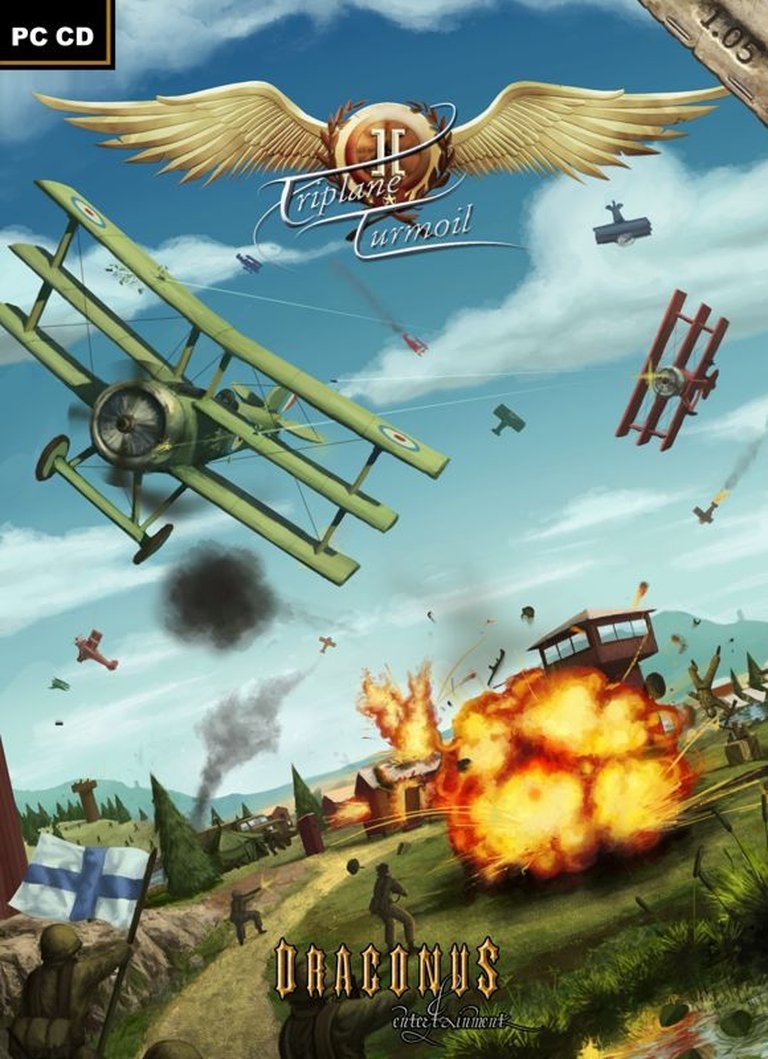
Description
Triplane Turmoil II is a fast-paced, side-scrolling 2D shooter that expands on its predecessor with enhanced 3D visuals, deeper backgrounds, and new gameplay features. The game offers six single-player campaigns, including intelligence missions where players photograph enemy facilities, and over 30 multiplayer maps for competitive play against both AI and human opponents. While initially limited to split-screen multiplayer, an online patch was planned to support large-scale battles with 100+ players.
Gameplay Videos
Triplane Turmoil II Cracks & Fixes
Triplane Turmoil II Patches & Updates
Triplane Turmoil II Guides & Walkthroughs
Triplane Turmoil II Reviews & Reception
reddit.com : A relatively good attempt at dog-fighting World War 1 arcade style game, available for $20 by digital download.
Triplane Turmoil II: A Soaring Tribute to Classic Dogfighting, Grounded by Ambition
Introduction: The Legacy of a Forgotten Gem
In the vast, ever-evolving landscape of video games, certain titles emerge not as revolutionary leaps forward, but as loving homages to the past—games that refine, expand, and occasionally stumble while attempting to recapture the magic of their predecessors. Triplane Turmoil II (2006), developed by Finland’s Draconus Entertainment, is one such title. A sequel to the beloved 1996 DOS classic Triplane Turmoil, itself a spiritual successor to David Clark’s 1984 Sopwith, Triplane Turmoil II is a curious artifact: a game that straddles the line between retro nostalgia and modern ambition, offering a fast-paced, side-scrolling aerial combat experience wrapped in a thin veneer of 3D graphics.
At its core, Triplane Turmoil II is a celebration of arcade-style dogfighting, a genre that has largely faded from mainstream gaming. It is a game that wears its influences proudly, from the chaotic multiplayer battles of its predecessor to the simplistic yet addictive gameplay loop of bombing, shooting, and outmaneuvering opponents. Yet, it is also a game that arrived at an awkward moment in gaming history—too late to ride the wave of late ’90s shareware nostalgia, yet too early to benefit from the indie renaissance that would later revive interest in retro-inspired titles.
This review seeks to dissect Triplane Turmoil II in its entirety: its development history, its narrative and thematic underpinnings, its gameplay mechanics, its artistic and auditory design, its reception, and its lasting legacy. Through this analysis, we will determine whether Triplane Turmoil II is a worthy successor to its predecessor, a forgotten relic of a bygone era, or something far more complex—a game that, despite its flaws, captures the pure, unadulterated joy of aerial combat in a way few modern titles dare to attempt.
Development History & Context: A Finnish Labor of Love
The Roots of a Classic
To understand Triplane Turmoil II, one must first understand its lineage. The original Triplane Turmoil (1996) was developed by Dodekaedron Software, a small Finnish team consisting of Markku Rankala, Teemu J. Takanen, and Henrikki Merikallio. Inspired by Sopwith, a 1984 DOS game that pioneered the side-scrolling aerial combat genre, Triplane Turmoil was a labor of passion—a shareware title that blended simple controls, chaotic multiplayer, and a surprisingly deep single-player campaign. Its success was modest but enduring, earning it a dedicated fanbase and, eventually, a place in the open-source community when its source code was released under the GPLv3 in 2009.
Triplane Turmoil II, however, was not developed by the original team. Instead, it was helmed by Draconus Entertainment, a Finnish studio that included Markku Rankala as a project supervisor—a rare thread connecting the two games. Released in 2006, Triplane Turmoil II arrived during a transitional period in gaming. The mid-2000s were dominated by the rise of 3D graphics, online multiplayer, and increasingly complex game design. Yet, Triplane Turmoil II clung to its 2D roots, offering a side-scrolling experience with a pseudo-3D aesthetic—a choice that was both a nod to its heritage and a potential limitation in an era where gamers were increasingly drawn to fully realized 3D worlds.
Technological Constraints and Design Philosophy
The development of Triplane Turmoil II was shaped by the technological and market realities of its time. The game was built for Windows XP, a platform that was rapidly becoming the standard for PC gaming. Unlike its predecessor, which was a purely 2D affair, Triplane Turmoil II incorporated 3D models for its aircraft and environments, though the gameplay remained firmly rooted in a 2D plane. This hybrid approach—often referred to as “2.5D”—allowed the game to retain the accessibility and simplicity of its predecessor while attempting to modernize its visual presentation.
However, this design choice came with its own set of challenges. The game’s 3D elements were rudimentary by 2006 standards, lacking the polish and detail of contemporary 3D titles. The backgrounds, while layered to create a sense of depth, were still fundamentally flat, and the aircraft models, though three-dimensional, moved along a strictly horizontal axis. This created a peculiar disconnect: the game looked more advanced than its predecessor, but its core mechanics remained unchanged.
Another significant constraint was the game’s multiplayer functionality. At launch, Triplane Turmoil II only supported local split-screen multiplayer—a feature that, while charming, felt increasingly anachronistic in an era where online gaming was becoming the norm. The developers promised an online multiplayer patch, but it never materialized, leaving the game’s multiplayer experience confined to couch co-op—a limitation that likely hindered its commercial success.
The Gaming Landscape of 2006
Triplane Turmoil II was released into a gaming ecosystem that was rapidly evolving. In 2006, the industry was in the midst of a generational shift. The Xbox 360 had launched the previous year, and the PlayStation 3 and Wii were on the horizon. PC gaming was dominated by titles like Half-Life 2, World of Warcraft, and The Elder Scrolls IV: Oblivion—games that pushed the boundaries of 3D graphics, storytelling, and online connectivity.
In this context, Triplane Turmoil II was an anomaly. It was a niche title, catering to a small but dedicated audience of fans who appreciated its retro sensibilities. Its shareware business model—a relic of the ’90s—was also becoming increasingly rare, as digital distribution platforms like Steam began to dominate the PC gaming market. The game’s limited retail release and lack of widespread marketing further relegated it to obscurity, ensuring that it would remain a cult classic rather than a mainstream success.
Yet, despite these challenges, Triplane Turmoil II is a fascinating case study in game development. It is a title that refused to conform to the trends of its time, instead doubling down on the core mechanics that made its predecessor beloved. In doing so, it carved out a unique space for itself—a game that is simultaneously a relic of the past and a testament to the enduring appeal of simple, skill-based gameplay.
Narrative & Thematic Deep Dive: War, Diplomacy, and Chaos in the Skies
A World on the Brink of War
Triplane Turmoil II is not a game that prioritizes narrative depth. Its story is minimal, serving primarily as a framework for its gameplay. Set in an alternate history loosely inspired by the interwar period of the early 20th century, the game presents a world where four (later expanded to six) major powers—Finland, Germany, Japan, Great Britain, the United States, and Russia—are locked in a series of escalating conflicts. The exact timeline is ambiguous, but the presence of triplanes (a type of aircraft that saw widespread use during World War I) and the absence of more advanced technology suggest a setting somewhere between the 1920s and 1930s.
The game’s narrative is delivered through a series of brief mission briefings, which outline the geopolitical tensions and shifting alliances that drive the conflict. Each of the six single-player campaigns follows a different nation, with the player taking on the role of an ace pilot tasked with completing a variety of objectives, from bombing enemy installations to conducting reconnaissance missions. The story is not linear; instead, it is shaped by the player’s actions, with each mission’s outcome influencing the diplomatic landscape.
Themes of Chaos and Fickle Alliances
The overarching theme of Triplane Turmoil II is one of chaos and instability. The game’s world is defined by rapidly shifting alliances, betrayals, and preemptive strikes. One mission might see the player allied with Germany against Russia, only for the next mission to pit them against their former allies. This volatility is not merely a narrative device—it is a reflection of the game’s core gameplay loop, which emphasizes quick thinking, adaptability, and the ability to turn the tide of battle in an instant.
This theme is further reinforced by the game’s multiplayer mode, which lacks any narrative context whatsoever. Instead, it is a pure, unadulterated test of skill, where players must rely on their reflexes and tactical acumen to outmaneuver their opponents. The absence of a story in multiplayer serves to highlight the game’s focus on gameplay above all else—a philosophy that harkens back to the arcade games of the ’80s and ’90s.
Characters and Dialogue: Minimalism in Service of Gameplay
Triplane Turmoil II does not feature traditional character development. The player’s avatar is a faceless pilot, and the game’s cast consists primarily of nameless commanders, diplomats, and enemy aces. Dialogue is sparse, limited to mission briefings and the occasional radio chatter during combat. This minimalist approach to storytelling is not a flaw, but rather a deliberate choice—one that allows the game to focus on its core strengths: tight controls, fast-paced action, and emergent gameplay.
That said, the game’s lack of narrative depth is not without its drawbacks. While the shifting alliances and geopolitical tensions provide a compelling backdrop for the gameplay, they are never explored in any meaningful detail. The game’s world feels more like a stage for its mechanics than a living, breathing entity—a missed opportunity, given the rich potential of its alternate history setting.
The Underlying Message: War as a Game
At its heart, Triplane Turmoil II is a game about war—but not in the sense of a serious, contemplative exploration of conflict. Instead, it presents war as a sport, a test of skill and reflexes where the stakes are high but the consequences are abstract. This is not a criticism, but rather an observation of the game’s design philosophy. Triplane Turmoil II is not interested in the moral complexities of war; it is interested in the thrill of combat, the satisfaction of outmaneuvering an opponent, and the sheer joy of blowing things up.
In this sense, the game is a product of its time—a time when arcade-style shooters were still a viable genre, and when games could afford to be unapologetically fun without the need for deep narrative or moral ambiguity. It is a game that embraces its own simplicity, and in doing so, it achieves a purity of design that is increasingly rare in modern gaming.
Gameplay Mechanics & Systems: The Art of Aerial Combat
Core Gameplay Loop: Bomb, Shoot, Repeat
At its core, Triplane Turmoil II is a game about mastery—mastery of its controls, its mechanics, and its chaotic, unpredictable battles. The gameplay is deceptively simple: players control a triplane, using the keyboard (or joystick) to pitch up, pitch down, roll 180 degrees, fire their machine gun, and drop bombs. The objective varies depending on the mission—bombing enemy installations, defending friendly targets, or engaging in dogfights—but the core mechanics remain consistent.
What elevates Triplane Turmoil II above its predecessors is the depth of its gameplay systems. Each of the six nations has its own unique aircraft, with varying stats for speed, maneuverability, bomb load capacity, endurance, ammunition capacity, and fuel capacity. Japanese planes, for example, are lightly armored and fast, while Finnish planes are more durable but slower. This variety ensures that each nation’s campaign feels distinct, requiring players to adapt their playstyle to the strengths and weaknesses of their chosen aircraft.
Combat: A Dance of Death in the Skies
Combat in Triplane Turmoil II is a delicate balance of aggression and caution. The game’s dogfighting mechanics are simple but effective: players must position their aircraft to get a clear shot at their opponents while avoiding enemy fire. The machine gun is the primary weapon, but bombs can also be used in a pinch—either as a ground-attack weapon or, in desperate situations, as a makeshift air-to-air missile.
One of the game’s most interesting mechanics is the ability to perform a kamikaze attack—a last-ditch effort where the player rams their aircraft into an enemy plane, sacrificing themselves to take down their opponent. This mechanic, while rarely used, adds a layer of tactical depth to the game, forcing players to weigh the risks and rewards of such a desperate maneuver.
The game’s damage system is also noteworthy. Aircraft take damage based on the number of bullets they absorb, with the amount of damage varying depending on the nation of origin. Japanese planes, for example, can be brought down with just a few well-placed shots, while Finnish planes can absorb a significant amount of punishment before going down. Damage is indicated by smoke trails, which grow darker and more pronounced as the aircraft nears destruction. This visual feedback is crucial, allowing players to assess the state of their aircraft and their opponents at a glance.
Ground Combat and Base Management
While aerial combat is the game’s primary focus, Triplane Turmoil II also features a robust ground combat system. Each faction begins with an airfield, complete with a bomb-proof hangar, a runway, infantry garrisons, and anti-aircraft turrets. The hangar serves as the player’s spawn point and a place to refuel, rearm, and repair their aircraft. Infantry provide weak anti-aircraft fire, but in large numbers, they can pose a significant threat to low-flying aircraft.
The game features two types of anti-aircraft turrets: Anti-Aircraft Machine Guns (AAMGs) and Anti-Aircraft Artillery (AAA or Flak). AAMGs are quick-firing but have a limited range, while Flak turrets are slower but more accurate and can reach higher altitudes. Avoiding these turrets is a key part of the game’s strategy, as taking fire from them can quickly cripple even the most durable aircraft.
Mission Design and Progression
The single-player campaigns in Triplane Turmoil II are structured as a series of six missions per nation, each with its own set of objectives. These objectives range from standard bombing runs to more complex reconnaissance missions, where the player must photograph enemy facilities. The missions are designed to escalate in difficulty, with the final mission of each campaign typically involving a desperate last stand against overwhelming odds.
One of the game’s most innovative features is its dynamic alliance system. The outcome of each mission influences the diplomatic landscape, with nations forming and breaking alliances based on the player’s actions. This system ensures that no two playthroughs are exactly alike, as the player’s choices have a tangible impact on the game’s world.
Multiplayer: Chaos on the Couch
Triplane Turmoil II’s multiplayer mode is where the game truly shines. Supporting up to four players locally (with plans for online multiplayer that never materialized), the multiplayer mode is a frantic, chaotic experience that rewards quick reflexes and tactical thinking. Players can choose to engage in free-for-all battles or team-based matches, with the game’s six nations serving as the basis for alliances.
The multiplayer mode features over 30 maps, each with its own unique layout and strategic considerations. Some maps are designed for large-scale battles, supporting up to 36 players (though this is only possible in theory, given the lack of online multiplayer), while others are more intimate, designed for smaller skirmishes.
One of the most interesting aspects of the multiplayer mode is its split-screen implementation. The game offers two video modes: VGA, which displays four separate screens (one for each player), and VESA SVGA, which displays the entire map in three horizontal bars, allowing players to see the entire battlefield at once. This latter mode is particularly effective, as it allows for a level of situational awareness that is rare in split-screen games.
Flaws and Missed Opportunities
Despite its strengths, Triplane Turmoil II is not without its flaws. The game’s controls, while simple, can be fin