
- Release Year: 1995
- Platforms: Macintosh, Windows
- Publisher: Virgin Interactive Entertainment, Inc.
- Developer: Cinematronics, LLC
- Genre: Puzzle, Tile matching puzzle
- Perspective: Top-down
- Game Mode: LAN, Single-player
- Gameplay: No gravity, No time limit, Tile matching puzzle
- Average Score: 100/100
Description
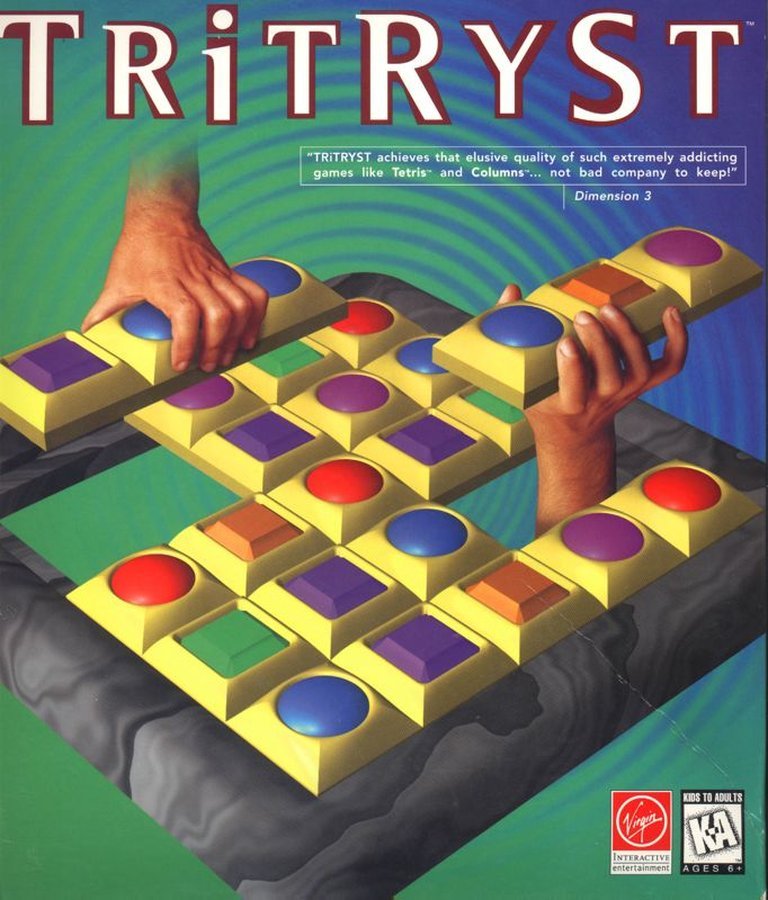
TriTryst is a color-matching puzzle game released in 1995 by Cinematronics and published by Virgin Interactive Entertainment. Players strategically place marbles of different colors on a grid, aiming to form rows of three or more identical marbles to clear them. Unlike similar titles like Tetris or Columns, TriTryst introduces no gravity mechanics or time constraints in its Normal mode, emphasizing deliberate strategy over speed. The game features over 20 varied levels with unique board layouts and bonus tiles, along with both Normal and Arcade modes. Despite its repetitive soundtrack and hypnotic gameplay loop, it offers a cerebral twist on the puzzle genre, though its high-score tracking is limited to a single leaderboard.
Gameplay Videos
TriTryst Free Download
TriTryst Patches & Updates
TriTryst Reviews & Reception
christiananswers.net (100/100): In the line of games like “Rings of the Magi”, the object of the game is to get matching pieces together. But the game is easier to play. In “Tritryst”, the object is to make three tiles touch, either in a row or touching.
TriTryst Cheats & Codes
PC
Enter codes without quotes during gameplay.
| Code | Effect |
|---|---|
| tritryst test | Enables debug counters and allows changing tiles on game pieces (use F1/F2/F3 keys) |
| tritryst skip | Skips forward to the next level in progressive mode |
| tritryst back | Moves back one level in progressive mode |
| tritryst count | Enables debug counters (same as ‘tritryst test’) |
| tritryst color | Functionality removed (previously unknown effect) |
TriTryst: Review
In the pantheon of classic puzzle games, TriTryst stands as a testament to the ingenuity and addictive potential of tile-matching mechanics. Released in November 1995 by Cinematronics and published by Virgin Interactive Entertainment, TriTryst offered players a unique and engaging experience that, while not groundbreaking, carved out a niche for itself in the crowded puzzle genre. This review will delve into the game’s development history, narrative depth, gameplay mechanics, world-building, critical reception, and lasting legacy, providing a comprehensive analysis of TriTryst‘s place in video game history.
Development History & Context
The Studio and Creators’ Vision
TriTryst was developed by Cinematronics, a studio known for its contributions to the pinball and arcade gaming industries. The game was spearheaded by Michael Sandige, who served as the original concept creator, lead designer, and lead programmer. Sandige’s vision for TriTryst was to create a puzzle game that combined elements of Tetris and Columns, but with a unique twist that set it apart from its contemporaries. The development team included a mix of experienced and up-and-coming talent, each bringing their skills to bear on different aspects of the game.
Technological Constraints and Gaming Landscape
The mid-1990s was a transitional period for the gaming industry, marked by the shift from 16-bit to 32-bit systems and the rise of CD-ROM-based games. TriTryst was released during this time, benefiting from the increased storage capacity and improved graphics capabilities of the era. However, the game also faced challenges due to the technological limitations of the time. The fixed/flip-screen perspective and top-down view were necessitated by the hardware constraints, but they also contributed to the game’s distinctive visual style.
The gaming landscape in 1995 was dominated by puzzle games like Tetris, Columns, and Puzzle Bobble. TriTryst entered this competitive field with the goal of offering a fresh take on the tile-matching genre. Its lack of gravity and time limits (in normal mode) differentiated it from other games, providing a more relaxed and strategic gameplay experience.
Narrative & Thematic Deep Dive
Plot and Characters
TriTryst is a puzzle game at its core, and as such, it does not have a traditional narrative or a cast of characters. The game’s focus is on the mechanics of tile-matching, with the player’s goal being to clear the board by aligning three or more tiles of the same color. However, the game’s simplicity belies a deeper thematic exploration of order and chaos.
The game’s levels are designed to progressively increase in difficulty, challenging the player to adapt their strategies and think more critically about their moves. This progression can be seen as a metaphor for the player’s journey from novice to master, with each level representing a new challenge to overcome.
Dialogue and Themes
Since TriTryst is a silent game, there is no dialogue to analyze. However, the game’s themes are evident in its design and mechanics. The game’s emphasis on pattern recognition and strategic planning encourages players to think critically and develop their problem-solving skills. The game’s lack of time limits and gravity also promotes a more relaxed and contemplative gameplay experience, allowing players to take their time and enjoy the process of solving each puzzle.
Gameplay Mechanics & Systems
Core Gameplay Loops
TriTryst features two primary gameplay modes: normal and arcade. In normal mode, players have an unlimited amount of time to clear the board, while arcade mode introduces a time limit, adding an extra layer of challenge. The game’s core mechanic involves placing tiles on a grid and attempting to align three or more tiles of the same color. When a match is made, the tiles disappear, and new tiles are added to the board.
The game features over 20 levels, each with a unique board shape and set of bonus tiles. These levels provide a variety of challenges, keeping the gameplay fresh and engaging. The game also includes a high-score list, allowing players to compete with each other for the top spot.
Combat and Character Progression
As a puzzle game, TriTryst does not feature combat or character progression in the traditional sense. However, the game does include a progression system in the form of its levels. As players advance through the game, they encounter increasingly difficult challenges, requiring them to adapt their strategies and think more critically about their moves.
The game also includes bonus tiles, which can provide extra points or limit the player’s movements. These tiles add an extra layer of strategy to the gameplay, encouraging players to think carefully about their moves and plan ahead.
User Interface
TriTryst‘s user interface is simple and intuitive, with a clear and uncluttered design. The game’s menus are easy to navigate, and the controls are responsive and easy to learn. The game’s visual style is distinctive, with a fixed/flip-screen perspective and top-down view that sets it apart from other puzzle games of the era.
World-Building, Art & Sound
Setting and Atmosphere
TriTryst does not have a traditional setting or atmosphere, as it is a puzzle game focused on tile-matching mechanics. However, the game’s visual style and sound design contribute to a unique and engaging experience. The game’s fixed/flip-screen perspective and top-down view create a sense of depth and complexity, while the game’s colorful and vibrant tiles add a sense of fun and playfulness.
Visual Direction
The game’s visual direction is characterized by its use of bright colors and simple, clean lines. The game’s tiles are designed to be visually appealing, with a variety of shapes and patterns that add to the game’s overall aesthetic. The game’s levels are also designed to be visually interesting, with unique board shapes and layouts that challenge the player’s perception and problem-solving skills.
Sound Design
The game’s sound design is minimalistic, with a focus on providing a relaxing and contemplative atmosphere. The game’s music is repetitive but not intrusive, allowing players to focus on the gameplay without being distracted. The game’s sound effects are also well-designed, providing clear and concise feedback to the player’s actions.
Reception & Legacy
Critical and Commercial Reception
TriTryst received mixed reviews upon its release. Critics praised the game’s unique mechanics and engaging gameplay, but some found the game to be too repetitive and lacking in depth. The game’s commercial performance was also underwhelming, with Virgin Interactive Entertainment eventually going out of business. Despite this, TriTryst has maintained a dedicated following among puzzle game enthusiasts, who appreciate its unique take on the tile-matching genre.
Influence on Subsequent Games and the Industry
TriTryst‘s influence on the gaming industry is difficult to quantify, as the game did not achieve the same level of success as other puzzle games of the era. However, the game’s unique mechanics and engaging gameplay have inspired other developers to experiment with new and innovative puzzle designs. The game’s lack of gravity and time limits, for example, has been adopted by other puzzle games, providing players with a more relaxed and strategic gameplay experience.
Conclusion
TriTryst is a puzzle game that, while not groundbreaking, offers a unique and engaging experience that sets it apart from other games in the genre. Its development history, narrative depth, gameplay mechanics, world-building, and critical reception all contribute to a comprehensive analysis of the game’s place in video game history. Despite its mixed reviews and underwhelming commercial performance, TriTryst has maintained a dedicated following among puzzle game enthusiasts, who appreciate its unique take on the tile-matching genre. The game’s influence on subsequent games and the industry as a whole is difficult to quantify, but its legacy as a classic puzzle game is secure. TriTryst is a testament to the ingenuity and addictive potential of tile-matching mechanics, and it deserves a place in the pantheon of classic puzzle games.