
- Release Year: 2003
- Platforms: Macintosh, Windows, Xbox
- Publisher: Buena Vista Interactive, Disney Interactive Studios, Inc., Disney Interactive, MacPlay
- Developer: Monolith Productions, Inc.
- Genre: Action, RPG
- Perspective: 1st-person
- Game Mode: LAN, Online PVP, Single-player
- Gameplay: Disc combat, Light cycle racing, RPG elements, Shooter, Sub-routine upgrades
- Setting: Cyberpunk, Cyberspace, dark sci-fi, Futuristic, Sci-fi
- Average Score: 87/100
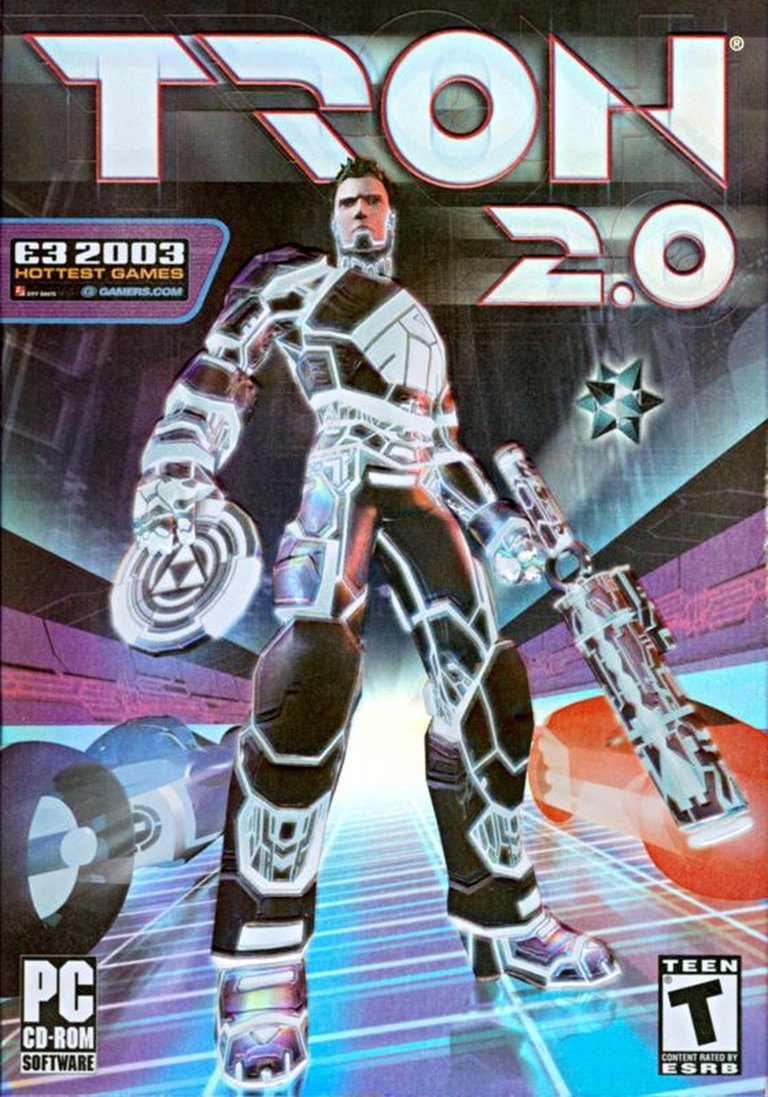
Description
TRON 2.0 is a first-person shooter with light RPG elements set in a cyberpunk, digital world inspired by the 1982 film TRON. Players take on the role of Jet Bradley, the son of Alan Bradley, who enters a computerized realm to rescue his father and combat digitized hackers from the sinister Future Control Industries (fCon). The game features iconic weapons like the TRON disc, energy-based combat, and a unique leveling system where players upgrade attributes and equip sub-routines. With its distinctive visuals, multiplayer light cycle races, and nods to the original film, TRON 2.0 blends action, strategy, and nostalgia in a futuristic, program-like environment.
Gameplay Videos
Where to Buy TRON 2.0
TRON 2.0 Free Download
TRON 2.0 Cracks & Fixes
TRON 2.0 Patches & Updates
TRON 2.0 Mods
TRON 2.0 Guides & Walkthroughs
TRON 2.0 Reviews & Reception
metacritic.com (84/100): A triumphant return to form for the series.
ign.com : I’m looking at it fondly because I enjoyed the story, presentation, and beautiful artwork, but the game itself wasn’t exactly the most exciting gameplay experience I’ve ever had on the PC.
gamespot.com : Despite its great look and some exciting moments, Tron 2.0 is a fairly conventional and uneven shooter.
impulsegamer.com (90/100): Tron 2.0 is a PC exclusive. The story takes place twenty years after the movie where Alan Bradley has vanished without a trace.
TRON 2.0 Cheats & Codes
PC
Press T to get the chat box then enter a code below. Press enter to activate the code.
| Code | Effect |
|---|---|
| mphealth | Max health |
| mptears | Health, energy & weapons |
| mpkfa | Health, energy & weapons |
| mpgod | God Mode |
| mpmaphole | Skip Level |
| mpguns | All guns |
| mparmor | Full armor |
| mpammo | Full energy |
| mppos | Show position |
| mpnextmission | Skips the entire mission |
| mprosebud | Spawns a tiny silver briefcase |
| mpasscam | Third person view |
| mpbuild | Display build version |
Game Boy Advance
At the title screen when the words ‘PRESS START’ are flashing, enter any of the following codes and you’ll hear a sound to confirm each code.
| Code | Effect |
|---|---|
| Up,Down,Up,Down,Up,Down,Up,Left,Select | Unlock all Battle mode Maps |
| Right,Right,Left,Left,Left,Right,Right,Up,Select | Unlock all Chip |
| Left, left, left, left, up, right, down, down, select | Unlocks all minigames |
Macintosh
Hit ‘t’ to enable the chat dialog, then type the code and hit enter.
| Code | Effect |
|---|---|
| mpguns | All guns |
| mpkfa | All weapons, full health and energy |
| mptears | All weapons, full health and energy. Only gives weapons that are available in level. |
| mparmor | Full armor |
| mpammo | Full energy |
| mphealth | Full health |
| mpgod | God Mode |
| mpmaphole | Level Skip |
| mppos | Show position |
| mpnextmission | Skips the entire mission |
| mprosebud | Spawns a tiny silver briefcase |
TRON 2.0: A Digital Odyssey of Light, Legacy, and Innovation
Introduction: The Grid Reawakens
In the pantheon of licensed video games, TRON 2.0 stands as a rare jewel—a title that not only honors its source material but transcends it, weaving a tapestry of cybernetic wonder, narrative depth, and mechanical innovation. Released in 2003 by Monolith Productions, TRON 2.0 is more than a sequel to the 1982 cult classic film; it is a love letter to the digital frontier, a bold reimagining of what it means to be “inside the computer.” This review delves deep into the game’s development, narrative, gameplay, and legacy, exploring why it remains a touchstone for fans of sci-fi, shooters, and the TRON universe alike.
Development History & Context: Crafting a Digital Dream
The Studio and the Vision
Monolith Productions, fresh off the success of No One Lives Forever 2, was tasked with a daunting challenge: revive the TRON franchise for a new generation. The studio’s pedigree in first-person shooters (FPS) with narrative depth made it an ideal candidate, but the true magic lay in its collaboration with the original film’s creative forces. Steven Lisberger, the visionary behind TRON, served as a consultant, ensuring the game’s aesthetic and thematic fidelity. Syd Mead, the legendary concept artist responsible for the film’s iconic light cycles, returned to redesign the vehicles for the game, bridging the gap between retro-futurism and modern gaming.
Technological Constraints and Innovations
TRON 2.0 was built on Monolith’s proprietary LithTech Jupiter engine, a tool that had already proven its mettle in NOLF2. However, the game’s unique visual style—glowing neon edges, wireframe environments, and a cel-shaded aesthetic—required significant customization. Monolith partnered with NVIDIA to develop a DirectX-based glow effect, a technical marvel that bathed the game’s digital landscapes in the signature TRON luminescence. This effect, achieved through multi-pass rendering and alpha-masked edge textures, was a breakthrough in real-time graphics, allowing even mid-range PCs of the era to render the game’s cybernetic beauty.
The game’s development was not without challenges. Optimizing the engine for DirectX 8 and 9 APIs, managing low-polygon models (2,000–4,000 triangles per character), and balancing performance with visual fidelity were constant hurdles. Yet, the team’s dedication to authenticity paid off, creating a world that felt both nostalgic and fresh.
The Gaming Landscape of 2003
The early 2000s were a golden age for FPS games, with titles like Half-Life 2, Doom 3, and Far Cry pushing the boundaries of realism and immersion. TRON 2.0 arrived in this competitive landscape as an outlier—a game that eschewed photorealism for a stylized, abstract aesthetic. Its release in August 2003 was met with curiosity and skepticism, but it quickly carved out a niche for itself, appealing to both TRON fans and gamers hungry for something different.
Narrative & Thematic Deep Dive: A Story of Code and Consequence
Plot Overview
TRON 2.0 picks up twenty years after the events of the original film. ENCOM, the tech conglomerate at the heart of the TRON universe, is on the brink of a corporate takeover by Future Control Industries (fCon), a shadowy entity with sinister ambitions. Alan Bradley, the original film’s protagonist, has developed a groundbreaking digitization technology, but his discovery puts him in fCon’s crosshairs. When Alan is kidnapped, his son, Jet Bradley, is digitized into the computer world by Ma3a, an advanced AI modeled after Jet’s late mother, Lora.
Jet’s mission is twofold: rescue his father and thwart fCon’s plan to deploy “DataWraiths”—digitized human hackers designed to infiltrate and control global networks. Along the way, Jet encounters a cast of digital entities, from the security program Kernel to the enigmatic Mercury, a champion light cycle racer voiced by Rebecca Romijn. The narrative unfolds through a mix of in-game cinematics, archived emails, and real-time interactions, creating a rich tapestry of intrigue and nostalgia.
Themes: Legacy, Identity, and the Digital Divide
At its core, TRON 2.0 is a story about legacy. Jet Bradley is not just following in his father’s footsteps; he is stepping into a world his father helped create, a world that is both familiar and alien. The game explores the tension between human and machine, between creator and creation, and between the analog past and the digital future. The character of Ma3a, with her eerie resemblance to Jet’s mother, embodies this duality—she is a program, yet she carries the emotional weight of a lost loved one.
The game also delves into themes of corporate espionage and digital ethics. fCon’s DataWraiths represent the dark side of technological progress, a cautionary tale about the dangers of unchecked corporate power in the digital age. The narrative’s blend of sci-fi action and philosophical musings gives it a depth rarely seen in licensed games.
Characters and Dialogue
The voice acting in TRON 2.0 is a standout feature, with Bruce Boxleitner reprising his role as Alan Bradley and Cindy Morgan lending her voice to Ma3a. The dialogue is sharp and often laced with humor, particularly in the game’s many Easter eggs and in-world references. For example, players might stumble upon a “Progress Bar” where programs hang out or encounter a corrupted Z-lot named “Durandal.exe,” a nod to the Marathon series. These touches add layers of personality to the digital world, making it feel alive and lived-in.
Gameplay Mechanics & Systems: A Hybrid of Shooter and RPG
Core Gameplay Loop
TRON 2.0 is, at its heart, a first-person shooter, but it incorporates light role-playing elements that set it apart from its peers. Players take on the role of Jet Bradley, navigating a series of linear levels set within various digital environments, from mainframes to PDAs. The goal is typically to complete objectives—such as retrieving permission bits (the game’s equivalent of keycards) or escaping a system format—while battling hostile programs.
Combat and Weapons
Combat in TRON 2.0 is a blend of traditional FPS mechanics and unique TRON-inspired twists. The game’s signature weapon is the Identity Disc, a throwable, boomerang-like projectile that can be used for both ranged attacks and melee strikes. The disc is not just a weapon; it’s a tool for hacking interfaces, solving puzzles, and even reflecting enemy attacks.
In addition to the disc, players can wield a variety of energy-based weapons, including:
– Rod Primitive: A melee weapon that consumes energy for powerful strikes.
– LOL (Lightcycle Operated Laser): A sniper rifle that fires high-damage beams.
– Energy Claw: A weapon that drains health from enemies to replenish the player’s energy.
– Grenades and Missiles: Explosive projectiles for dealing with groups of enemies.
Each weapon consumes energy, which also powers Jet’s subroutines (more on those later). Energy can be replenished by standing in glowing data streams or by defeating enemies.
Character Progression: Subroutines and Build Notes
One of TRON 2.0’s most innovative features is its RPG-like progression system. As Jet completes objectives, he collects “build notes,” which allow him to upgrade his “version number” (e.g., Jet 0.0.0 becomes Jet 0.0.1). Each upgrade grants a point that can be allocated to one of five core attributes:
1. Health: Increases maximum health.
2. Energy: Increases maximum energy capacity.
3. Weapons Skill: Improves weapon accuracy and damage.
4. Transfer Rate: Enhances hacking and interaction speed.
5. Processor Speed: Boosts movement and reaction speed.
In addition to these attributes, Jet can equip subroutines—modular programs that grant special abilities. Subroutines are categorized into three types:
– Combat: Offensive abilities like disc upgrades or energy weapons.
– Defense: Protective measures like shields or viral resistance.
– Utility: Tools for hacking, stealth, or environmental interaction.
Subroutines come in three tiers—Alpha, Beta, and Gold—each offering improved performance and reduced memory usage. Players must strategically choose which subroutines to equip, as each level has a unique “memory configuration” that limits the number and size of subroutines Jet can carry. This system adds a layer of tactical depth, forcing players to adapt their loadout to each mission’s demands.
Light Cycle Racing: A Nod to the Original
No TRON game would be complete without light cycles, and TRON 2.0 delivers in spades. The game features several light cycle sequences, both as part of the main campaign and as standalone multiplayer modes. These races are fast-paced, strategic, and visually stunning, with players attempting to trap opponents by forcing them into their own trails.
The light cycle mechanics are simple but deep:
– Classic Light Cycle: Responsive and agile, ideal for tight turns.
– Super Light Cycle: Faster and more durable, but harder to control.
– Power-Ups: Items like nitro boosts and shields add variety to races.
The light cycle sequences are not just a nostalgic callback; they are a core part of the gameplay, offering a welcome change of pace from the FPS action.
Multiplayer Modes
TRON 2.0 includes a robust multiplayer component, with support for LAN, internet, and even Xbox Live (in the Killer App edition). Multiplayer modes include:
– Disc Arena: A competitive mode where players battle using only their discs.
– Light Cycle Racing: Up to 16 players can compete in high-speed races.
– OverRide: A hybrid mode that combines FPS combat with light cycle racing.
While the multiplayer was well-received, it was not without issues. The game’s netcode struggled with high latency, making light cycle races over the internet a laggy affair. Despite this, the multiplayer community remained active, with fans creating custom maps and mods long after the game’s official support ended.
World-Building, Art & Sound: A Digital Symphony
Setting and Atmosphere
TRON 2.0’s world is a masterclass in digital world-building. The game’s environments are a mix of abstract geometry and functional design, with each location reflecting its purpose within the computer system. For example:
– Mainframes: Vast, grid-like structures with towering spires and glowing data streams.
– PDAs: Cramped, minimalist spaces that emphasize the limitations of early 2000s mobile tech.
– The Internet: A sprawling cyber-metropolis, teeming with programs and data traffic.
The game’s art direction is a faithful evolution of the original film’s aesthetic, with neon-lit corridors, wireframe architecture, and a color-coded system that denotes different types of programs (e.g., red for security, green for corrupted). The attention to detail is staggering, from the way light refracts off surfaces to the subtle animations of background programs going about their digital lives.
Visual Design and Technical Achievements
The LithTech Jupiter engine, enhanced with custom shaders and glow effects, brings the TRON universe to life in ways the original film could only dream of. The game’s use of color is particularly noteworthy:
– Blue: Represents the player and allied programs.
– Red: Denotes security programs and hostile entities.
– Green: Signifies corruption and viral infection.
– Yellow: Indicates neutral or utility programs.
This color-coding not only aids in gameplay (e.g., identifying enemies at a glance) but also reinforces the game’s thematic dichotomy between order and chaos.
Sound Design and Music
The auditory experience in TRON 2.0 is as immersive as its visuals. The game’s sound design is a mix of electronic hums, digital beeps, and synthesized voice effects, all of which evoke the original film’s iconic soundtrack. The music, composed by Nathan Grigg, is a modern reinterpretation of Wendy Carlos’s 1982 score, blending orchestral and electronic elements to create a dynamic, adaptive soundtrack. The music shifts seamlessly between exploration, combat, and cinematic moments, enhancing the game’s emotional impact.
Voice acting is another highlight, with the cast delivering performances that range from dramatic to humorous. The game’s dialogue is peppered with tech jargon and in-jokes, adding to its geeky charm. For example, enemies might taunt the player with phrases like “in your interface!” or “scuzzy wares!”—a callback to the original film’s quirky lexicon.
Reception & Legacy: A Cult Classic is Born
Critical Reception
TRON 2.0 was met with widespread acclaim upon its release, earning an aggregate score of 84% on Metacritic for the PC version. Critics praised the game’s faithful recreation of the TRON universe, its innovative gameplay mechanics, and its stunning visuals. Outlets like Eurogamer (9/10) and PC Gamer (91%) lauded it as one of the best licensed games of the year, while Computer Gaming World awarded it “Best Use of License” in its 2003 awards.
However, the game was not without its detractors. Some critics found the gameplay too conventional for its unique setting, and the Xbox port (Killer App) suffered from technical issues, including long load times and subpar controls. Despite these flaws, TRON 2.0 was widely regarded as a triumph of style and substance.
Commercial Performance and Fan Support
Despite its critical success, TRON 2.0 underperformed commercially, failing to meet Disney’s sales expectations. This led to Buena Vista Interactive dropping official support for the game just two years after its release. However, the game’s dedicated fanbase refused to let it fade into obscurity. Modders and community developers created custom maps, multiplayer modes, and even an unofficial expansion, keeping the game alive long after its official lifespan.
Influence and Legacy
TRON 2.0’s influence extends beyond its immediate reception. It proved that licensed games could be more than mere cash grabs—that they could be innovative, narratively rich, and visually stunning. The game’s blend of FPS and RPG mechanics paved the way for future hybrids like Deus Ex: Human Revolution and Cyberpunk 2077, while its cybernetic aesthetic inspired a generation of indie developers.
The game’s legacy was somewhat overshadowed by the release of TRON: Legacy in 2010, which retconned TRON 2.0 out of the official canon. However, its impact on the TRON franchise and the gaming industry as a whole remains undeniable. It is a testament to the power of passion and creativity, a game that dared to dream in a sea of sameness.
Conclusion: A Digital Masterpiece
TRON 2.0 is more than a game; it is an experience. It is a journey into a world of light and code, of legacy and identity, of human ingenuity and digital wonder. Monolith Productions took a beloved but niche property and transformed it into something extraordinary—a game that honors its roots while forging its own path.
From its innovative gameplay mechanics to its breathtaking visuals, from its rich narrative to its immersive sound design, TRON 2.0 is a masterclass in game development. It is a game that rewards exploration, punishes complacency, and celebrates the geeky joy of being “inside the computer.”
In the annals of video game history, TRON 2.0 stands as a cult classic, a hidden gem, and a testament to the power of creativity. It is a game that deserves to be remembered, replayed, and revered—a digital odyssey that continues to inspire and captivate.
Final Verdict: 9.5/10 – A Must-Play for Fans of Sci-Fi, Shooters, and the TRON Universe
End of Line.