
- Release Year: 2014
- Platforms: Windows
- Publisher: Kalypso Media Group GmbH
- Developer: Kalypso Media Group GmbH
- Genre: Compilation
- Perspective: Isometric
- Game Mode: Single-player
- Gameplay: City building, Political simulation
- Setting: Caribbean
Description
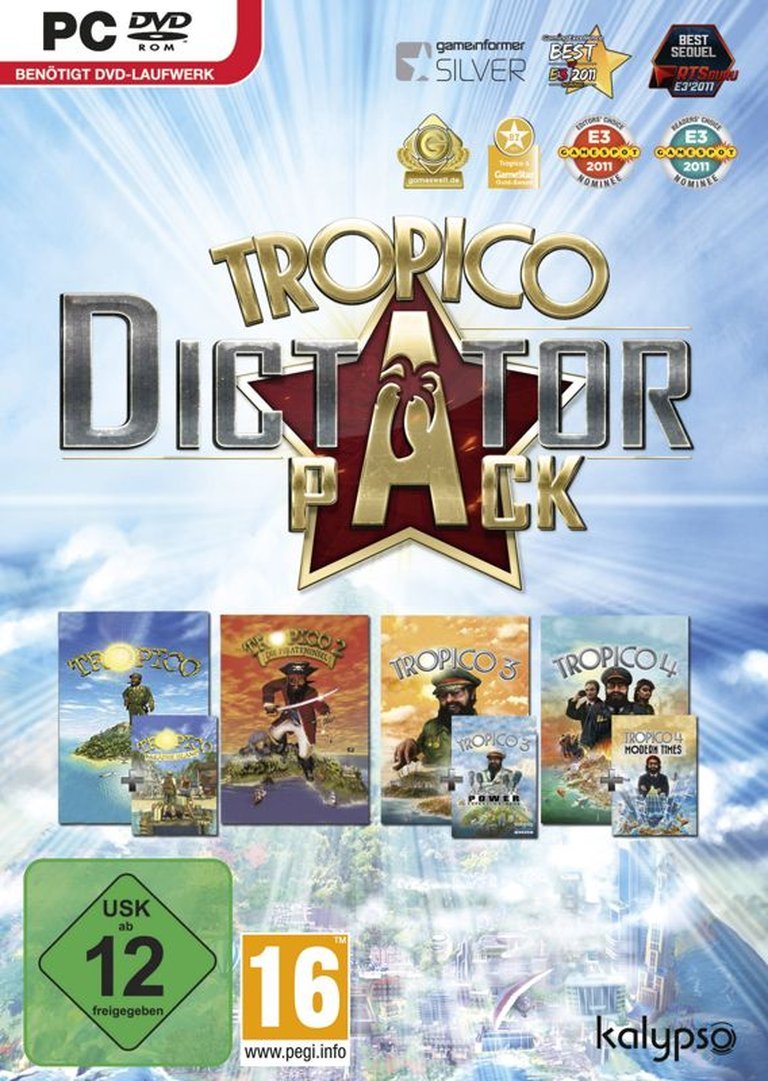
Tropico: Dictator Pack is a compilation of the first four games in the Tropico series, including expansions like Tropico 3: Absolute Power and Tropico 4: Modern Times. Players take on the role of ‘El Presidente,’ ruling a fictional Caribbean island during the Cold War era, balancing political satire, economic management, and diplomatic relations with superpowers. The collection features tongue-in-cheek humor, strategic city-building, and regime survival across diverse scenarios—from pirate havens to modern governance—while navigating rebellions, elections, and foreign interventions.
Tropico: Dictator Pack Review
The Definitive Collection of Caribbean Kleptocracy
Introduction
In the pantheon of political simulation games, Tropico stands as a sardonic monument to the absurdity of authoritarian rule. Released in 2014, Tropico: Dictator Pack compiles the first four mainline entries and their expansions—a 13-year journey from PopTop Software’s 2001 debut to Haemimont Games’ Cold War revival. This anthology isn’t just a bundle; it’s a time capsule of biting satire, technological evolution, and the delicate art of balancing Swiss bank accounts against peasant revolts. Our thesis: while the Dictator Pack lacks modern polish, it captures the series’ genius—a darkly comedic dissection of power, ideology, and the banana republic grind.
Development History & Context
Studio Vision & Technological Constraints
Developed by PopTop Software (creators of Railroad Tycoon II) and later by Bulgaria’s Haemimont Games, Tropico emerged in 2001 as a cheeky rebuttal to sanitized city-builders like SimCity. Leveraging the era’s isometric 2D engines, PopTop embraced limited hardware to craft a politically charged sandbox. The original game’s AI-driven citizens, faction systems, and dynamic Cold War diplomacy were groundbreaking, though hampered by pathfinding issues and a steep learning curve.
The Shifting Landscape
– 2001–2003: Tropico (2001) and Tropico 2: Pirate Cove (2003) debuted amid post-Soviet irony and SimCity 4’s dominance. PopTop’s focus on narrative-driven scenarios (e.g., playing as Fidel Castro or Che Guevara expys) set it apart.
– 2009–2012: After Kalypso Media acquired the IP, Haemimont rebooted the series with Tropico 3 (2009), introducing 3D graphics, voiced advisors like DJ Juanito, and a more accessible interface. Tropico 4 (2011) refined this formula but faced criticism for iterative design.
– Dictator Pack’s 2014 Release: Arriving alongside Tropico 5, this compilation targeted nostalgia and newcomers amid a resurgence of retro bundles. Technical constraints? Compatibility issues with modern OSes and no graphical upgrades.
Narrative & Thematic Deep Dive
The Banana Republic Opera
Each Tropico game casts players as El Presidente, a custom-crafted dictator ruling a fictional Caribbean island during the Cold War. The narrative isn’t linear but emergent—woven through faction demands, superpower meddling, and the player’s moral bankruptcy.
Core Themes:
– Power & Corruption: From rigging elections to embezzling foreign aid, the games frame governance as a kleptocratic art.
– Ideological Farce: Six factions—Communists (workers’ rights), Capitalists (laissez-faire greed), Religious (moral puritans), Intellectuals (liberty advocates), Militarists (jingoistic enforcers), and Environmentalists—clash in absurd demands. In Tropico 4, Religious leader Reverend Esteban, a whisky-swilling hypocrite, condemns casinos while secretly gambling.
– Cold War Satire: U.S. and USSR envoys trade threats and bribes. Tropico 3’s nuclear program (Absolute Power) lets players weaponize MAD logic: “No invade us, or we glass ourselves!”
Notable Expansions:
– Tropico: Paradise Island (2002) emphasized tourism, adding resorts and environmental mechanics.
– Modern Times (2012) escalated satire with tech like social media, cynically parodying Silicon Valley and surveillance states.
Gameplay Mechanics & Systems
The Dictator’s Toolkit
Across the pack, gameplay revolves around resource management, political maneuvering, and disaster mitigation.
Core Loop:
1. Economy: Export rum, cigars, or stolen treasures (Pirate Cove). Import raw materials for factories (Tropico 4).
2. Politics: Bribe faction leaders, rig elections, or cancel democracy. Faction happiness affects revolt risks.
3. Crisis Management: Quell rebels, placate superpowers, and survive hurricanes.
Evolution by Entry:
| Game | Key Mechanics | Innovations | Flaws |
|---|---|---|---|
| Tropico (2001) | Isometric view, faction loyalty, Swiss accounts | Political depth, dynamic citizens | Clunky UI, slow construction |
| Tropico 2 (2003) | Pirate-themed slavery, ship raiding | Unique premise, crew morale | Repetitive raiding |
| Tropico 3 (2009) | 3D graphics, voice acting, tourism | Streamlined controls, radio broadcasts | Shallow AI, “samey” missions |
| Tropico 4 (2011) | Modern tech, Twitter/FB integration | Customizable constitution, disasters | Over-reliance on Tropico 3’s blueprint |
Standout Features:
– Edicts: From Book BBQ (burning texts to please the Religious faction) to Martial Law.
– Raids (Tropico 6 preview): Steal global landmarks like the Eiffel Tower in later concepts.
– Heists & Espionage: Dictator Pack’s Modern Times adds cyber-ops and brainwashing.
UI & Systems Critique:
– Pros: Intuitive overlays for happiness/economy (Tropico 3 onward).
– Cons: Pathfinding glitches, AI laziness (citizens ignoring nearby services), and dated tutorials.
World-Building, Art & Sound
Aesthetic Identity
– Visual Design: Tropico’s palette evolves from gritty 2D (Tropico 1) to cartoonish 3D (Tropico 4), blending Caribbean vibrancy with Soviet brutalism. Palaces echo Havana’s Palacio de Valle, while shantytowns scream inequality.
– Soundscape: Daniel Indart’s Latin jazz and calypso scores (Tropico 1’s “Original Musical Composition” AIAS winner) juxtapose upbeat rhythms with dystopian drudgery. Tropico 3’s Juanito radio broadcasts drip with propaganda-laced humor.
Atmosphere:
Rainforests, beaches, and slums coalesce into a darkly comic microcosm. Pirate Cove’s sanguinary levity—where pirates whine about soggy biscuits—contrasts with Tropico 4’s Orwellian tech dystopia.
Reception & Legacy
Launch Reception
– Tropico (2001): 85/100 Metacritic. Praised for satire, panned for difficulty.
– Tropico 3: 79/100. Called “more polished, less revolutionary.”
– Dictator Pack (2014): Mixed. MobyGames’ 5.0/5 (based on 1 user) underscores its niche appeal.
Commercial Impact:
– By 2007, Tropico sold 1 million copies.
– Tropico 4’s Steam release revitalized the franchise, leading to sequels.
Cultural Legacy:
– Genre Influence: Paved the way for Democracy 4 and Cities: Skylines’ political DLC.
– Satirical Benchmark: Its takedowns of U.S./USSR hypocrisy remain relevant.
Conclusion
Tropico: Dictator Pack is a flawed monument. It bundles 13 years of bureaucratic farce, from PopTop’s ambitious debut to Haemimont’s polished iterations, but falters as a lazy port—no remasters, no QoL fixes. Yet, its value lies in unvarnished history: a chronicle of gaming’s love affair with political dystopia. For $20 (frequent sale price), it’s a masterclass in satire and systems-driven storytelling. Final verdict: A must-play for sim historians, but casual players should grab Tropico 6 instead.
Final Score: 7.5/10 – A flawed anthology, but the definitive ode to tyranny.
Viva El Presidente… but maybe rig the vote just in case.