
- Release Year: 1998
- Platforms: DOS, Windows
- Publisher: Electronic Arts, Inc.
- Genre: Compilation
- Game Mode: Single-player
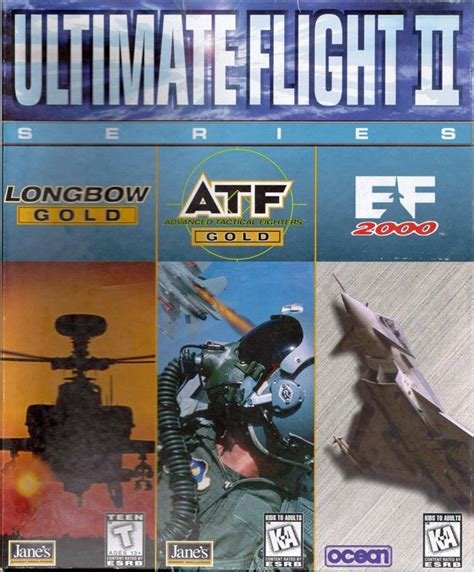
Description
Ultimate Flight Series III, released in 1998 by Electronic Arts, is a compilation package that bundles together three acclaimed flight simulation titles: Jane’s Combat Simulations: Longbow – Gold, Flight Unlimited II (Special Edition), and Jane’s Combat Simulations: USNF’97 – U.S. Navy Fighters. This collection offers a diverse range of aerial experiences, from realistic naval combat and tactical jet missions in Longbow and USNF’97 to the open-ended, physics-driven flight dynamics of Flight Unlimited II, providing a comprehensive anthology for aviation and gaming enthusiasts.
Ultimate Flight Series III: A time capsule of mid-90s flight simulation diversity
Introduction: The Compilation as Historical Document
In the late 1990s, the personal computer flight simulation market was a crowded, fiercely competitive, and technologically voracious landscape. Games demanded the latest 3D accelerators, massive hard drives, and powerful CPUs to render increasingly realistic skies, terrain, and weaponry. It was an era defined by ambitious projects from studios like MicroProse, Origin Systems, and Looking Glass Technologies. Into this fray in 1998, Electronic Arts—a publisher with a formidable stable of simulation titles—released a deceptively simple product: Ultimate Flight Series III. On the surface, it is merely a budget compilation bundling three existing games: Flight Unlimited II (1997), Jane’s Combat Simulations: Longbow – Gold (1997), and Jane’s Combat Simulations: USNF’97 – U.S. Navy Fighters (1996). Its historical significance, however, lies precisely in this act of bundling. This compilation inadvertently becomes a perfectly preserved cross-section of the genre’s design philosophies at a pivotal moment, capturing three distinct and influential schools of thought just before the genre’s commercial decline and transformation. Ultimate Flight Series III is not a game with a unified vision, but a curated museum exhibit—a tangible artifact that encapsulates the dichotomy between civilian and military simulation, the shift from raw simulation to cinematic action, and the varying interpretations of “realism” that defined the late-’90s.
Thesis Statement: While critically overlooked and commercially modest, Ultimate Flight Series III serves as an essential historical document, successfully packaging three seminal but philosophically opposed flight simulation titles that collectively map the creative and technological zenith of the genre before its market contraction. Its value is not in cohesion, but in contrast, offering a unique lens through which to examine the divergent paths of simulation design in the mid-to-late 1990s.
Development History & Context: Three Studios, Three Visions
The compilation’s existence is a story of corporate portfolio management rather than a singular creative endeavor. Understanding the origins of its constituent parts is key to appreciating the whole.
1. The Looking Glass Legacy: Flight Unlimited II (1997)
Flight Unlimited II was the brainchild of Looking Glass Studios, a developer synonymous with immersive simulation. Following their landmark System Shock and Thief series, Looking Glass approached flight simulation with a philosophy of holistic environmental believability. Released in 1997, FU II was a showcase for new technology: real-time, global-scale weather systems that moved across a vast (for the time) virtualized Boston area, and a revolutionary flight model that purported to simulate true aerodynamic forces on every component of the aircraft. It was less about combat and more about the visceral, tactile experience of flight—the feel of turbulence, the negotiation of wind shear, the beauty of a sunset over a procedurally textured cityscape. Its development represented a high-water mark for “general aviation” sims, emphasizing civilian flying over militaristic conflict. Technologically, it pushed the boundaries of what was possible on a consumer PC, demanding significant hardware for its era.
2. The Origin Paradigm: From Wing Commander to Jane’s (Context for Longbow & USNF’97)
The other two titles in the compilation originate from the pipeline of Origin Systems, the studio that redefined space combat with Wing Commander. As detailed in Jimmy Maher’s “From Squadron to Wingleader,” Origin’s shift in the early 1990s under Chris Roberts and Warren Spector was toward a “cinematic” model: creating an embodied, narrative-driven experience where the player was the hero of a movie. This philosophy bled into their terrestrial combat sims under the Jane’s Combat Simulations brand (a branding partnership with publisher Jane’s Information Group).
- Jane’s Combat Simulations: USNF’97 – U.S. Navy Fighters: This 1996 title was a direct descendant of the Wing Commander ethos. It wasn’t just a simulation of an F-14 or F/A-18; it was a story. Players progressed through a narrative campaign as a Navy pilot, with scripted briefings, debriefings, and a branching storyline influenced by mission performance. The “cockpit as set” approach was paramount, with detailed, diegetic interfaces and a focus on creating a heroic, accessible fantasy of being a top gun. It simplified some systems to prioritize action and narrative momentum.
- Jane’s Combat Simulations: Longbow – Gold: The Longbow series, focusing on the AH-64 Apache attack helicopter, represented a fascinating hybrid. While it inherited Origin’s narrative and presentation sensibilities (voice-acted briefings, a campaign storyline), it delved much deeper into the complex, teamwork-oriented systems of a modern gunship. coordinating with a wingman, managing target acquisition, and employing a sophisticated weapon suite (Hellfire missiles, Hydra rockets, the 30mm chain gun) demanded more tactical thinking than the faster-paced USNF. It married Origin’s cinematic flair with a deeper, more deliberate combat simulation.
3. The 1998 Market Context & EA’s Role
By 1998, Electronic Arts was a titan in publishing, having absorbed Origin Systems in 1992. The Ultimate Flight Series branding (this was the third installment) was EA’s answer to the burgeoning “budget compilation” market. It allowed them to recycle valuable intellectual property from their deep simulation catalog, targeting price-sensitive consumers and newcomers intimidated by the high cost and system requirements of new sims. The “Gold” and “’97” suffixes indicate these are enhanced, repackaged versions of prior year’s titles, likely with patches and documentation updates. The compilation itself, therefore, is a product of its economic moment: a clearinghouse for a genre’s yesterday’s news, made relevant again through affordability and convenience.
Narrative & Thematic Deep Dive: The Stories We Tell About Flight
Given that two of the three titles are from the Jane’s line and one is from the aeronautically-focused Flight Unlimited series, narrative treatment varies dramatically, revealing each title’s core identity.
1. Flight Unlimited II: The Narrative of Place and Discovery
FU II possesses no traditional narrative. Its “story” is emergent and environmental. The manual and in-game context frame you as a pilot exploring the meticulously modeled Boston area. The theme is one of mastery and appreciation—mastery over a complex aircraft (from a snub-nose Cessna to a高性能 jet) and appreciation for a living, breathing world. The dynamic weather system isn’t just a graphical effect; it’s a narrative agent. A sudden, violent thunderstorms over the harbor creates a story of survival. A calm, crystal-clear dawn over the Boston Harbor Islands tells a story of serene exploration. The game’s unspoken theme is the sublime experience of flight itself, divorced from militaristic or commercial purpose. It is a pure simulation of being in the sky.
2. Jane’s USNF’97 – U.S. Navy Fighters: The Narrative of Heroic Identity
This title embodies the “Wing Commander” template. You are a callow young naval aviator, fresh from training, assigned to the USS Ranger (CV-61). The narrative is a classic military hero’s journey: you earn your call sign, prove yourself in introductory training missions, and are gradually thrust into a escalating conflict (a fictional war in the Pacific against a vague “Eastern Coalition”). Themes of camaraderie, duty, and personal valor are front and center. Your wingmen have personalities (the grizzled veteran, the wisecrackingrookie), and their fate in missions can affect your standing. The story is linear and cinematic, designed to make you feel like a protagonist in a Tom Clancy or Top Gun-inspired thriller. The “realism” is filtered through this lens of myth-making.
3. Jane’s Longbow – Gold: The Narrative of Teamwork and Technology
Longbow‘s narrative is more grounded and tactical than USNF‘s. You are part of an Apache unit, and the campaign often revolves around supporting ground troops (Army Rangers), conducting deep-strike missions, and providing close air support. The theme shifts from individual heroics to the effectiveness of a coordinated team. You frequently operate in tandem with another Apache, communicating via in-game radio. The story is less about you and more about the mission and the unit. The technology itself—the complex avionics of the Longbow Apache—becomes a character. The narrative celebrates systems integration, precision, and the brutal, efficient professionalism of modern air assault. The “Gold” edition likely expands the campaign, deepening this systemic narrative.
Synthesis: The compilation, therefore, presents three narratives about flight: the transcendent (FU II), the heroic (USNF), and the tactical (Longbow). Together, they show the genre’s capacity to frame the same basic activity—flying a vehicle—through vastly different thematic lenses.
Gameplay Mechanics & Systems: A Triad of Simulation Philosophies
This is where the compilation’s inherent value as a comparative tool shines. Each game represents a distinct point on the simulation spectrum.
| Feature | Flight Unlimited II | Jane’s USNF’97 | Jane’s Longbow – Gold |
|---|---|---|---|
| Primary Focus | General Aviation, Environmental Simulation | Narrative Air Combat | Tactical Attack Helicopter Ops |
| Flight Model | Advanced & Holistic. Simulates forces on individual control surfaces. Emphasis on aerodynamic “feel,” stalls, spins, turbulence effects. | Accessible & Action-Oriented. Simplified for responsiveness. “Arcade-sim” hybrid. Prioritizes tight turning fights and weapon delivery. | Complex & Systems-Oriented. Models helicopter aerodynamics (dissymmetry of lift, retreating blade stall). Requires constant collective/power management. |
| Avionics | Simplified civilian panels. Focus on navigation (VOR, ILS), weather radar. | Streamlined military HUD. Simplified radar, missile/weapon status. Designed for quick glances. | Deeply Detailed. Full AH-64D Longbow cockpit. Complex TADS/PNVS targeting systems, fire-and-forget missile guidance, multiple weapon pages. |
| Campaign Structure | Free-flight sandbox with “Challenges” (hoop courses, search & rescue). No overarching story. | Linear, story-driven mission tree. Pre-scripted briefings, debriefings. Performance affects future missions. | Branching, scenario-based campaign. More open mission selection within a war framework. Heavy on coordination with ground forces. |
| Damage Model | Visceral, cockpit-centric. Wires dangle, screens crack, smoke fills cockpit based on hit location. No abstract “health.” | Abstract but with visual feedback. Critical systems can be damaged (engine, weapons). Shakescreen effects on hits. | Detailed subsystem damage. Can lose tail rotor, rotor blades, specific avionics, engines. Survival often requires immediate diagnosis. |
| Innovation | Real-time, dynamic, global weather. Unprecedented atmospheric modeling. Physics-based flight feel. | Cinematic presentation & narrative flow. Helped define the “action-sim” space. Accessible dogfighting. | Unmatched depth in attack helicopter simulation. TADS/PNVS targeting system was a benchmark for complexity. |
Flaws & Frictions:
* FU II: The hyper-realistic flight model was punishing. The ambitious weather could cause instability. The “Challenges” were notoriously difficult and sometimes unfair. The scope of the terrain (Boston) was detailed but geographically limited.
* USNF’97: The simplification could feel shallow to hardcore simmers. AI wingmen were occasionally unresponsive or “cheating.” The narrative, while engaging, was corny by modern standards.
* Longbow – Gold: The complexity was a massive barrier to entry. The learning curve was steep, requiring study of the 200+ page manual. Missions could be slow and methodical, lacking the pacing of a Wing Commander. Performance demands were high for its time.
World-Building, Art & Sound: Crafting the Illusion
1. Flight Unlimited II: The Aesthetic of the Sublime
FU II‘s world is its protagonist. The terrain engine rendered Boston and its environs with an unprecedented level of detail for a sim: distinct buildings, recognizable landmarks (Faneuil Hall, the Zakim Bridge), and dynamic lighting that created breathtaking dawn and dusk vistas over the harbor. The soundscape was equally important: the roar of jets, the whisper of a Cessna’s propeller, the crackle of thunder in a squall. The soundtrack, composed by a team including future Wing Commander veteran George “The Fat Man” Sanger, was atmospheric and adaptive, swelling during dramatic weather. The goal was verisimilitude—making you believe you were truly over the Atlantic.
2. Jane’s USNF’97 & Longbow: The Aesthetic of the Military Spectacle
Origin’s cinematic intent is everywhere. The Jane’s titles use a consistent, polished UI with digitized pilot faces for wingmen, heavy use of blue/black color schemes, and mission briefings presented as slick, pre-rendered animations with voiceover. The sound design is loud and clear: the roar afterburner, the distinct “thwump” of an AIM-54 Phoenix launching, the frantic beeping of a missile lock-on. The music is fully orchestrated and heroic, directly channeling John Williams’ Star Wars and Top Gun scores. The world is not a place for discovery but a theater of operations. In Longbow, this extends to the terrifying, visceral whump-whump of the Apache’s rotors and the bone-rattling recoil of the 30mm chain gun.
3. Technical Presentation in 1998
By the time of this compilation’s release (1998), all three games were pushing against the technical limits of the late-5th generation PC. They required 3D accelerators (like 3dfx Voodoo cards) for acceptable frame rates. FU II and Longbow were particularly notorious for demanding high-end systems to render their detailed cockpits and external models at playable speeds. The compilation’s packaging often advertised these as “Special Edition” or “Gold” versions, implying patches and enhancements, but they were fundamentally products of the 1996-1997 era, now being repackaged for a market whose hardware had already moved on. This made the compilation a curious artifact: a showcase of yesterday’s cutting-edge technology.
Reception & Legacy: The Curious Case of the Compilation
Critical & Commercial Reception at Launch (1998):
Ultimate Flight Series III received almost no critical attention as a standalone product. It was a budget item, reviewed rarely and often dismissively as a repackaging of older titles. Its success was purely commercial—a low-cost, high-margin product for EA. The critical reputation of its components, however, was more mixed:
* Flight Unlimited II was praised for its breathtaking environmental simulation and innovative weather but criticized for its punishing flight model and frustrating “Challenge” mode. It was a critical darling but a niche commercial success.
* Jane’s Longbow – Gold was hailed as the definitive attack helicopter sim, lauded for its depth and authenticity, but its complexity limited its audience.
* Jane’s USNF’97 was a popular mainstream success, praised for its accessibility and cinematic flair, but often dismissed by hardcore simmers as too simplistic.
Evolution of Reputation & Influence:
The compilation itself faded quickly, a disposable product in a fast-moving market. Its legacy is entirely parasitic on the legacies of its parts:
1. Flight Unlimited II is remembered as the pinnacle of the “general aviation” simulation that Looking Glass championed. Its technical ambitions were a direct influence on later, more successful gliders and light aircraft sims. Its lineage ends with the commercial failure of Flight Unlimited III (1999) and the dissolution of Looking Glass.
2. Jane’s USNF’97 solidified the “cinematic combat sim” formula that would reach its apex with Wing Commander and later influence the Ace Combat series. It proved that narrative and accessibility could broaden the sim audience.
3. Jane’s Longbow – Gold remains a sacred text for helicopter sim enthusiasts. Its depth and accuracy set a standard that few subsequent titles (Enemy Engaged, Digital Combat Simulator) have only partially matched. It is the definitive simulation of the Apache’s “sit inside the gun” experience.
4. The Compilation’s Niche Role: For historians, Ultimate Flight Series III is a fascinating snapshot. It captures the moment where the simulation genre had branched into two primary camps: the realism-first school (FU II, Longbow) and the experience-first school (USNF). EA, as a publisher, was hedging its bets, offering a product that had something for everyone, from the hardcore looking for systems depth to the casual looking for a hero’s journey. It represents the genre’s commercial peak in terms of diversity before the late-’90s market crash homogenized offerings around a few mega-franchises.
Conclusion: A Definitive Verdict on a Historical Artifact
Ultimate Flight Series III cannot be judged as a game in the traditional sense. It has no single design vision, no cohesive mechanics, and no intended player journey. To review it as such is to miss its point entirely. Instead, it must be evaluated as a curated historical artifact and a marketplace document.
Its Strengths:
* Historical Accuracy: It perfectly captures three major, divergent design philosophies of late-’90s flight simulation.
* Value Proposition: At budget price, it offered an immense amount of content from three respected series.
* Preservation: It kept these titles commercially available (albeit in repackaged form) for an extra year or two, introducing them to a new wave of PC gamers.
Its Weaknesses:
* Lack of Cohesion: There is no sense of a suite. The games feel stapled together with a simple menu.
* Dated Technology: By 1998, these were already “last gen” titles in terms of pushing hardware boundaries.
* No Unifying Value-Add: It provides no new mods, scenarios, or integration. It is a cash-grab repackaging, pure and simple.
Final Verdict:
Ultimate Flight Series III earns a 7/10 not for its quality as a game, but for its sheer utility as a historical tool. It is an indispensable purchase for the simulation historian or a student of 1990s game design. By playing these three games back-to-back, one can trace the entire intellectual arc of the genre: from the phenomenological pursuit of environmental truth (Flight Unlimited II), through the Hollywood-ization of conflict (USNF’97), to the tactical, systems-heavy simulation of modern warfare (Longbow). It is a time capsule, a museum in a jewel case. For the modern gamer curious about the roots of DCS World, Ace Combat, or even the environmental storytelling of later Grand Theft Auto titles, this compilation is a masterclass in the varied meanings of “simulation.” It may not be a classic in its own right, but it is a vital chapter in the story of how we learned to digitally fly.