
- Release Year: 2007
- Platforms: Windows
- Publisher: Empire Interactive Europe Ltd.
- Genre: Compilation
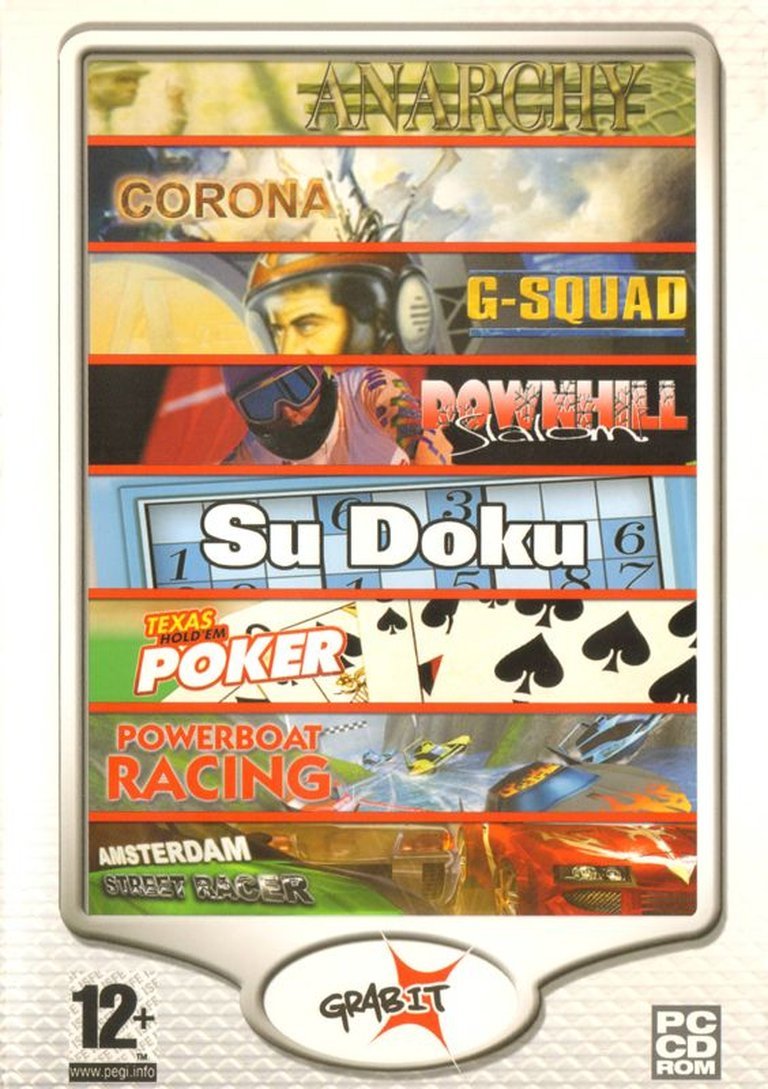
Description
Ultimate Gamer Multidisc is a Windows compilation game released in 2007 by Empire Interactive Europe Ltd., featuring eight distinct games on a single CD-ROM: The Varginha Incident (1998), Amsterdam Street Racer (2006), Dark Corona Pegasus (1997), Downhill Slalom (2006), Genocide: Remixed Version (1999), Powerboat Racing (2005), Su Doku (2006), and Texas Hold’em Poker. This collection offers diverse genres including racing, puzzle, and card games, with a PEGI 12 rating.
Ultimate Gamer Multidisc: Review
Introduction
In an era defined by high-definition epics like Super Mario Galaxy and Call of Duty 4: Modern Warfare, Ultimate Gamer Multidisc emerges as an unlikely time capsule. Released in 2007 by Empire Interactive Europe Ltd., this unassuming Windows compilation bundles eight disparate experiences onto a single CD-ROM—a veritable smorgasbord of racing, puzzles, shooters, and card games. While it lacks the narrative cohesion or technical polish of its contemporaries, its existence as a snapshot of 2007’s gaming landscape is undeniable. This review argues that Ultimate Gamer Multidisc serves as a fascinating artifact of mid-2000s PC gaming, where genre diversity trumped coherence, and budget compilations offered affordable access to niche thrills. Its legacy lies not in innovation, but in its preservation of ephemeral genres and the enduring, if fragmented, spirit of arcade-inspired gameplay.
Development History & Context
Ultimate Gamer Multidisc was published by Empire Interactive Europe Ltd., a company specializing in accessible, budget-priced titles. The compilation itself is a pragmatic response to 2007’s gaming ecosystem. The console wars dominated headlines—the Nintendo DS led hardware sales globally, while the Wii, PS3, and Xbox 360 battled for supremacy—but PC gaming retained its own vibrant, lower-budget subculture. Compilations like this, bundling disparate titles on a single disc, were common for PC players seeking value. Technologically, it leveraged the era’s CD-ROM ubiquity, offering no groundbreaking features but ensuring broad accessibility.
The included games span development from 1997 (Dark Corona Pegasus) to 2006 (Su Doku), revealing a patchwork of studio histories. Notably, The Varginha Incident (retitled Alien Anarchy) traces roots to Ultimate Play the Game, the enigmatic 1980s studio famed for cryptic, high-quality arcade ports like Jetpac. As detailed in archival investigations, Ultimate’s legacy is shrouded in mystery, with titles like The Varginha Incident embodying their trademark lack of exposition and atmospheric tension. Other entries, such as the racing games Amsterdam Street Racer and Powerboat Racing, reflect the late-2000s boom in accessible, physics-lite racing titles, capitalizing on the Burnout and Need for Speed craze without matching their scope.
Narrative & Thematic Deep Dive
As a compilation, Ultimate Gamer Multidisc eschews a unified narrative, instead offering isolated vignettes that collectively paint a portrait of 1990s-2000s genre storytelling.
– The Varginha Incident (Alien Anarchy): This 1998 title weaves a conspiratorial tale inspired by Brazil’s alleged 1996 UFO incident. Players navigate claustrophobic corridors, fending off alien entities with minimal exposition—dialogue is sparse, and the plot unfolds through environmental storytelling. Its themes evoke Cold War paranoia and government secrecy, channeling the era’s fascination with extraterrestrial cover-ups.
– Dark Corona Pegasus: A 1997 space shooter, it adopts the classic “last stand” trope: humanity’s survival hinges on a lone pilot battling through hordes of biomechanical invaders. Its narrative is distilled to mission briefings (“Defend the sector!”), emphasizing action over lore. Thematically, it echoes the militaristic sci-fi of Gyruss (a title potentially linked to Ultimate’s obscure roots), blending exploration with relentless combat.
– Genocide (G-Squad Remixed): This 1999 vertical shooter reframes war as a cosmic purge. Players pilot mechs against swarms of robotic foes, with the titular “genocide” serving as both mission objective and thematic metaphor. The remixed version amplifies the original’s bleak tone, framing conflict as an inevitable, industrialized purge.
Other titles (Amsterdam Street Racer, Powerboat Racing) prioritize visceral thrills over narrative, while Su Doku and Texas Hold’em Poker offer zero-player narratives, reducing story to mechanics. The compilation’s thematic unity lies in its celebration of “pure play”: games as self-contained systems divorced from cinematic ambitions.
Gameplay Mechanics & Systems
Ultimate Gamer Multidisc’s value lies in its mechanical diversity, though execution varies wildly:
| Game | Genre | Core Mechanics | Innovations/Flaws |
|---|---|---|---|
| Amsterdam Street Racer | Urban Racing | Point-to-point races through Amsterdam; drift-based handling. | Flawed AI and repetitive tracks undermine its open-world promise. |
| Dark Corona Pegasus | Space Shooter | Side-scrolling combat; weapon upgrades; boss battles. | Smooth controls but dated difficulty spikes. |
| Downhill Slalom | Extreme Sports | Ski/snowboard slalom courses; precision timing; gate challenges. | Intuitive but repetitive; lacks polish compared to SSX Tricky. |
| Genocide (G-Squad) | Vertical Shooter | Waves of enemies; power-up collection; score-chasing. | Remixed version adds new enemies but retains punishing difficulty. |
| Powerboat Racing | Vehicle Racing | Arcade-style boat physics; track shortcuts; time trials. | Water physics feel floaty; courses are bland. |
| Su Doku | Puzzle | Classic number-logic puzzles; difficulty levels; hint system. | Faithful but unspectacular; lacks modern features like daily challenges. |
| Texas Hold’em Poker | Card Game | AI opponents; tournament modes; betting mechanics. | Basic AI; no online multiplayer limits replayability. |
| The Varginha Incident | Survival Horror | Resource scavenging; puzzle-solving; fixed camera angles. | Tense atmosphere marred by clunky combat and save limitations. |
The compilation’s UI is rudimentary, with a bare-bones menu to launch titles. Progress is rarely saved beyond individual sessions, reflecting the era’s reliance on high-score bragging rights. While Su Doku and Poker offer timeless appeal, the action games struggle with balancing challenge and accessibility—a common pitfall for budget compilations.
World-Building, Art & Sound
The compilation’s aesthetic is a collage of late-1990s and mid-2000s trends:
– World-Building: The Varginha Incident constructs a haunting, claustrophobic world inspired by Brazilian folklore and conspiracy theories, using dim corridors and static UFO imagery to evoke dread. Dark Corona Pegasus opts for cosmic grandeur, with nebula-drenched backdrops and biomechanical enemy designs. Racing games (Amsterdam Street Racer, Powerboat Racing) prioritize realism, digitizing Amsterdam’s canals and generic waterways with middling detail.
– Art Direction: A stark divide exists between pixel-art shooters (Genocide, Dark Corona Pegasus) and 3D racers. The former’s chunky sprites and limited color palettes evoke arcade nostalgia, while the latter’s blocky environments and low-poly assets betray their mid-2000s origins. Su Doku’s clean, minimalist UI and Poker’s static card art offer functional, if unmemorable, visuals.
– Sound Design: Electronic soundtracks dominate, from the pulsating beats of Amsterdam Street Racer to the eerie ambience of The Varginha Incident. Weapon effects are generic, and voice acting is nonexistent, except for Poker’s robotic dealer calls. The overall soundscape is competent but forgettable, prioritizing clarity over immersion.
While no game achieves visual or auditory brilliance, the compilation’s eclecticism creates a compelling museum of genre aesthetics.
Reception & Legacy
Ultimate Gamer Multidisc arrived in 2007 without critical fanfare or commercial impact. MobyGames lists no professional reviews, and its absence from Wikipedia’s annual roundup underscores its status as a niche, budget title. Player reviews are equally sparse, suggesting it passed through the gaming zeitgeist unnoticed.
Its legacy is thus retrospective:
– Influence: It exemplifies the “compilation” model that thrived on PC, bundling varied genres to maximize value—a precursor to modern services like Xbox Game Pass. Games like Su Doku and Texas Hold’em Poker reflect the era’s casual gaming boom, while shooters like The Varginha Incident preserve the influence of cult studios like Ultimate.
– Historical Significance: As a time capsule, it highlights genres now marginalized in AAA spaces. Top-down shooters (Genocide) and arcade racers (Powerboat Racing) are relics of an era before open-world dominance. Its inclusion of The Varginha Incident also ties into ongoing efforts to document Ultimate’s obscure history, as uncovered by investigative journalism.
– Enduring Appeal: For retro enthusiasts, it offers a curated window into 2007’s experimentalism. Its flaws—dated graphics, uneven difficulty—also serve as a reminder of gaming’s rapid evolution, contrasting sharply with the year’s landmark titles like BioShock or The Orange Box.
Conclusion
Ultimate Gamer Multidisc is not a great game, but it is a vital one. As a compilation, it lacks the cohesion or ambition of its 2007 contemporaries, yet its eclectic mix of shooters, racers, and puzzles encapsulates an era of gaming defined by accessibility and experimentation. Its legacy lies in its preservation of ephemeral genres and the enigmatic spirit of arcade-inspired design, particularly through titles like The Varginha Incident that echo the mystique of Ultimate Play the Game.
In a gaming landscape increasingly dominated by cinematic epics and live-service models, Ultimate Gamer Multidisc stands as a humble testament to diversity. It rewards not with polished thrills, but with historical curiosity—a snapshot of when a CD-ROM could contain a universe of experiences, however fleeting. For the archeologist of gaming, it is a flawed, fascinating artifact; for the player, a curious relic of a time before gaming’s homogenization. Its place in history is secure, not as a masterpiece, but as a reminder of gaming’s boundless, and often messy, creative past.