
- Release Year: 2006
- Platforms: Windows
- Publisher: The Codemasters Software Company Limited
- Genre: Compilation
- Perspective: Third-person
- Game Mode: Single-player
- Gameplay: Racing
- Average Score: 86/100
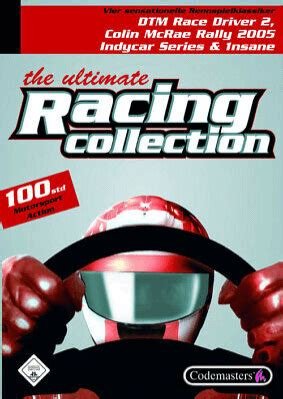
Description
Ultimate Racing Collection is a 2006 Windows compilation from Codemasters featuring four diverse racing games: the realistic rally simulation Colin McRae Rally 2005, the intense touring car battles of DTM Race Driver 2, the high-speed open-wheel action of IndyCar Series, and the chaotic off-road multiplayer mayhem of 1NSANE, delivering a budget-friendly assortment of motorsport thrills across various disciplines on DVD-ROM.
Ultimate Racing Collection Reviews & Reception
retro-replay.com : Ultimate Racing Collection delivers an eclectic mix of four distinct racing experiences, each showcasing Codemasters’ mastery of vehicle dynamics and track design.
Ultimate Racing Collection: Review
Introduction
Imagine strapping into a cockpit that seamlessly shifts from the gravel-slinging fury of World Rally Championship stages to the precision drafting of open-wheel ovals, all without swapping discs—this is the thrill Ultimate Racing Collection delivers. Released in 2006 by Codemasters as a budget-friendly DVD-ROM bundle for Windows PCs, this compilation packs four distinct racing titles: Colin McRae Rally 2005, DTM Race Driver 2, IndyCar Series, and 1NSANE. In an era when racing games were exploding with sim-like realism amid the rise of titles like GTR 2 and Forza Motorsport, Codemasters leveraged its pedigree to offer unparalleled variety at a mere 30 Euros. My thesis: Ultimate Racing Collection stands as a cornerstone budget compilation, masterfully distilling mid-2000s motorsport simulation into an accessible, replayable package that prioritizes depth over flash, cementing Codemasters’ legacy while exposing the genre’s evolving boundaries between arcade chaos and authentic sim-racing.
Development History & Context
Codemasters, the British powerhouse behind rally icons like the Colin McRae series, curated Ultimate Racing Collection as a strategic budget release on January 27, 2006, targeting PC gamers hungry for value in a post-Gran Turismo world. The studio’s vision, rooted in authentic vehicle physics and diverse motorsport disciplines, shone through: Colin McRae Rally 2005 (2005) brought WRC-licensed realism with dynamic weather; DTM Race Driver 2 (2003, rebranded from TOCA Race Driver 2 in some markets) expanded touring-car sims with team management; IndyCar Series (2003) captured oval dominance and road course nuance; and 1NSANE (2001) injected arcade off-road mayhem via monster trucks and buggies.
Technological constraints of the early 2000s PC landscape—prevalent DirectX 9 engines, limited multi-core support, and no online ubiquity—shaped these titles. Codemasters’ in-house engines emphasized physics over polygons, prioritizing tire wear, weight transfer, and terrain deformation amid hardware like Pentium 4 CPUs and GeForce 6-series GPUs. The 2006 gaming scene buzzed with sim-racing maturation: GTR – FIA GT Racing Game (2005) set physics benchmarks, while arcades like OutRun 2 influenced accessibility. Compilations like Atari’s Collection: Racing (2005) proved the model’s viability, but Codemasters differentiated with full, uncompromised games rather than demos. This collection emerged as a “greatest hits” salve for players missing individual releases, reflecting Codemasters’ pivot from annual franchises to evergreen bundles amid rising development costs.
Narrative & Thematic Deep Dive
Racing compilations rarely boast cinematic epics, and Ultimate Racing Collection leans into career-mode progression as its storytelling backbone, eschewing overt plots for emergent driver legacies. Themes of ambition, rivalry, and mastery permeate, aligning with racing’s “sensation-seeking” psychology—dopamine rushes from shaved lap times mirroring real-world adrenaline, as noted in genre histories.
Colin McRae Rally 2005 crafts a rookie-to-champion arc via co-driver radio banter and contract unlocks, thematizing peril amid dynamic weather shifts from sunny tarmac to blizzard blindness. DTM Race Driver 2 weaves deeper intrigue: a fictional team campaign with cutscenes of sponsor squabbles and rival sabotage, elevating races beyond laps into political drama. IndyCar Series‘ Championship Mode follows an underdog’s season-long grind—qualies, pits, ovals—bullet-point updates evoking Rookie of the Year tension at Indy or Michigan. 1NSANE flips to arcade whimsy: a “World Tour” narrated tongue-in-cheek, traversing backstories from derelict mines to swamps, boss challenges underscoring chaotic rebellion.
Collectively, narratives flex modularly per game design principles—flexible, player-driven plots sans rigid linearity. No branching dialogues, but progression fosters emotional investment: the co-driver’s panic in a McRae skid or DTM‘s radio taunts build stakes. Lore draws from real motorsports—WRC stages, DTM circuits—embedding authenticity without exposition dumps, rewarding sim fans with tangible history.
Gameplay Mechanics & Systems
Ultimate Racing Collection‘s genius lies in its eclectic loops, deconstructing racing into rally, touring, open-wheel, and off-road silos while sharing Codemasters’ hallmark physics.
Core loops emphasize mastery: qualify, race, upgrade. Colin McRae Rally 2005 nails rally with stage-based loops—pace notes, handbrake drifts, terrain feedback—progressing via WRC ladder unlocks. DTM Race Driver 2 innovates with multi-class weekends: drafting-heavy touring cars demand team tweaks (tires, fuel), blending sim depth and endurance strategy. IndyCar Series thrives on ovals (220+ mph drafting, push-to-pass) versus road courses (apex precision), full-season calendars including pits and cautions for oval peril. 1NSANE arcades it up: buggy flips, destructible terrain, multiplayer duels in mud-splattered chaos.
Controls unify responsiveness—throttle modulation, ABS simulation—though era flaws persist: no force feedback universality, clunky UIs. Progression shines: car unlocks, liveries, time trials. Multiplayer? LAN/split-screen only, dated sans online, but hotseats foster rivalry. Flaws: 1NSANE‘s age shows in jittery physics; IndyCar‘s AI occasionally rubber-bands. Yet innovations like McRae‘s weather deformation and DTM‘s career politics endure, offering 100+ hours across modes.
| Game | Core Loop | Key Innovation | Progression Depth |
|---|---|---|---|
| Colin McRae Rally 2005 | Stage rallies | Dynamic weather/pace notes | WRC ladder, co-drivers |
| DTM Race Driver 2 | Weekend series | Team management/drafting | Rivalries, multi-events |
| IndyCar Series | Full seasons | Oval vs. road balance | Rookie-to-champ calendar |
| 1NSANE | World Tour | Destructible off-road | Boss challenges, locales |
UI critiques: Vintage menus lack polish, but mod communities extend life via widescreen patches.
World-Building, Art & Sound
Settings span global motorsports: Finland’s forests (McRae), neon DTM night circuits, Indy ovals, 1NSANE‘s post-apocalyptic wilds—world-building via authenticity over fantasy.
Visuals capture 2000s prowess: McRae‘s lush greenery, snow transitions; DTM‘s floodlit gloss; IndyCar‘s carbon-fiber sheen, motion blur; 1NSANE‘s dust clouds, mud splats, deformations. Retro textures age gracefully on modern rigs (60+ FPS at 4K), particle effects immersing via velocity cues. Atmospheres elevate: rally isolation, circuit spectacle.
Sound design roars: Engine varietals (Subaru WRX growl to Indy V8s), tire squeals, co-driver urgency. 1NSANE‘s announcer quips add levity; menus pulse with era techno. Stereo/surround sells speed—rev-matching feedback, crowd roars—enhancing “edge-of-control” tension per genre experts.
These elements cohere into euphoric immersion: scenery blurs at speed, audio amps arousal, fostering replayability.
Reception & Legacy
Launch reception averaged 86% (PC Games: 89%, GameStar: 83%), lauded as “budget gem” for McRae/DTM stars, critiquing 1NSANE‘s dated visuals and IndyCar‘s mediocrity—”worth it if you lack the pearls, else buy GTR.” Commercial success as 30-Euro value mirrored racing’s boom (market at $2bn+ by 2023), influencing bundles like Codemasters Racing Collection (2020).
Legacy endures: Codemasters’ sim DNA paved DiRT, GRID; career modes inspired Forza‘s depth. Fan mods revive it on Steam-era PCs, influencing genre’s sim-arcade blend. In history—from Gran Trak 10 (1974) to Forza Horizon—it exemplifies mid-2000s PC compilations bridging arcade (OutRun) and sim (GTR), training reflexes akin to Gran Turismo prodigies.
Conclusion
Ultimate Racing Collection transcends its budget roots, delivering Codemasters’ mid-2000s zenith: four physics-driven jewels spanning rally grit to off-road anarchy, with career arcs providing light but satisfying narrative glue. Flaws—dated multiplayer, uneven quality—pale against variety, value, and enduring sim craft. Verdict: Essential 9/10 for racing historians and enthusiasts—a time capsule affirming compilations’ role in preserving genre evolution, warranting modern re-releases for its foundational influence on sim-racing’s golden age. Rev your engines; this collection still laps the competition.