
- Release Year: 1998
- Platforms: Windows
- Publisher: Electronic Arts, Inc.
- Developer: Maxis
- Genre: Compilation
- Perspective: Third-person
- Game Mode: Single-player
- Gameplay: City building, Driving, Flight Simulation
- Setting: Urban
- Average Score: 70/100
Description
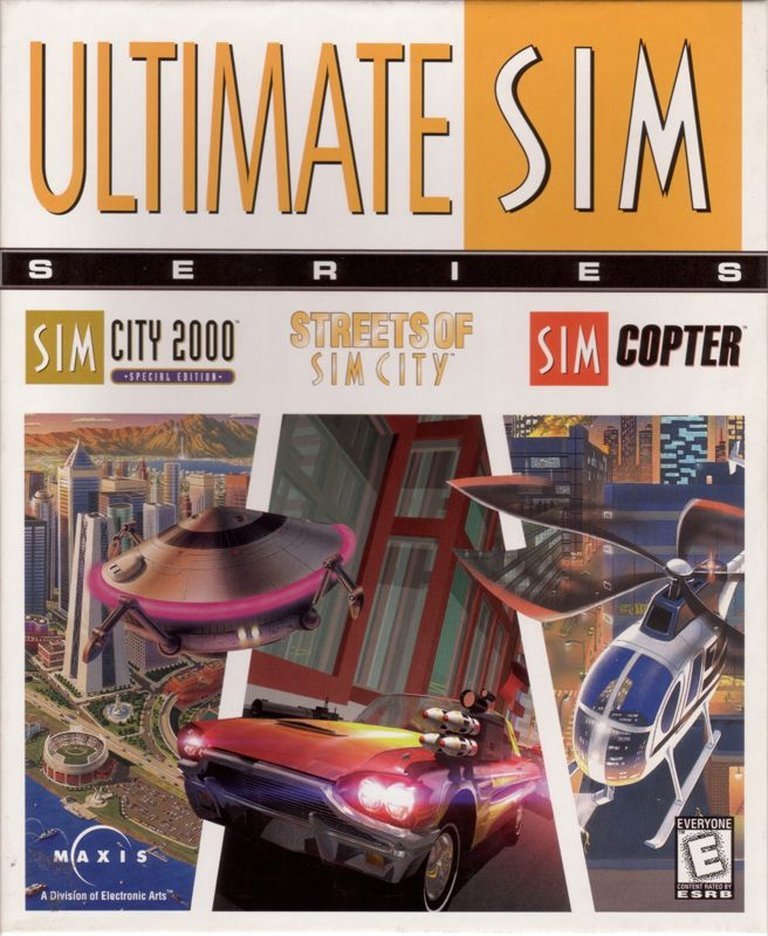
Ultimate Sim is a compilation of three classic Maxis simulation games: SimCity 2000: Special Edition, SimCopter, and Streets of SimCity. Released in 1998 for Windows, this collection allows players to build and manage cities in SimCity 2000, then explore them from the air in SimCopter or navigate the streets in Streets of SimCity. The games are interconnected, sharing the same city data files, which enhances the immersive experience. While the graphics and sound in SimCopter and Streets of SimCity are dated due to their DirectX 3 technology, the compilation offers a unique and engaging way to experience these beloved simulation titles.
Ultimate Sim Patches & Updates
Ultimate Sim Reviews & Reception
mobygames.com (70/100): A fun, although dated, weekend diversion.
Ultimate Sim Cheats & Codes
The Sims 1: Complete Collection (PC)
Press Ctrl + Shift + C in-game to open the cheat console and enter the desired command.
| Code | Effect |
|---|---|
| ! | Repeats the last cheat entered |
| ; | Enter several codes at the same time (e.g., !;!;!;!;!) |
| autonomy [0-100] | Adjusts Sims’ free will (0 = none, 100 = full) |
| bubble_tweak [number] | Sets, in pixels, how far from a Sim’s head the thought bubble appears |
| draw_floorable on/off | Enables/disables floor grid |
| edit_char | Opens Create-a-Sim in the middle of gameplay |
| interests | Shows Sim interests |
| lot_size [number] | Adjusts lot size |
| map_edit on/off | Allows modification of neighborhoods |
| move_objects on/off | Allows movement and deletion of any object or sim |
| nessie | Brings up the Loch Ness monster on the Downtown, Old Town, and Vacation neighborhood view |
| rosebud | Adds 1,000 Simoleons (use !; to repeat; alternatively, type rosebud;rosebud;rosebud;…) |
| set_hour [0-23] | Changes the in-game hour |
| sim_speed [-1000 to +1000] | Changes game speed |
Ultimate Sim: A Retrospective on Maxis’ Ambitious but Flawed Compilation
Introduction: A Bold Experiment in Simulation Synergy
Ultimate Sim (1998) stands as a fascinating artifact in the history of simulation games—a bold attempt by Maxis to merge three distinct urban simulation experiences into a single, cohesive package. Released during the late 1990s, a period when the Sim franchise was expanding beyond SimCity into more niche territories, Ultimate Sim bundled SimCity 2000: Special Edition, SimCopter, and Streets of SimCity into one CD-ROM. This compilation was more than just a marketing gimmick; it represented an ambitious vision of interconnected gameplay, where players could design a city in SimCity 2000, then explore it from the ground in Streets of SimCity or from the air in SimCopter.
Yet, despite its innovative premise, Ultimate Sim remains a polarizing entry in the Sim series. It is a product of its time, reflecting both the creative ambition of Maxis and the technological limitations of the late 1990s. This review will dissect Ultimate Sim in exhaustive detail, examining its development context, gameplay mechanics, narrative (or lack thereof), technical execution, and lasting legacy. By analyzing its strengths and flaws, we can better understand its place in the evolution of simulation games and the broader Sim franchise.
Development History & Context: The Rise of the Sim Empire
The Maxis Vision: From SimCity to Ultimate Sim
Maxis, founded by Will Wright and Jeff Braun in 1987, had already cemented its reputation as a pioneer in simulation games with the release of SimCity in 1989. The studio’s philosophy revolved around creating “software toys”—games that emphasized open-ended gameplay and player creativity over traditional win-lose mechanics. By the mid-1990s, Maxis had expanded its portfolio with titles like SimEarth, SimAnt, and SimTower, each exploring different facets of simulation.
The release of SimCity 2000 in 1993 marked a significant evolution for the franchise, introducing isometric graphics, deeper mechanics, and a more polished interface. Building on this success, Maxis sought to diversify its offerings further. SimCopter (1996) and Streets of SimCity (1997) were experimental titles that allowed players to interact with their SimCity 2000 creations in new ways—SimCopter as a helicopter pilot and Streets of SimCity as a driver navigating the city’s roads.
Ultimate Sim, released in 1998, was the culmination of this experimentation. It was not merely a compilation but an attempt to create a unified experience where each game complemented the others. The idea was revolutionary: players could design a city in SimCity 2000, then import it into SimCopter or Streets of SimCity to experience it from different perspectives. This interoperability was a technical marvel for its time, leveraging shared data files to create a seamless transition between games.
Technological Constraints and the Late 1990s Gaming Landscape
The late 1990s were a period of rapid technological advancement in gaming. The shift from 2D to 3D was underway, and DirectX was becoming the standard for PC game development. However, Ultimate Sim was constrained by the limitations of DirectX 3, which was already outdated by the time of its release. This technological lag resulted in SimCopter and Streets of SimCity suffering from rudimentary graphics and sound design, which felt primitive compared to contemporary titles like Half-Life (1998) or Unreal (1998).
The gaming landscape of 1998 was also highly competitive. Strategy and simulation games were thriving, with titles like Age of Empires II, StarCraft, and Civilization II dominating the market. Ultimate Sim faced the challenge of appealing to both hardcore SimCity fans and casual gamers who might be intimidated by the complexity of urban simulation. Its compilation format was a double-edged sword: while it offered variety, it also diluted the focus of each individual game.
The Role of Electronic Arts
Electronic Arts (EA), which acquired Maxis in 1997, played a crucial role in the development and marketing of Ultimate Sim. EA’s resources allowed Maxis to experiment with ambitious projects, but the publisher’s commercial priorities also influenced the game’s design. Ultimate Sim was positioned as a budget-friendly way to experience multiple Sim games, targeting players who might not want to purchase each title separately. This strategy reflected EA’s broader approach to the Sim franchise, which increasingly emphasized accessibility and mass-market appeal.
Narrative & Thematic Deep Dive: The Absence of Story in a Sandbox World
The Non-Narrative Nature of Ultimate Sim
Ultimate Sim is, at its core, a sandbox experience devoid of traditional narrative structures. Unlike story-driven games of the era, such as Final Fantasy VII or Baldur’s Gate, Ultimate Sim offers no overarching plot, characters, or dialogue. Instead, it invites players to create their own stories through emergent gameplay.
This absence of narrative is not a flaw but a deliberate design choice. The Sim series has always prioritized player agency over scripted storytelling, and Ultimate Sim exemplifies this philosophy. The “story” of Ultimate Sim is whatever the player makes of it—whether it’s designing a sprawling metropolis in SimCity 2000, rescuing citizens as a helicopter pilot in SimCopter, or cruising through the streets in Streets of SimCity.
Themes of Urban Planning and Player Creativity
The thematic underpinnings of Ultimate Sim revolve around urban planning, systems management, and creative expression. SimCity 2000 challenges players to balance economic, social, and environmental factors in city design, while SimCopter and Streets of SimCity allow them to experience the consequences of their decisions firsthand.
SimCopter, in particular, introduces themes of emergency response and public service, as players take on the role of a helicopter pilot tasked with extinguishing fires, transporting passengers, and maintaining law and order. Streets of SimCity, meanwhile, emphasizes the mundane yet critical aspects of urban life, such as traffic management and infrastructure maintenance.
The Lack of Character and Dialogue
One of the most striking aspects of Ultimate Sim is its complete lack of character development or dialogue. Unlike The Sims (2000), which would later introduce virtual people with personalities and relationships, Ultimate Sim focuses solely on systems and mechanics. The “characters” in SimCopter and Streets of SimCity are faceless NPCs with no distinct identities or backstories. This absence of humanization can make the experience feel sterile, but it also reinforces the game’s focus on simulation over storytelling.
Gameplay Mechanics & Systems: A Triumvirate of Simulation Experiences
Core Gameplay Loops: Building, Flying, and Driving
Ultimate Sim comprises three distinct gameplay experiences, each with its own mechanics and objectives:
-
SimCity 2000: Special Edition
- Gameplay Loop: Players design and manage a city, balancing residential, commercial, and industrial zones while managing budgets, infrastructure, and public services.
- Innovations: Introduces underground infrastructure (subways, water pipes), zoning tools, and disaster scenarios (fires, floods, riots).
- Strengths: Deep, strategic gameplay with high replayability. The Special Edition includes additional scenarios and improved tools over the original 1993 release.
- Flaws: Steep learning curve for newcomers; some mechanics (e.g., traffic simulation) are oversimplified.
-
SimCopter
- Gameplay Loop: Players pilot a helicopter, performing tasks such as firefighting, passenger transport, and police patrols. Missions are generated dynamically based on the player’s SimCity 2000 saves.
- Innovations: First-person flight simulation with direct integration into SimCity 2000 cities. Features a day-night cycle and weather effects.
- Strengths: Unique perspective on city management; fun, arcade-like gameplay.
- Flaws: Clunky controls, repetitive missions, and poor AI pathfinding. The helicopter’s limited fuel capacity restricts exploration.
-
Streets of SimCity
- Gameplay Loop: Players drive through their SimCity 2000 creations, completing missions such as delivering packages, chasing criminals, or racing against the clock.
- Innovations: One of the first games to allow players to explore their SimCity creations from street level. Features a variety of vehicles, from police cars to ambulances.
- Strengths: Novelty of driving through player-designed cities; simple, accessible gameplay.
- Flaws: Repetitive missions, bland visuals, and lack of depth. The driving physics are rudimentary.
Interconnected Gameplay: A Flawed but Ambitious System
The most innovative aspect of Ultimate Sim is its interconnected gameplay. Players can design a city in SimCity 2000, then import it into SimCopter or Streets of SimCity to experience it from different angles. This feature was groundbreaking for its time, offering a level of immersion rarely seen in simulation games.
However, the execution of this interoperability is flawed. The transition between games is not seamless—players must manually export and import city files, which can be cumbersome. Additionally, the limitations of SimCopter and Streets of SimCity (e.g., fuel constraints, mission repetition) often highlight the shortcomings of the player’s city design rather than its strengths. As noted in the MobyGames review by Dave Schenet, “Within minutes, my map-sprawling cities were engulfed in flames, crime ran rampant, traffic was at a standstill, and I didn’t have enough fuel to get from one end to the other.”
UI and Controls: A Product of Its Time
The user interface (UI) and controls of Ultimate Sim reflect the technological constraints of the late 1990s. SimCity 2000 features a functional but dated UI, with small icons and menus that can be difficult to navigate on modern displays. SimCopter and Streets of SimCity suffer from even more archaic controls, with SimCopter’s flight mechanics being particularly unwieldy.
The lack of modern quality-of-life features, such as tooltips, contextual help, or customizable controls, makes Ultimate Sim feel clunky by today’s standards. However, these limitations are understandable given the era in which the game was developed.
World-Building, Art & Sound: A Mixed Bag of Innovation and Obsolescence
World-Building: The Joy of Player-Created Cities
The world-building in Ultimate Sim is its strongest suit. SimCity 2000 allows players to craft intricate, living cities with a level of detail that was unprecedented at the time. The ability to zone residential, commercial, and industrial areas, lay down roads and infrastructure, and manage public services creates a deeply engaging sandbox experience.
The integration with SimCopter and Streets of SimCity adds another layer to this world-building. Seeing your city from the perspective of a helicopter pilot or a street-level driver provides a sense of scale and immersion that SimCity 2000 alone cannot achieve. This multi-perspective approach was a bold experiment in environmental storytelling, even if the execution was imperfect.
Art Direction: Isometric Beauty Meets Rudimentary 3D
SimCity 2000’s isometric art style remains one of its most enduring features. The game’s visuals are clean, colorful, and highly functional, allowing players to easily distinguish between different types of buildings and infrastructure. The Special Edition includes enhanced graphics and additional building types, making it the definitive version of the game.
In contrast, SimCopter and Streets of SimCity suffer from primitive 3D graphics that have not aged well. The blocky, low-polygon models and muddy textures are a far cry from the polished aesthetics of SimCity 2000. The DirectX 3 limitations are particularly evident in these titles, with poor lighting, limited draw distances, and choppy animations.
Sound Design: From Charming to Cacophonous
The sound design in Ultimate Sim is a mixed bag. SimCity 2000 features a charming, minimalist soundtrack that complements its relaxed gameplay. The ambient sounds of city life—traffic, construction, and emergency sirens—add to the immersion without being intrusive.
SimCopter and Streets of SimCity, however, fare poorly in the audio department. The helicopter’s engine noise in SimCopter is repetitive and grating, while Streets of SimCity’s sound effects are bland and uninspired. The lack of voice acting or dynamic music further contributes to the games’ sterile atmosphere.
Reception & Legacy: A Niche Classic with Lasting Influence
Critical and Commercial Reception
Ultimate Sim received modest attention upon its release, with a MobyGames user score of 3.5 out of 5 based on two ratings. The sole player review, written by Dave Schenet in 2001, praises the compilation’s concept but criticizes its execution:
“I had a blast, loading my old SC2K cities into SimCopter and Streets, and just flying and/or driving around. It made me realise how inefficient and horribly-designed my cities were, and gave me an excuse to spend some time rebuilding them. 🙂 This is probably one of the best compilation packs I’ve seen, since the games all relate to one another (they use the same data files).”
However, Schenet also highlights the game’s flaws:
“Unfortunately, my cities were too enormous—there are only so many things you can do with a single helicopter. Within minutes, my map-sprawling cities were engulfed in flames, crime ran rampant, traffic was at a standstill, and I didn’t have enough fuel to get from one end to the other (in either of the vehicle-based games). Also, the graphics and sound for Copter and Streets were pretty horrid…”
Commercially, Ultimate Sim was likely a modest success, appealing primarily to existing SimCity fans rather than attracting new players. Its budget-friendly pricing and the novelty of its interconnected gameplay made it an attractive option for simulation enthusiasts, but its technical limitations prevented it from achieving mainstream appeal.
Influence on Subsequent Games
Despite its flaws, Ultimate Sim had a subtle but lasting influence on the Sim franchise and the broader simulation genre. Its experiment with interconnected gameplay foreshadowed later titles like The Sims (2000), which allowed players to design homes and then populate them with virtual people. The idea of experiencing a simulation from multiple perspectives also influenced games like Cities: Skylines (2015), which includes a first-person mode for exploring player-created cities.
Ultimate Sim also demonstrated the potential of compilation packs as a way to introduce players to multiple games within a franchise. This approach would later be adopted by other publishers, particularly in the strategy and simulation genres.
Legacy: A Cult Classic for Simulation Enthusiasts
Today, Ultimate Sim is remembered as a cult classic—a flawed but ambitious experiment that pushed the boundaries of what simulation games could achieve. While it is not as celebrated as SimCity 2000 or The Sims, it holds a special place in the hearts of Sim fans who appreciate its innovative gameplay and interconnected design.
The game’s legacy is also tied to its historical context. Released during a transitional period in gaming, Ultimate Sim reflects both the creative ambition of Maxis and the technological limitations of its era. It serves as a reminder of how far simulation games have come, while also highlighting the timeless appeal of open-ended, player-driven experiences.
Conclusion: A Flawed Gem in the Sim Crown
Ultimate Sim is a game of contradictions—a bold vision hampered by technical limitations, a revolutionary concept marred by repetitive gameplay, and a compelling sandbox experience that ultimately feels incomplete. Yet, despite its flaws, it remains a fascinating artifact in the history of simulation games.
For modern players, Ultimate Sim is a challenging but rewarding experience. Its interconnected gameplay and open-ended design offer a level of creativity and immersion that is rare even in contemporary titles. However, its dated graphics, clunky controls, and repetitive missions make it a difficult sell for those accustomed to modern gaming standards.
Final Verdict: Ultimate Sim is a niche classic that will appeal primarily to Sim franchise enthusiasts and retro gaming aficionados. It is not a game for everyone, but for those willing to overlook its flaws, it offers a unique and ambitious simulation experience that remains unmatched in its scope and creativity.
Score: 7/10 – A flawed but ambitious compilation that pushes the boundaries of simulation gaming, despite its technical limitations.
Post-Script: The Sim Franchise’s Evolution
Ultimate Sim’s release in 1998 marked a transitional period for the Sim franchise. Just two years later, The Sims (2000) would revolutionize the series by shifting the focus from urban planning to virtual people, becoming one of the best-selling PC games of all time. The lessons learned from Ultimate Sim—particularly its emphasis on player agency and interconnected gameplay—would inform the design of The Sims and its sequels.
Today, the Sim franchise continues to thrive, with The Sims 4 (2014) and the upcoming Project Rene pushing the boundaries of life simulation. Ultimate Sim, while largely forgotten by mainstream audiences, remains a testament to Maxis’ innovative spirit and its willingness to experiment with bold, unconventional ideas. It is a game that, despite its flaws, deserves to be remembered as a pioneering effort in the world of simulation gaming.