
- Release Year: 2024
- Platforms: Windows, Nintendo Switch, PlayStation 5, Xbox Series
- Publisher: Kasedo Games Limited
- Developer: Beard Envy Ltd.
- Genre: Puzzle, Simulation
- Perspective: First-person
- Gameplay: Roguelike
- Setting: Space
- Average Score: 85/100
Description
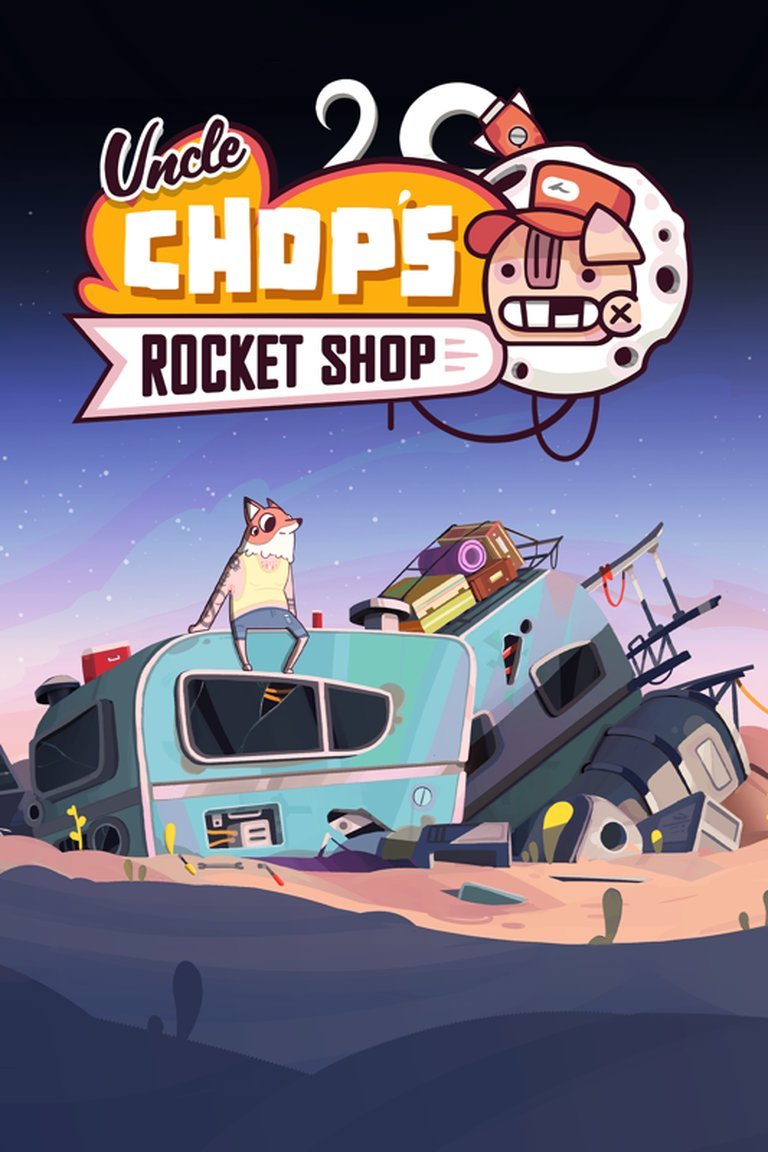
Uncle Chop’s Rocket Shop is an intergalactic roguelite simulation and puzzle game where players embody Droose, a four-eyed ‘fox-guy’ mechanic. Stationed at the titular rocket repair shop, the core objective is to diagnose and fix a continuous stream of malfunctioning customer spaceships, tackling issues from low oil to critical module failures and even exploding reactors. This humorous experience combines workshop management with challenging roguelite loops, all while players strive to earn enough to pay “R.E.N.T.” to a demanding employer and avoid dire financial consequences.
Gameplay Videos
Where to Get Uncle Chop’s Rocket Shop
PC
Patches & Mods
Guides & Walkthroughs
Reviews & Reception
metacritic.com (85/100): If you’re in the market for a game that combines spaceship repair with existential crises and absurd humour, Uncle Chop’s Rocket Shop is well worth checking out.
gamesasylum.com : Here’s one of the weirder and more imaginative examples of the Roguelike genre.
web.phenixxgaming.com : The developers of Uncle Chop’s Rocket Shop have a really great thing going, though the Switch version has a flaw or two that need to be addressed.
videogamesgood.com : Uncle Chop’s Rocket Shop consumed me, reeling me in with its easy to understand manual-driven gameplay styles and deep lore.
gamersocialclub.ca : The main draw of the game though has to be repairing the ships; it’s incredibly immersive.
Uncle Chop’s Rocket Shop: A Deep Dive into the Galactic Grind
In the bustling cosmos of modern indie gaming, where innovation often springs from unexpected genre fusions, Uncle Chop’s Rocket Shop emerges as a truly singular phenomenon. Developed by Beard Envy Ltd. and published by Kasedo Games, this roguelite spaceship repair simulator plunges players into a frantic, darkly humorous, and surprisingly philosophical journey of intergalactic blue-collar labor. It is a game that challenges, frustrates, and ultimately rewards in equal measure, carving out a niche as an “unforgettable experience” that firmly secures its place as a “stellar indie gem.”
Development History & Context
Studio & Vision
Uncle Chop’s Rocket Shop is the brainchild of Beard Envy Ltd., a development trio known for their previous puzzle-focused title, Filament. This lineage is evident in Rocket Shop‘s intricate, manual-driven gameplay, which demands significant mental processing power and attention to detail. Partnering with publisher Kasedo Games, who specializes in “Triple I” indie titles, the team set out to create an experience inspired by the comedic and aesthetic sensibilities of cartoons like Adventure Time and Rick & Morty. This influence is palpable in the game’s distinctive art style, its liberal use of profanity, and its pervasive sense of absurdity.
The creators’ vision was to blend several disparate genres: the high-stakes, repetitive loop of a roguelite, the intricate systems management of a simulation game, and the diagnostic problem-solving of a puzzle title. Critically, it drew comparisons to the manual-driven cooperation of Keep Talking and Nobody Explodes (but for a single player), and the narrative-driven, high-pressure job simulation of Papers, Please and Strange Horticulture. The intent was clearly to craft a game that was simultaneously dense in its mechanics and rich in its storytelling, pushing players to “embrace chaos” while finding satisfaction in mastery.
Technological Constraints & Era
Released on December 5, 2024, Uncle Chop’s Rocket Shop arrived at a time when indie games, particularly those blending unique mechanics with stylized aesthetics, were flourishing. Developed using Unreal Engine 4 for its visual fidelity and FMOD for robust sound design, the game benefited from modern engine capabilities to create its vibrant, tactile world.
The game’s simultaneous launch across Windows PC, PlayStation 5, Xbox Series X/S, and Nintendo Switch demonstrated a commitment to broad accessibility, though this multi-platform approach later highlighted specific challenges related to control schemes. Rather than grappling with raw technological limitations, Beard Envy focused on refining their intricate gameplay systems and distinctive artistic vision within the current generation’s capabilities, prioritizing a handcrafted feel over photorealistic ambitions.
Gaming Landscape
At the time of its release, the gaming landscape was fertile ground for roguelites and simulation games. The genre of “routine-based simulators,” which immerses players in a specific, often mundane, job with high stakes and branching narratives, had garnered significant traction. Uncle Chop’s Rocket Shop positioned itself at the forefront of this trend, offering a sci-fi twist on the “job simulator” that felt both familiar in its core loop and fresh in its execution. Its blend of frantic, timed gameplay and deep, lore-rich narrative aimed to appeal to players seeking both challenge and engaging storytelling in their procedural experiences. The presence of a free Steam demo prior to launch also allowed players to “brush up their skills” and gauge their interest, a common strategy for niche indie titles aiming to build early community engagement.
Narrative & Thematic Deep Dive
Plot Overview
The core narrative of Uncle Chop’s Rocket Shop thrusts players into the role of Wilbur, a vest-clad, four-eyed, fox-headed mechanic toiling away at an asteroid-bound service station in a remote space lane. Wilbur’s existence is a perpetual cycle of grueling labor, driven by the ever-increasing R.E.N.T. payments demanded by his corporate overlord, the colossal holographic Uncle Chop. Failure to meet these payments results in Wilbur’s gruesome death, triggering a time loop that sends him back to the start of the week to “do it all over again, but better.” This cyclical existence forms the backbone of the game, framing every repair job and customer interaction within the desperate struggle for survival and solvency. The routine—wake up, clock in, fix ships, make friends and enemies, pay R.E.N.T., go to bed—is a grim reality, yet one infused with an overwhelming sense of absurdity.
Characters & Dialogue
The cast of Uncle Chop’s Rocket Shop is a masterclass in eccentric character design and darkly comedic dialogue.
* Wilbur: Our protagonist is a distinctively animated bipedal fox with multiple eyes and a “funk walk cycle.” He’s portrayed as a humble mechanic, often haphazardly stumbling through his tasks, yet capable of growth and learning. His journey is one of endurance against an oppressive system, fostering a quiet sense of empathy from the player.
* Uncle Chop: The titular corporate overlord is a constant, looming threat. Appearing as a “colossal hologram,” he represents unchecked capitalism and ruthless financial demands. His threats of “murdering you for being too much of a financial liability” or “imploding Wilbur’s head” for missed R.E.N.T. payments establish the game’s high stakes and morbid humor.
* Droose: The foul-mouthed, greasy fry-cook who runs the adjacent diner is Wilbur’s most dependable companion and mentor. He guides Wilbur through the initial bewildering tasks, teaches him the ropes, and, crucially, possesses the ability to “bring you back to life,” hinting at the deeper narrative mechanics of the time loop. Droose provides a grounding, if crude, presence amidst the chaos.
* Customers: The parade of “oddballs,” “eccentric clients,” and “Rick & Morty-esque aliens” arriving with their broken ships are a source of constant comedic and narrative intrigue. These characters belong to various factions with “inane agendas,” ranging from “worshipping deranged space gods” and “feeding random crap to a sentient black hole” to “endlessly digging for The Treasure™” or “mentally enslaving donut shop workers.” Their unique issues and often hilarious dialogue contribute to the game’s anthology-style storytelling.
* Kyle: A “colossal creature” residing in Wilbur’s basement, Kyle serves as a unique NPC who provides permanent upgrades, tying into the roguelite progression system and adding another layer of bizarre world-building.
Underlying Themes
Uncle Chop’s Rocket Shop is surprisingly rich in thematic depth, despite its outlandish facade.
- Existentialism & the Futility of Labor: The recurring motif of “pondering the futility of your existence” is central. Wilbur’s endless grind against rising R.E.N.T. payments, punctuated by death and resurrection, highlights the Sisyphean struggle of blue-collar labor under an oppressive corporate structure. The time loop itself forces a confrontation with purpose and meaning in a seemingly meaningless cycle.
- Dark Humor & Absurdity: The game’s humor is its defining characteristic. It’s a “delightful blend of humor, strategy, and chaos,” drawing from the “morbid humor” and “Adult Swim-adjacent humor” of its inspirations. The juxtaposition of mundane repair tasks with cosmic absurdity, foul-mouthed dialogue, and Cronenbergian horrors creates a distinctly warped and memorable atmosphere.
- Critique of Capitalism & Exploitation: Uncle Chop, as the corporate overlord, embodies the relentless demands of unchecked capitalism. Wilbur’s “paltry living” and the constant threat of eviction or death for financial liability serve as a potent, if comedic, commentary on worker exploitation and the pressures of modern economic systems.
- Learning, Mastery, and Persistence: Despite the grim context, a powerful theme of growth and mastery runs through the game. The roguelite structure, with its persistent upgrades and the player’s accumulating knowledge, ensures that “you’ll also get faster and smarter the more you do the thing.” This allows players to feel a genuine sense of personal progression and competence, transforming an initially overwhelming experience into one of satisfying skill acquisition.
- Choice & Consequences in a Looping Narrative: The “multiple-ending, overarching narrative” and “anthology-style storytelling” provide layers of player agency. Engaging with different factions and making dialogue choices can significantly impact future events and unlock various endings, adding considerable depth and replayability beyond the core repair loop. The “deep and rich and good” lore is something players are encouraged to “discover,” hinting at hidden puzzles and secrets that enrich the overall experience.
Gameplay Mechanics & Systems
Core Gameplay Loop
At its heart, Uncle Chop’s Rocket Shop is a roguelite spaceship repair simulator. The player, as Wilbur, is tasked with diagnosing and fixing a variety of procedurally generated spaceship modules within a daily time limit, or under stricter perfectionist conditions. The ultimate goal is to earn enough money to meet escalating R.E.N.T. payments every three in-game days, failure meaning death and a reset to the beginning of the “run.” Each run lasts three days, during which players must clock in, accept repair jobs of varying complexity, and meticulously work on the ships before nightfall to avoid hefty penalties. This high-pressure environment defines the “Frantic Fixing” mode, while a “Focused Fixing” mode offers a less time-constrained, but often more challenging, alternative.
Repair Mechanics
The game’s repair mechanics are its most distinguishing feature, designed to be highly tactile and deeply engaging:
* Tools & Interaction: Players utilize a diverse range of tools, diagnostic devices, parts, and workshop appliances. Gameplay involves physically “fumbling, slicing, loosening, tightening, grabbing, and dropping” components. This includes unfastening/tightening screws, disassembling modules in precise sequences, delving into electrical panels, and even performing unsavory tasks like hosing out clogged toilets.
* The Grimoire (Manual): Crucial to success is the in-game “grimoire,” a detailed manual sorted by tabs. It provides guidance for diagnosing faults, correcting them, and operating workshop appliances. Amusingly written with “handwritten notes” and “pretty diagrams,” it’s like “IKEA furniture-assembly training” for spaceships. However, a significant criticism, especially on consoles, is that the clock continues to tick while players consult this essential guide, adding another layer of pressure.
* Module Variety: The game boasts a “huge variety of ships and modules,” ensuring that “your hands are gonna get real dirty real fast, in some real unusual places.” Tasks range from simple refuels, oil changes, and recharging fuel cells to more complex procedures like recalibrating starmaps, shutting off security systems (often requiring code-cracking mini-games), and repairing entertainment decks, including VR headsets and game consoles. These often incorporate brief mini-games to diagnose issues.
* Inventory Management: Limited inventory space forces players to juggle parts and tools, adding a strategic layer to resource management.
* Consequences of Failure: Botched jobs, unfixed issues, or leaving screws undone incur significant financial penalties, impacting customer satisfaction and potential tips. Being presented with a new, complex system while the customer’s patience meter depletes is a constant source of tension.
Progression & Upgrades
To make subsequent runs “a little more tolerable,” Uncle Chop’s Rocket Shop incorporates persistent upgrades:
* Workshop Expansion: Earned money allows players to expand their workshop with new workstations, ranging from “industrial devices to esoteric altars.” These upgrades enable taking on “bigger and more lucrative ships.”
* Permanent Upgrades: Through characters like Kyle in the basement, or a computer in Wilbur’s shack, players can purchase power tools and other persistent upgrades. The 1.1 update further expanded this with:
* Vending Machines: Seven new machines like the “Inflationator” (escalating bonus per job) and “Large Loss Nullifier” (turns biggest penalty positive) offer “fun and interesting playstyles.”
* Omen Upgrades: Five new upgrades such as “Vending Variety” (more machine options), “Nap Time” (sleep through first R.E.N.T.), and “Second Wind” (survive one fatal job) soothe specific pains and support vending machine use.
* New Ship Type: The “Schlepper” adds to the variety of repair challenges.
Difficulty & Replayability
The roguelite nature ensures “no two workdays are ever the same.” Procedurally generated ships, random events, hidden puzzles, upgrades, and secret lore contribute to exceptional replayability. However, the game is notoriously difficult. Critics frequently describe it as “unforgiving,” “punishing,” and possessing “sadistic mechanics,” particularly the “difficulty spike” in Timed Mode. The “stiff learning curve” means minor mistakes can “ruin a good thirty minutes of playtime,” leading to early “frustration” and a “tedious slog” for some. The “monotony of attempting the same objectives over and over” was a critique by Niche Gamer.
The dual playstyles, Frantic Fixing and Focused Fixing, partially mitigate this. Many reviewers recommended starting with Focused Fixing to absorb the manual and gain mastery over individual repair modules before tackling the timed pressure. The satisfaction of learning and growing, with the manual becoming less necessary over time, is a key rewarding element. Ultimately, the game requires “utmost patience, a laser-focused attention span, and a love for tinkering.”
UI & Controls
The game employs a point-and-select interface, seemingly intuitive for PC players with a mouse. However, console versions faced significant criticism regarding controls. Reviewers lamented “clunky” controls on the Nintendo Switch, “finicky” interactions, and the repair manual being a “nightmare to navigate on console.” Some actions required “two buttons to be pressed at once,” making it “quite apparent that this was designed with a mouse in mind.” This control scheme inconsistency proved to be a “roadblock” for many console players, detracting from the otherwise immersive tactile mechanics. The developers did implement accessibility features like color-blind friendly modes and options to disable dialogue skipping, showing responsiveness to player feedback.
World-Building, Art & Sound
Setting & Atmosphere
Uncle Chop’s Rocket Shop masterfully crafts a distinct and memorable setting: an asteroid-bound service station in a “unfrequented space lane,” often described as an “interplanetary dump.” This grimy, utilitarian backdrop is juxtaposed with the vibrant chaos of its inhabitants and narrative. The atmosphere is a unique blend of modern sci-fi, “1950s Americana” (particularly in the adjacent greasy spoon diner), and “eldritch and surreal” elements. It manages to feel simultaneously chaotic and “oddly cozy,” absurdly humorous yet deeply immersive. The constant feeling of being under pressure, combined with the bizarre encounters, creates an environment that is both stressful and strangely endearing.
Visual Direction
The game’s art style is a critical component of its charm. It’s a “delightful mix of vibrant colors, quirky character designs, and detailed environments reminiscent of cartoons like Adventure Time.” The “fluidly animated sprites” bring characters like Wilbur, with his unique walk cycle and multi-eyed fox head, and Droose, the greasy fry-cook, to life. Each spaceship is “uniquely crafted, with intricate modules that make every repair feel personal.” The visual direction strikes a “perfect balance between humorous chaos and immersive design,” making it stand out with its “distinctive aesthetic and humor” and “indie-type art.” The use of Unreal Engine 4 allows for these stylized visuals to be rendered with clarity and detail, even on lower graphics settings, as improved resolutions for important textures like polaroids and business cards were noted in early patches.
Sound Design & Music
The auditory experience of Uncle Chop’s Rocket Shop is as integral to its immersion as its visuals. The sound design is “top-notch,” featuring a satisfying array of effects, “from the clanging of tools to the hum of spaceship engines.” The tactile nature of the repair mechanics is greatly enhanced by responsive audio cues, making the intricate fiddling with parts feel all the more satisfying.
The musical score complements the gameplay perfectly. Reviewers noted a “moody twang of guitar tracks” and a “banjo-led musical score” reminiscent of the SteamWorld franchise. The soundtrack expertly transitions between “upbeat tracks that keep the energy high during repair sessions and mellow tones during narrative moments.” The 1.1 update even added a music player to the Speakeasy, allowing players to choose their preferred soundtrack, a small but appreciated quality-of-life feature that acknowledges the game’s strong musical identity.
Reception & Legacy
Critical Reception at Launch
Uncle Chop’s Rocket Shop launched on December 5, 2024, to a generally favorable critical reception. MobyGames reported an average score of 79% based on 15 ratings, while Metacritic’s PC score settled at a solid 85 based on 6 critic reviews.
Praises:
* Many critics lauded its innovative blend of roguelite, simulation, and puzzle genres, calling it a “good video game that manages to fit the simulation soul and the roguelite one.” (The Games Machine).
* The game’s unique humor, distinctive art style (compared to Adventure Time and Rick & Morty), and quirky narrative were consistently highlighted as major strengths. “The humor and uniqueness of the game is a high bonus too” (Phenixx Gaming).
* The tactile and engaging repair mechanics, coupled with the detailed in-game manual, provided a deep and satisfying gameplay loop for those willing to commit. TheGamer, giving it a perfect 100%, noted, “Roguelites usually frustrate me, but I’ve never once wanted to rage quit Uncle Chop’s Rocket Shop… I can’t stop playing.”
* Its high replayability, stemming from procedurally generated ships, random events, and a branching, multiple-ending narrative, was also a key positive. “Every run is different and there’s a wealth of content” (Phenixx Gaming).
* The “Focused Fixing” mode was appreciated for offering an alternative playstyle for players averse to time pressure.
Criticisms:
* A recurring point of contention was the game’s difficulty and unforgiving nature. Phrases like “punishing, sadistic mechanics” (Nintendo Life), “harsh sledding” (PlayStation Country), and “difficulty spike” were common. Niche Gamer, rating it 50%, felt “any feelings of satisfaction will be quickly replaced by frustration once the monotony of attempting the same objectives over and over starts to set in.”
* Control issues, particularly on consoles, were a significant drawback. Many reviewers noted that the “clunkiness of the controls” (Phenixx Gaming) and the “repair manual being a nightmare to navigate on console” made the experience rougher. The clock continuing to run while reading instructions was a particular source of frustration.
* Some found the initial learning curve too steep and the early game “overwhelming,” hindering enjoyment for casual players. Games Asylum, while appreciating its creativity, noted, “This isn’t a chilled experience… If you play games to relax and progress at your own pace, this isn’t for you.”
Scores ranged from perfect 100%s (TheGamer, Gaming Furever) to 50%s (Nintendo Life, Niche Gamer), indicating a divisive but largely positive reception, dependent on player tolerance for difficulty and control quirks.
Commercial Reception
Specific commercial figures are not detailed in the provided materials. However, the game was priced at $19.99 for the standard edition, with a Deluxe Edition (including a digital soundtrack, artbook, and “Drunk Wilbur” skin) also available. A free demo was offered on Steam, a common strategy for indie titles to build player interest and allow prospective buyers to gauge the gameplay before purchase. Its presence across all major modern platforms suggests a significant effort to reach a wide audience.
Evolution of Reputation & Influence
Given its release date, it is too early to definitively assess Uncle Chop’s Rocket Shop‘s long-term legacy and influence. However, its immediate reception indicates it’s “not the kind of experience that’s forgotten any time soon.” Its unique fusion of roguelite elements with a job simulation, particularly the tactile repair mechanics and deep lore, sets a precedent that could inspire future indie developers.
The consistent patches released post-launch (December 2024 through March 2025) demonstrate Beard Envy’s commitment to improving the player experience. These updates addressed numerous bugs, improved controller navigation, and introduced significant content like new vending machines and Omen upgrades, enhancing replayability and offering new playstyles. This proactive support is crucial for building a dedicated community and ensuring the game’s reputation evolves positively over time. The potential for “community-driven mystery solving” and lore breakdowns highlighted by one critic suggests a game that could foster a lasting, engaged player base, much like other narrative-heavy puzzle or simulation titles.
Conclusion
Uncle Chop’s Rocket Shop is a masterclass in eccentric game design, a chaotic yet captivating blend of roguelite, simulation, and puzzle mechanics wrapped in a darkly humorous sci-fi aesthetic. It successfully delivers on its promise of an innovative genre fusion, immersing players in the desperate, absurd, and ultimately rewarding life of Wilbur, the fox-headed mechanic.
Its strengths are undeniable: a rich, multi-layered narrative populated by memorable, bizarre characters; sharp, witty dialogue; a unique visual direction inspired by classic cartoons; and a deeply tactile gameplay loop that, for the patient player, evolves into a satisfying curve of mastery. The inclusion of two distinct playstyles, “Frantic Fixing” and “Focused Fixing,” cleverly caters to different player preferences, while persistent upgrades and extensive replayability ensure each return to the asteroid-bound shop feels fresh and offers new opportunities for discovery.
However, the journey is not without its turbulence. The game’s steep difficulty, punishing mechanics, and initial overwhelming nature can be a barrier to entry for some, requiring a specific kind of player who relishes challenge and intricate problem-solving. Furthermore, the less-than-intuitive controls on consoles proved to be a notable flaw, impacting the flow of what is intended to be a highly tactile experience.
Despite these caveats, Uncle Chop’s Rocket Shop stands as an exceptional indie title. It is a bold, creative, and endlessly engaging experience that celebrates the grind while satirizing the systems that impose it. For those willing to embrace its chaos, consult its wonderfully weird manual, and persevere through its demanding challenges, a profound sense of accomplishment and a truly unforgettable gaming journey await. It is a vibrant testament to indie innovation, securing its place in video game history as a uniquely crafted “stellar indie gem” that delivers on its outlandish promises.