
- Release Year: 2004
- Platforms: Windows
- Publisher: 3000AD, Inc., DreamCatcher Interactive Inc., Play Ten Interactive, Russobit-M
- Developer: 3000AD, Inc.
- Genre: Simulation
- Perspective: 1st-person
- Game Mode: Online PVP, Single-player
- Gameplay: Character Creation, Dog fights, Exploration, Ground skirmishes, Naval combat, Space battles, Space flight
- Setting: Land, Sea, Space
- Average Score: 55/100
Description
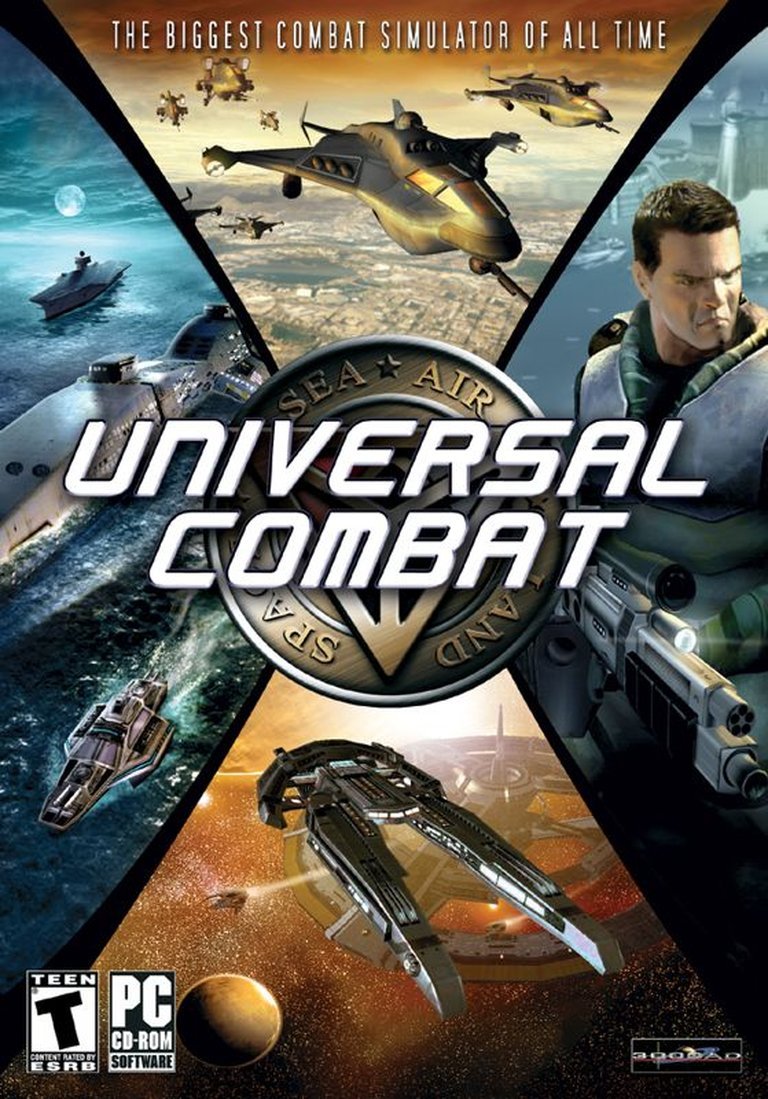
Universal Combat is a sprawling space simulation and the fifth installment in the Battle Cruiser Series, offering players action-packed battles across sea, land, and space. With customizable characters from 12 different races, players engage in dynamic combat scenarios—from ground skirmishes to interstellar dogfights—while exploring over 250 planets featuring more than 21,000 points of interest like military bases, cities, and star bases.
Gameplay Videos
Where to Buy Universal Combat
PC
Universal Combat Free Download
Universal Combat Patches & Updates
Universal Combat Guides & Walkthroughs
Universal Combat Reviews & Reception
metacritic.com (54/100): There are still a ton of controls in the newest version of the Battlecruiser series…but 3000 AD has done a good job in making them a little more accessible for things that you will do most often during the game.
ign.com (59/100): A skyscraper built by hand.
gamefaqs.gamespot.com (54/100): A dreary atmosphere, blatantly outdated visuals, AI bugs, and many other issues inherited from the game’s predecessor, all contribute to an overall disappointing experience.
Universal Combat: Review
Introduction
In the annals of video game history, few titles embody the dichotomy of ambition and infamy quite like Universal Combat. Released in 2004 as the fifth installment in Derek Smart’s long-running Battlecruiser series, this space-combat simulator promised a galaxy-spanning sandbox where players could command fleets, pilot fighters, and wage war across terrestrial and cosmic battlegrounds. Yet, beneath its grandiose vision lay a legacy of technical turmoil, polarizing design, and a developer-publisher feud that became as dramatic as the in-game conflicts. This review dissects Universal Combat’s troubled genesis, its Sisyphean attempts to marry depth with accessibility, and its enduring reputation as a cautionary tale of unchecked ambition in game design.
Development History & Context
The Vision of Derek Smart and 3000AD
Universal Combat emerged from the mind of Derek Smart, a polarizing auteur whose career has been defined by combative forums posts, legal battles, and games that prioritize scale over polish. Developed by Smart’s studio 3000AD, Universal Combat began life as Battlecruiser Generations—a successor to 2003’s Battlecruiser Millennium (Gold Edition). Smart’s vision was characteristically vast: a seamless universe combining space combat, terrestrial warfare, and RPG-lite character progression.
Technological Ambitions and Constraints
Originally, Smart licensed Croteam’s Serious Sam engine in 2000 for “Project ABC,” aiming to overhaul the Battlecruiser formula for modern hardware. By 2003, publisher DreamCatcher Interactive rebranded the project as Universal Combat, pushing for an “action-focused” pivot to attract mainstream players. Yet the tech underpinning this ambition was already dated. The Game Builder System III engine struggled with rendering 250+ planets, 21,000 points of interest, and real-time tracking of crewmember needs (hunger, fatigue, AI routines). Procedural generation and Newtonian physics further strained the design, resulting in a game that demanded Windows 98/2000 compatibility but buckled under its own scope.
The DreamCatcher Debacle
Days before release, Smart sued DreamCatcher for slashing the price from $39.99 to $19.99, arguing it “devalued” the product. The publisher countersued, citing “subpar graphics” and bugs. A judge denied Smart’s injunction, allowing the discounted release—a decision that cemented Universal Combat’s reputation as a budget-bin curiosity.
Narrative & Thematic Deep Dive
A Galaxy Without a Soul
Universal Combat’s narrative framework is ostensibly epic: players choose among 12 races and assume roles like Commander, Elite Force Pilot, or Marine across a galaxy embroiled in Terran-Insurgent conflicts. Yet the storytelling is atomized and lifeless. Mission briefings are utilitarian; characters lack voice acting or defined personalities. Thematically, it echoes military sci-fi tropes—loyalty, rebellion, resource scarcity—but without nuance or emotional stakes.
The Illusion of Choice
While the game boasts 9 careers and 54 scenarios, most devolve into repetitive fetch quests or base assaults. The lone campaign, A Fragile Hope, tasks players with stabilizing a war-torn sector, but its pacing is undermined by jarring transitions (e.g., abruptly switching from capital-ship command to infantry combat). Dialogue, where present, is riddled with stilted exposition:
“Captain, sensors detect insurgent activity on Planet Tau-4. Deploy forces immediately.”
The absence of branching outcomes or moral choices reduces the universe to a static chessboard—a missed opportunity for emergent storytelling.
Gameplay Mechanics & Systems
The Curse of Complexity
Universal Combat’s greatest strength—and weakness—is its simulation-first ethos. Players can:
– Pilot 28 vehicles (fighters, submarines, tanks)
– Manage crew morale and ship subsystems
– Board enemy vessels via EVA suits
– Engage in 64-player multiplayer battles
Yet these systems drown in obtuse UX design. The keyboard requires 100+ bindings; menus bury critical data under nested tabs. Launching a shuttle involves:
1. Walking to the hangar (no fast travel)
2. Manually priming engines via a clunky HUD
3. Plotting orbital paths using a 3D starmap without tutorials
Combat: Quantity Over Quality
Space dogfights suffer from floaty physics and wonky hit detection. Ground combat feels like a PS1-era shooter, with blocky models and AI that spasms between omniscient and catatonic. Naval engagements, while novel, control like arcade minigames—a stark contrast to the sim’s aspirations.
Progression and Multiplayer
Character progression is minimal: completing missions unlocks minor stat boosts, but without RPG depth. Multiplayer, though ambitiously scaled, was hamstrung by netcode issues and a barren player base. The 2008 freeware release removed online support entirely, cementing its isolation.
World-Building, Art & Sound
A Universe of Cardboard and Static
Universal Combat’s 250 planets are technically impressive but artistically barren. Terrain textures resemble Play-Doh landscapes; cities are lifeless clusters of repeated assets. Space vistas, while dotted with nebulas and asteroid fields, feel disconnected—like skyboxes plastered onto a void.
Directionless Aesthetic
The art design lacks a cohesive identity: Terran ships evoke Babylon 5-ish pragmatism, while alien races rely on generic “futuristic” spires. Enemy designs recycle assets from earlier Battlecruiser titles, exacerbating the cut-and-paste feel.
Sound Design: Ambience as Afterthought
The score alternates between synthesized militaristic marches and dissonant ambient tracks. Weapon sounds lack punch (lasers evoke soda cans hissing); voice lines repeat ad nauseam. The sole standout is the collision alarm—a piercing klaxon that becomes the game’s most memorable audio cue.
Reception & Legacy
Launch: A Symphony of Disappointment
Universal Combat garnered scathing reviews:
– GameSpot (5.9/10): “Torpedoed by an incomprehensible interface.”
– IGN (5.9/10): “A skyscraper built by a handful of people—impressive but unfinished.”
– PC Zone (22%): “Avoid like a diseased badger.”
Critics lambasted its bugs, including quests that soft-locked if NPCs pathfound into walls. Players echoed this disdain (MobyGames users: 2.8/5 avg), though a vocal niche praised its “masochistic freedom.”
Post-Release Redemption?
3000AD released updates (Gold Edition, A World Apart), polishing visuals and adding DX9/FMOD audio. The 2008 freeware release salvaged its reputation as a historical curio, while the Collector’s Edition (2007) bundled earlier Battlecruiser titles—a nostalgia ploy for series loyalists.
Influence and Industry Impact
Universal Combat’s DNA lingers in games like Star Citizen and Elite Dangerous, which balance scale with usability. Yet Smart’s refusal to streamline influenced no one—his design philosophy remains a relic of ’90s “hardcore sim” obsessions. Today, Universal Combat is cited in debates about scope creep and early access pitfalls—a parable of ambition outpacing execution.
Conclusion
Universal Combat is a fascinating artifact—a Tower of Babel crafted by a developer who prioritized scale above all. Its 250 planets, multi-role combat, and crew simulations hint at a universe teeming with potential, but raw ambition collides with technical limits, opaque design, and Derek Smart’s intractable ego. For simulation devotees, it offers a glimpse into a parallel gaming timeline where complexity trumped accessibility. For all others, it’s a 20-hour tutorial on patience.
Final Verdict:
Universal Combat deserves its place in history not as a great game, but as a warning: a testament to the perils of designing for depth without joy, scope without soul. Its stars still flicker in bargain bins and abandonware sites—dim reminders of a galaxy that could have been.