
- Release Year: 1998
- Platforms: Windows
- Publisher: Sold Out Sales & Marketing Ltd., The 3DO Company, Tommo Inc., Ziggurat Interactive, Inc.
- Developer: Cyclone Studios
- Genre: Action, Strategy, Tactics
- Perspective: 1st-person
- Game Mode: LAN, Online PVP, Single-player
- Gameplay: Base building, Real-time strategy, Vehicle combat
- Setting: Futuristic, Sci-fi
- Average Score: 77/100
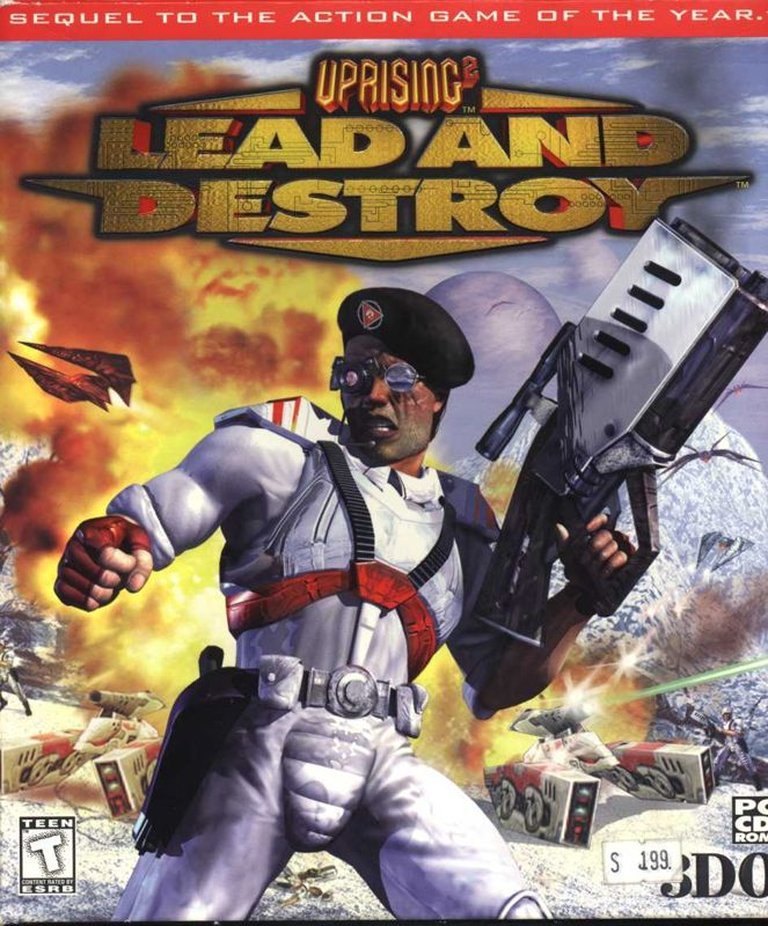
Description
Uprising 2: Lead and Destroy is a sci-fi action-strategy sequel that continues the intense conflict between humanity and the alien Kri’iSara race, on the brink of destruction, featuring improved graphics, sounds, and simplified controls over its predecessor. Blending real-time strategy with first-person and behind-view action gameplay akin to the Battlezone series, players lead forces in dynamic battles across futuristic terrains.
Gameplay Videos
Where to Buy Uprising 2: Lead and Destroy
Uprising 2: Lead and Destroy Cracks & Fixes
Uprising 2: Lead and Destroy Guides & Walkthroughs
Uprising 2: Lead and Destroy Reviews & Reception
en.wikipedia.org (67/100): packs enough fast action, deep strategy, and overall intensity to please any gamer, and that’s what really counts.
gamespot.com : While the changes to Uprising 2 are notable and (for the most part) positive, the game still manages to underwhelm because of some seemingly minor flaws.
myabandonware.com (84/100): Uprising 2 is almost identical in every respect to the original Uprising with a slightly nicer looking graphics engine.
game-over.com (83/100): Visually speaking, this game is beautiful.
Uprising 2: Lead and Destroy Cheats & Codes
PC
Press M (or Enter in some versions) during gameplay to open the chat prompt, type the code exactly, and press Enter.
| Code | Effect |
|---|---|
| DANGEROUS | Unlimited Weapons, health paks |
| STORMY | Rainy |
| WAY NO MONEY | +5000 |
| SLICK | Die |
| DONE | Win scenario |
| YOYO | Invincible |
| CLEARSKY | Clear |
| FLURRY | Snow |
| CHUMP | Invincible |
| TUFF ASS | Super weapons |
| DANGEROUS CHUMP | Unlimited weapons and invincibility |
| WAY MO MONEY | +5000 |
Uprising 2: Lead and Destroy: Review
Introduction
Imagine piloting a hulking hover-tank through fog-shrouded alien landscapes, lasers blazing as you beam in squadrons of reinforcements amid a hail of enemy fire—not from a detached overhead view, but plunged into the chaos of first-person combat. This was the revolutionary hook of Uprising: Join or Die in 1997, a genre-bending fusion of real-time strategy (RTS) and first-person shooter (FPS) that predated similar hybrids like Battlezone. Uprising 2: Lead and Destroy, released in December 1998, doubles down on that formula, polishing its predecessor’s rough edges with superior visuals and streamlined controls while thrusting players into a desperate interstellar war against the bloodthirsty Kri’iSara aliens. As a sequel, it delivers addictive, tank-commanding thrills but stumbles by feeling like a graphical facelift rather than a bold evolution. My thesis: Uprising 2 solidifies Cyclone Studios’ pioneering hybrid gameplay as a late-’90s curiosity, rewarding fans with refined action-strategy mayhem yet underscoring the challenges of sequel innovation in a post-StarCraft RTS explosion.
Development History & Context
Cyclone Studios, a small but ambitious American developer founded in the mid-’90s, helmed Uprising 2 under director John Eberhardt, associate director Chris Baena, and lead programmer Patrick MacKellar. The team of 37 credits included notable talents like “Programmer Without Portfolio” Bill Budge (Pinball Construction Set fame) and artists such as Mark Dixon and Derek A. Hauffe. Published by The 3DO Company—riding high on hits like Army Men but struggling financially—the game launched on December 9, 1998, in North America for Windows, with European release in 1999. Later re-releases by Sold Out Sales & Marketing, Tommo Inc., and Ziggurat Interactive (including modern Steam/GOG ports at $1.39) kept it alive.
The creators’ vision was clear: refine the original Uprising‘s “tank sim meets RTS” core, born from Eberhardt’s desire to immerse players directly in battles rather than omnipotent god-view. Technological constraints shaped this era—Pentium-era PCs with 32MB RAM minimum, CD-ROM drives, and 3D acceleration via 3dfx Glide only (no Direct3D support, alienating Riva TNT users). This Glide exclusivity showcased eye-candy like lens flares and dynamic skies but limited accessibility. The 1998 gaming landscape was RTS-saturated (StarCraft dominated, Total Annihilation innovated 3D), FPS-mature (Half-Life revolutionized storytelling), and hybrid-curious (Battlezone from Activision echoed Uprising‘s tank-RTS blend). Cyclone aimed to capitalize on the original’s cult appeal—poorly marketed despite innovation—but faced stiff competition. Simplified controls addressed the first game’s steep curve, while a level editor nodded to modding culture. Ultimately, Uprising 2 embodied late-’90s ambition: pushing hardware limits for immersive sci-fi warfare amid an industry chasing multiplayer frenzy and cinematic narratives.
Narrative & Thematic Deep Dive
Uprising 2 picks up post-Join or Die, where humanity’s New Alliance has toppled the Imperial oppressors, only for the ancient Kri’iSara (aka Trich)—ruthless, DNA-harvesting aliens from the original’s PlayStation port—to unleash genocidal fury. Players command the upgraded Wraith tank across 36 missions (28 in three non-linear mini-campaigns, plus eight standalone scenarios), liberating planets from citadel strongholds. The plot unfolds via radio briefings from commanders, sparse cutscenes, and mission logs, emphasizing survival against extinction: “After a century of bloody galactic battle, a horde of intelligent bloodthirsty aliens threaten to exterminate all human life.”
Characters are archetypal—faceless Alliance brass barking orders, no named protagonists beyond your silent Wraith pilot—but enemy Trich units (angular, dark infantry/vehicles) embody otherworldly menace, contrasting human forces. Dialogue is functional: terse acknowledgments like “Citadel claimed” or “Nuke inbound,” laced with urgency (“New Alliance Command is counting on you”). Themes probe humanity’s fragility post-victory—hubris invites alien apocalypse—and tactical leadership’s burden, blending Star Wars-esque rebellion with Aliens-style infestation horror. Covert ops (e.g., timed strikes) add espionage flavor, but repetition dilutes depth; non-linear campaigns allow replayability, yet the “complex conflict” promised feels surface-level, prioritizing action over branching narratives. It’s competent space opera, elevating tank skirmishes but lacking the emotional hooks of contemporaries like Homeworld.
Gameplay Mechanics & Systems
At its core, Uprising 2 loops around exploration, base-building, and assault: Scout fog-veiled maps in your invincible Wraith (lasers, missiles, shields), claim citadel pads by dropping structures via ‘F’ key (dropships deliver vulnerable towers), harvest subsurface energy with Power Buildings, then beam units (F1-F6 hotkeys: light/heavy tanks, AAVs, bombers, infantry, nukes) near hotspots for support. Unlike top-down RTS, you must lead from the front—teleporting reinforcements demands proximity, merging FPS dogfights with strategy. Combat shines: Strafe turrets, crush infantry, upgrade Wraith weapons mid-mission. Progression unlocks via bonus points for vehicle buffs (armor/weapons) and tech like BMS nukes (countered by Patriots), escalating from skirmishes to planetary conquests.
Innovations include unit micro (F-key select, spacebar attack/guard), “auto” AI hints, and unit caps (rising per mission, simulating comms upgrades—artificial but balanced). UI improvements ditch the original’s power triangle for color-coded targeting and streamlined menus, easing entry (tutorial helps). Flaws abound: Repetitive “claim all citadels” loops, predictable AI (pre-scripted bases, no enemy Wraiths, weak repairs), invisible barriers, and F-key labels’ absence (counting costs seconds). Multiplayer (2-8 players, IP/LAN/modem) adds chaos, with level editor for custom maps. It’s addictive hybrid mastery—strategy demands presence—but eases too much, lacking original’s bite.
World-Building, Art & Sound
The sci-fi setting spans diverse planets: Volcanic hellscapes, icy tundras, neon-lit nights—each with unique palettes, hills, lakes, and weather (rain, fog). Citadels pulse as organic hubs, Trich hives ooze menace, fostering claustrophobic atmospheres where horizons tease threats. Visuals dazzle via 3dfx: Lush terrain texturing, Unreal-rivaling skies, smoke trails, lens flares; units gleam (detailed tanks, blocky infantry). Draw distance fog and “gray wall” glitches mar high-end rigs, but variety combats repetition.
Sound design immerses: Dolby Surround booms tank crunches, laser zaps (irritatingly repetitive), explosions; Maurice Jackson’s audio pairs Nerve Factor’s moody synth-orchestral score, shifting from tense builds to triumphant fanfares. Radio chatter and CD audio enhance isolation, though no 3D positional audio limits immersion. Collectively, they forge pulse-pounding urgency, making every citadel siege visceral.
Reception & Legacy
Critics averaged 76% (MobyGames, 20 reviews): Gaming Entertainment Monthly (88%) hailed “exhilarating graphics” and ceaseless action; GameSpot (77%) noted positives but “underwhelm[ing]” flaws like ease and repetition; PC Games (DE, 72%) called it “Uprising Light.” GameRankings tallied 67%, praising hybrid fun (Next Generation: “fast action, deep strategy”) but slamming predictability, 3dfx exclusivity, and minimal changes (Adrenaline Vault: “merely good”). Players rated 3.3/5 (sparse). Commercial fate mirrored the original—modest sales amid 3DO’s woes, bundled in Gold Games 4.
Reputation evolved fondly among retro fans (Steam/GOG revivals), but legacy is niche: Pioneered FPS-RTS (inspiring Battlezone, Urban Assault), yet overshadowed by RTS giants. No direct successors beyond Uprising X (1998 PS1 spin-off); Cyclone folded into 3DO’s 2003 bankruptcy. Influences linger in vehicular MOBAs (Planetside 2) and hybrids (Natural Selection 2), marking it as a “what if” artifact—innovative blueprint unfulfilled.
Conclusion
Uprising 2: Lead and Destroy refines its predecessor’s bold FPS-RTS alchemy into a slick, accessible joyride—stunning visuals, intuitive beaming, and Wraith-led mayhem deliver hours of tactical euphoria across 36 missions. Yet, iterative flaws (repetition, ease, tech limits) cap its ambitions, rendering it a competent sequel rather than transcendent leap. In video game history, it carves a vital niche: Cyclone’s swansong in hybrid innovation, bridging ’90s RTS/FPS silos and foreshadowing immersive sims. Essential for genre historians and bargain-bin hunters (grab the $1.39 port), it earns a firm 8/10—a polished relic of untapped potential, forever hovering in cult firmament.