
- Release Year: 1998
- Platforms: Nintendo 64, Windows
- Publisher: Infogrames Entertainment SA, Infogrames Europe SA, Infogrames, Inc.
- Developer: Eden Studios
- Genre: Driving Simulation, Racing
- Perspective: 1st-person, Behind view
- Game Mode: Co-op, Single-player
- Gameplay: Off-roading, Rally racing, Simulation, Track racing
- Setting: Off-road, Rally stages, Real-world
- Average Score: 90/100
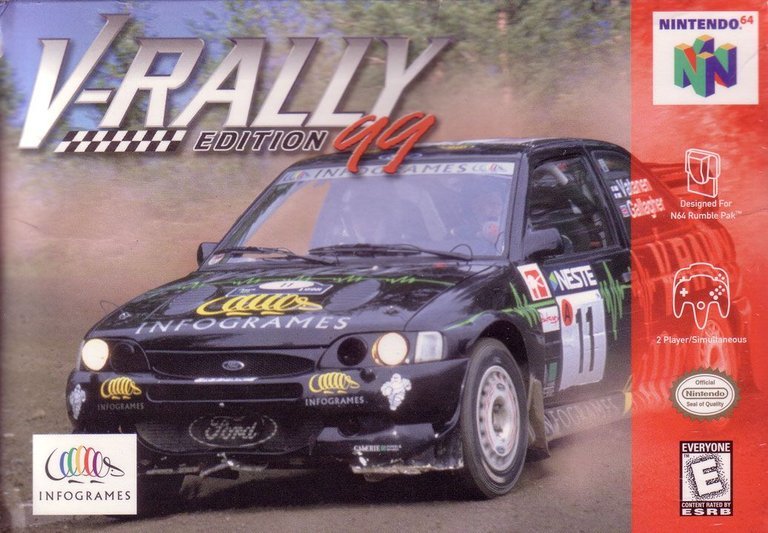
Description
V-Rally: Edition 99 is a rally racing simulation where players compete in the World Rally Championship, racing through eight countries with 12 official cars across diverse terrains including snow, mud, rain, and gravel. As a Nintendo 64 port of the original PlayStation game, it features enhanced graphics, split-screen multiplayer for 1-2 players, and immersive off-road track conditions.
Gameplay Videos
V-Rally: Edition 99 Reviews & Reception
djcube.co.uk (90/100): V-Rally is a top-quality driver.
mobygames.com : Great fun rally game to just pick up and play, but I wouldn’t call it a long lasting title you will play for hours on end.
n-europe.com (90/100): V-Rally is a top-quality driver.
V-Rally: Edition 99 Cheats & Codes
Nintendo 64
Enter button sequences at the Press Start screen or during gameplay as described, or input Gameshark codes using a cheat device.
| Code | Effect |
|---|---|
| L+R, C-Left, C-Right, L+R, START, hold Z, rapidly tap L until Cheat Mode appears | Unlocks Cheat Mode with special modes and bonus cars |
| L+R, C-Left, C-Right, L+R, then go to Options, hold Z, press L | Unlocks bonus cars |
| Push left on control stick and A+B+C-down+C-left after crash | Resets car to center of track after crash |
| 80140D1A 0070 | Unlocks all tracks |
| 80140D1F 003F | Unlocks all cars |
| 80140D28 0001 | Unlocks champion mode |
| 80140D1C 0031 | Enables expert times |
| 81020E1C 2400 | Grants infinite time |
| 81020CA8 2400 | Stops lap timer |
| D11B1F14 0000 | Unlocks cheat menu (requires Gameshark 3.0 or higher) |
| 811B1F14 00FF | Unlocks cheat menu (requires Gameshark 3.0 or higher) |
| 811D530A 04FF | Unlocks cheat menu (requires Gameshark 3.0 or higher) |
| D11B1F14 00FF | Unlocks cheat menu (requires Gameshark 3.0 or higher) |
| 811B0270 FF03 | Unlocks cheat menu (requires Gameshark 3.0 or higher) |
V-Rally: Edition 99: A Detailed Historical Review
Introduction: The Rally Port That Divided a Generation
In the late 1990s, the Nintendo 64 was a console defined by bold, colorful, and often arcade-centric experiences—Mario Kart 64, Wave Race 64, F-Zero X. Into this landscape, in December 1998 (PAL) and September 1999 (NA), arrived V-Rally: Edition 99, a port of Infogrames’ 1997 PlayStation phenomenon. It was not merely another racing game; it was a deliberate, uncompromising attempt to transplant the gritty, physics-intensive world of professional rally simulation onto a cartridge-based console whose library largely eschewed such realism. This review argues that V-Rally: Edition 99 stands as a fascinating, deeply flawed historical artifact—a game that captured the authentic spirit of the World Rally Championship with commendable breadth and ambition, yet was often undermined by the technological constraints of its platform and a control scheme so divisive it became its defining legacy. It is a game that must be understood not in isolation, but as a key bridge between European rally sim traditions and the evolving expectations of a global console audience.
Development History & Context: From Lyon to the N64 Cartridge
The lineage of V-Rally: Edition 99 begins not on the Nintendo 64, but in the development studios of Infogrames in Lyon, France. The original V-Rally (1997) was crafted by a core team of 20 developers who would later formalize as Eden Studios. Over a nearly two-year development cycle with a budget of approximately $2 million, this team built a custom engine from the ground up, as existing PlayStation development kits allegedly did not meet their needs. Their rendering approach used Gouraud shading to smooth 3D polygons, a significant technical feat for the time.
A pivotal influence was the involvement of former World Rally Champion Ari Vatanen as a technical consultant. His insights were not merely cosmetic; he provided fundamental guidance on vehicle dynamics, particularly the pronounced behavioral differences between two-wheel-drive Kit Cars and four-wheel-drive World Rally Cars. This commitment to authenticity was the game’s foundational pillar. The PlayStation original was a massive European success, selling over two million copies worldwide by late 1998 and becoming the third best-selling PlayStation game of all time in France.
The decision to port the game to Nintendo 64, materializing as V-Rally: Edition 99, was a response to the platform’s glaring lack of serious racing simulations. Developed again by Eden Studios, this was not a simple re-release. It was an “Edition 99,” updated to reflect the 1998 World Rally Championship season, featuring revised physics for “better vehicle feel and control,” new vehicles like the Toyota Corolla WRC, and redesigned menus. However, the transition to the N64’s cartridge format presented brutal constraints: a 96-megabit cartridge, the absence of in-game music during races (a stark omission), and the ever-present challenge of pop-in and draw distance issues on a console with no hard drive for streaming data. The Windows port (Multiplayer Championship Edition) later offered sharper textures and online play, but the N64 version was the console debut that carried the most historical weight, attempting to prove that a serious rally sim could thrive outside the PlayStation ecosystem.
Narrative & Thematic Deep Dive: The Story of the Stage
Unlike narrative-driven games, V-Rally: Edition 99 possesses no traditional plot, characters, or dialogue-driven story. Its “narrative” is implicit, environmental, and systemic—the story of the rally stage itself, and the driver’s mastery over it. The game’s thesis is delivered not through cutscenes, but through its very structure and presentation.
Thematically, the game is a paean to authenticity and environmental hostility. Each of the eight global locations—from the snow-laden forests of Sweden to the muddy Costa Brava of Spain, the gravel tracks of Kenya to the tarmac of Monaco—is not merely a visual backdrop but an active antagonist. The gamemanual and promotional material emphasize that “each track has its own course conditions,” and the core gameplay loop is a constant negotiation with these surfaces. Snow, mud, rain, and gravel aren’t aesthetic filters; they are fundamental variables that alter friction, braking distances, and drift characteristics. This creates a thematic through-line of adaptation and precision. The player is not a speedster but a survivor, a technician reading the road. The co-driver’s pace notes, while often cited as annoying by players, are the primary “dialogue” of the experience—a terse, urgent litany of upcoming hazards (“Right 4… over crest… jump!”) that reinforces the game’s仿真 nature.
The lack of a traditional arc is, in itself, the point. The “Championship” mode’s structure of accumulating points across multiple stages mirrors the real-world mental marathon of a WRC season. The narrative is the player’s own progression from spinning off the road in Corsica to setting a podium time in New Zealand. The licensed cars—Subaru Impreza WRC, Mitsubishi Lancer WRC, Peugeot 306 Maxi—are not just models but artifacts of engineering, each with its own “personality” dictated by drive layout and tuning potential. The game’s ultimate story is one of man (or woman) and machine versus the elements, a quiet, intense drama enacted over 40+ stages. It is a narrative of pure mechanics and environment, where the only protagonist is the player’s skill, and the only antagonist is the immutable physics of a slippery corner.
Gameplay Mechanics & Systems: A Cauldron of Simplicity and Depth
The core gameplay of V-Rally: Edition 99 is deceptively simple on paper, yet its execution reveals a system of profound depth and equally profound frustration.
Core Loops and Modes:
The game offers three principal modes, all supporting 1-2 player split-screen.
1. Arcade Mode: This is the most accessible entry point. Players race in a series of “circuits” composed of multiple laps on closed-loop track sections. The key mechanic is a credit system: start with three lives, lose one for failing a stage or missing a checkpoint, gain one for winning. It introduces competition with AI opponents on the track simultaneously.
2. Championship Mode: This is the heart of the simulation. It presents eight rallies (based on real WRC events), each comprising three “special stages” (A-to-B point-to-point runs). There are no checkpoints. Players are ranked by points awarded per stage (5 for 1st, 3 for 2nd, 1 for 3rd). A crucial sub-setting is the ability to race “against the clock” (time-trial style) or in a “V-Rally” mode where you compete directly against the AI cars’ ghost times on the stage. This mode is where the simulation’s teeth are bared.
3. Time Trial: A pure, unadulterated pursuit of the ghost on any unlocked stage.
Vehicle Dynamics & “The Slippery Slope”:
This is the game’s most notorious and defining system. The driving model is hyper-sensitive, prioritizing simulation over accessibility. The handling is frequently described in reviews as “slippery,” “floaty,” and “unrealistic,” but from Eden’s perspective, it was an attempt to model the loss of traction inherent to loose-surface rallying. The difference between two-wheel-drive (Kit Cars) and four-wheel-drive (WRC cars) is massive, as per Ari Vatanen’s consultation. The tuning menu allows players to adjust suspension stiffness, gear ratios, and understeer/oversteer sensitivity, but this depth is a double-edged sword. For the sim enthusiast, it’s a necessary toolkit to tame the beast for specific surfaces. For the casual player, it’s a bewildering array of settings that often fails to produce a “drivable” car. The fundamental criticism, echoed from GameSpot to PC Action, is that the base physics feel broken—cars spin out from minor impacts, corrections are nearly impossible, and the sense of control is perpetually precarious. This creates a brutal skill ceiling; the game is either a deeply rewarding precision challenge or an exercise in futile frustration, with little middle ground.
UI and Menu Systems:
The N64 port’s “slightly improved graphics and menus” compared to the PS1 original are noted. The menus are functional and clean, using hi-res assets, but offer limited post-race analysis—a point of criticism from German magazine Power Play, which desired more comprehensive telemetry and damage modeling for a true simulation. The on-screen display is minimal, focusing on position, time, and a co-driver icon, keeping the view uncluttered but providing scant strategic feedback.
Innovation and Flaw:
The game’s innovation was its sheer scope and uncompromising simulation on a console not known for it. However, its fatal flaw was the execution of that simulation. While competitors like Sega Rally Championship were praised for being “fun” and accessible, and later Colin McRae Rally would offer a more balanced blend of sim and playability, V-Rally stood alone in its punishing, almost ascetic, difficulty. Its “innovative” physics became its greatest liability, polarizing players and critics instantly.
World-Building, Art & Sound: A Technical Marvel and an Aesthetic Miss
Visual Direction & Atmosphere:
On the Nintendo 64, V-Rally: Edition 99 was a visual outlier. While most N64 racers opted for bright, stylized graphics (Mario Kart, Diddy Kong Racing), this port aimed for a muted, atmospheric realism. The game’s strength, universally noted by European critics (e.g., Total!, N64 Magazine), is its environmental variety and weather effects. The eight locations are distinct not just in palette but in geometry and foliage. The Sweden stages are icy and pine-dense; Kenya is dusty and savannah-like; Indonesia is lush and jungle-choked.
The most heralded technical achievement was the rain effect. As documented by retro analysts like DJcube, the rain does not use a static overlay but renders as droplets that physically move toward the camera, creating a genuine sense of driving into a storm—a rare and impressive effect on the N64. Fog on English stages and snow in the Alps further enhanced the atmospheric simulation. The game also natively supported widescreen, a forward-thinking feature.
However, these strengths were counterbalanced by the N64’s hardware limits. Pop-in of roadside objects (trees, signs, rocks) was severe and frequently criticized (CVG, GameSpot). The vehicle models, while detailed in their decals, were blocky and lacked the polygonal refinement of PlayStation counterparts. The textures on tracksides and terrain were often cited as “bland” and “ugly bitmaps” (Power Play), especially on the Windows port where higher expectations exposed the dated asset quality. The overall visual impression is one of stark, sometimes beautiful, but technically limited environments.
Sound Design:
The audio landscape is a study in functional minimalism. The engine notes are adequate, conveying speed and gear changes, but are not particularly distinctive. The most prominent and infamous audio element is the co-driver’s voice. Delivered in a rapid, monotone, and heavily accented style (varying by language), the pace notes are a necessary tool that many players found immersion-breakingly annoying. The decision to exclude in-game music during races was a conscious simulation choice, removing any potential “arcade” feel but also leaving a sometimes hollow aural space filled only by engine roar, tire scrub, and the co-pilot’s chatter. The menu music, composed by “Rhapsody,” is a generic rock/electronic track that does little to establish tone.
In totality, the art and sound design successfully create the intended atmosphere of remote, unforgiving stages, but they do so with the obvious compromises of a cartridge-based port from a CD-era original. The praise is for its ambition and specific effects (rain), while the criticism is aimed at its frequent technical ugliness and lack of polish.
Reception & Legacy: A Tale of Two Continents
The critical reception for V-Rally: Edition 99 was a stark geographic schism, mirroring the original PlayStation version’s reception.
European Critical Acclaim: In its home territory, the game was embraced. German magazine 64 Power awarded it 88%, calling it “definitely a game for perfectionists and people who are into realistic driving.” Total! (85%) and Mega Fun (83%) praised its track design, speed, and sheer number of courses, though Mega Fun noted it was “incredibly difficult” and that “technically more should have been possible on the N64.” French publication Jeuxvideo.com (80%) declared it “one of the very best racing games on the N64,” highlighting its near-simulation handling. N64 Magazine‘s legendary 90% review, quoted in retrospectives, hailed it as a “top-quality driver” that solved the N64’s drought for a serious car game. The consensus was clear: for the European audience, raised on Sega Rally Championship and with a deep cultural connection to rallying, this was a long-awaited, authentic, and rewarding masterpiece.
North American and Mixed Global Reception: Across the Atlantic, the response was muted to hostile. GameSpot‘s 48% review was scathing, condemning the “shoddy control” and advising even hard-core fans to avoid it. Electronic Gaming Monthly (55%) agreed, finding the physics “wacky and unnatural.” Computer and Video Games (60%) noted the “unrealistic slippery handling” would split gamers down the middle. The PC ports fared poorly against the rising giant of Colin McRae Rally. PC Action (57%) lamented cars that “lie like grease on the street,” and GameStar (48%) bluntly stated it had “no chance” against Colin McRae or N.I.C.E. 2. The Metacritic/GameRankings aggregates (66-68%) reflect this deep divide.
Commercial Performance & Legacy: Commercially, the story was again split. In Europe, the original V-Rally was a multi-million seller and a perennial chart-topper. The N64 port, while not reaching those heights, capitalized on the brand’s strength. In North America, it was a quiet, late release on a platform already being eclipsed by the PlayStation, and it made little impact.
Its legacy is twofold. First, as a foundational title for Eden Studios. The team responsible for V-Rally would go on to develop the better-received V-Rally 2 (1999) and V-Rally 3 (2002), refining the physics and presentation that were so contentious here. The series itself would sell millions and see a revival with V-Rally 4 in 2018. Second, as a curated snapshot of a specific design philosophy. It represents the “purist” European rally sim approach on a console dominated by American and Japanese arcade styles. Its flaws—the controls, the graphics pop-in—are now part of its historical character. Modern retrospects (like N-Europe’s) acknowledge its technical achievements for the N64 (rain, widescreen) and its incredible track count, but consistently conclude that its simulation is too archaic and unforgiving compared to modern benchmarks like the DiRT series. It is remembered not as a classic, but as a cult curio—the game that tried its hardest to be the Gran Turismo of rally on the N64, but whose most memorable feature was often the frustration it induced.
Conclusion: The Unrefined Gem of the Rally genre
V-Rally: Edition 99 cannot be easily summarized with a star rating or a simple recommendation. It is a game defined by its contradictions: a technically impressive surface hiding a deeply flawed core; a massive roster of authentic tracks undermined by a driving model many found unusable; a celebrated European hit that flopped in America.
Its place in history is secure, not as a pinnacle of its genre, but as a pivotal and passionate statement. It proved that a dedicated rally simulation was possible on the Nintendo 64, offering a breadth of content and environmental variety unmatched by any of its console peers at the time. The involvement of Ari Vatanen lent it an air of legitimacy that few games could claim. For the patient few who could adapt to its “slippery” handling, it offered a deep, rewarding, and genuinely challenging simulation of rally’s demands.
However, for the vast majority, it remains a cautionary tale. Its legacy is one of potential unfulfilled. The control scheme, arguably its most important system, was so divisive that it overshadowed every else. In the relentless forward march of game design, where iteration refines player experience, V-Rally: Edition 99 feels like a rough prototype—the brave first draft of a formula that would be perfected, ironically, by other studios (most notably Codemasters’ Colin McRae Rally) and by Eden itself in later sequels.
It is an essential game for historians and collectors, a fascinating “what if” of the N64’s library. But as a playable experience in 2024, it is best approached with lowered expectations, an appreciation for its ambition, and a high tolerance for the very real frustration that defines its infamous reputation. It is the story of a game that passionately spoke the language of rally, but in an accent so thick and a grammar so irregular that many listeners simply could not understand it.