
- Release Year: 1996
- Platforms: PlayStation, SEGA Saturn, Windows
- Publisher: Konami Co., Ltd.
- Developer: Konami Computer Entertainment Tokyo Co., Ltd.
- Genre: Role-playing (RPG), Strategy, Tactics
- Perspective: Diagonal-down
- Game Mode: Single-player
- Gameplay: Tactical RPG, Turn-based
- Setting: Fantasy
- Average Score: 80/100
Description
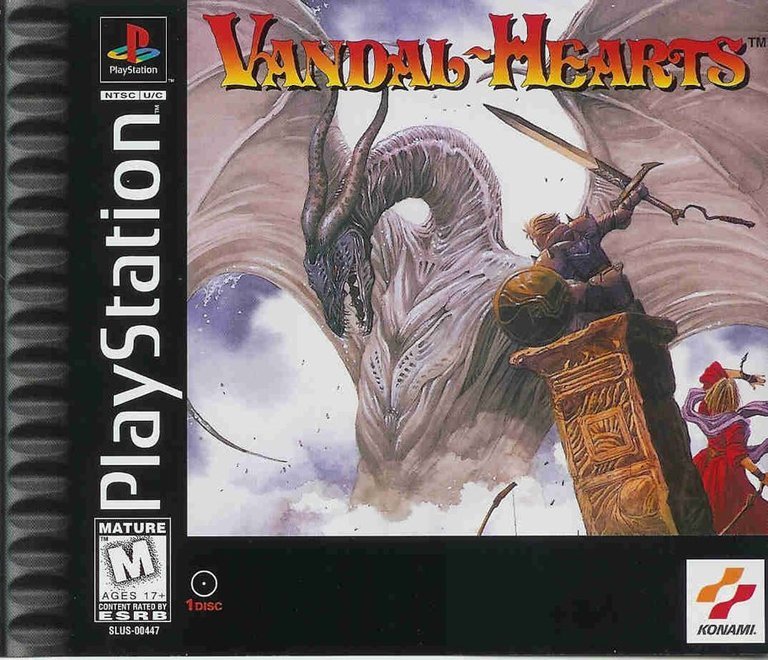
Vandal Hearts is a turn-based tactical RPG set in a medieval fantasy world where a nation, freshly liberated from a corrupt tyrannical government through a bloody revolution, begins to crumble under schemes of corruption, deceit, and greed following the mysterious disappearance of its heroic leader. Players control Ash Lambert and his Domestic Security Forces comrades, navigating strategic grid-based battles on 3D maps with obstacles, recruiting allies who advance through unique class paths like swordsmen, archers, healers, and mages, while exploring cities, purchasing equipment, and advancing a fixed plot through immersive cutscenes.
Gameplay Videos
Vandal Hearts Free Download
PlayStation
SEGA Saturn
Vandal Hearts Guides & Walkthroughs
Vandal Hearts Reviews & Reception
tgbproject.blogspot.com (77/100): Vandal Hearts is a perfect (retro) game to suggest to newcomers to the series.
reddit.com : it’s fun and the battles really make you feel like your decisions matter.
gamesfromtheblackhole.wordpress.com : Vandal Hearts – an attractive and inviting RPG with gameplay that’s simple to learn and easy to enjoy – was the perfect introduction to tactics games.
thepatientgamer.substack.com : I got hooked very quickly with the gory fights.
mobygames.com (83/100): Medieval fantasy at its best.
Vandal Hearts Cheats & Codes
PlayStation (PS1) NTSC-U
These are GameShark, CodeBreaker, or Pro Action Replay codes. Use with a compatible cheat device on a physical console or supported emulators like ePSXe.
| Code | Effect |
|---|---|
| D0122E48 0000 | Joker Command |
| 80140700 FFFF | Infinite Money |
| 8002AAB0 0000 | Level Up All Characters |
| D0122E48 000F 801405A8 0002 |
Quickly Win A Battle (Press and release L1+L2+R1+R2 during battle to win instantly) |
| 80141E24 FFFF | Infinite Money |
| 80123B28 0000 | PAL2NTSC |
| 50005402 0000 801405D6 0001 |
Have All Items (Cheat Device 2.2 Or Higher Needed) |
Vandal Hearts: Review
Introduction
In the blood-soaked battlefields of 1996 PlayStation gaming, where polygons were still finding their footing and tactical RPGs were a niche import away from mainstream stardom, Vandal Hearts erupted like a crimson geyser—Konami’s visceral entry into the strategy genre that splattered its way into cult classic status. Developed amid the 32-bit console wars, this turn-based tactical RPG thrust players into a gritty tale of post-revolutionary intrigue, where every grid-square decision could mean victory or a fountain of digital gore. As a game historian, I’ve revisited Vandal Hearts countless times, and its legacy endures not as a revolutionary titan like Final Fantasy Tactics or Tactics Ogre, but as the accessible gateway drug for Western audiences craving chess-like combat in a fantasy wrapper. My thesis: Vandal Hearts masterfully balances strategic depth with narrative punch in an era of technical infancy, cementing its place as a foundational SRPG that prioritizes tactical purity over bloat, even if its linearity and dated visuals hold it back from immortality.
Development History & Context
Konami Computer Entertainment Tokyo spearheaded Vandal Hearts (known in Japan as Vandal Hearts: Ushinawareta Kodai Bunmei, or “Lost Ancient Civilization”), with a team of 33 credited talents including scenario and map designer Nobuya Nakazato, character designer Hiroshi Kyomasu, and sound effect maestro Akira Yamaoka—fresh off early Konami projects and later legends like Silent Hill. Published by Konami Co., Ltd., the PlayStation original launched October 25, 1996, in Japan, hitting North America on March 27, 1997, and Europe June 1, 1997. Ports followed: Sega Saturn (Japan-only, November 27, 1997, by Konami Computer Entertainment Nagoya, adding cutscenes and multiple endings) and Windows (Japan/Korea, 1998, with Direct3D support).
The era’s technological constraints shaped its vision: PlayStation’s 3D capabilities allowed rotatable isometric battlefields with polygonal terrain, but 2D sprites for characters kept costs low and animations fluid— a hybrid approach echoing Shining Force but with PS1 flair. Konami aimed for a “chess-like” strategy focus over exploration-heavy RPGs, stripping away grinding for fixed battles to emphasize plot-driven tactics. Amid a landscape dominated by Final Fantasy VII‘s hype and imports like Ogre Battle (1993 JP), Vandal Hearts was Konami’s bid to Westernize SRPGs post-Suikoden. No massive budget like Square’s, but smart reuse of battle engines for cutscenes maximized impact. A planned Nintendo DS sequel in 2004 was canned, underscoring Konami’s shifting priorities, yet the game’s DNA lived on in Vandal Hearts II (1999) and the PSN/XBLA prequel Flames of Judgment (2010).
Narrative & Thematic Deep Dive
Plot Overview
Set on the continent of Sostegaria, Vandal Hearts unfolds across six chapters in the fledgling Republic of Ishtaria, born from Arris the Sage’s revolution against the tyrannical Holy Ashah Dynasty 15 years prior. Arris vanishes post-victory, leaving a power vacuum exploited by corrupt officials like Minister of Defense Hel Spites and his Crimson Guard. Protagonist Ash Lambert, platoon leader in the Domestic Security Forces (DSF), investigates General Magnus Dunbar’s disappearance alongside comrades Clint Picard and Diego Renault. What begins as a missing persons case spirals into a conspiracy involving magical artifacts—the titular Vandal Heart sword, Flames of Judgment, and time-warping limbo realms—culminating in coups, betrayals, and Emperor Hel’s rise.
The linear structure delivers escalating twists: temporary alliances shatter (e.g., with Dolf), “good” characters reveal ulterior motives, and time travel inserts like Zohar Abu Sa’id’s ancient wizardry add surreal depth. Endings vary slightly by Saturn version, but the core arc ends with Ash’s disappearance, empire collapse, and epilogues for survivors like Eleni’s journal or Clint leading the DSF.
Characters and Dialogue
Up to 12 recruitable allies flesh out the roster, each with backstories tying into war’s scars: Ash grapples with his traitorous father’s legacy; orphan Eleni seeks adoptive father Magnus; mercenary Kira Wulfstan risks recklessly; drunken sailor Grog Drinkwater drowns pirate-induced grief. Supporting cast like Dolan, Amon, Sara, and Huxley add personal stakes—romantic tensions, pessimism, mentorship. Dialogue, voiced sparingly (narrator only), is menu-driven in towns, blending exposition with sarcasm. Lines like Clint’s cautious barbs or Diego’s carefree quips humanize them, though writing feels archetypal by modern standards.
Themes
Vandal Hearts probes revolution’s double edge: democracy crumbles into authoritarianism, echoing French Revolution/Nazi parallels (Crimson Guard evokes SS imagery). Corruption, greed, bravery, and revenge dominate—artifacts amplify inner demons, time limbo forces reckonings. Unlike FFT‘s moral ambiguity, it’s straightforward heroism amid “grim and smooth” tragedy (GameCritics.com), with post-credits showing rebuilt lives underscoring fleeting victory. Brutal, politically charged for 1996, it prioritizes emotional arcs over player agency.
Gameplay Mechanics & Systems
Core Loops and Combat
Turn-based on rotatable 3D grid maps (trees, rivers, bridges as obstacles), player units move first in side-by-side turns. Victory: rout enemies, assassinate bosses, escort NPCs, defend towers, or survive turns. Leader Ash’s death = instant loss; others penalize gold (finite resource). No grinding—fixed battles demand positioning, prediction. Combat mimics rock-paper-scissors: Swordsmen/Armors beat Archers; Archers beat Hawknights; Hawknights beat Swordsmen; Mages shred Armors; Monks/Clerics heal variably.
Progression and UI
Seven base classes (Swordsman, Archer, etc.) promote at Lv10 (branching: Archer → Bowman/Hawknight) and Lv20/40 (linear). Ash unlocks secret “Vandalier” via hidden chapter battles (obscure items/secrets). Equipment: weapons/armor/headgear from shops/chests; items for consumables. UI is menu-heavy—towns offer shop, dojo (promotions), tavern (dialogue), items/save. Clunky item transfers and no mid-battle grinding frustrate, but savestates mid-battle aid retries. AI targets low-HP relentlessly, forcing chokepoints; counterattacks add risk. Replay via class experiments, no-death runs, secrets.
Innovations/Flaws: Pioneering 3D terrain elevates strategy (height advantages); gore feedback satisfies. Flaws: linearity kills exploration; easy post-Lv20; boss HP underwhelms; wait-heavy enemy turns.
World-Building, Art & Sound
Sostegaria feels war-torn: isometric PS1 visuals blend polygonal maps (rotate for scouting) with detailed 2D sprites—promotions refresh designs (e.g., Hawknights fly). Gritty medieval aesthetic: crumbling republics, pirate-infested seas, limbo dimensions. FMV chapter intros and blood-splatter deaths amplify immersion; dated polygons/textures age poorly but evoke era charm.
Sound shines: Yamaoka’s visceral clashes (swords, spells, gore geysers); orchestral BGM (Hiroshi Tamawari, Miki Higashino) fits melancholy battles (“Warlock,” “Harbor City Ports”). Croatian intro song (US), narrator adds gravitas—minimal voicework suits austerity.
Reception & Legacy
Launch acclaim averaged 83% critics (MobyGames), 7.8/10 players: EGM’s Game of the Month (86%), Strategy Runner-Up; Video Game Critic 100%; GameSpot 71% (linear “fatal flaw”). Praised addictive tactics, story, spectacle; dinged graphics, no replay beyond classes/secrets. Commercial: Solid PS1 seller (#140 ranked), cult hit sans ads—borrowed via friends (blogs recall).
Reputation evolved: “Vanilla SRPG” (TGB Project, 72/100) for newcomers; gateway rivaling Shining Force. Influenced Konami’s SRPG push (VH2, prequel); early Western SRPG wave pre-FFT (1998). Trivia: MGS Easter egg; ports enhanced Saturn. Cult endures—Reddit lauds gore/story; modern plays (Patient Gamer 7/10) praise aging grace.
Conclusion
Vandal Hearts distills tactical RPG essence—strategic euphoria, revolutionary tragedy, satisfying splatter—into 20-25 addictive hours, flaws like linearity notwithstanding. A Konami underdog bridging 16-bit tactics (Fire Emblem) and PS1 epics, it hooked generations despite no innovations, proving fundamentals age best. Definitive verdict: Essential historical artifact, 8.5/10—play for pure, bloody strategy bliss; its heart beats eternal in SRPG history.