
- Release Year: 2007
- Platforms: Windows
- Publisher: Alten8 Ltd.
- Genre: Action
- Perspective: Top-down
- Game Mode: Single-player
- Gameplay: Arcade
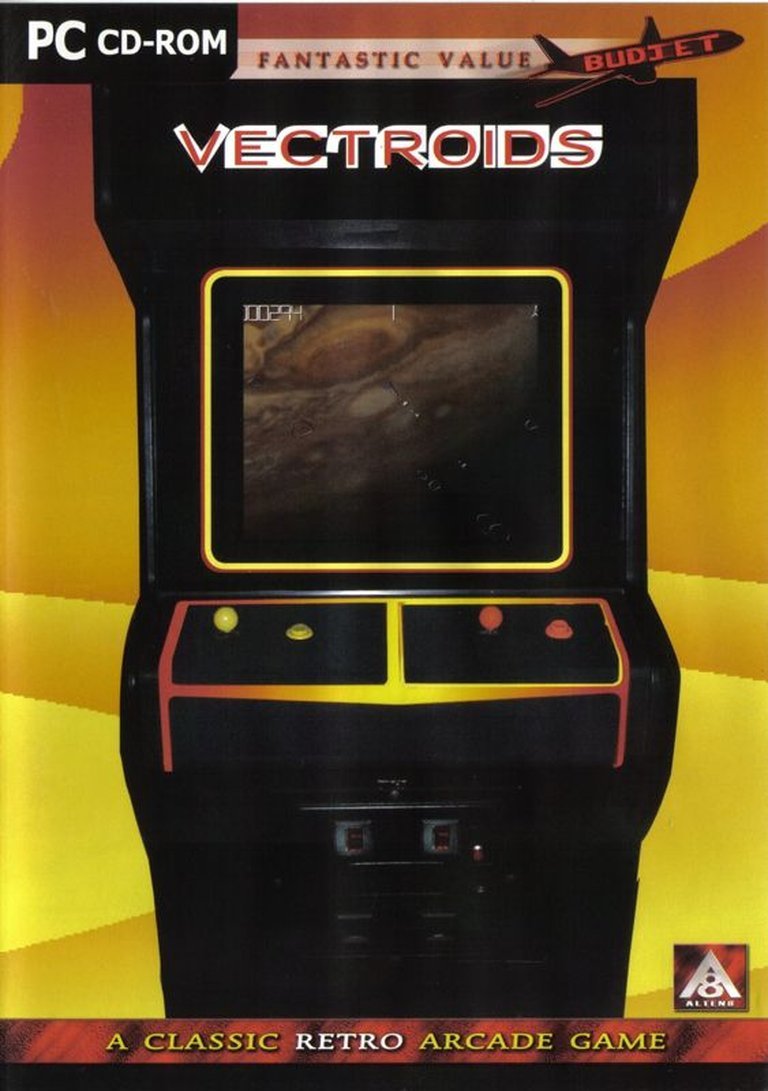
Description
Vectroids is an action arcade game released in 2007 for Windows, serving as a commercial upgrade of the freeware title Vectoroids, which placed third in the SDL Game Programming Contest in 2002. Players pilot a spaceship in a vector-based environment, destroying asteroids and avoiding collisions while navigating through space, adhering to the classic Asteroids-style gameplay mechanics in a commercial package.
Vectroids: Review
Introduction
In the vast cosmos of video game history, certain titles emerge as humble yet fascinating artifacts of their time—games that embody the spirit of experimentation and genre refinement without achieving mainstream celebrity. Vectroids, a 2007 commercial release from Alten8 Ltd., stands as precisely such a title. Born from the fertile ground of the freeware scene and the SDL Game Programming Contest, this Windows-exclusive title represents a meticulous, if unheralded, iteration on the seminal Asteroids formula. While it may lack the narrative depth or technological spectacle of its more famous contemporaries, Vectroids serves as a compelling microcosm of early-2000s indie game development—a testament to the enduring appeal of arcade purity in an era increasingly dominated by bloated triple-A productions. This review deconstructs Vectroids not merely as a game, but as a historical artifact, examining its DNA, context, and legacy within the broader tapestry of video game evolution.
Development History & Context
Vectroids emerged from the intersection of two significant 2000s trends: the rise of indie game development via digital distribution and the legacy of arcade classics. The game is a commercial adaptation of Vectoroids, a freeware title that placed third in the January 2002 “SDL Game Programming Contest.” SDL (Simple DirectMedia Layer) was a cross-platform development toolkit crucial for indie creators in the pre-Steam era, enabling small teams to create games with minimal resources. Alten8 Ltd., the publisher, specialized in resurrecting obscure freeware projects for commercial release, capitalizing on the growing market for accessible, budget-priced PC games.
Technologically, Vectroids operated within the constraints of early-2000s Windows gaming. Released on CD-ROM, it relied on basic 2D vector graphics—a nod to its Asteroids heritage—and eschewed the 3D polygonal revolution that defined the era’s consoles. This choice was both a limitation and a deliberate artistic statement, harking back to the minimalist ethos of 1979’s Asteroids. The gaming landscape at the time was marked by the dominance of established franchises and the nascent rise of digital platforms like Steam. Vectroids occupied the margins of this ecosystem, appealing to nostalgia seekers and purists of the arcade shooter genre. Its release coincided with the tail end of the sixth console generation (PlayStation 2, Xbox), where polygonal 3D reigned, making Vectroids a deliberate anachronism—a digital artifact preserving the purity of a bygone era.
Narrative & Thematic Deep Dive
Like its progenitor Asteroids, Vectroids presents a narrative of pure abstraction. There is no protagonist, no antagonists, and no contextual lore. The player controls a lone spaceship adrift in an asteroid field, with the sole objective of survival and high scores. This minimalist approach is not a deficiency but a thematic strength. The game embodies the “endless confrontation” motif of classic arcade titles, where conflict is existential and victory is fleeting. The asteroids—massive, indestructible boulders and smaller fragments—serve as the primary antagonists, their chaotic patterns mirroring the unpredictable nature of space itself.
Dialogues are nonexistent, replaced by the visceral language of gameplay: the hum of the ship’s thrusters, the percussive blast of lasers, and the shattering cry of destroyed asteroids. This absence of explicit narrative forces players to project their own interpretations onto the experience. Is the player a defender of humanity? A desperate scavenger? Or merely a participant in an abstract, eternal dance between order and chaos? The game’s themes revolve around perseverance against overwhelming odds and the cathartic satisfaction of mastering a system. In a medium increasingly obsessed with cinematic storytelling, Vectroids offers a radical counterpoint: a narrative distilled to its most primal elements, where meaning is forged in the crucible of play.
Gameplay Mechanics & Systems
Vectroids adheres rigidly to the Asteroids blueprint, but with subtle refinements that reflect its contest-winning origins. The core loop is deceptively simple: pilot a triangular spaceship, rotate and thrust to navigate, and shoot asteroids to break them into smaller, more dangerous fragments. Destroying all asteroids advances the player to the next, increasingly challenging wave. The controls are precise but unforgiving—momentum conservation means players must master counter-thrust to avoid drifting into oblivion.
Innovations are subtle but significant. The freeware Vectoroids introduced power-ups like temporary shields and rapid-fire lasers; Vectroids expands this with “bonus asteroids” that grant score multipliers or temporary invincibility. The scoring system rewards precision—hitting smaller fragments yields higher points—encouraging risk-reward gameplay. Lives are limited, and collision with an asteroid or a fragment results in instant death, heightening tension. The UI is minimalist, displaying only the score, lives, and wave number, a stark contrast to the HUD-heavy design of contemporary games.
Flaws stem from its fidelity to the formula. The lack of progression beyond escalating difficulty may feel repetitive for modern audiences, and the absence of online multiplayer or leaderboards limits its replayability compared to arcade classics. Yet these constraints are part of Vectroids’ charm. It is a game of pure skill, unfettered by extraneous systems—a digital distillation of arcade purity.
World-Building, Art & Sound
Vectroids’ world is one of sublime abstraction. The setting is a featureless void, punctuated only by geometric asteroids and the player’s ship. This minimalist design evokes the cold, indifferent vastness of space, focusing attention on the immediate dance of survival. The vector graphics—crisp, monochrome lines against a black background—are a deliberate homage to 1970s arcade aesthetics. Asteroids pulse with a faint glow, and explosions are rendered as expanding circles of light, creating a hypnotic, almost hypnotic visual rhythm.
Sound design is equally sparse yet effective. The ship’s thruster emits a low, continuous hum, punctuated by the sharp pew of lasers and the percussive crack of asteroid destruction. These beeps and boops are not merely audio cues but the game’s primary emotional language, conveying tension, precision, and catharsis. The absence of music is notable, allowing the mechanical sounds to dominate, reinforcing the game’s focus on tactile, unadorned gameplay. Together, the art and sound create an atmosphere of austere elegance—a digital canvas where the player’s actions are the only brushstrokes.
Reception & Legacy
Upon release, Vectroids arrived with little fanfare. Commercially, it was a niche product, overshadowed by AAA juggernauts like Halo 3 and The Legend of Zelda: Twilight Princess. Critical reception was sparse, with most reviews acknowledging its faithfulness to the Asteroids formula but questioning its relevance in a gaming landscape dominated by 3D graphics and complex narratives. MobyGames lists no critical reviews, and player reviews remain absent, suggesting the game failed to make a significant cultural impact.
Yet its legacy is more nuanced. As a commercial adaptation of an award-winning freeware title, Vectroids exemplifies the early 2000s trend of indie games achieving wider distribution through publishers. It stands as a precursor to the modern “remake” culture, where classic formulas are revisited with modern sensibilities. Though it never spawned a franchise, its DNA persists in the wave of indie arcade shooters that followed, such as Geometry Wars. Historically, Vectroids is a footnote—a reminder of the era’s fascination with digital preservation and the enduring power of minimalist design. It is a game that time forgot, yet one whose purity resonates with players seeking refuge from the complexity of modern gaming.
Conclusion
Vectroids is a paradox: a commercial artifact of a freeware contest winner, a relic of arcade simplicity in an age of cinematic excess, and a game whose brilliance lies in its limitations. It eschews narrative and spectacle for the timeless appeal of pure, unadorned gameplay. While it may never be remembered alongside genre-defining titles, Vectroids occupies a unique space in video game history—a testament to the potency of the Asteroids formula and the ingenuity of early indie developers. In a world saturated with bloated productions, Vectroids serves as a poignant reminder that sometimes, the most enduring experiences are the simplest. For historians and purists, it is a gem worth unearthing—a small ship in a vast asteroid field, forever carving its path through the annals of gaming history.