
- Release Year: 2013
- Platforms: Linux, Macintosh, Ouya, Windows
- Publisher: Locomalito
- Developer: Locomalito
- Genre: Action
- Perspective: Top-down
- Game Mode: Co-op, Single-player
- Gameplay: Arcade, Flag capture, Score attack, Wave-based
- Setting: Futuristic, Sci-fi
Description
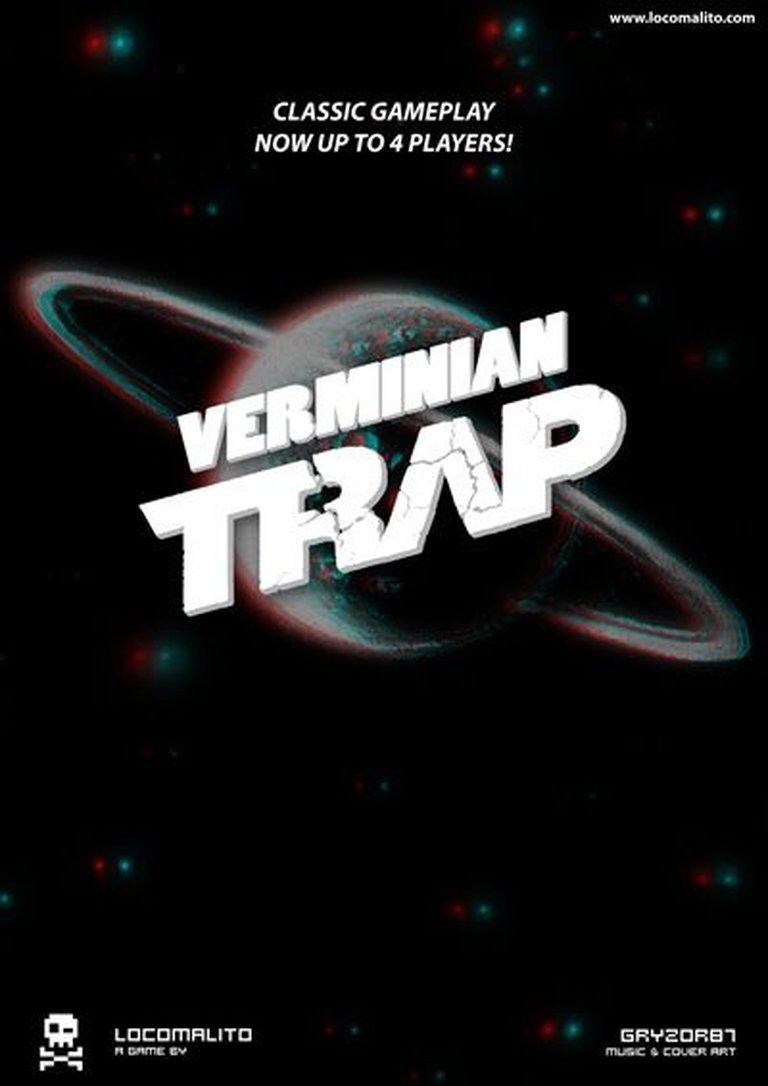
Verminian Trap is a retro single-screen arcade shooter where players, after their space pod crashes on the hostile Verminian Quarantine Zone, must survive endless waves of giant insect enemies across six challenging locations. Supporting 1-4 players in cooperative or competitive modes, this sci-fi game draws inspiration from early 1980s arcade classics with its top-down perspective and fast-paced action.
Verminian Trap Free Download
Verminian Trap Reviews & Reception
rgcd.co.uk : Overall, I was left very disappointed with Verminian Trap.
Verminian Trap: A Cortege of Cosmic Crickets and Cooperative Chaos
In the sprawling, digital equivalent of a well-stocked retro game museum, few contemporary artisans curate their exhibits with the passionate authenticity of Juan Antonio Becerra Vilchez, better known as Locomalito. His oeuvre is a loving, often brutally challenging, homage to the 8-bit and 16-bit eras. Against this backdrop, Verminian Trap (2013) emerges not as a sprawling epic like Hydorah or a gothic platformer like Maldita Castilla, but as a focused, razor-sharp fragment of arcade design. It is a game that strips the cooperative shooter down to its foundational elements—a single screen, waves of enemies, and the frantic, friendship-testing scramble for points—and infuses it with a distinct insectile menace. This review will argue that Verminian Trap is a masterclass in constrained, multiplayer-centric design that perfectly captures the spirit of early ’80s arcade cabinets, even if its single-player experience proves as fleeting as the rescuers promised in its narrative.
Development History & Context: A Prototype’s Evolution
Verminian Trap was born from a rapid development cycle. According to developer notes and retrospective coverage, its core prototype was built in a single afternoon for the RetroMadrid event. This origin story is crucial; it explains the game’s purity of design. There is no bloat, no narrated story sequences, no extraneous systems. It is the essence of a game idea, polished to a sheen. The full release came just months later, in September 2013, for Windows, Mac, Linux, and later the OUYA, all as freeware—a hallmark of Locomalito’s philosophy during this period.
The technological constraints were self-imposed artistic choices. Built using GameMaker, the game runs at a base resolution of 320×240 pixels with a restricted 32-color palette. This is not a limitation of the engine but a deliberate aesthetic directive, mimicking the visual restrictions of early arcade hardware like the Namco Pac-Man or Williams Defender boards. The sound design, handled by the ever-reliable Javier García (Gryzor87), utilizes FM synthesis (YM2203 emulation) and DPCM samples, directly channeling the chiptune and punchy sound effects of 1983. This technological modesty is a statement: the focus must be on pure gameplay.
The gaming landscape of 2013 was seeing a strong independent “retro revival,” but much of it was pastiche or metafiction. Verminian Trap stands apart by avoiding ironic distance. It is not a game about old games; it is a game that sincerely is an old game, transplanted into a modern context with impeccable polish. It arrived alongside other Locomalito classics like Gaurodan and as a sequel/spinoff to the 2012 shoot-’em-up They Came from Verminest, establishing the “Verminian” universe—a sci-fi setting where Earth is invaded by a hostile, insectoid species from the planet Verminest. This game, however, shifts the perspective from a side-scrolling shooter to a tactical, top-down maze battle, showcasing the versatility of its fictional setting.
Narrative & Thematic Deep Dive: SOS from a Silent Screen
Narrative in Verminian Trap is not delivered through cutscenes or dialogue but through environmental storytelling and paratext. The backstory, provided in the official description and promotional materials, is stark: a space pod has crash-landed in the “Verminian Quarantine Zone,” a decidedly hostile territory. The survivors’ only hope is to survive long enough for a rescue unit that may never come.
This framing creates a potent, grim subtext to the arcade action. The players are not soldiers on a glorious mission; they are desperate, stranded prey. The endless waves of enemies are not a sport but a relentless, biological siege. The six selectable locations—Deadly Plains, Night Swamp, Deep Jungle, North Mountains, Black Canyon, and Forgotten Tomb—function as a progression into deeper, more dangerous sectors of the alien planet. Their increasing difficulty isn’t just a game balance curve; it’s a narrative descent into the heart of the Verminian infestation.
Thematically, the game explores isolation vs. camaraderie and the futility of resistance against overwhelming odds. In cooperative mode, players are literally in the same screen-space, forced to coordinate attacks and share scarce power-ups, forging a fragile alliance against a common enemy. Yet, as the RGCD review brilliantly notes, this cooperation is inherently unstable. The mechanics of friendly fire (stunning and dropping power-ups) transform the game into a social experiment. The underlying theme becomes the fragility of human solidarity under pressure—how quickly a cooperative struggle mutates into competitive betrayal. The cute, stun animation for hitting a teammate underscores this tragicomic tension: the violence is cartoonish, but the interpersonal rupture it causes is real. The game posits that in a true “trap,” the most dangerous variable may not be the external enemy, but the other humans in the cage with you.
Gameplay Mechanics & Systems: The Elegance of the Arena
At its core, Verminian Trap is a single-screen, top-down arena shooter. The “maze” is usually a labyrinth of simple walls, but it functions more as a constrained arena for tactical positioning. Players control a small humanoid character (the “spaceman”) who can move in eight directions and shoot a single, straight projectile. This limitation is fundamental to the design, demanding careful positioning and timing rather than run-and-gun agility.
The game is structured around three distinct modes, each altering the social contract:
1. Arcade Game (Cooperative): The purest test of survival. Players share a global health pool? No—each player has their own health, but the goal is collective: survive as long as possible and achieve a high score. Enemies spawn in waves that increase in number and difficulty. This mode demands coordination, awareness of teammates’ positions to avoid friendly fire, and strategic retrieval of dropped power-ups (like faster shooting, shields, or bombs).
2. Capture 10 Flags: A competitive mode where a flag sporadically appears on the map. The first player to touch it scores a point and the flag respawns elsewhere. This injects a frantic, territorial scramble into the enemy-clearing routine, turning the shared threat into a backdrop for a frantic point-capture race.
3. Reach 1000 pts: Another competitive mode where points are scored primarily by killing enemies (with different enemies providing different values). The first to the target wins. This shifts the focus to efficient enemy elimination and potentially “stealing” kills from teammates, maximizing PvP conflict.
The six locations are more than cosmetic skins. While the base layout is similar, each introduces new hazards or enemy types. The Night Swamp likely features obscuring fog or darkness; the Forgotten Tomb may have traps. The design philosophy is one of graduated complexity, a common arcade trope (seen in Galaga‘s stage variations or Pac-Man‘s maze changes) used to steadily increase cognitive load and challenge.
The progression system is purely score-based and ephemeral. There is no persistent character progression, unlockable content, or story advancement. The game’s “length” is famously short—around 10 minutes for a skilled run to the hardest waves. This is not a flaw but a feature: it encourages multiple, quick sessions focused on mastering the system and besting friends’ scores. The high-score table is the only legacy.
A key innovative, and socially volatile, mechanic is the friendly fire stun. Shooting a teammate doesn’t cause damage but freezes them for a second, causing them to drop any collected power-ups. This single rule transforms the game dynamics. In theory, it prevents griefing (you can’t kill teammates). In practice, it creates a tactical griefing economy. You can disable a rival competitor in Capture Flags or Reach 1000 pts, making them vulnerable to enemies or forcing them to lose a useful power-up. In Arcade mode, it’s a catastrophic mistake that can cascade into a team wipe. This mechanic is the spark that ignites the “unofficial death-match” described by the RGCD review, proving that the most engaging system can be one that empowers players to undermine each other.
World-Building, Art & Sound: A Deliberately Austere Alien Menace
The visual presentation is a masterclass in evocative minimalism. The 32-color palette is dominated by murky greens, browns, and blacks for the environments, making the player characters (in distinct colors for 1-4 players) and the Verminian insects pop with urgency. The enemies are simple, often single-color sprites—beetles, spiders, praying mantises—but their animation is surprisingly fluid and menacing for the resolution. The “cute” stun animation for players is a charming, cartoonish counterpoint to the grim setting.
The art direction reinforces the “trap” feeling. The single-screen mazes feel claustrophobic. The lack of scrolling means the entire threat is visible at all times, creating a sense of inescapable pressure. The six location themes are conveyed through subtle palette swaps and minor sprite changes (e.g., different rock formations in North Mountains, tomb motifs in Forgotten Tomb), not through complex tilesets. This austerity is a direct homage to the memory limitations of 1983 arcade boards, where a handful of colors had to define an entire world.
Sound design is where Gryzor87’s talent shines, even with its deliberate FM synthesis limitations. The soundtrack is minimalist, often just a pulsing, tense bassline or a haunting melody that underscores the desperation, rather than a driving, energetic track. This is a significant departure from the soaring, heroic scores of Hydorah or Maldita Castilla. Here, the music is atmospheric, supporting the theme of isolation. The sound effects, however, are perfection: crunchy blaster shots, satisfying plinks when enemies are hit, and the distinctive bonk and comical squeak of stunning a teammate. These audio cues are critical for situational awareness in the chaotic multiplayer moments.
The atmosphere is thus one of tense, retro-futuristic dread. It’s less Aliens and more The Last Starfighter‘s bug planet—a cheap, video-gamey representation of an alien threat that feels authentic to its era. The combination of drab, hazardous environments and bright, player-controlled sprites creates a clear visual hierarchy: you are the bright, fragile hope in a dark, crawling world.
Reception & Legacy: The Cult of the Local Multiplayer Gem
Formal critical reception for Verminian Trap is virtually non-existent on aggregators like Metacritic, which lists no critic reviews. Its MobyGames score is “n/a,” and only 5 players have “collected” it on that database as of the latest data. This is the story of most Locomalito titles: they exist in a vibrant ecosystem of indie retro blogs, word-of-mouth, and dedicated retro gaming communities, bypassing mainstream press entirely.
Within that community, the reception is deeply polarized but passionate. The RGCD repost of J. Monkman’s review is the most cited contemporary批评. It praises the game’s “Wizard of Wor retro feel” and its explosive potential as a four-player party game with beer. It explicitly states that the game “evolves” into a PvP bloodbath, highlighting the emergent gameplay as its core strength. Conversely, the Retro Spirit Games review delivers a scathing critique, finding the single-player experience “repetitive and actually quite dull,” with “drab” graphics and a lack of engaging music. This divergence is the key to understanding the game: its genius is almost entirely unlocked through local multiplayer.
Its commercial model—freeware distribution directly from the developer’s site—ensured it reached its target audience: enthusiasts of hardcore, local co-op/competitive games. Its release on the OUYA was a smart move, tapping into that console’s early focus on indie and retro titles. The game’s legacy is twofold:
1. As a pinnacle of constrained design: It demonstrates that profound depth and social dynamism can emerge from a single-screen, two-button control scheme. It is a direct descendant of the arcade cabinet mentality where the hardware limitations defined the creative challenge.
2. Within Locomalito’s “Verminian” saga: It successfully translates the Verminest threat into a new gameplay genre (maze shooter), expanding the universe’s palette beyond shoot-’em-ups. It sits chronologically between They Came from Verminest and Death Came from Verminest, acting as a tactical side-story.
Its influence is subtle but present in the thriving indie scene of “couch co-op” and “arcadey” competitive games. Titles like Sportsfriends or Nidhogg explore similar emergent PvP dynamics from simple rules. Verminian Trap stands as an early, pure example of how a free, focused game can build a lasting cult reputation through sheer, unadulterated gameplay integrity.
Conclusion: A Fleeting, Fierce Masterpiece
Verminian Trap is not for everyone. It will not hold your hand. Its narrative is a sentence. Its visuals are a study in 8-bit austerity. Its single-player mode is a brief, tense warm-up. But gather three friends on a couch, hand them controllers, and set the screen to Arcade mode on Black Canyon, and you will experience something magical. You will witness the spontaneous combustion of cooperation into chaos, the howls of laughter and betrayal over a stunning, pixelated spaceman. You will feel the squeeze of the “trap” as the screen fills with alien chitin and the panic of trying to grab a power-up before your “ally” freezes you and steals it.
In the pantheon of video game history, Verminian Trap will not be listed among the genre-defining giants. It will not be taught in universities for its narrative or technological breakthroughs. Instead, its place is secure in the lowercase canon of perfect party games—the titles that exist to be played, shared, and remembered in smoky rooms or crowded living rooms. It is a testament to the enduring power of the arcade ideal: simple rules, deep play, and the human element as the ultimate unpredictable variable. Locomalito and Gryzor87 didn’t just make a game; they crafted a social catalyst in the form of a free, 10-minute download. For that singular, brilliant purpose, Verminian Trap is an unqualified, enduring success.
Final Verdict: 8/10 – A fiercely intelligent, brutally minimalist arena shooter that transforms from a routine retro exercise into a legendary social experience with friends. Its single-player campaign is forgettable, but its multiplayer legacy is permanent.