
- Release Year: 2011
- Platforms: Windows
- Publisher: I-play, S.A.D. Software Vertriebs- und Produktions GmbH
- Developer: Zagrava Games Studio
- Genre: Puzzle, Tile matching puzzle
- Perspective: 1st-person
- Game Mode: Single-player
- Gameplay: Exploration, Hidden object, Point and select, Real-time, Tile matching
- Setting: Fantasy, Tropical Island
- Average Score: 70/100
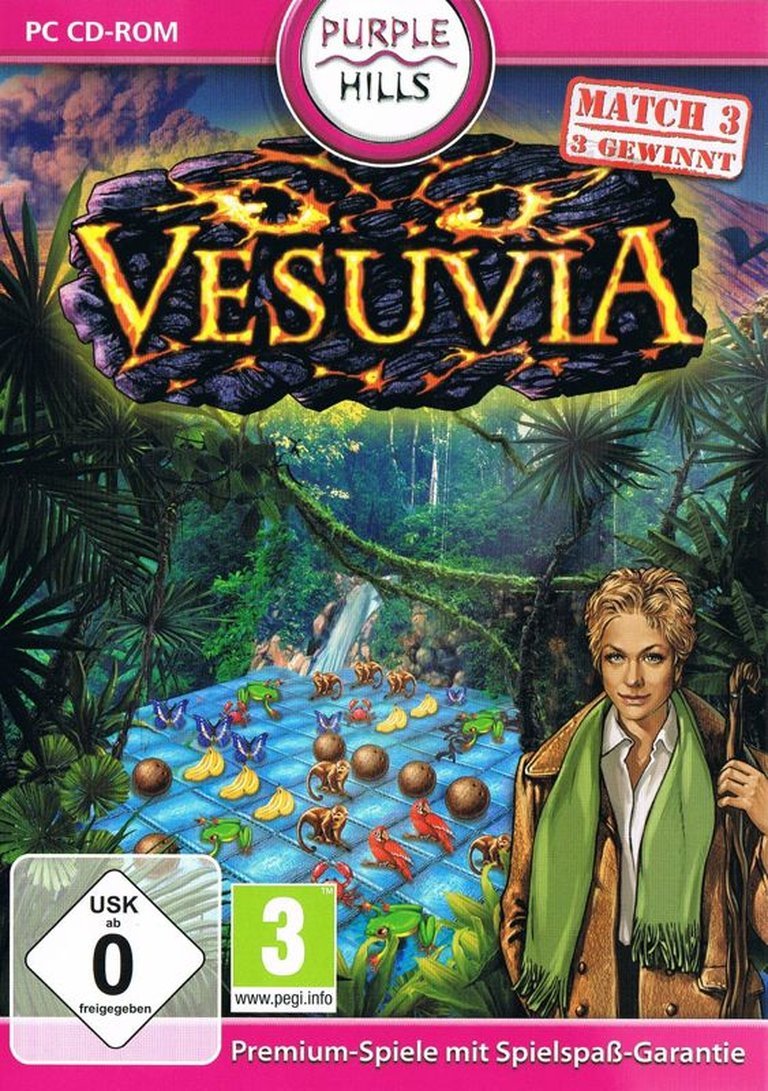
Description
Vesuvia is a ‘match 3’ tile-matching puzzle game with adventure elements, set on a mysterious tropical island. The player takes on the role of Jake, who must navigate the island, solve puzzles, and uncover the secrets of his surroundings. The gameplay involves matching tiles to explore the environment, collect hidden items, and overcome obstacles, all while unraveling a compelling narrative through journal entries and voice-acted cutscenes.
Vesuvia Free Download
PC
Vesuvia Guides & Walkthroughs
Vesuvia Reviews & Reception
killerbetties.com : Vesuvia is not a game to buy. Try the demo first and ask yourself after an hour of it if you will still like it after playing the same type of matching repeatedly for ten hours or more.
gamezebo.com (70/100): Vesuvia offers innovative match-3 gameplay as you explore a cursed island.
Vesuvia Cheats & Codes
PSP
Go to ‘My WWE’ -> ‘Options’ -> ‘Cheat Codes’ and enter the codes.
| Code | Effect |
|---|---|
| SLURPEE | Unlock John Cena Street Fight gear and Avatar T-Shirt |
| apexpredator | Unlock Randy Orton Alternate Attire |
| 8thannualtribute | Unlock ‘Tribute to the Troops’ arena |
| historicalbelts | Unlock Cruiserweight, Hardcore, & Million Dollar Championship Belts |
| QWERASDFZXCV | Unlock Goldust |
| QWERTYUIOPA | Unlock Masked Kane |
| OPENTHEROCK | Unlock The Rock |
PS2
Go to ‘My WWE’ -> ‘Options’ -> ‘Cheat Codes’ (codes are case-sensitive).
| Code | Effect |
|---|---|
| HISTORICALBELTS | Unlock all Championship Belts |
| APEXPREDATOR | Unlock Randy Orton’s alternate attires |
| SLURPEE | Unlock John Cena’s attires and entrance |
| 8THANNUALTRIBUTE | Unlock ‘Tribute to the Troops’ arena |
| THEGREATLEGENDSTONE | Unlock The Rock |
PS3
Go to ‘Cheat Codes’ section in-game and enter the codes.
| Code | Effect |
|---|---|
| SLURPEE | John Cena Street Fight gear and Avatar T-Shirt |
| 8thannualtribute | Unlock ‘Tribute to the Troops’ arena |
| apexpredator | Unlock Randy Orton Alternate Attire |
| historicalbelts | Unlock Hardcore, Million Dollar, and Cruiserweight Championships |
Xbox 360
Go to ‘My WWE’ -> ‘Options’ -> ‘Cheat Codes’.
| Code | Effect |
|---|---|
| SLURPEE | John Cena Civilian |
| historicalbelts | Unlock Million Dollar, Hardcore, and Cruiserweight Belts |
| apexpredator | Unlock Randy Orton Alternate Attire |
| 8thannualtribute | Unlock ‘Tribute to the Troops’ arena |
Vesuvia: A Shipwrecked Puzzle Odyssey Lost in Repetition
Introduction
In April 2011, Zagrava Games Studio unleashed Vesuvia, a match-3 puzzle title cloaked in a mystery-laden adventure. At a time when casual games like Bejeweled dominated the landscape, Vesuvia dared to fuse exploratory storytelling with tile-matching mechanics—a bold but uneven experiment. This review argues that while Vesuvia’s atmospheric world and innovative movement system showed promise, its repetitive gameplay loops and underdeveloped narrative left it stranded between genres, earning it a middling legacy as a cult curiosity rather than a genre-defining classic.
Development History & Context
Developed by Ukraine-based Zagrava Games Studio (Charlaine Harris: Dying for Daylight) and published by I-play, Vesuvia emerged during the peak of casual gaming’s “match-3 boom.” The studio, helmed by producer Mary K. McBride and game designer Ryan Spain, sought to distinguish itself by embedding a Lost-inspired narrative into a familiar formula.
Technological constraints of the era limited the game to static 2D visuals and voice-acted cutscenes rather than animated sequences. The team’s vision centered on evoking exploration through mechanics—each tile match physically shifts the player’s view, simulating movement across a sprawling, cursed island. However, the decision to structure the game into ten chapters with up to ten levels each led to bloated pacing, a critique that haunted its reception.
Narrative & Thematic Deep Dive
Vesuvia follows Jake, a marine geologist shipwrecked on a sentient island that seemingly lures victims into its depths. The story unfolds through three primary vehicles:
1. Journal Entries: Brief, text-based logs between levels hint at Jake’s psychological unraveling.
2. Voice-Acted Cutscenes: Full voiceovers accompany still images at chapter ends, revealing encounters with spectral figures and trapped islanders.
3. Environmental Storytelling: Hidden journal pages and compass fragments litter the boards, implying a darker history.
Thematically, Vesuvia flirted with cosmic horror—Jake’s realization that the island “may have brought him there” echoes Lovecraftian helplessness—but critics lamented its underdeveloped execution. GameZebo’s review noted the mystery was “compelling enough to see through to the end,” yet Killer Betties criticized the “unexplained” finale as unsatisfying. Supporting characters like fellow castaway Lila and the tormented spirit of Captain Rourke added flavor but lacked depth, rendering the narrative more atmospheric than impactful.
Gameplay Mechanics & Systems
At its core, Vesuvia is a match-3 title with two key innovations:
– Movement via Matching: Each match shifts the camera directionally, simulating exploration. Players “navigate” jungles and caves by matching toward unexplored board edges.
– Equipment System: Tools like dynamite (clears tile clusters) and whips (teleports players) are unlocked by collecting energy bottles during matches.
Level Design:
– Exploration Levels: Break tiles to uncover hidden keys, compass parts, and journal fragments. Progress gates require specific items (e.g., rafts for water crossings).
– Animal Rescue Levels: Free fiery creatures by clearing cage tiles.
– Torch Levels: Light dark areas by matching near torch icons.
Despite these mechanics, repetition plagued the experience. With ten nearly identical levels per chapter—only differentiated by tilesets—Killer Betties likened the grind to “doing chores.” Frenzy Mode’s 60-second score attacks offered respite but failed to offset the campaign’s fatigue.
World-Building, Art & Sound
Vesuvia’s visual and auditory design stood as its strongest asset:
– Environmental Variety: Each chapter (Tropics, Prairie, Cave, etc.) boasted unique color palettes and tile icons—vines for jungles, shells for beaches—crafted by lead artist Igor Filyk.
– Atmospheric Sound: Ambient tracks blended tropical motifs with eerie undertones, heightening the island’s duality as paradise and prison.
However, the fixed-perspective boards and limited animations (handled by Dmitriy Koziychuk) strained immersion. While the art direction earned praise, GameZebo noted that “the gameplay starts to feel rote” despite these flourishes.
Reception & Legacy
Upon release, Vesuvia garnered mixed reviews:
– Critics: Averaged 70% (GameZebo: “Solid gameplay… but repetitive”).
– Players: Rated it 4.5/5, suggesting niche appeal among puzzle enthusiasts.
Its legacy is twofold:
1. Innovation: Pioneered “moving boards” in puzzle games, influencing later titles like Gems of War.
2. Cautionary Tale: Highlighted the risks of overextending a thin premise—its 10+ hour runtime tested patience.
While Vesuvia never achieved mainstream recognition, it remains a footnote in puzzle-adventure hybrids, remembered for its ambition if not its execution.
Conclusion
Vesuvia is a paradoxical gem—a game brimming with unrealized potential. Its atmospheric world and clever movement mechanics deserve applause, yet its repetitive structure and half-baked storytelling anchor it to mediocrity. For puzzle completists, it offers a nostalgic, if flawed, journey. For most, however, it stands as a testament to the perils of prioritizing quantity over nuance. In the annals of puzzle history, Vesuvia is neither a triumph nor a disaster—merely a curious relic of what might have been.
Final Verdict: A 6/10 cult oddity—worth a curious play for genre fans, but unlikely to convert skeptics.