
- Release Year: 1996
- Platforms: Windows
- Publisher: SouthPeak Interactive LLC
- Developer: SouthPeak Interactive LLC
- Genre: Puzzle
- Perspective: Point and select
- Game Mode: Single-player
- Gameplay: Auto-solve, Hint Feature, Jigsaw puzzle, Piece Flipping, Piece Rotation, Timer, Two-sided Puzzles
- Setting: Wildlife
- Average Score: 78/100
Description
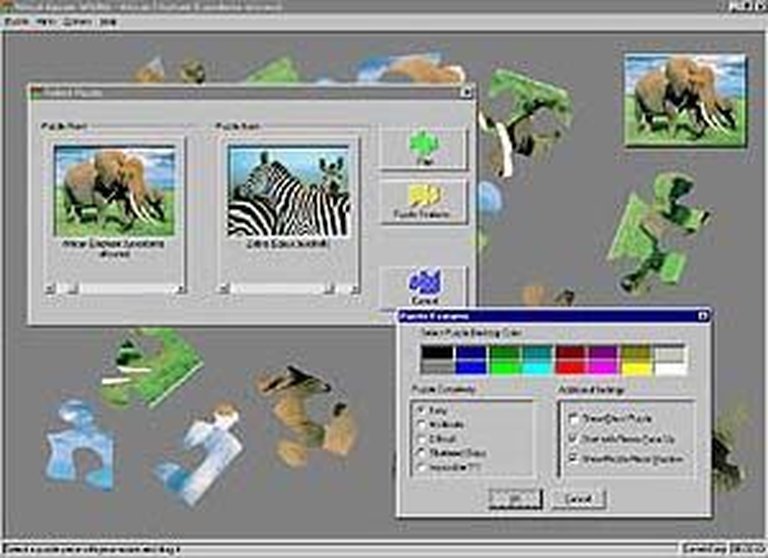
Virtual Jigsaw: Wildlife Edition is a 1996 Windows puzzle game where players assemble professional photographs of wild animals using freely rotatable and flippable jigsaw pieces, with options for challenging two-sided puzzles featuring different images on each side. It includes helpful features like hints, auto-solve, and an optional timer, rewarding completed puzzles with animal sound effects and fascinating facts, alongside a bonus essay on the history of jigsaw puzzles.
Virtual Jigsaw: Wildlife Edition Free Download
Virtual Jigsaw: Wildlife Edition: Review
Introduction
In an era dominated by frenetic first-person shooters like Quake and real-time strategy epics like Command & Conquer, Virtual Jigsaw: Wildlife Edition emerges as a serene oasis—a digital embodiment of tactile puzzle-solving digitized for the CD-ROM age. Released in 1996 by SouthPeak Interactive, this unassuming title invites players to piece together stunning professional photographs of majestic wild animals, blending relaxation with subtle education. As a historian of gaming’s often-overlooked edutainment corners, I argue that Virtual Jigsaw: Wildlife Edition exemplifies the mid-90s multimedia boom, offering a timeless antidote to high-octane gaming while preserving the tactile joy of jigsaws in a nascent digital form. Though niche, its thoughtful features and wildlife focus cement it as a worthy artifact in puzzle gaming history.
Development History & Context
SouthPeak Interactive LLC, a small North Carolina-based publisher and developer, crafted Virtual Jigsaw: Wildlife Edition amid the explosive growth of CD-ROM technology in the mid-1990s. This was a pivotal time when Windows 95 revolutionized PC accessibility, enabling richer multimedia experiences on home computers. The game targets modest hardware—requiring only a 486 processor, 8MB RAM, SVGA graphics at 640×480 with 256 colors, a mouse, and a double-speed CD-ROM drive—making it playable on the average family PC without demanding Pentium power or sound cards (though 16MB RAM and 16-bit audio enhanced it).
SouthPeak’s vision was clear: democratize jigsaw puzzles through software, leveraging high-quality images and CD storage for expansive photo libraries. Wildlife Edition is the third confirmed entry in the Virtual Jigsaw series, following Photo Gallery and Master Pieces (both 1996), with Purr-fect Puzzles contemporaneous and a teased Curator’s Collection in collaboration with the North Carolina Museum of Art (its release unconfirmed). All titles share the same engine, swapping image sets for variety—wildlife here, art in Master Pieces, cats in Purr-fect. This modular approach minimized development costs, reflecting indie studios’ resourcefulness against giants like id Software or Blizzard.
The 1996 gaming landscape contrasted sharply: arcades waned post-Pac-Man heyday, consoles like the PlayStation launched, but PC CD-ROMs fueled edutainment (Reader Rabbit lineage) and family fare. SouthPeak positioned Virtual Jigsaw as a $19.95 “family-oriented” alternative to “blood-and-guts” shooters, per contemporary reviews. Technical hurdles, like slow loads from missing Win95 DLLs (addressed via VJSYSTEM.EXE installer), highlight era-specific pains—games often bundled system files. Promo materials and a dedicated support page (archived 1998) underscore SouthPeak’s commitment, listing sound card vendors (Creative Labs, Ensoniq) for troubleshooting. Preserved today via Internet Archive ISOs, it endures as a snapshot of pre-broadband, CD-driven gaming.
Narrative & Thematic Deep Dive
Virtual Jigsaw: Wildlife Edition eschews traditional plots, characters, or dialogue, embracing a minimalist “narrative” centered on discovery and completion. The player’s journey unfolds across a virtual menu scrolling through evocative wildlife photographs—elephants in savannas, bears in forests, zebras on plains, panthers prowling, seals basking—each a portal to natural habitats. No protagonists drive the story; instead, the user authors their own tale of patience and revelation, selecting single images for straightforward puzzles or pairing two for double-sided challenges.
Thematically, the game celebrates nature’s majesty and educational wonder. Completion triggers dual rewards: authentic animal sound effects (roars, trumpets, barks) and factual tidbits, transforming puzzles into interactive field guides. This fosters appreciation for biodiversity, aligning with 90s eco-conscious trends amid rising environmental awareness. A deeper layer arrives via the included essay “Puzzling Through History” by historian Anne D. Williams, accessible on the CD—a scholarly treatise tracing jigsaws from 18th-century map dissections to modern pastimes. It elevates the game beyond diversion, weaving themes of human ingenuity, leisure evolution, and tactile cognition into the digital realm.
Analytically, this absence of overt narrative is a strength: themes emerge organically through iteration, mirroring life’s puzzles. The two-sided mode introduces duality—two images vying for dominance—forcing perceptual shifts, symbolizing wildlife’s multifaceted existence. No branching paths or moral choices exist, but the metanarrative of mastery (tracked via timers) builds quiet accomplishment, subverting action-game dopamine loops for meditative fulfillment.
Gameplay Mechanics & Systems
At its core, Virtual Jigsaw: Wildlife Edition replicates physical jigsaws with digital fidelity, anchored in a intuitive point-and-click interface. The loop is elegantly simple yet deeply engaging:
- Puzzle Selection: Browse high-resolution photos via a scrolling main menu. Choose one for standard play or two for two-sided (front/back variants on pieces).
- Customization: Set difficulty (piece count implied via image complexity), background color, and optional timer.
- Assembly: Pieces scatter on a virtual table. Drag to move, right-click or drag to rotate/flip freely. Correct fits “snap” with satisfying audio clicks, auto-locking clusters.
- Aids & Closure: Hints highlight edges/corners; auto-solve accelerates frustration-free finishes. Completion yields animal sounds, facts, and solve-time stats.
Innovations shine in rotatable/flippable pieces, mimicking real jigsaws absent in rigid grid-puzzlers like Tetris. Two-sided puzzles demand advanced spatial reasoning—players must mentally toggle perspectives, elevating challenge without complexity creep. UI is spartan but effective: no bloated menus, just a clean workspace prioritizing photos. Flaws? CD-ROM reliance caused load hitches (mitigated by VJSYSTEM.EXE), and solo play limits replay socially, though timers encourage personal bests.
Progression is light—unlocking via completion, with facts as “rewards”—but replayability stems from variable setups. No combat or RPG elements; it’s pure logic, ideal for zoning out. Compared to contemporaries, it innovates edutainment by wedding mechanics to content, predating modern Animal Crossing-style relaxers.
World-Building, Art & Sound
The “world” is a boundless digital workbench, evoking infinite tabletops where wildlife vignettes coalesce. Atmosphere hinges on professional photography: crisp, habitat-immersive shots (e.g., zebras mid-gallop, seals on ice) render animals vividly, backgrounds fading to player-chosen hues for focus. Visual direction prioritizes realism—SVGA 256-color limits notwithstanding—optimizing for 640×480, scalable to 800×600 high/true color. No 3D vistas; it’s flat, functional elegance, art serving gameplay without distraction.
Sound design amplifies immersion minimally yet impactfully. Piece snaps provide tactile feedback, animal roars/trumpets reward triumph (e.g., elephant bellows post-assembly), and subtle music (volume-adjustable) underscores calm. No voice acting or score bloat—era-appropriate, as sound cards were optional. These elements synergize: visuals educate eyes, audio rewards ears, crafting a multisensory paean to nature that lingers post-play.
Reception & Legacy
Launch reception was sparse but positive: Online Gaming Review’s 70% (7/10, 1997) lauds it as a “thinking game” for families weary of shooters, praising value at $19.95 and educational perks. No MobyScore aggregates (n/a), one critic rating, zero user reviews—indicative of its niche amid 1996 blockbusters (Diablo, Duke Nukem 3D). Commercially modest, it sold via CD-ROM retail, untracked in charts but preserved in series context.
Legacy endures quietly. As Virtual Jigsaw #4, it influenced jigsaw digitization—echoed in modern Steam titles like Nature & Wildlife: Jigsaw Puzzle (2022) or Virtual Jigsaw Puzzles. MobyGames entry (2023, Havoc Crow) and Archive.org ISO ensure preservation, while series trivia (unreleased Curator’s Collection) sparks collector interest. In puzzle history—from Tetris (1984) to Monument Valley—it bridges physical/digital, embodying CD-ROM edutainment’s peak before web/apps supplanted it. Its influence? Subtle, inspiring relaxers valuing mindfulness over adrenaline.
Conclusion
Virtual Jigsaw: Wildlife Edition distills 1996’s CD-ROM optimism into a flawless jigsaw simulator: mechanically sound, thematically enriching, and atmospherically soothing. SouthPeak’s modest triumph—flawed only by tech-era quirks—offers respite from gaming’s intensity, blending wildlife awe with puzzle heritage. In video game history, it claims a secure niche as edutainment pioneer, a 7/10 relic deserving emulation revivals. Verdict: Essential for puzzle aficionados; a meditative masterpiece in obscurity. Play it via Archive.org—history awaits assembly.